
The futures screen shows a funding rate next to a countdown, and it is not obvious whether you will pay it or receive it.
The funding rate is exchanged between longs and shorts who hold a position at the settlement time. It is not a fee paid to the exchange. The amount is position value multiplied by the funding rate.
We checked the official help pages of MEXC, BingX, Bitunix and BYDFi on 16 November 2026. This guide covers their settlement times, the formula and where to find the rate.
Summary: the funding rate moves money between longs and shorts
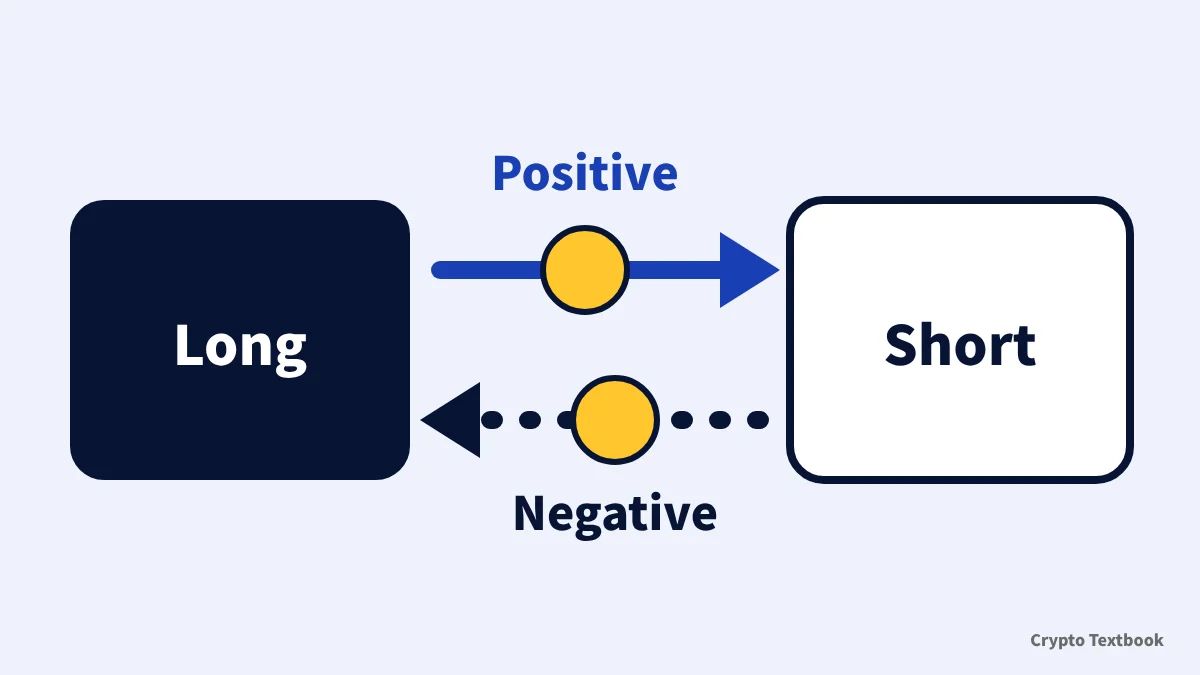
- Positive rate: longs pay, shorts receive
- Negative rate: shorts pay, longs receive
- MEXC, BingX and BYDFi say the exchange takes no cut of funding
- Standard interval is 8 hours: 01:00, 09:00 and 17:00 Japan time
- Payment = position value x funding rate (not margin)
Our spot versus perpetual futures guide explains how the two products differ. This guide covers only the funding rate, through to the formula and where to check it.
Spot vs perpetual futures: holding, leverage and liquidation
What is the funding rate? How it works
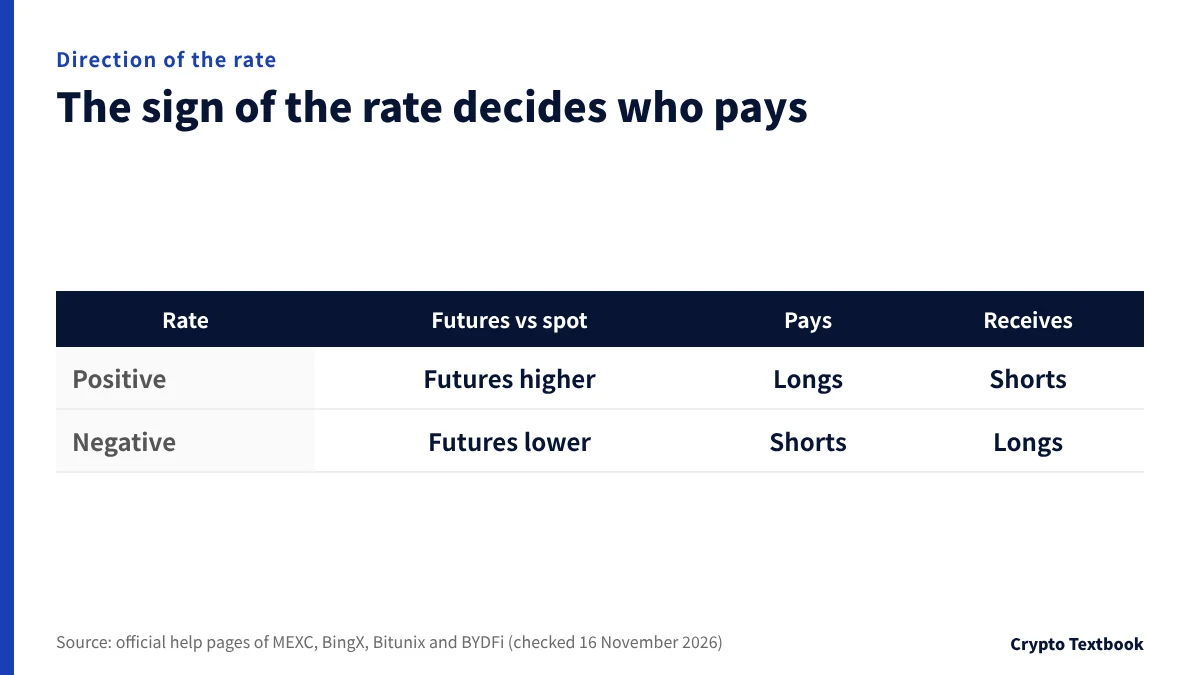
Perpetual futures have no expiry date. Without a correction, the futures price could stay away from the spot price. The funding rate pulls the two back together.
| Rate | Market state given by the exchanges | Pays | Receives |
|---|---|---|---|
| Positive | Futures price above spot | Longs (buyers) | Shorts (sellers) |
| Negative | Futures price below spot | Shorts (sellers) | Longs (buyers) |
How the rate is set
MEXC gives the formula as interest rate plus the clamped premium index. The premium index measures the gap between futures and spot, kept within -0.05% to +0.05%.
- Interest rate: described by MEXC as the cost of holding a position
- Premium index: how far futures trade from the spot index
- Clamp: a range that stops short-lived gaps from swinging the rate
In the example on the MEXC funding rate history page, a 0.1% premium index is capped at +0.05%. Adding the 0.01% interest rate gives a funding rate of 0.06%.
The funding rate is not an exchange fee
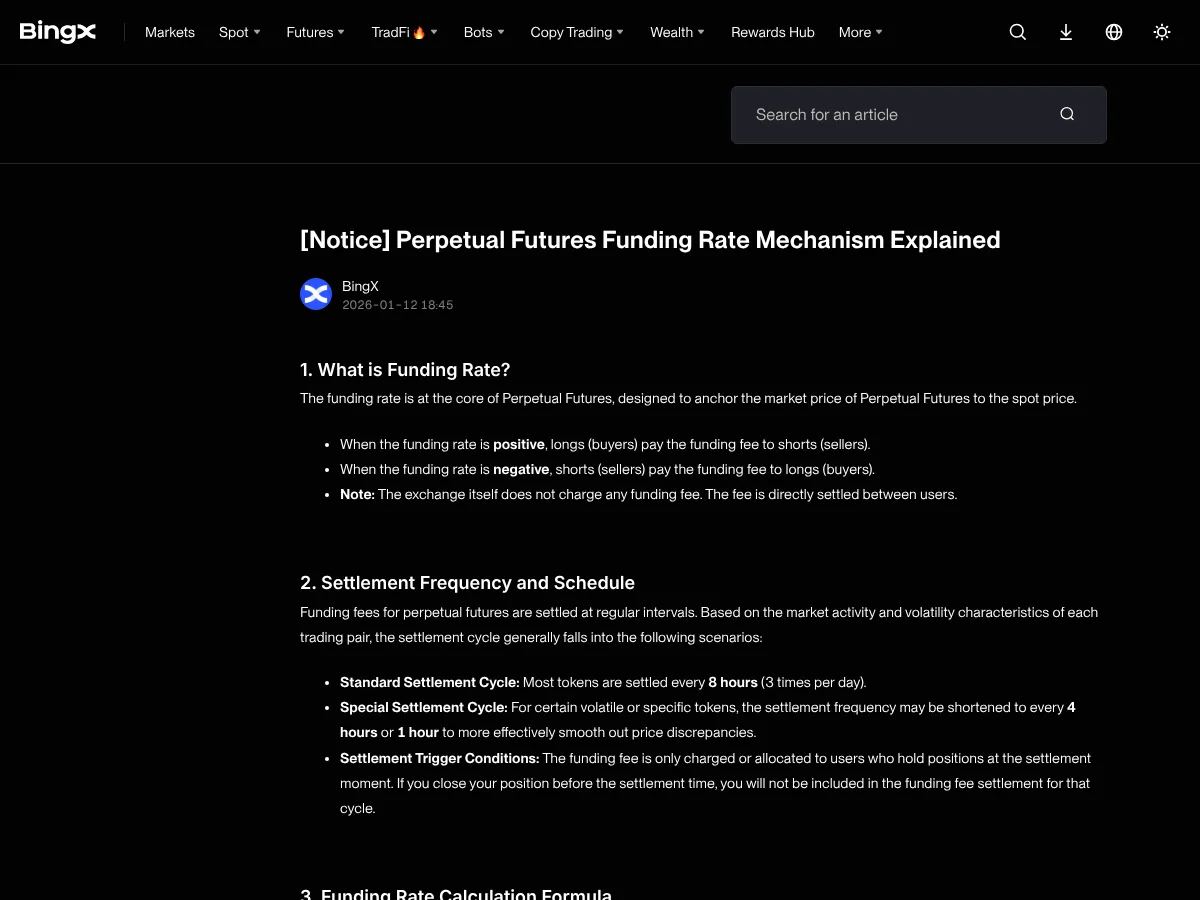
Maker and taker fees go to the exchange. Funding moves between users.
The help pages of MEXC, BingX and BYDFi state that the exchange takes no fee from these payments. Bitunix's help article (id=79) does not say whether the exchange receives any of it.
| Item | Trading fee | Funding |
|---|---|---|
| Paid to | The exchange | Holders of the opposite position |
| When | When an order fills | When you hold a position at settlement |
| Direction | Always a cost | A cost or an income, by the sign of the rate |
| Spot trading | Charged | Not charged (perpetual futures only) |
Bitunix adds that the amount you receive also depends on the total deducted from the other side. Check what you actually received in your history after each settlement.
When funding is paid: settlement times at four exchanges
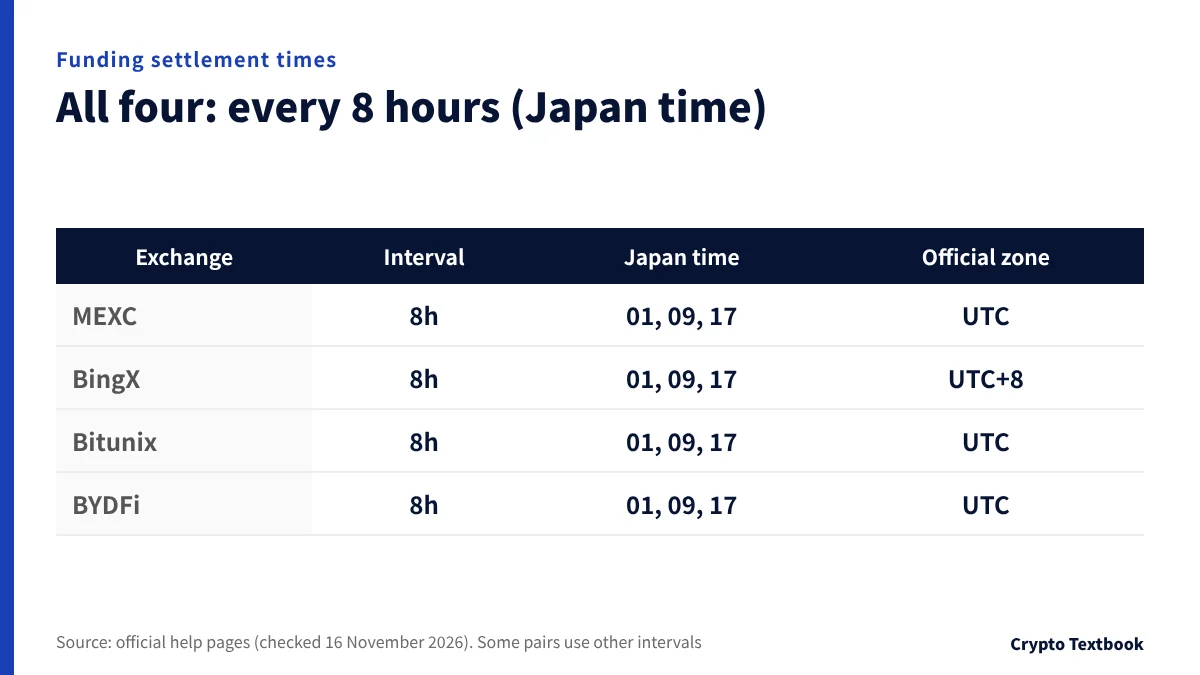
All four use an 8-hour standard, three times a day. Their help pages give times in UTC or UTC+8. Converted to Japan time, all four settle at 01:00, 09:00 and 17:00.
| Exchange | Official wording | Japan time | Exceptions |
|---|---|---|---|
| MEXC | Every 8h, UTC 00:00, 08:00, 16:00 | 09:00, 17:00, 01:00 | Some pairs differ. Up to 15 seconds late |
| BingX | Every 8h, UTC+8 00:00, 08:00, 16:00 | 01:00, 09:00, 17:00 | Some tokens every 4h or 1h. Up to 1 minute late |
| Bitunix | Every 8h, UTC 00:00, 08:00, 16:00 | 09:00, 17:00, 01:00 | Times adjusted for some pairs |
| BYDFi | Every 8h, UTC 00:00, 08:00, 16:00 | 09:00, 17:00, 01:00 | Some pairs use a different interval |
Holding at the settlement moment is what counts
Only positions open at the settlement time pay or receive funding. Close before that moment and you are out of that round. There is no pro rata charge for a shorter holding.
BingX gives a borderline case. A position opened at 15:59:59 and closed at 16:00:01 pays nothing. One closed at 16:00:04 is included, because settlement finished at 16:00:03.
The interval can change to 4 hours or 1 hour for some pairs. BingX says the interest component is scaled to the settlement cycle. Check the countdown on the contract before you open a position.
How to calculate the funding fee, with examples
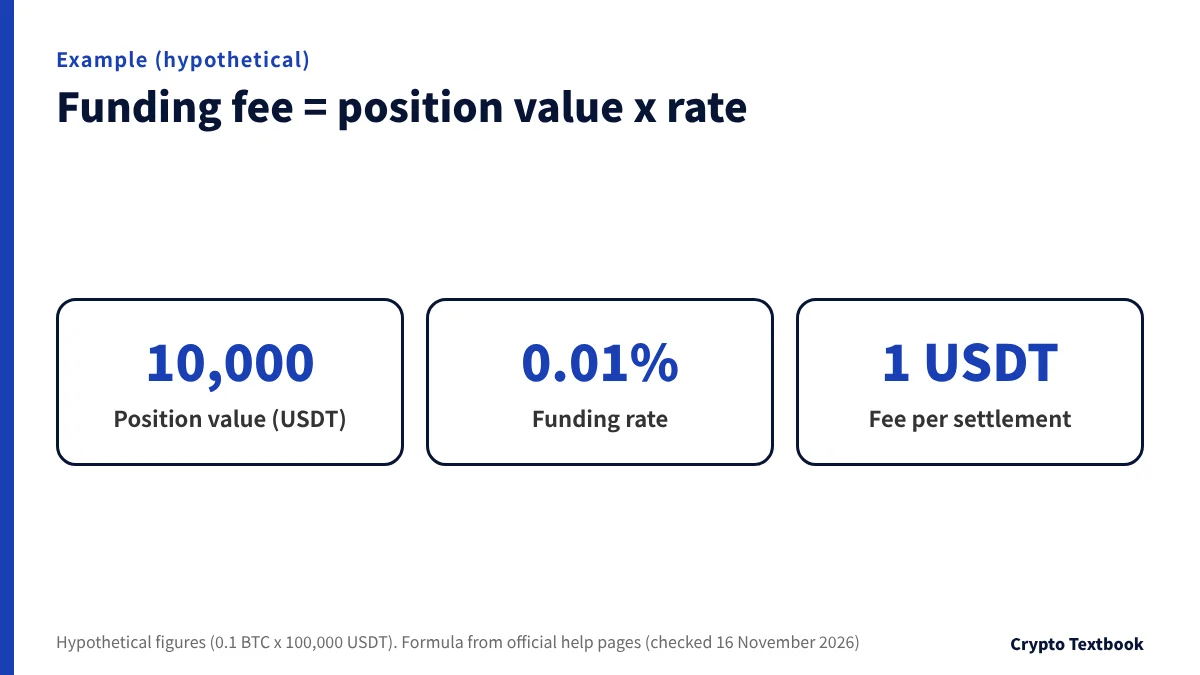
The four help pages use the same formula: funding fee = position value x funding rate. For USDT-margined futures, position value = quantity x price.
- MEXC and BYDFi: price is the fair price
- BingX: price is the mark price
- Bitunix: net position x contract face value x settlement price x rate
Worked example (hypothetical numbers)
These are our own hypothetical figures. You hold a 0.1 BTC long and the settlement price is 100,000 USDT. The position value is 10,000 USDT.
| Case | Calculation | Result |
|---|---|---|
| +0.01%, one settlement | 10,000 x 0.01% | Long pays 1 USDT |
| -0.005%, one settlement | 10,000 x 0.005% | Long receives 0.5 USDT |
| +0.01%, 3 times a day | 1 x 3 | Pays 3 USDT per day |
| +0.01% for 30 days | 3 x 30 | Pays 90 USDT over 30 days |
The rate applies to position value, not to margin. With 1,000 USDT of margin at 10x, the position is 10,000 USDT, and 90 USDT over 30 days is 9% of the margin.
Position value is contracts x contract size / price, and you pay in coin. In MEXC's example, 1,000 contracts of 100 USD at 100,000 USD is 1 BTC, so 0.01% is 0.0001 BTC.
Where to check the funding rate
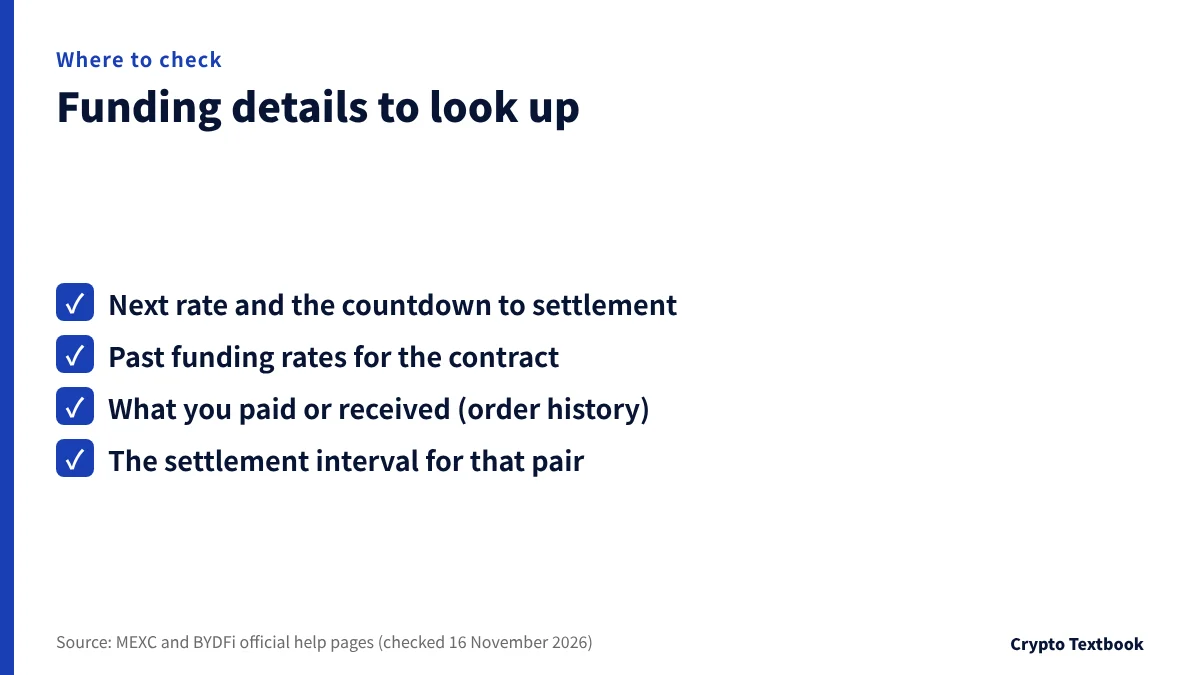
There are three numbers to look up: the next rate with its countdown, past rates, and what you paid or received. MEXC and BYDFi describe where each one sits.
| Exchange | Next rate and countdown | Past rates and your payments |
|---|---|---|
| MEXC | Above the chart on the futures page | Funding rate history page; Funding Fees under Futures Orders (top right) or order history |
| BYDFi | Info bar above the futures chart | Funding Fees under Futures Orders (top right) or order and trade history |
| BingX | Help page explains the mechanism, times and formula | Check per contract |
| Bitunix | Help page explains the mechanism, times and formula | Check per contract |
When the displayed rate is fixed
- MEXC: changes with positioning until settlement
- BYDFi: the screen shows the rate planned for the next settlement
- Bitunix: set at the start of a period from the previous period's data
- BingX: weighted average of premium samples taken every 5 minutes
How funding affects margin and liquidation
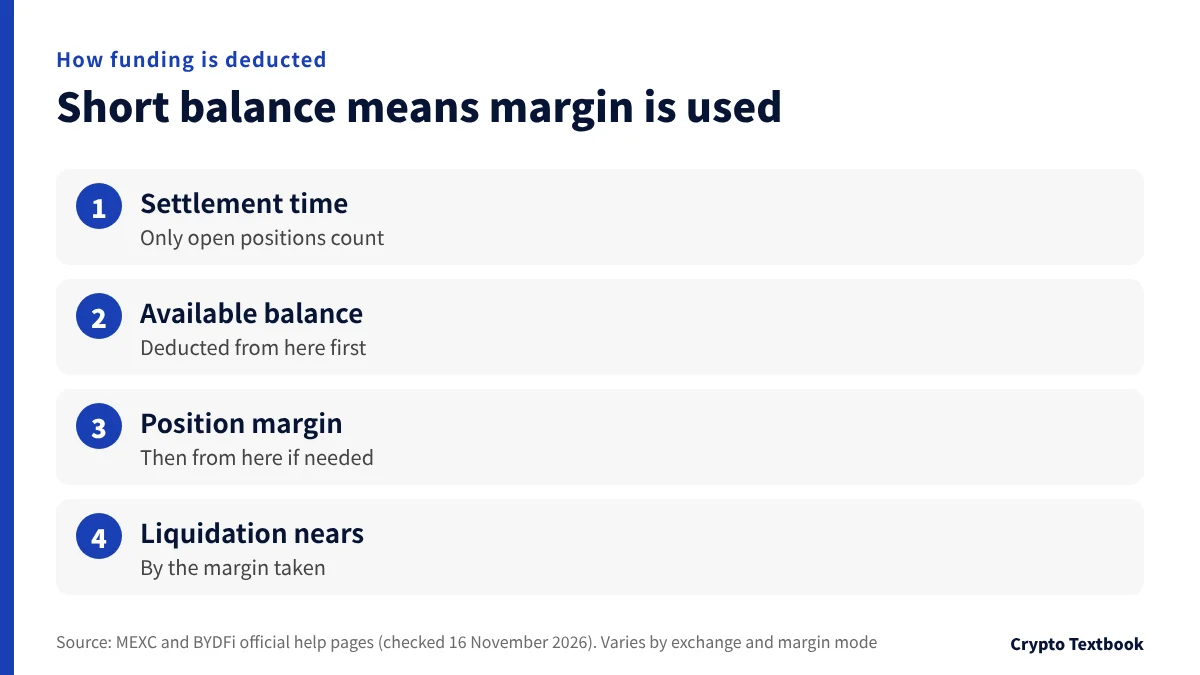
Funding is deducted automatically. At MEXC and BYDFi it comes from available margin first, then from position margin if that runs short.
| Exchange | Cross margin | Isolated margin |
|---|---|---|
| MEXC | Available margin, then position margin | Available margin, then position margin |
| BingX | Deducted from balance | Deducted from initial margin |
| Bitunix | Deducted from futures balance | Balance, then cancel open orders, then position |
| BYDFi | Available balance, then position | Deducted from position margin |
When funding comes out of position margin, the liquidation price moves closer to the market price. BingX states that insufficient margin can lead to liquidation.
Perpetual futures are leveraged and you can lose the margin you deposit. Funding changes your balance at each settlement, separately from price moves.
Leverage and liquidation explained
MEXC futures leverage and liquidation rules
Bitunix futures leverage and liquidation rules
BYDFi futures: up to 500x, liquidation, insurance fund and ADL
BingX fees: spot, futures, funding and withdrawals
Funding applies once for each settlement at which you hold a position. The estimate is position value x rate x number of settlements. Measured against margin, the same rate weighs more at higher leverage.
Frequently asked questions
Q. What is the funding rate in crypto futures?
A. It is a rate exchanged between longs and shorts to keep perpetual futures close to spot. Longs pay when it is positive and shorts pay when it is negative.
Q. Is the funding rate a fee paid to the exchange?
A. No. The help pages of MEXC, BingX and BYDFi say funding is settled between users and the exchange takes no cut. Bitunix's help article does not say whether the exchange receives any of it. Count it separately from trading fees.
Q. How is the funding fee calculated?
A. Funding fee = position value x funding rate. With a hypothetical 10,000 USDT position and a 0.01% rate, one settlement is 1 USDT.
Q. How often is funding paid?
A. The standard at all four exchanges is every 8 hours, at 01:00, 09:00 and 17:00 Japan time. BingX says some tokens settle every 4 hours or every hour.
Q. Do I pay funding if I close before the settlement time?
A. No. Only positions held at the settlement moment pay or receive. BingX notes that settlement can take up to one minute to complete.
Q. Is there funding on spot trades?
A. No. Funding belongs to perpetual futures, which have no expiry. Spot costs are trading fees and deposit or withdrawal fees.
Q. Can funding alone cause liquidation?
A. Payments taken from position margin move the liquidation price closer. BingX says insufficient margin may lead to liquidation, and BYDFi says funding can raise liquidation risk.
Sources and conditions
- MEXC: What is the MEXC futures funding rate? Calculation, settlement and where to check (official, updated 13 November 2026, Japanese) →
- MEXC: Funding rate history, BTC_USDT (formula and example) →
- BingX: Perpetual Futures Funding Rate Mechanism Explained (official help) →
- BingX: Perpetual Futures Fee Schedule (official help, settlement times and deductions) →
- Bitunix: Introduction to Futures Funding Rate? (official help, updated 28 May 2026) →
- BYDFi: Futures funding rates, how to check and calculate (official help, Japanese) →
- BYDFi: How funding rates and funding fees are calculated (official help, Japanese) →
FX Textbook is an independent information site, not an exchange or a provider of personal investment advice. Crypto-asset trading involves risk: price moves, liquidation of leveraged positions, transfer errors and exchange operating risk can result in the loss of some or all invested capital.
NEXT STEP
Know how funding works? Compare the exchanges next.
Spot and futures fees, maximum leverage and liquidation rules, organised exchange by exchange.
Listed exchanges