
BYDFi futures advertises up to 500x leverage, but the leverage you can use depends on the pair and the size of your position. Picking a high multiple without knowing the rules can wipe out your margin on a move of a few percent.
According to the official help pages, liquidation starts when the maintenance margin ratio reaches 100%. Losses beyond your margin may be covered by an insurance fund, but a full guarantee is not stated.
This guide works out liquidation prices by leverage with hypothetical numbers and shows where to verify each rule on the official screens. Checked on 8 November 2026.
Bottom line: 500x is a ceiling, so check the liquidation rules first
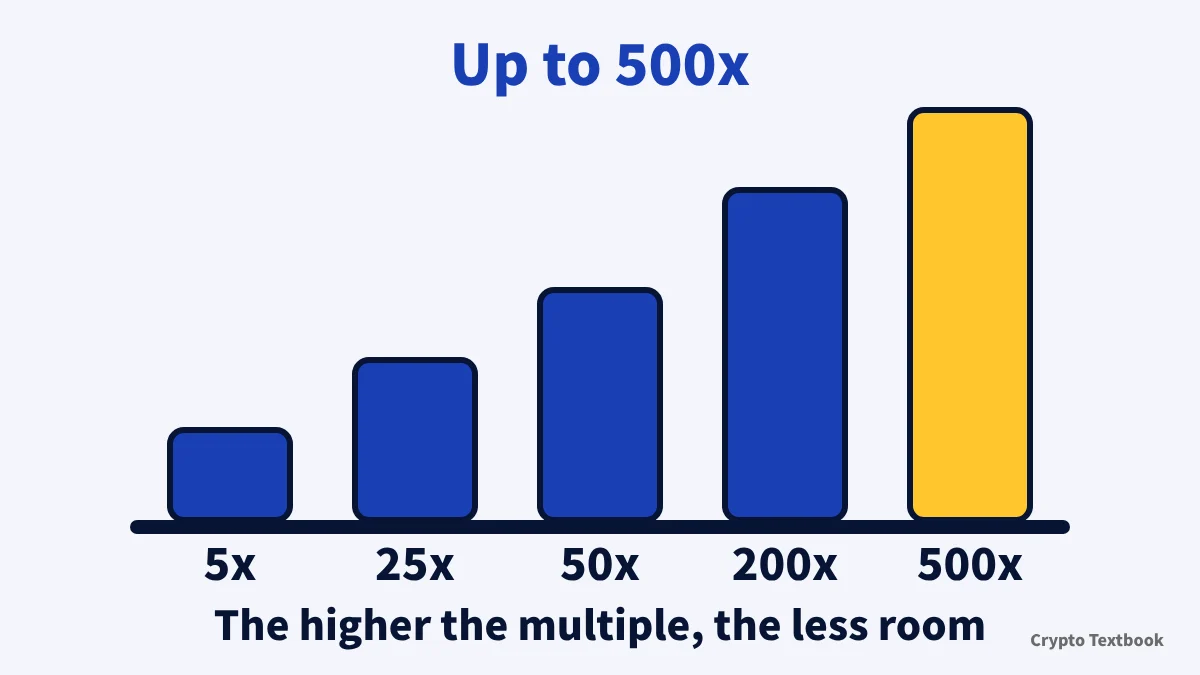
- The official futures page says up to 500x, and the menu shows a BTC 500x tag
- Usable leverage differs by pair, and larger positions get a lower cap
- Liquidation starts when the maintenance margin ratio reaches 100% or more, judged on the fair price
- Losses beyond your margin may be covered by the insurance fund (a full guarantee is not stated)
- If the insurance fund runs short, auto-deleveraging (ADL) comes next
What 500x really means: larger positions get a lower leverage cap
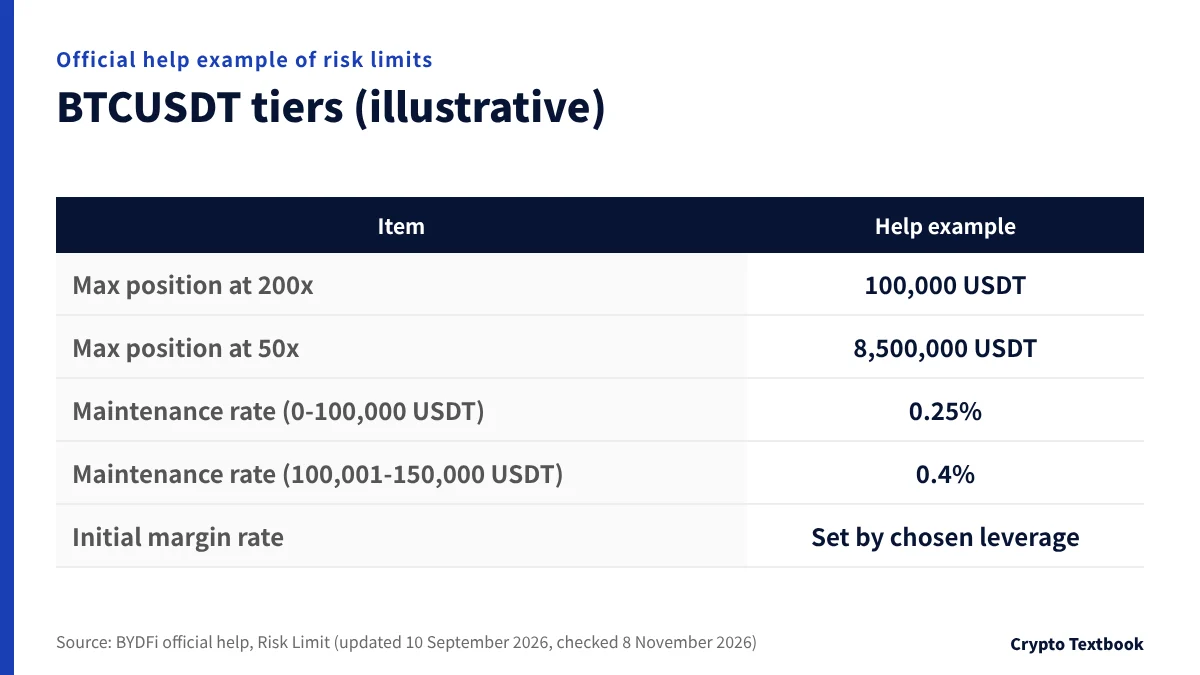
According to the official help pages, BYDFi uses a tiered margin system called risk limits. The larger the position, the lower the maximum leverage you can use.
In the BTCUSDT example, 200x allows a maximum position of 100,000 USDT, and 50x allows 8,500,000 USDT.
The help text we checked does not say up to what position size 500x applies. The highest tier shown in the help examples is 200x.
The liquidation FAQ has a different tier table, where 200x carries a 0.40% maintenance rate. The risk limit example shows 0.25%. Both are illustrations, so read the real values on each pair's Risk Limit screen.
Maintenance margin follows position size, not leverage
The maintenance margin rate is set by position size, not by the leverage you pick. In the risk limit example, 0 to 100,000 USDT is 0.25%, and 100,001 to 150,000 USDT is 0.4%.
The initial margin rate follows your leverage: 0.5% at 200x. The 0.25% gap to the maintenance rate is your room before liquidation (our calculation).
- Web: open the futures trading page, choose Risk Limit, then select a pair
- App: Futures, the top-right menu, Futures Info, then Risk Limit
The help pages say BYDFi may adjust maximum leverage, position caps and maintenance margin rates during abnormal price moves or extreme markets. The figures here come from a page updated on 10 September 2026, so confirm the current values on screen before you trade.
Choosing margin: USDT-M vs COIN-M, isolated vs cross
BYDFi has two kinds of perpetuals: USDT-M and COIN-M. USDT-M calculates margin and profit in USDT. COIN-M uses the traded coin itself as margin, so ETHUSD needs ETH.
| Item | USDT-M | COIN-M |
|---|---|---|
| Margin | USDT | The traded coin (for example ETH for ETHUSD) |
| Insurance fund | Shared across all contracts | Separate per coin |
| Unrealized profit | In cross mode, usable as margin for new positions | Not usable for new positions or withdrawals |
With COIN-M, when the coin you hold as margin falls, the value of your margin falls too, apart from the contract's own profit and loss (official comparison table).
USDT-M also offers a hedge mode that lets you hold long and short in the same pair at once (official FAQ). Every worked example in this guide uses USDT-M.
The futures page lists USDC-M futures as coming soon. A help page updated on 2 September 2026 says BYDFi supports USDT-M and USDC-M futures. Check availability on screen before you trade.
Isolated vs cross margin
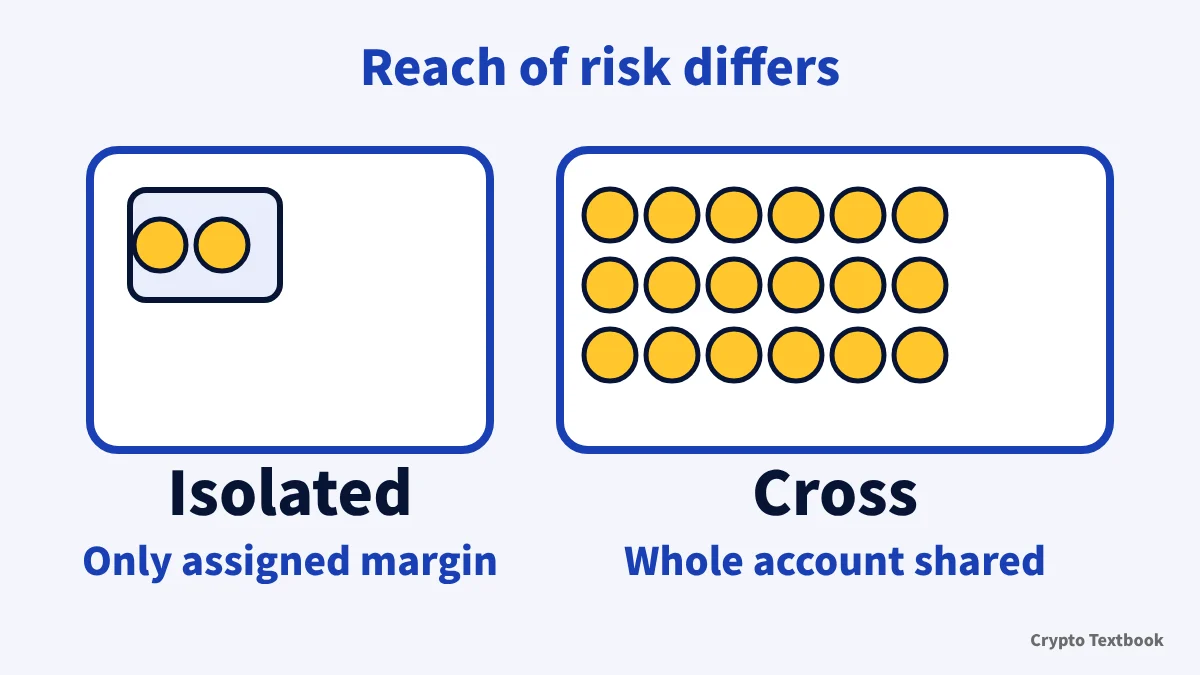
Cross margin is the default. You can switch to isolated only when you hold no positions or orders.
| Item | Isolated margin | Cross margin |
|---|---|---|
| Funds at risk | The margin assigned to that position | All usable funds in the account |
| Margin allocation | Separate for each position | Shared by all positions |
| Adjusting | Add or reduce manually | Account funds are shared automatically |
Cross margin shares account funds, so a large unrealized loss puts the whole account at stake. Even in isolated mode, a fill worse than the bankruptcy price can push the loss past the assigned margin.
- You can reduce only the margin you added manually
- You cannot lower leverage while holding a position or trigger orders
- Auto margin addition works in isolated mode only, up to 100 times
- When it adds margin, it first cancels that position's unfilled orders
How liquidation unfolds: it starts at a 100% ratio and follows the fair price
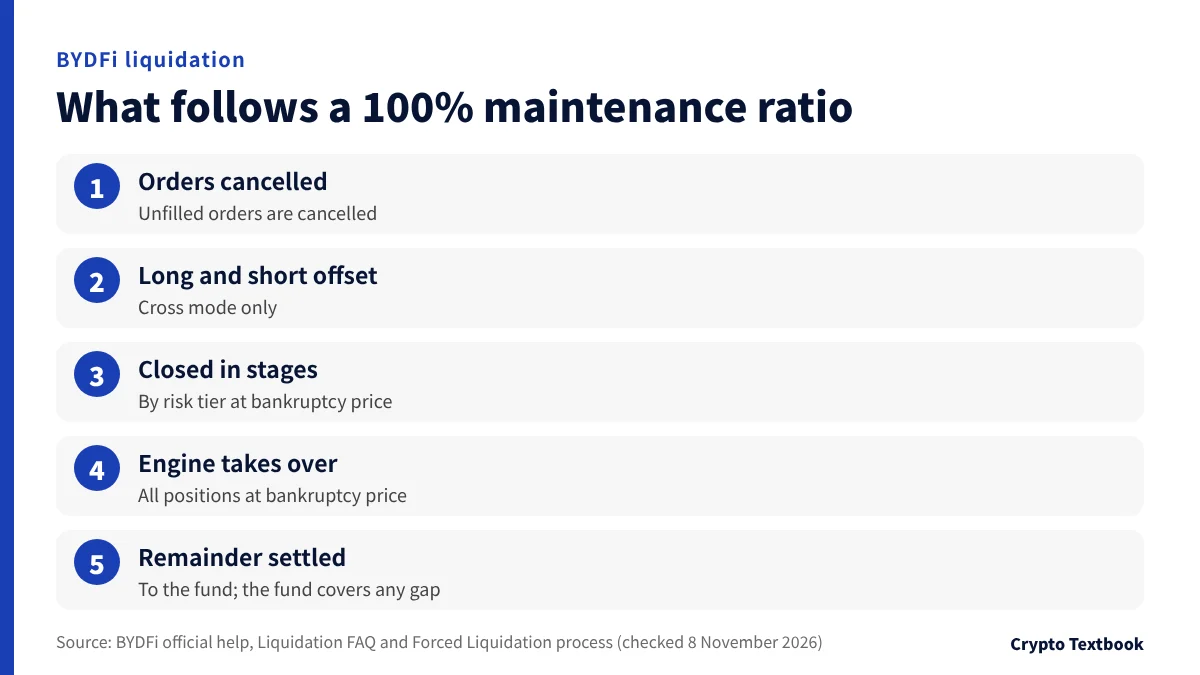
Liquidation starts when the maintenance margin ratio (MMR) reaches 100% or more. For isolated margin the formula is:
- MMR = (maintenance margin + liquidation fee) / (position margin + unrealized P&L)
The USDT-M liquidation help says positions are triggered by the margin ratio and the liquidation price is only a reference. In cross mode, when one position triggers, all cross positions are closed.
- 01Unfilled orders are cancelled
In cross mode all orders are cancelled. In isolated mode with auto margin on, that contract's unfilled orders are cancelled.
- 02Long and short are offset
If you hold both in cross mode, the system shrinks the positions through self-trading.
- 03Positions are closed in stages
A position above the lowest risk tier is closed part by part at the bankruptcy price, and the ratio is recalculated.
- 04The liquidation engine takes over
If the ratio is still 100% or more at the lowest tier, the engine takes the rest at the bankruptcy price.
- 05What is left is settled
If the fill beats the bankruptcy price, the remaining margin goes to the insurance fund. If not, the fund covers the gap, and ADL follows if it falls short.
The takeover does not go through the matching engine, so the bankruptcy price appears on neither the chart nor the trade history. The average close price in your position history shows the takeover price.
Bankruptcy price vs liquidation price
The bankruptcy price (takeover price) is the theoretical price where all margin is gone and the balance is zero. Liquidation starts earlier, at the liquidation price.
Because the process starts when the liquidation price is reached, the help says it is rare for the price to reach the bankruptcy price. In a fast market the fill can land beyond it.
The reference is the fair price, not the last price
Liquidation is judged on the fair price (mark price), not the latest traded price. The fair price affects the liquidation price and unrealized P&L, and does not affect realized P&L.
| Price | How it is set (official) | Where it is used |
|---|---|---|
| Index price | Weighted average of major spot exchanges; an exchange more than 1% from the median of all exchanges is excluded | Input to fair price |
| Fair price | Median of the funding-rate premium, a mid-price-based value and the last price | Liquidation and unrealized P&L |
| Last price | The latest futures trade | Switchable on the chart |
※ The exchanges and weights behind the index price may change.
The chart can switch between the three prices. Judge your distance to the liquidation line on the fair price. A small unrealized loss right after a fill comes from the gap between fair and last price, which the help calls normal.
Insurance fund and ADL: when losses exceed your margin
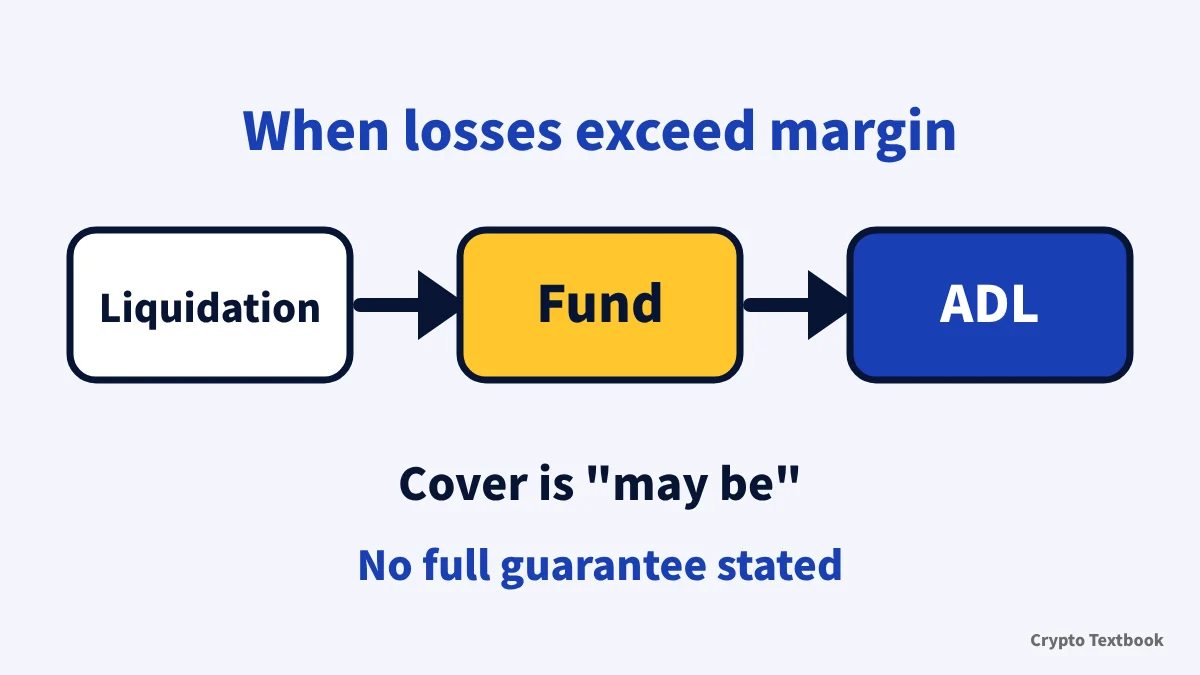
The insurance fund exists to cover losses left after liquidation. Surplus from fills better than the bankruptcy price also builds up in it.
The official help says losses "may be covered". It also states that the fund does not remove risk entirely.
If the fund is not enough, auto-deleveraging (ADL) applies and risk can reach other traders. The help text we checked does not explain how ADL targets are ranked.
The USDT-M insurance fund is shared across all contracts, and COIN-M funds are separate per coin. You can view the balance under Insurance Fund Account on the futures trading rules screen.
Automatic clearing of negative balances, and the "zero-cut" label
The USDT-M liquidation help describes automatic clearing of negative balances. If liquidation leaves the account balance negative, the futures insurance fund absorbs the deficit as far as possible.
It applies to accounts with no open positions that have not moved funds since liquidation. The process runs every 10 minutes.
The official pages we checked do not use the term zero-cut, and we found no promise to waive losses in full. The wording stops at "as far as possible", so avoid sizing positions on the assumption of a bailout.
Hypothetical numbers: liquidation price by leverage
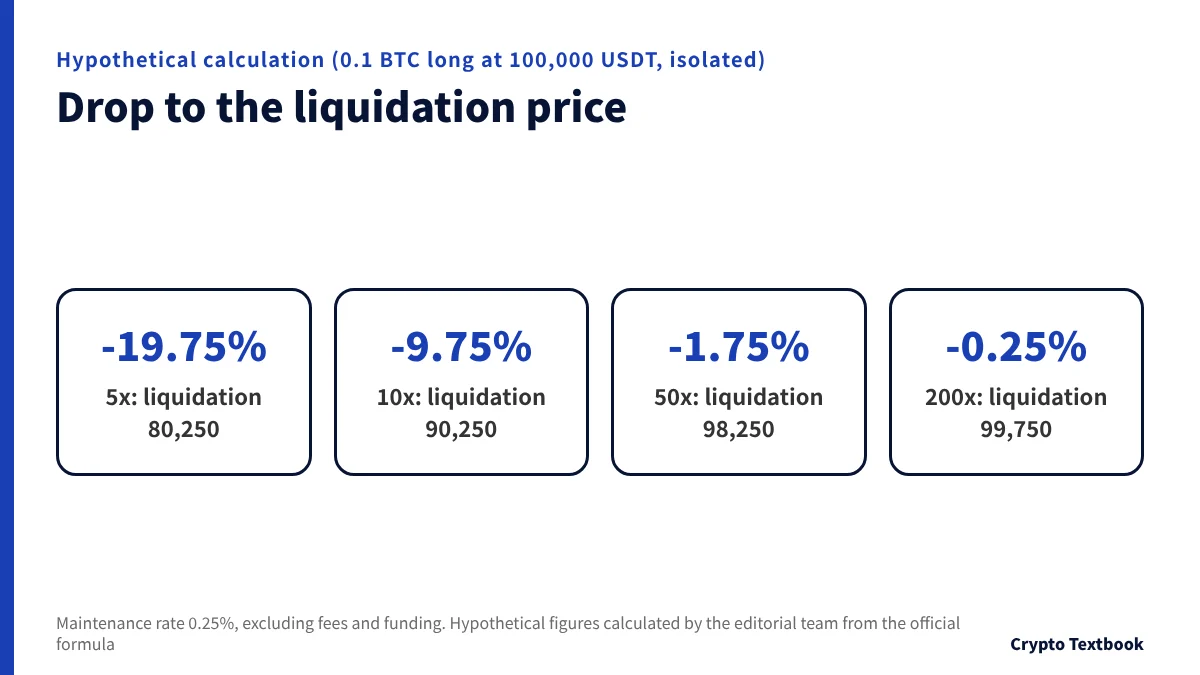
Following the official help example, this uses a long position in isolated margin. Every figure is hypothetical.
- 0.1 BTC of BTCUSDT bought at 100,000 USDT
- Notional 10,000 USDT
- Maintenance margin rate 0.25% (maintenance margin 25 USDT)
| Leverage | Initial margin | Liquidation price | Drop from entry |
|---|---|---|---|
| 5x | 2,000 USDT | 80,250 USDT | -19.75% |
| 10x | 1,000 USDT | 90,250 USDT | -9.75% |
| 25x | 400 USDT | 96,250 USDT | -3.75% |
| 50x | 200 USDT | 98,250 USDT | -1.75% |
| 100x | 100 USDT | 99,250 USDT | -0.75% |
| 200x | 50 USDT | 99,750 USDT | -0.25% |
※ Trading fees, funding and liquidation fees are excluded. Actual maintenance rates and fill slippage change the result.
Going from 5x to 10x cuts the drop to liquidation from 19.75% to 9.75%, roughly half. At 200x, a 0.25% fall reaches the liquidation price.
The formula is: liquidation price = entry price - (initial margin - maintenance margin) / quantity. At 25x, 400 - 25 is 375, divided by 0.1 gives 3,750, which is 3.75% below entry.
When the fill is worse than the bankruptcy price
At 10x the bankruptcy price is 90,000 USDT. If a fast move fills the close at 89,000 USDT, the shortfall is (90,000 - 89,000) x 0.1, or 100 USDT.
That 100 USDT is a loss the insurance fund may cover. Whether it does depends on how BYDFi applies the rule.
With cross margin
Holding the same long in cross margin with a 5,000 USDT balance and no other positions puts the liquidation price at 50,250 USDT. That is 49.75% below entry and far from the 90,250 USDT of isolated 10x.
It is far because the whole 5,000 USDT acts as margin. The amount you can lose before liquidation is just as large.
Funding rate and fees: two costs that eat into margin

The base futures fee on the official fee page is 0.020% maker and 0.060% taker (VIP0). The listed pairs such as BTCUSDT carry a special fee rate label.
The same page notes that rates may differ by platform event and by the user's region, and points you to your actual trade history.
VIP level is assessed on 30-day spot volume, 30-day futures volume and holdings, and the highest level applies. VIP0's 0.020% / 0.060% falls to 0.007% / 0.030% at VIP7. VIP1 starts at 100,000 USDT spot, 10 million USDT futures and 50,000 USDT of holdings.
On 10,000 USDT, a round trip costs 12 USDT as taker and 4 USDT as maker. Opening as maker and closing as taker costs 8 USDT.
A 10x position needs 1,000 USDT of margin, so a 12 USDT taker round trip is 1.2% of it. Fees chip away at your room before liquidation.
Funding is paid every eight hours
Funding keeps the perpetual price close to spot. It is not exchange revenue; traders pay each other.
It normally settles every eight hours (UTC 00:00, 08:00 and 16:00; Japan time 9:00, 17:00 and 1:00 the next day). Only traders holding a position at that moment pay or receive. A few pairs use a different interval, so check the pair you trade.
- 0.01% rate: 1 USDT per settlement, 3 USDT per day (3 times), 21 USDT per 7 days (21 times)
- 0.03% rate: 3 USDT per settlement, 9 USDT per day, 63 USDT per 7 days
This assumes a held position of 10,000 USDT notional, the paying side and a constant rate. The official guide cites a typical range of +/-0.01% to +/-0.03%, and the actual rate changes every period.
If your available balance is short, the payment is taken from position margin. Your margin shrinks, so the liquidation price moves closer to the current market price.
Three USDT a day is 0.3% of 1,000 USDT of margin at 10x, and 0.75% of 400 USDT at 25x. The higher the leverage, the heavier the same cost.
A help page updated on 2 September 2026 lists futures maker 0.00% and taker 0.02%. This guide uses the current fee page values of 0.020% and 0.060%.
Avoiding liquidation, and how to verify the rules on the official screens
The official liquidation FAQ lists three methods: add margin or lower leverage, place a stop loss, and set a liquidation alert. None of them reliably prevents liquidation.
- Add margin or lower leverage: the liquidation price moves away from entry
- Place a stop loss: it may not fill in extreme markets, and when it does it executes as a market order
- Set a liquidation alert: at most once per 30 minutes for each position
- Use auto margin addition: isolated mode only, up to 100 times
If the stop loss does not sit before the liquidation price, liquidation starts first. A market order can fill away from your set price.
The help presents auto margin addition as something to use alongside a stop loss. If the market does not turn back, it can keep drawing on your available balance until it is gone.
Margin call and liquidation emails are not guaranteed to arrive (USDT-M liquidation help). Do not wait for a message; watch the maintenance margin ratio on screen.
Practise on demo trading first
The futures page offers demo trading, described as a way to practise with zero risk. The official FAQ says beginners can practise on demo before going live.
You can try placing orders and reading the position screen without using funds. Learn how to read the liquidation price before you raise leverage.
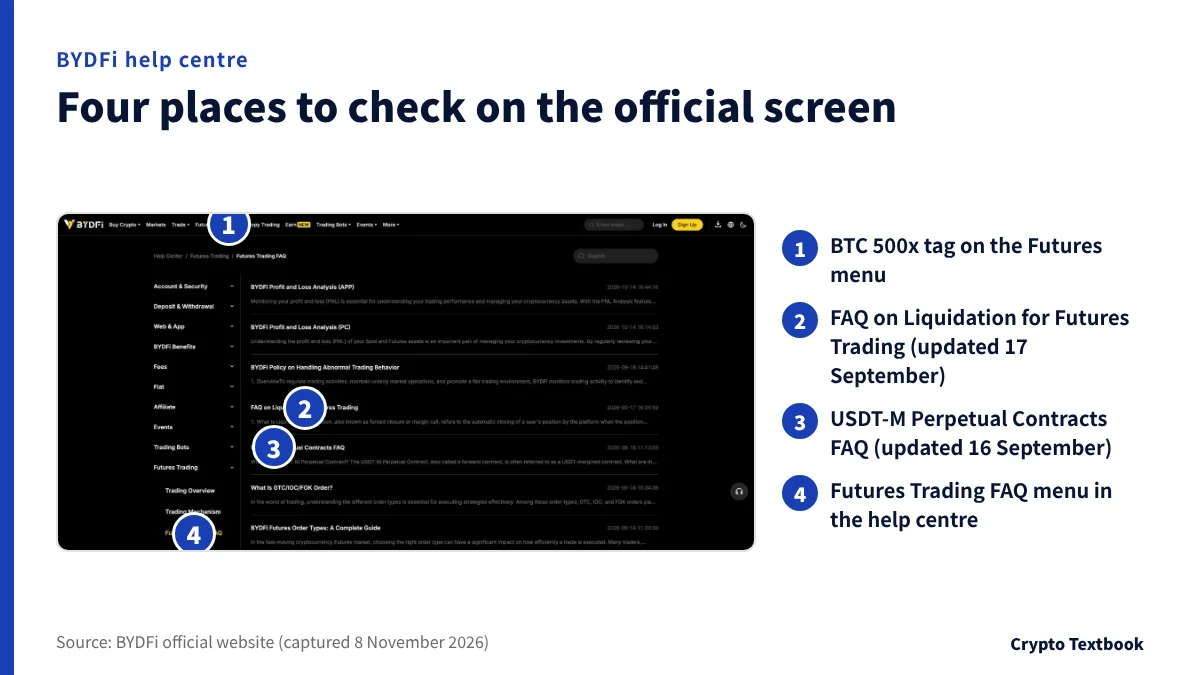
How to verify the rules on the official screens
- 01Check max leverage on the futures page
The Futures menu shows a BTC 500x tag, and the page announces up to 500x.
- 02Open Risk Limit for the tiers
Pick a pair to see leverage, position cap and maintenance margin rate for each tier.
- 03Read the liquidation rules in the help centre
Help Center, Futures Trading, Futures Trading FAQ. The liquidation FAQ and the 3 key prices article are there.
- 04View the insurance fund balance
Futures, Trading Rules, Show all futures trading rules, then Insurance Fund Account.
- 05Check the funding rate
Above the candlestick chart you see the current rate and a countdown to the next settlement.
The liquidation FAQ was updated on 17 September 2026, the 3 key prices article on 26 October and the insurance fund article on 27 October. Rules can change, so confirm the latest dates before you trade.
Editorial verdict: 500x is a ceiling you can choose, not a target
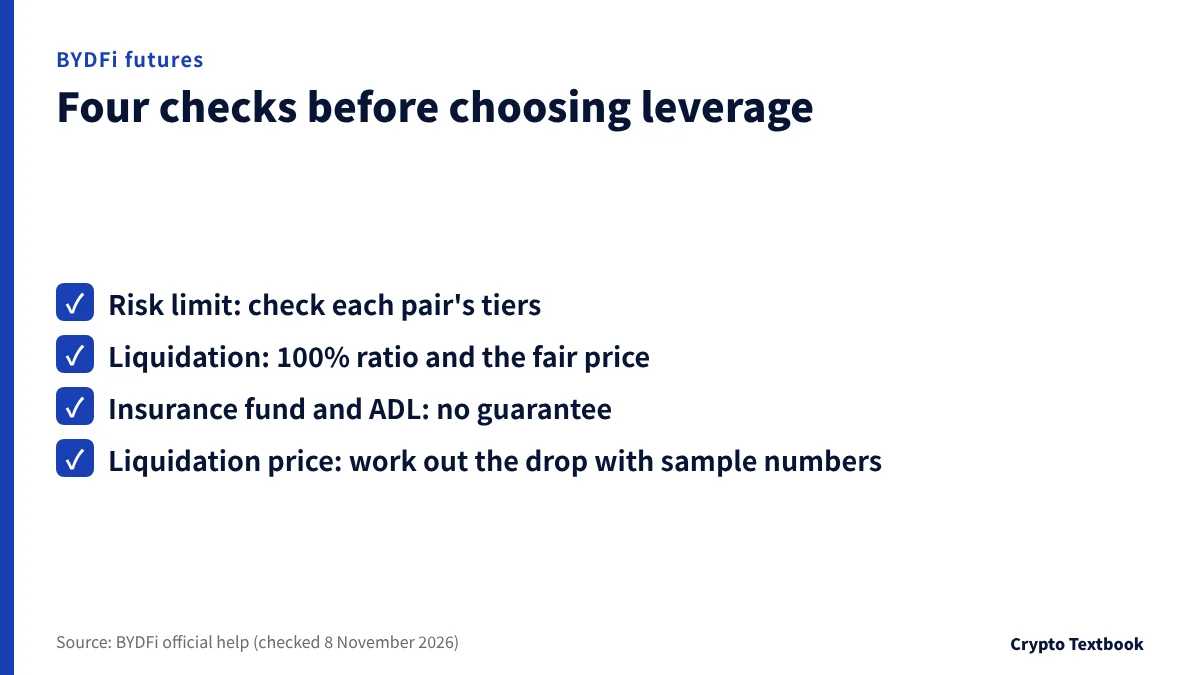
BYDFi's 500x is the upper limit of what you can select. Work out the liquidation price first, then choose your leverage. Insurance fund cover is "may be", not a full guarantee.
- Open the pair's Risk Limit screen and check the tiers before choosing leverage
- Calculate the drop from entry to liquidation with sample numbers
- Decide between cross and isolated, and count fees and funding as costs
- Start with demo trading to try the order and position screens
BYDFi is an overseas exchange, so you trade outside the framework that applies to domestic registered providers. Futures can cost you all of your margin, and losses can exceed it.
Check the bonus page for the amount and conditions of sign-up rewards.
Frequently asked questions
Q. What is the maximum leverage on BYDFi futures?
A. The official futures page says up to 500x. Usable leverage depends on the pair and position size, and larger positions get a lower cap. We could not confirm up to what position size 500x applies. Check the exact tiers on the Risk Limit screen of the futures trading page.
Q. When does BYDFi liquidation start?
A. It starts when the maintenance margin ratio reaches 100% or more. The reference is the fair price (mark price), not the last price. The process has five stages, from cancelling orders to the liquidation engine taking over.
Q. If losses exceed my margin, will I be billed for the shortfall?
A. The help pages we checked say nothing about billing for a shortfall. They say the futures insurance fund absorbs negative balances after liquidation as far as possible. A full guarantee is not stated, so check the terms of service.
Q. What happens if the insurance fund runs out?
A. The official help says auto-deleveraging (ADL) applies and risk can reach other traders. The help text we checked does not explain how ADL targets are ranked.
Q. Should I choose USDT-M or COIN-M?
A. USDT-M uses USDT as margin, and COIN-M uses the traded coin itself. With COIN-M, unrealized profit cannot be used for new positions or withdrawals. Profit and loss are easier to follow with USDT-M.
Q. When is the BYDFi funding rate paid?
A. It normally settles every eight hours (UTC 00:00, 08:00 and 16:00; Japan time 9:00, 17:00 and 1:00 the next day). Only traders holding a position at that moment pay or receive. It is not exchange revenue.
Q. Does BYDFi have demo trading?
A. Yes. The futures page offers demo trading. The official FAQ says beginners can practise on demo before trading with real funds.
Sources
- BYDFi | Futures trading page (up to 500x, demo trading, USDC-M, official, checked 8 November 2026) →
- BYDFi | FAQ on Liquidation for Futures Trading (official help centre, updated 17 September 2026, checked 8 November 2026) →
- BYDFi | The Process of Forced Liquidation (USDT-M, official help centre, updated 16 September 2026, checked 8 November 2026) →
- BYDFi | What is the BYDFi Insurance Fund? (official help centre, updated 27 October 2026, checked 8 November 2026) →
- BYDFi | 3 Key Prices in Futures Trading (official help centre, updated 26 October 2026, checked 8 November 2026) →
- BYDFi | Risk Limit (USDT-M and COIN-M Contracts) (official help centre, updated 10 September 2026, checked 8 November 2026) →
- BYDFi | Isolated/Cross Margin Mode (official help centre, updated 26 October 2026, checked 8 November 2026) →
- BYDFi | USDT-M Perpetual Contracts FAQ (official help centre, updated 16 September 2026, checked 8 November 2026) →
- BYDFi | COIN-M Perpetual Contracts FAQ (official help centre, updated 18 September 2026, checked 8 November 2026) →
- BYDFi | Fully Understand the BYDFi Perpetual Futures Trading Model (USDC-M and an older fee line, official help centre, updated 2 September 2026, checked 8 November 2026) →
- BYDFi | Futures Funding Rates (official help centre, updated 2 September 2026, checked 8 November 2026) →
- BYDFi | How to Use the Auto Margin Addition Function (official help centre, updated 4 September 2026, checked 8 November 2026) →
- BYDFi | Fees (futures maker 0.020%, taker 0.060%, official, checked and captured 8 November 2026) →
- BYDFi | VIP program (futures fees and volume by level, official, checked 8 November 2026) →
FX Textbook is an independent information site, not an exchange or a provider of personal investment advice. Crypto-asset trading involves risk: price volatility, liquidation of leveraged positions, transfer mistakes and the operational risk of exchanges and service providers can cause you to lose some or all of your invested capital. No result is guaranteed.
NEXT STEP
Check BYDFi's rating, fees and rewards on the exchange page.
The exchange page collects base rates, leverage and rewards with official check dates.
Exchanges related to this column
Fees, leverage, funding options and current offers are on each exchange page.