
At VIP 0, BYDFi and Bitunix charge the same futures fees: 0.02% maker and 0.06% taker. The differences are in maximum leverage, withdrawal limits by verification level, USDT withdrawal fees and copy trading terms.
This page sets the values from the official pages and help articles checked in November 2026 side by side, item by item.
After reading, you will know which official screen to open for each condition you care about.
Summary: same VIP 0 futures fees; spot, leverage, withdrawals and copy trading differ
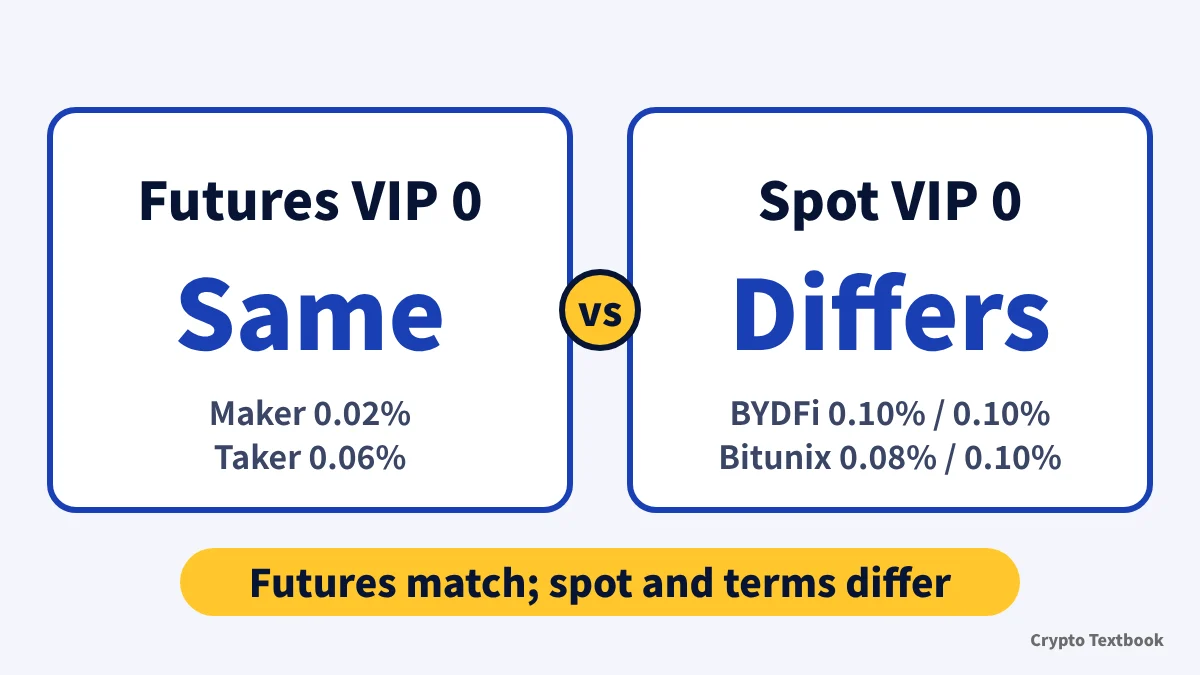
- Futures at VIP 0: 0.02% maker and 0.06% taker at both exchanges
- Spot: BYDFi 0.10% / 0.10%; Bitunix 0.08% maker and 0.10% taker
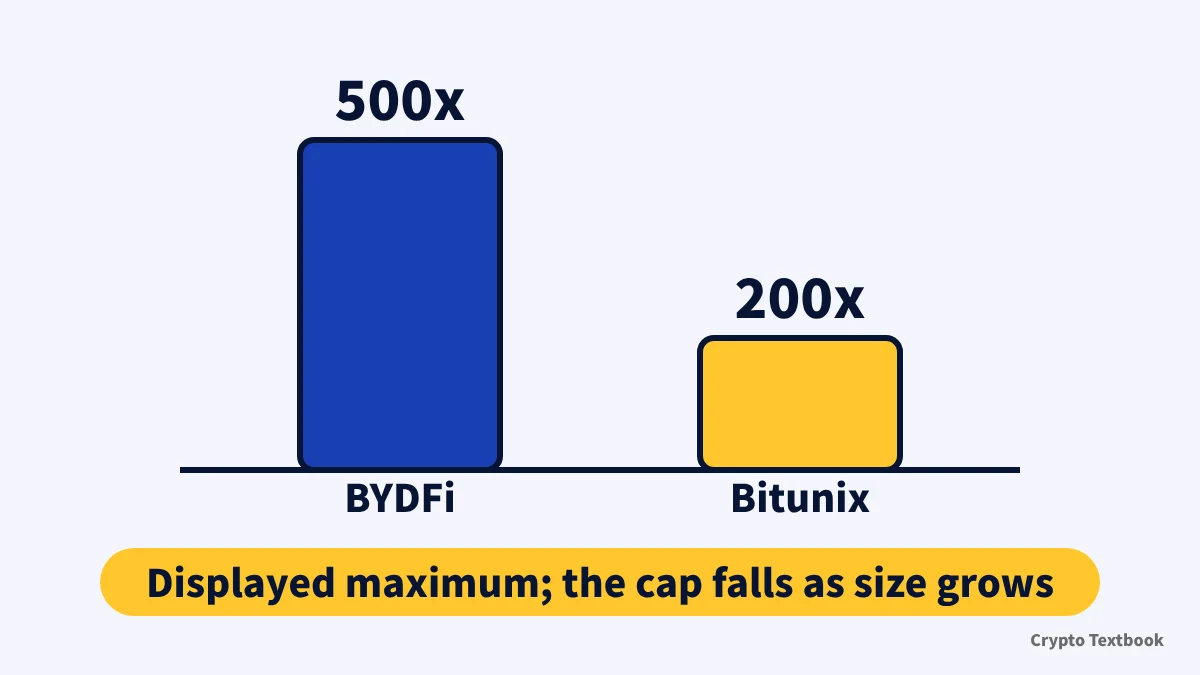
- Displayed maximum leverage: BYDFi 500x on BTC; Bitunix 200x on five symbols
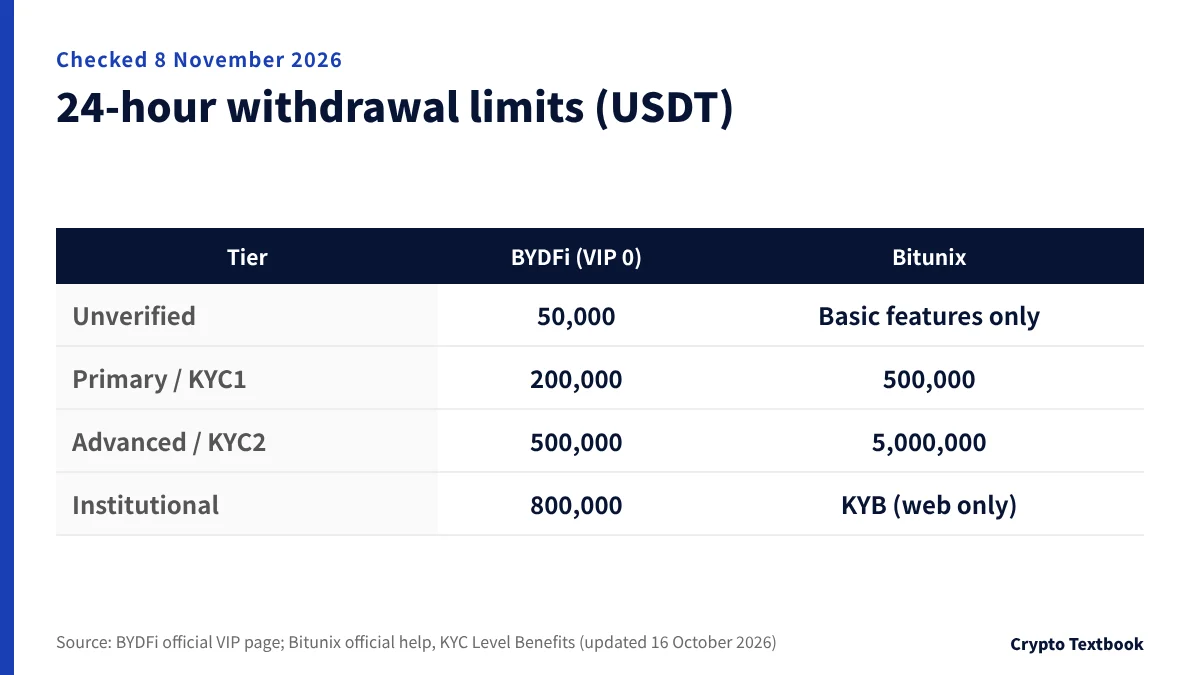
- 24-hour withdrawal limit: BYDFi Advanced KYC (VIP 0) 500,000 USDT; Bitunix KYC2 5,000,000 USDT
- Copy trading profit share settles daily at BYDFi and every Monday 00:00 (UTC) at Bitunix
- What a Japan-based user can do without verification cannot be confirmed from either exchange's official pages
BYDFi fees in detail, from VIP tiers to withdrawals (BYDFi fees column) →
Bitunix fees in detail, from VIP tiers to withdrawals (Bitunix fees column) →
Fees compared: spot differs, futures at VIP 0 does not
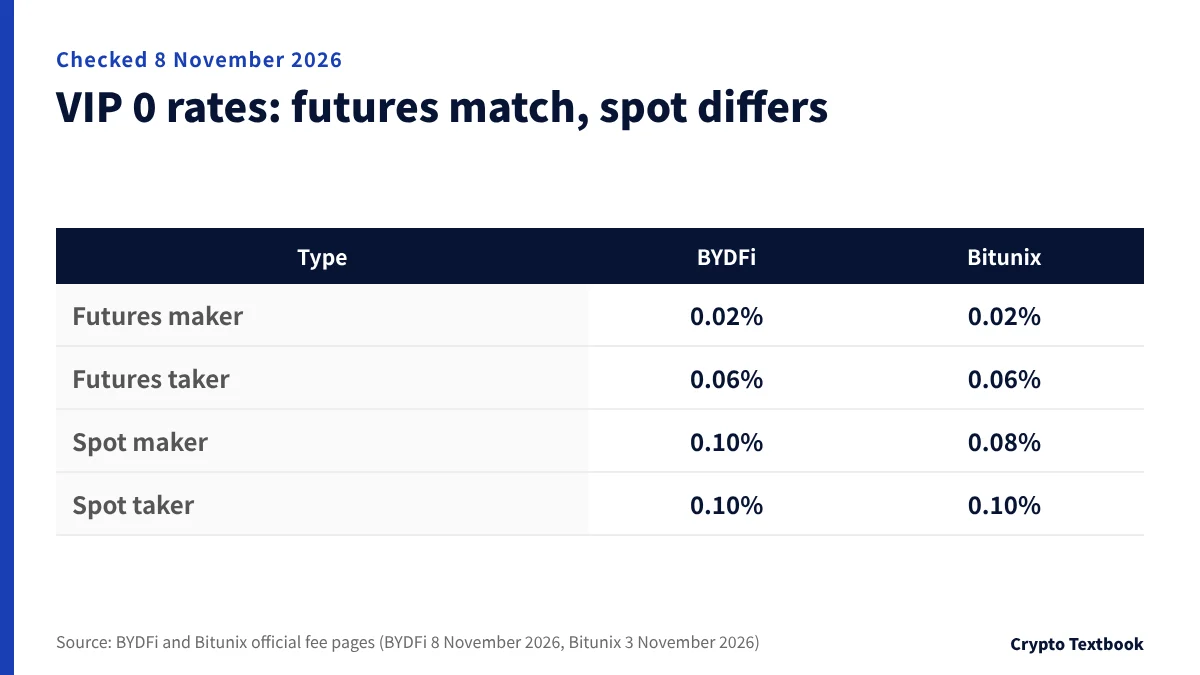
At VIP 0 the futures rates are identical. The gap is in spot, and in the rates once VIP levels rise.
| Level | BYDFi spot (M / T) | Bitunix spot (M / T) |
|---|---|---|
| VIP 0 | 0.10% / 0.10% | 0.08% / 0.10% |
| VIP 1 | 0.10% / 0.10% | 0.07% / 0.09% |
| VIP 2 | 0.10% / 0.10% | 0.06% / 0.08% |
| VIP 3 | 0.10% / 0.10% | 0.035% / 0.06% |
| Level | BYDFi futures (M / T) | Bitunix futures (M / T) |
|---|---|---|
| VIP 0 | 0.02% / 0.06% | 0.02% / 0.06% |
| VIP 1 | 0.018% / 0.06% | 0.02% / 0.05% |
| VIP 2 | 0.016% / 0.05% | 0.016% / 0.05% |
| VIP 3 | 0.014% / 0.04% | 0.014% / 0.04% |
BYDFi's pair list also shows 0.0800% for spot, with 0.1000% struck through. The official pages give no reason.
- BYDFi VIP 1: 30-day spot volume 100,000, futures 10,000,000 or assets 50,000 USDT (the highest of the three sets the level)
- Bitunix VIP 1: spot 100,000, futures 1,000,000 or balance 300 USDT (the table joins the three with "or")
- VIP updates: BYDFi daily at 11:00 Japan time; Bitunix in real time, a promoted level held 90 days
Trading 10,000 USDT in and out (an opening and a closing fill), VIP 0 futures cost 12 USDT for two taker fills and 4 USDT for two maker fills at both exchanges. Two spot taker fills cost 20 USDT at both.
The gap is in two spot maker fills: 20 USDT at BYDFi (16 at the 0.08% list display) and 16 USDT at Bitunix. This is this site's calculation with assumed figures; funding and price moves are excluded.
Both exchanges settle futures funding every 8 hours, which is 9:00, 17:00 and 1:00 the next day in Japan time. Some symbols use a different interval. Check the actual rate on each futures screen.
Leverage and liquidation compared: reading 500x and 200x
| Item | BYDFi | Bitunix |
|---|---|---|
| Max leverage (displayed) | BTC 500x | 200x on BTC, ETH, XAUUSDT, XAGUSDT, PAXGUSDT |
| Caps on other symbols | Not confirmed | 125x on BTCUSDC, ETHUSDC and others; SOL and XRP 100x; DOGE and BNB 75x |
| How the cap is set | Falls with position-size tiers (BTCUSDT: 200x up to 100,000 USDT) | Per-symbol cap plus tiers (BTC: 50x is tier 3, up to 2,500,000 USDT) |
| Liquidation trigger | Maintenance margin ratio (MMR) 100% | Maintenance margin (by tier) |
| Negative balance | Auto-cleared every 10 minutes (insurance fund absorbs as far as possible) | Not confirmed (not stated in the futures help) |
| Practice environment | Demo trading (testnet) | Demo trading (50,000 USDT virtual funds) |
BYDFi's 500x is the figure shown on its futures page. The tier examples in the official help stop at 200x, and the position size at which 500x applies could not be confirmed.
In Bitunix's official API, 5 of 794 symbols allow 200x, 4 allow 125x and 658 are capped at 50x or lower. For BYDFi, no per-symbol cap list turned up within this site's review, so caps other than BTC are not stated here.
The higher the leverage, the sooner a small adverse move reaches liquidation. Liquidation can wipe out all or part of your margin.
BYDFi futures leverage and liquidation (BYDFi futures column) →
Bitunix futures leverage and liquidation (Bitunix futures column) →
Verification and withdrawal limits compared: tiers and caps differ
| Item | BYDFi | Bitunix |
|---|---|---|
| Individual tiers | Primary and Advanced (2 tiers) | KYC1 and KYC2 (2 tiers) |
| Business | Institutional KYC | KYB (web only) |
| Review time (guide) | Primary within 24 hours; Advanced about 24 hours | KYC1 minutes to 24 hours; KYC2 manual, 1 to 3 hours |
| Address check | Proof of address (dated within 3 months) | Address document at KYC2 |
| What raises the limit | A higher VIP level | Verification methods, risk review and region |
At BYDFi the 24-hour limit rises with the VIP level. The Advanced KYC limit is 500,000 USDT at VIP 0 and 3,000,000 USDT at VIP 7.
Bitunix's withdrawal FAQ also gives 10,000 USD-equivalent per day for a "basic" level, defined by one verification method. That is a separate classification from KYC tiers, and the official pages do not reconcile the two.
BYDFi's KYC FAQ says some deposits, withdrawals and trading may be restricted depending on regional regulation. Bitunix's level table lists unverified accounts as basic features only. What a Japan-based user can do is not confirmed by either.
BYDFi verification steps and withdrawal limits (BYDFi KYC column) →
Deposits and withdrawals compared: USDT fees vary by network
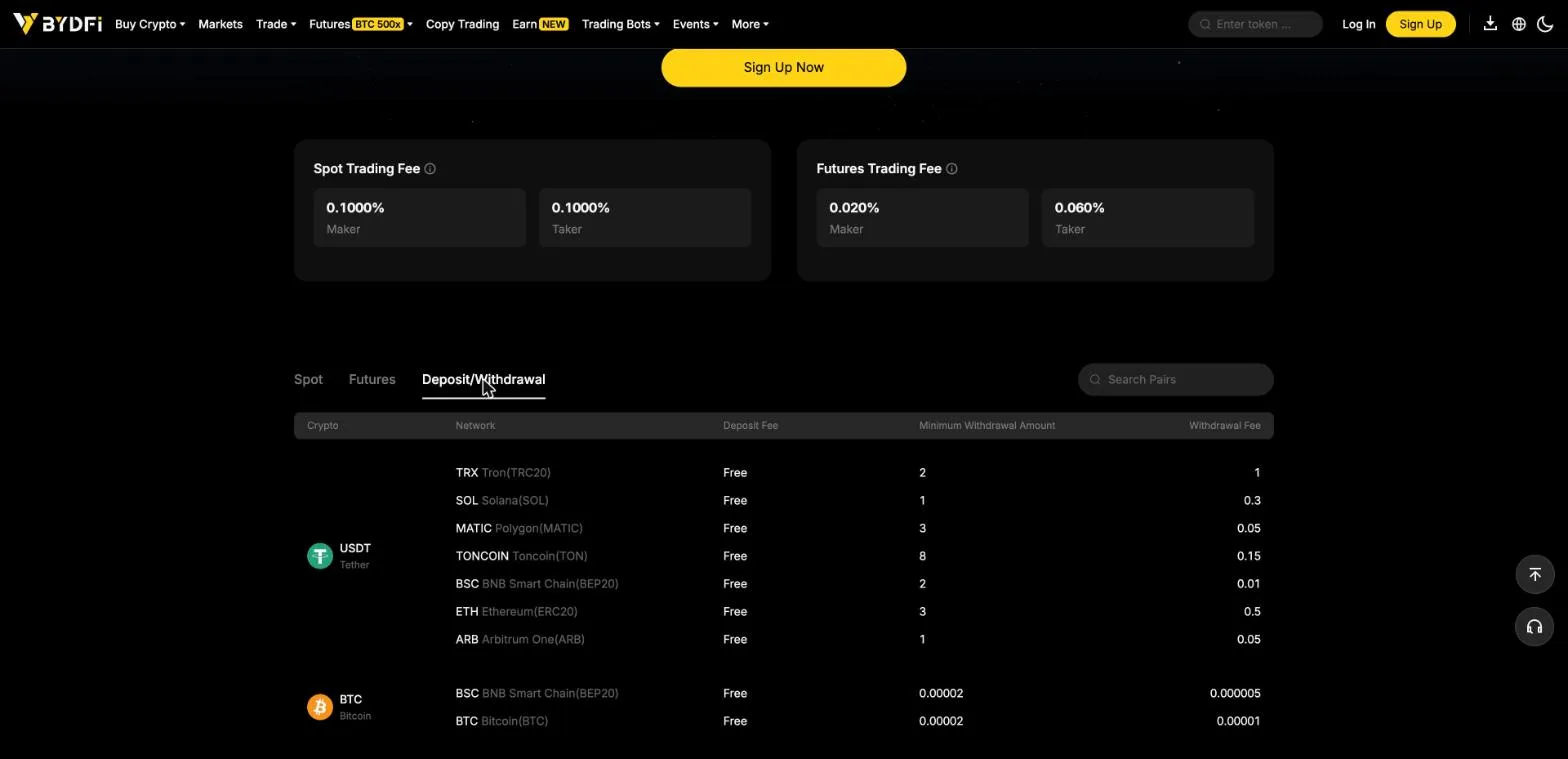
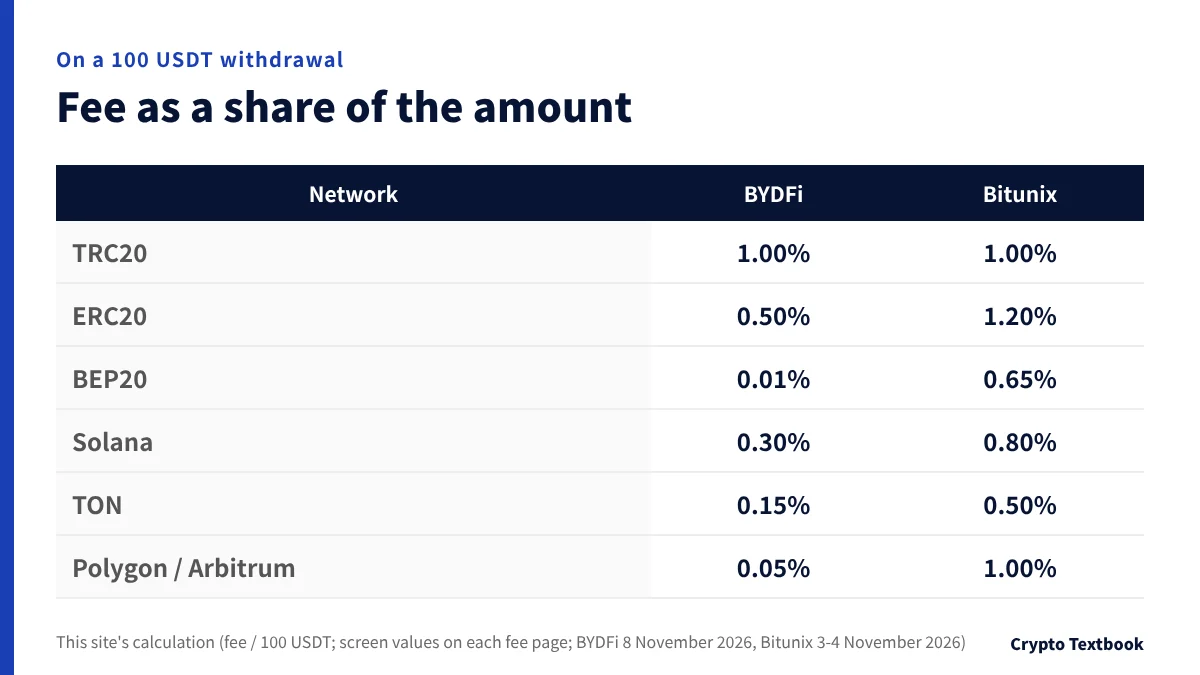
| USDT network | BYDFi (min / fee) | Bitunix (min / fee) |
|---|---|---|
| Tron (TRC20) | 2 / 1 | 2 / 1 |
| Ethereum (ERC20) | 3 / 0.5 | 2 / 1.2 |
| BNB Smart Chain (BEP20) | 2 / 0.01 | 2 / 0.65 |
| Solana | 1 / 0.3 | 2 / 0.8 |
| TON | 8 / 0.15 | 1 / 0.5 |
| Polygon | 3 / 0.05 | 2 / 1 |
| Arbitrum | 1 / 0.05 | 2 / 1 |
- Deposits: free at BYDFi (help updated 30 September 2026); no extra deposit fee at Bitunix
- Buying with fiat: BYDFi uses 7 partner processors; Bitunix offers card, P2P and SEPA, and KYC may be required first at both
- Deposits in Japanese yen: no method was found in either exchange's official pages within this site's review
Bitunix's withdrawal-fee help (updated 13 August 2026) lists ERC-20 at 2, BEP-20 at 0.5, Solana at 1 and TON at 1. The fee page screen shows 1.2, 0.65, 0.8 and 0.5. The table uses the screen values; confirm on the withdrawal screen before sending.
BYDFi deposits, withdrawals and what to check when one fails (BYDFi deposit and withdrawal column) →
Bitunix deposits, withdrawals and choosing a network (Bitunix deposit and withdrawal column) →
Copy trading compared: modes, profit sharing and stopping
| Item | BYDFi | Bitunix |
|---|---|---|
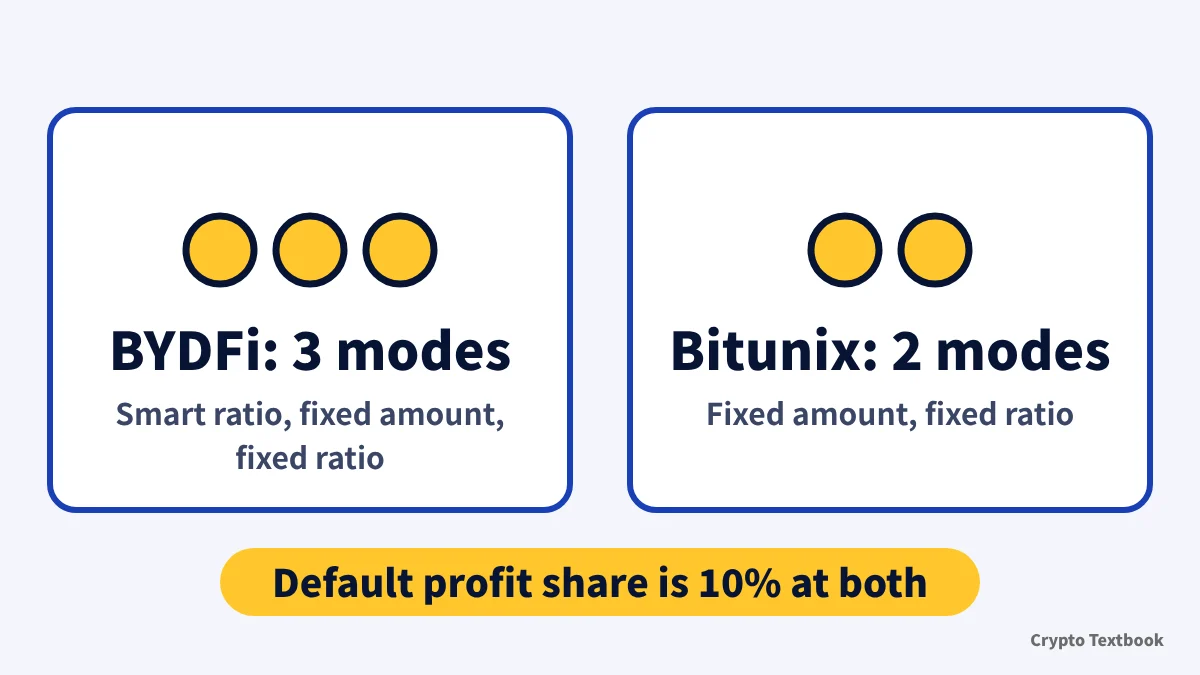
| Copy modes | Smart ratio, fixed amount, fixed ratio | Fixed amount, fixed ratio |
| Amount floor and range | Minimum 30 USDT (PC tutorial); the terms explainer says 0.01 USDT or more | Fixed amount 10-1,000 USDT per order; fixed ratio 100-100,000 USDT in total |
| Default profit share | 10% (change request once a day) | 10% |
| Settlement | Daily, 16:00-17:00 (UTC) = 1:00-2:00 the next day in Japan | Every Monday 00:00 (UTC) = Monday 9:00 in Japan |
| Handling of losses | In the official example, shared only when cumulative PnL is positive | Shared only when the period's realized profit is positive |
| Leverage when copying | Set on the settings page | Up to 10x |
| Stopping tools | Account stop-loss; liquidation-linking option | Strategy stop-loss 5-95%; per-position TP/SL |
| Copy-specific fees | Not confirmed | None added (standard futures rates) |
In BYDFi's official example, after a losing day nothing is shared until cumulative PnL turns positive again. Bitunix's formula shares 10% of each period's profit and sets a losing period to 0.
The PC tutorial (updated 3 September 2026) says a minimum of 30 USDT; the terms explainer (7 September) says 0.01 USDT or more. Check the settings screen. Copy trading results are not guaranteed.
How to start and stop copy trading on Bitunix (Bitunix copy trading column) →
How to start copy trading on BYDFi (BYDFi copy trading column) →
Bonuses compared: only the offers listed on this site
| Item | BYDFi | Bitunix |
|---|---|---|
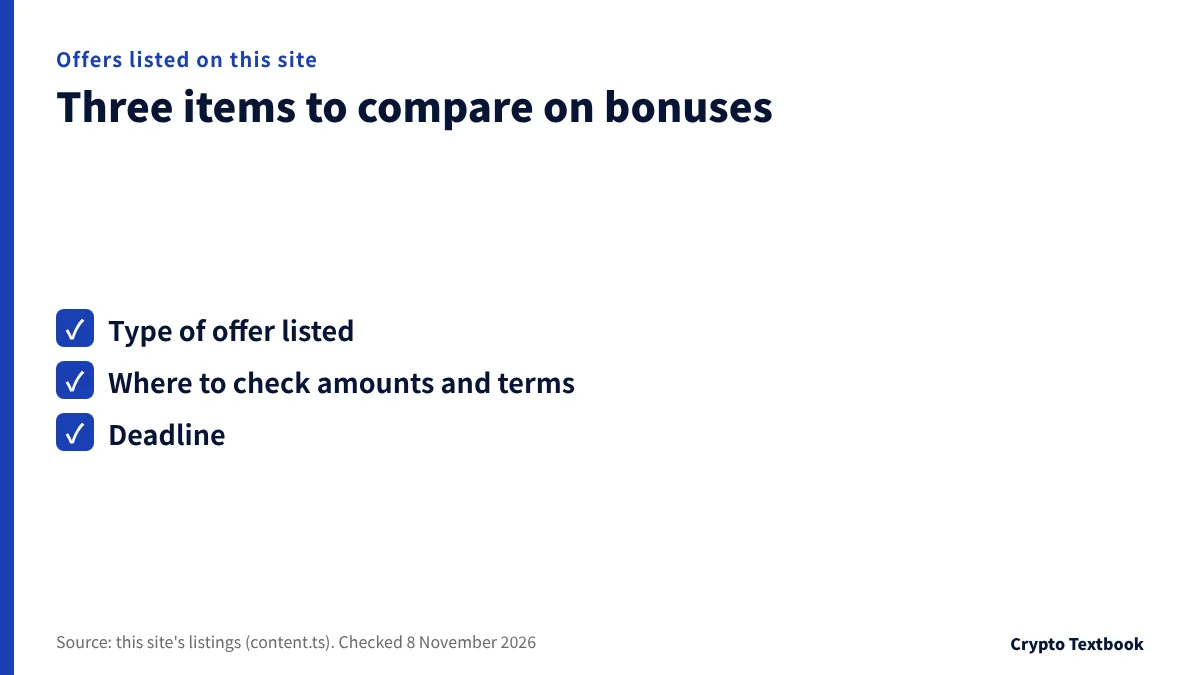
| Listed offers | Deposit bonus (futures bonus) | New user rewards; CFD account cushion bonus |
| Where to check amounts and terms | The bonus page | Up to 10,000 USDT (official rewards hub); CFD: 50-1,000 USDT for a first deposit of 100-4,000 USDT |
The BYDFi deposit bonus has its amounts and conditions on the bonus page.
Bitunix's CFD cushion bonus covers losses after your own funds run out. Moving principal out of the CFD account triggers full recovery of the bonus, and this site lists it until 31 December 2026 (end time unconfirmed).
BYDFi deposit bonus conditions (bonus page) →
Bitunix new user rewards (campaign page) →
How the Bitunix CFD cushion bonus works (CFD cushion bonus column) →
Operations compared: terms, proof of reserves and language support
| Item | BYDFi | Bitunix |
|---|---|---|
| Operator in the terms | Split across three official documents: Terms of Use = BYDFi BLOCKCHAIN LTD (Colorado law) and Terms of Service = BYDFi Fintech LTD (Seychelles law), both updated 7 August 2026; User Agreement (9 January 2026) = Multinex Inc. (English law) | No operating company stated in the terms |
| Started | 2020 (formerly BitYard) | 2021 (self-reported on the About page) |
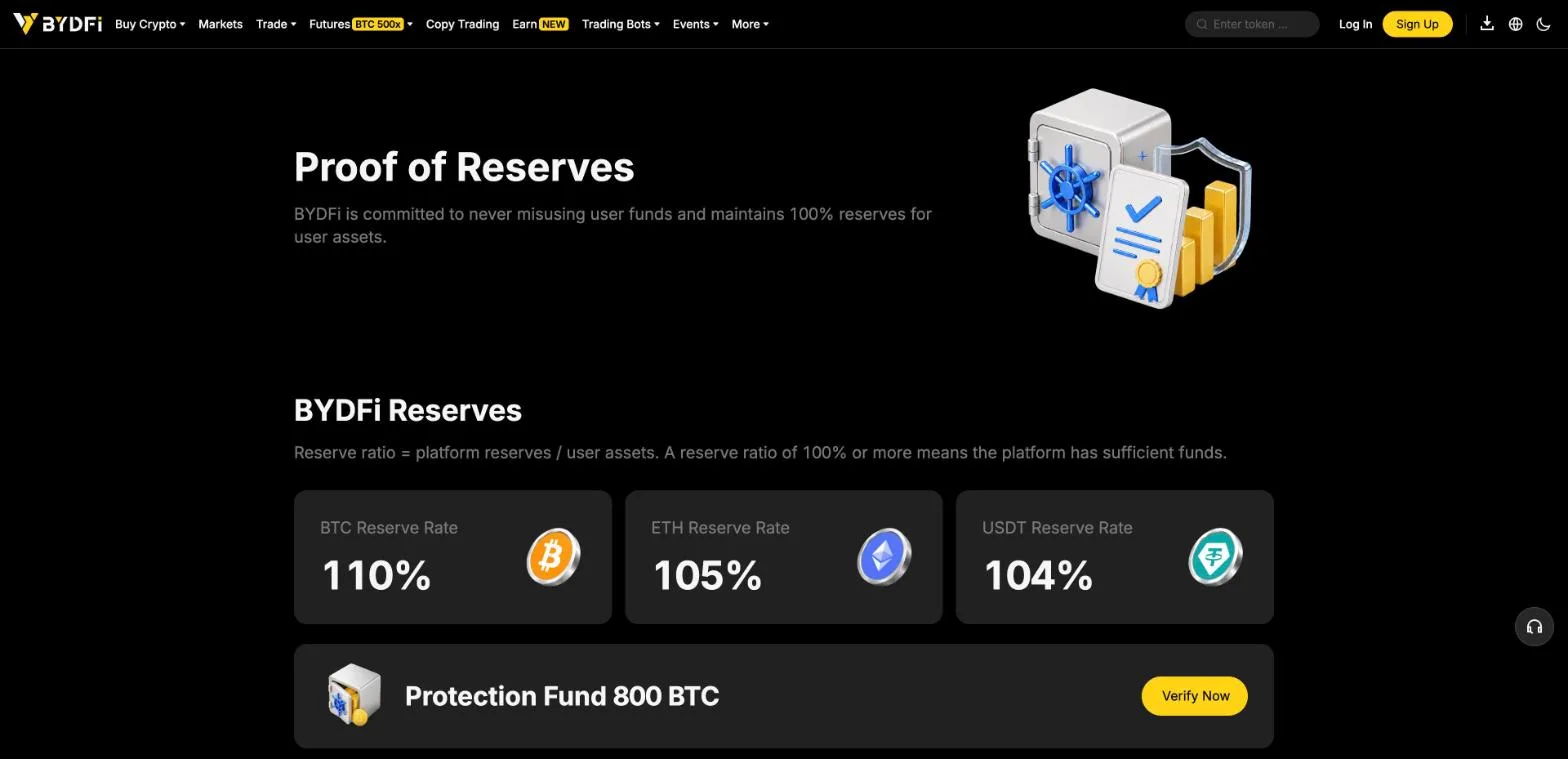
| Proof of reserves | BTC 110%, ETH 105%, USDT 104%; no snapshot date shown | BTC 156%, ETH 108%, USDT 105%; audit time 1 October 2026 (UTC+0) |
| Protection fund | 800 BTC (as labeled on the PoR page) | Not confirmed officially |
| Japanese | Japanese site and help center; support-desk languages unconfirmed | Japanese site; help articles in English; support in Chinese, English and Spanish |
| Prohibited or restricted regions | Japan is not in the terms' prohibited list | Japan is not listed in the restricted-regions notice (examples only) |
The ratios are figures published by each exchange, not a guarantee of your deposits. BYDFi's three official documents name different operating companies, and none says which one contracts with users in Japan.
BYDFi's operator and why company names differ by document (BYDFi operations and safety column) →
Bitunix's restricted regions and proof of reserves (Bitunix operations and safety column) →
Editorial verdict: where to check, by what you care about
Which one fits depends on what you trade and how much you move. Here is where to check the numbers, by condition.
- Futures as a maker: the gap opens at VIP 1 (BYDFi maker 0.018%, Bitunix taker 0.05%)
- Mostly spot: BYDFi is 0.10% at every level; Bitunix is 0.035% / 0.06% at VIP 3
- Many small withdrawals: on 100 USDT the BEP20 fee share is 0.01% at BYDFi and 0.65% at Bitunix
- Large amounts: Advanced KYC allows 500,000 USDT at BYDFi (VIP 0); Bitunix KYC2 allows 5,000,000
- Using a bonus: read what can be withdrawn, and by when, on each bonus page
- Not confirmed: the position size at which BYDFi's 500x applies, and any copy-trading-specific fee rate
- Not confirmed: how Bitunix treats negative balances, and tier tables beyond the 200x symbols
- Not confirmed: how to deposit Japanese yen, and what a Japan-based user can do unverified
See fees and trading terms on the BYDFi exchange page →
See fees and trading terms on the Bitunix exchange page →
Open the BYDFi sign-up page (with this site's referral link) →
Open the Bitunix sign-up page (with this site's referral code) →
How to enter the Bitunix invite code and what to do after sign-up (Bitunix invite code column) →
Frequently asked questions
Q. Are BYDFi and Bitunix futures fees different?
A. At VIP 0 they are the same: 0.02% maker and 0.06% taker. Only at VIP 1 do they differ: BYDFi's maker is lower at 0.018% and Bitunix's taker is lower at 0.05%. From VIP 2 the rates match.
Q. How do the spot fees differ?
A. At VIP 0, BYDFi charges 0.10% for both maker and taker. Bitunix charges 0.08% maker and 0.10% taker. BYDFi's pair list also shows 0.0800%, and the official pages give no reason.
Q. What is the maximum leverage?
A. The displayed figures are 500x on BTC at BYDFi and 200x on five symbols, including BTC and ETH, at Bitunix. BYDFi's help tiers only go to 200x, and the position size for 500x could not be confirmed. Both lower the cap as position size grows.
Q. Can I use them without identity verification?
A. It depends on the region. BYDFi's KYC FAQ describes regional restrictions, and Bitunix lists unverified accounts as basic features only. What a Japan-based user can do is not confirmed by either exchange.
Q. How much do USDT withdrawal fees differ?
A. It depends on the network. TRC20 is 1 USDT at both. BEP20 is 0.01 at BYDFi and 0.65 at Bitunix; ERC20 is 0.5 at BYDFi and 1.2 at Bitunix. These are the screen values as of November.
Q. How much is the copy trading profit share?
A. The default is 10% at both. BYDFi settles daily and Bitunix settles every Monday at 00:00 (UTC). At BYDFi, in the official example, sharing only happens while cumulative PnL is positive.
Q. Can both be used from Japan?
A. Japan is not listed in BYDFi's prohibited countries or in Bitunix's restricted-regions notice. Bitunix's list is illustrative, and BYDFi's app-supported countries and prohibited countries do not match. This article does not judge the position under Japanese law.
Q. Which exchange has bonuses?
A. This site lists BYDFi's deposit bonus and Bitunix's new user rewards and CFD account cushion bonus. Check amounts and conditions on each bonus page.
Sources
- BYDFi | Fee Overview (official, spot, futures and deposit/withdrawal, checked 8 November 2026) →
- BYDFi | BYDFi VIP (official, requirements, benefits and withdrawal limits, checked 8 November 2026) →
- BYDFi | Proof of Reserves (official, checked 8 November 2026) →
- BYDFi | Terms of Service (official help, shown as updated 7 August 2026, checked 8 November 2026) →
- BYDFi | Risk Limit for USDT-M and COIN-M Contracts (official help, checked 8 November 2026) →
- BYDFi | The Process of Forced Liquidation (USDT-M) (official help, updated 16 September 2026, checked 8 November 2026) →
- BYDFi | BYDFi KYC Verification FAQ (official help, updated 3 November 2026, checked 8 November 2026) →
- BYDFi | Copy Trade Profit Sharing Rules Explained (official help, updated 17 September 2026, checked 9 November 2026) →
- BYDFi | Copy Trading Tutorial (PC) (official help, updated 3 September 2026, checked 9 November 2026) →
- Bitunix | Fees (official, trading tab and deposit/withdrawal tab, checked 3-4 November 2026) →
- Bitunix | KYC Level Benefits (official help, updated 16 October 2026, checked 8 November 2026) →
- Bitunix | Futures Copy Trading Rules (official, updated 9 July 2026, checked 8 November 2026) →
- Bitunix | Tiered Risk and Forced Liquidation for Futures (official help, checked 8 November 2026) →
- Bitunix | Trading Pairs (official API, max leverage by pair, checked 8 November 2026) →
- Bitunix | Proof of Reserves (official, checked 3 November 2026) →
- Bitunix | How to use CFD Cushion Bonus (official help, updated 24 September 2026, checked 8 November 2026) →
FX Textbook is an independent information site, not an exchange or a provider of personal investment advice. Crypto-asset trading involves risk: price volatility, liquidation of leveraged positions, transfer mistakes and the operational risk of exchanges and service providers can cause you to lose some or all of your invested capital. No result is guaranteed.
NEXT STEP
Check BYDFi and Bitunix fees and leverage on their exchange pages.
Spot, futures and copy trading conditions, organized exchange by exchange from official pages.
Exchanges related to this column
Fees, leverage, funding options and current offers are on each exchange page.