
You want to buy ENA (Ethena), but it does not show up in any Japanese exchange app. We checked primary sources to find out where and in what order to buy it.
As of 8 November 2026, ENA is not listed at the seven registered Japanese exchanges we checked or on the JVCEA member list. Spot trading is available at three exchanges whose official APIs we checked: MEXC, BingX and Bitunix.
This article explains how ENA differs from the synthetic dollar USDe, how to send crypto from Japan, buy ENA, convert back to yen, and the tax basics.
Answer: Japanese exchanges do not list ENA; three overseas exchanges do
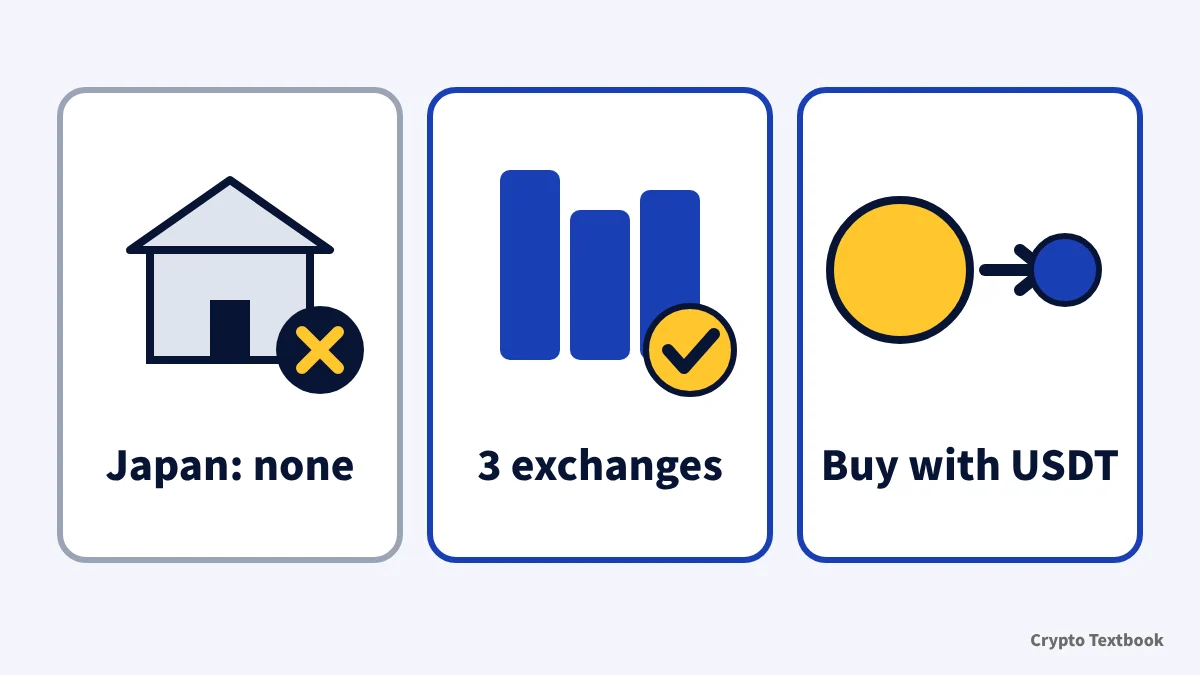
- ENA is not on the listings of seven registered Japanese exchanges or on the JVCEA list of 113 assets (checked 8 November)
- MEXC offers four ENA pairs including ENA/USDT; BingX and Bitunix offer ENA/USDT
- The pairs are quoted in USDT and similar coins, so you cannot buy directly with yen. Send crypto bought in Japan and swap it
- None of the overseas exchanges covered here is registered with Japan's FSA. Japanese investor protection does not apply
- ENA is a token used to vote on how Ethena is run. It is not the same as USDe, a synthetic dollar designed to stay near $1
- Look-alike fake tokens and fake sites exist, and exchanges can delist a coin
We do not give price outlooks or timing advice. ENA moves sharply and can fall below what you paid. Only use money you can afford to lose.
What is Ethena (ENA)? The voting token of the protocol behind USDe
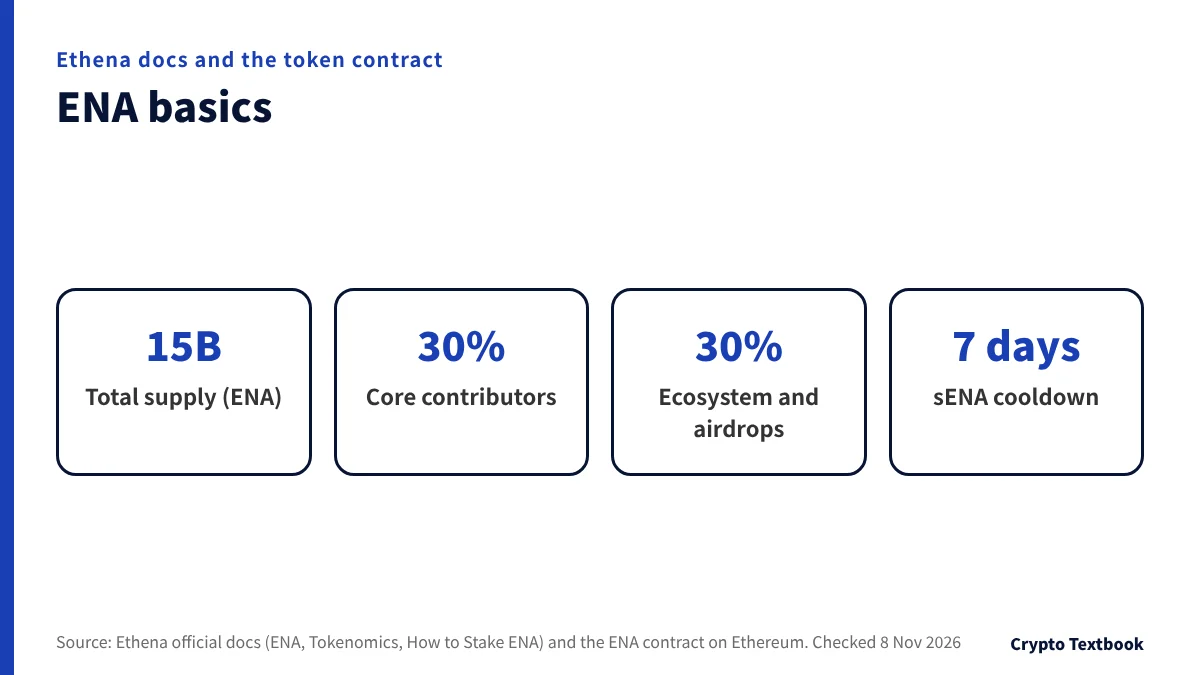
ENA is the governance token of the Ethena protocol, used to vote on how the protocol is run. Ethena issues USDe, a dollar-denominated synthetic dollar.
Ethena's documentation lists four kinds of decisions that ENA holders vote on.
- The composition of the assets backing USDe
- Whether to add new backing strategies
- How protocol revenue will be allocated in future
- The membership and remit of the Risk Committee
ENA is available on Ethereum and on a number of other chains through LayerZero. The website and its terms are operated by Ethena (BVI) Limited in the British Virgin Islands.
| Item | Details |
|---|---|
| Total supply | 15 billion ENA (totalSupply value of the contract) |
| Core contributors (team and advisors) | 30%. 25% after a one-year cliff, the rest monthly over three years |
| Investors | 25% after a one-year cliff, the rest monthly over three years |
| Ecosystem development and airdrops | 30%. Used for rewards campaigns, exchange partnerships and more |
| Foundation | Used for USDe adoption, development, audits and similar costs |
※ The documentation text gives no percentage for investors or the Foundation. On the official chart, all 15 billion ENA are unlocked by Q2 2028.
Staking ENA gives you sENA (staked ENA). After you request to unstake, it takes 7 days before you can withdraw ENA.
According to the documentation, distributions to sENA are purely discretionary, and as of September 2025 none were in effect or announced. Staking is limited to users in permitted jurisdictions.
ENA and USDe are different: how the synthetic dollar works
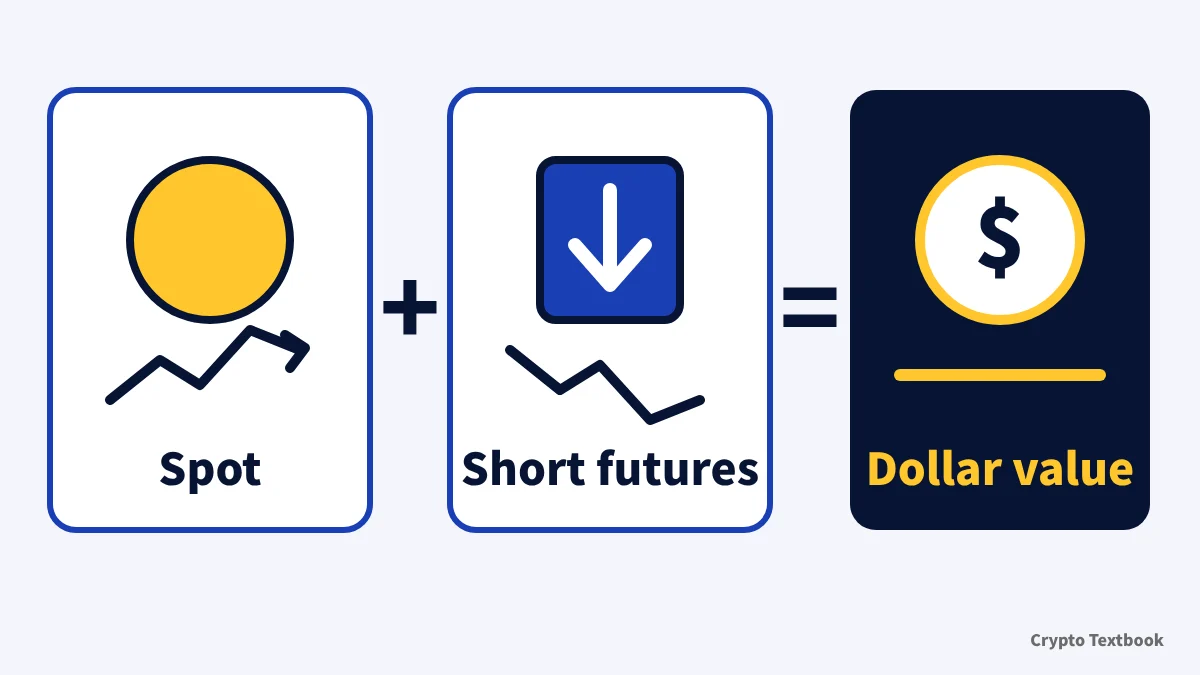
USDe is a dollar-denominated synthetic dollar issued by Ethena. The documentation states clearly that it is not the same as a fiat-backed stablecoin such as USDC or USDT.
For most of its history, its backing has centred on spot crypto paired with short futures positions of about the same size. Gains and losses on the futures offset the price moves of the spot assets, keeping the dollar value stable.
| Item | ENA | USDe |
|---|---|---|
| Role | Used to vote on the protocol | Dollar-denominated synthetic dollar |
| Price | Moves freely in the market | Designed to stay near $1 (no guarantee) |
| Minting and redeeming | Bought and sold on exchanges and DEXs | Only whitelisted users who pass identity checks |
| Rewards | None just for holding | USDe itself pays no interest; staked sUSDe is eligible for distributions (not offered to EU or EEA residents) |
The backing now goes beyond crypto futures. The documentation lists these categories.
- Spot crypto paired with short futures
- Basis trades in non-crypto markets such as commodities
- DeFi lending and lending to institutional counterparties
- Tokenised assets such as short-dated government debt, and liquid stablecoins
ENA's price moves independently of USDe's $1 target. If you want to use USDe, treat it as a separate coin.
USDe can move away from $1: the risks Ethena lists
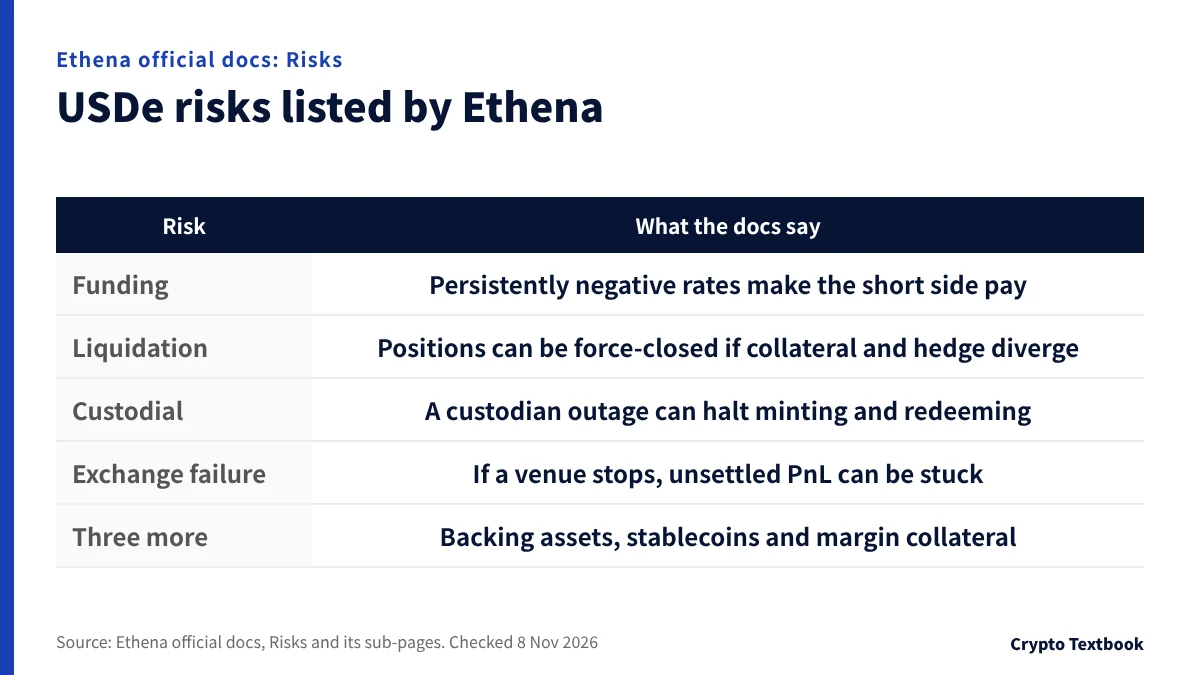
Ethena's documentation lists seven risks for USDe. It also says there is no guarantee for the backing.
| Risk | What the documentation says |
|---|---|
| Funding | If funding rates stay negative, the short side has to pay |
| Liquidation | If collateral differs from the futures underlying, a price gap can force a close |
| Custodial | An outage at a custodian holding the backing can halt minting and redeeming |
| Exchange failure | If a venue holding the futures stops, unsettled PnL can be left outstanding |
| Three more | Risks tied to backing assets, stablecoins and margin collateral |
When the price moves away from $1, the design relies on arbitrage by whitelisted users to bring it back. The official example is buying at $0.95 and redeeming at $1.00.
There is also a Reserve Fund to absorb negative revenue. The documentation says, however, that 0% of revenue currently goes to it.
Only whitelisted users who pass identity checks can mint and redeem USDe. If you simply buy and hold it on an exchange or DEX, you sell at the market price of the moment.
Can you buy ENA in Japan? What we found at registered exchanges
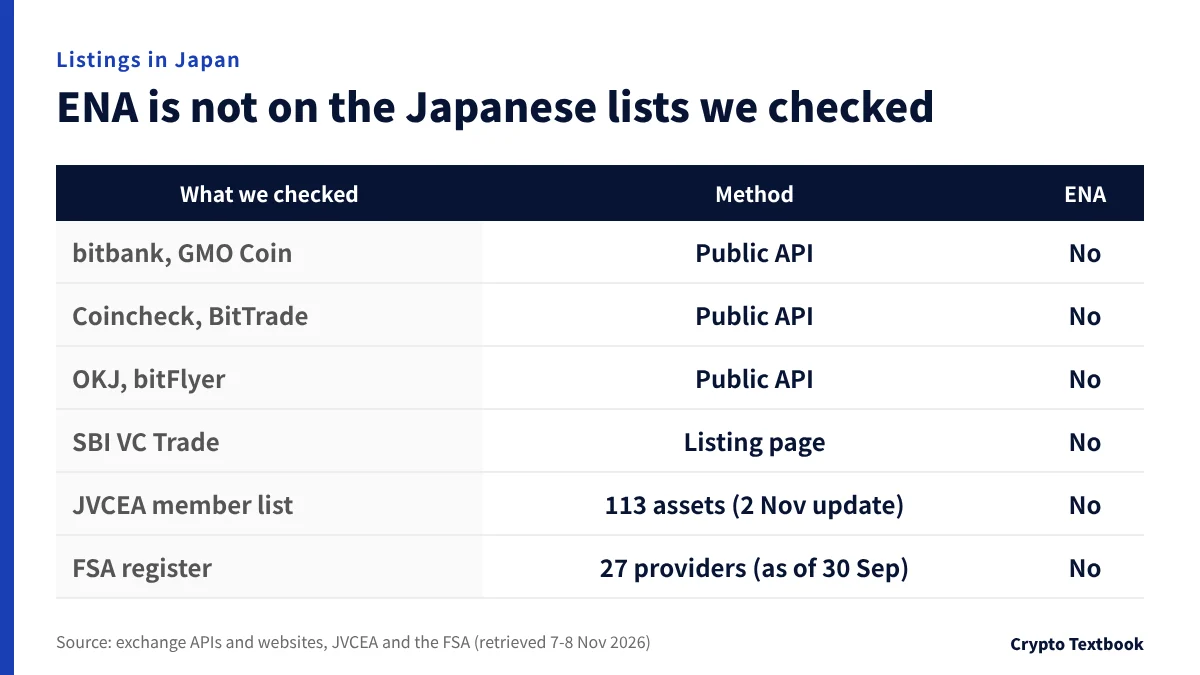
On 8 November 2026 we checked seven registered Japanese exchanges. We used the public APIs of six of them and the listing page of SBI VC Trade.
| What we checked | Method | ENA |
|---|---|---|
| bitbank | Public API | No |
| GMO Coin | Public API | No |
| Coincheck | Public API (exchange and broker) | No |
| BitTrade | Public API | No |
| OKJ | Public API | No |
| bitFlyer | Public API (order book markets) | No |
| SBI VC Trade | Listing page | No |
| JVCEA member list | 113 assets (updated 2 November 2026) | No |
| FSA register | Listed assets of 27 providers | No |
※ The JVCEA list covers member exchanges such as Binance Japan, Rakuten Wallet and Zaif. USDe is not on any of these lists either. We did not open each exchange's current app screens.
Not being listed in Japan has three consequences.
- You buy at an overseas exchange that is not registered with the FSA
- Japanese investor protections such as segregation and trusts under the Payment Services Act do not apply
- ENA has not passed the JVCEA review that registered Japanese exchanges go through
Running a crypto exchange business requires registration under the Payment Services Act. Japanese exchanges go through a JVCEA review before listing a new coin.
The Payment Services Act penalties target those who run a crypto exchange business without registration. In the provisions we read, we found none that penalise users. Even so, Japanese rules will not protect you if something goes wrong.
Can people in Japan use BingX? FSA warnings, registration and protection explained →
Where can you buy ENA? MEXC, BingX and Bitunix compared
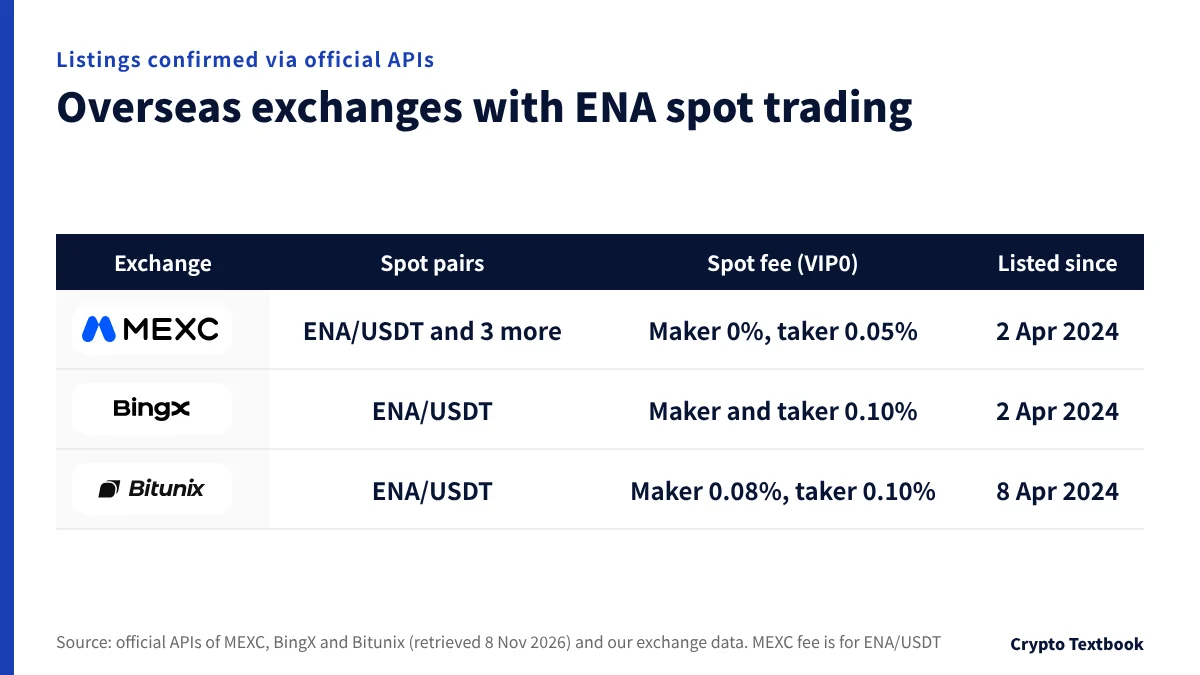
Of the overseas exchanges we cover, three show ENA spot trading in their official APIs. BYDFi has no public API and we could not capture its pages, so it is not covered here.
| Exchange | ENA spot pairs | Spot fee (VIP0) | Listed since (API) |
|---|---|---|---|
| MEXC | ENA/USDT, ENA/USDC, ENA/USDE, ENA/USD1 | ENA/USDT maker 0%, taker 0.05% | 2 April 2024 |
| BingX | ENA/USDT | Maker and taker 0.10% | 2 April 2024 |
| Bitunix | ENA/USDT | Maker 0.08%, taker 0.10% | 8 April 2024 (record date) |
※ Start dates are MEXC firstOpenTime and BingX timeOnline in Japan time. In the MEXC API, ENA/USDC and ENA/USDE fees are 0% and ENA/USD1 is 0.01%.
MEXC has four pairs; BingX and Bitunix have one each. Withdrawal limits depend on your identity verification (KYC) level.
| Exchange | KYC levels | Withdrawal limit |
|---|---|---|
| MEXC | Primary and Advanced KYC | 80 BTC and 200 BTC per day (checked 26 September) |
| BingX | Unverified and Advanced KYC | 20,000 and 5,000,000 USDT per 24 hours (unverified: deposits and trading unavailable per the official table, checked 8 Nov 2026) |
| Bitunix | KYC1 and KYC2 | 500,000 and 5,000,000 USDT per 24 hours (checked 4 November) |
- MEXC: 0% maker fee on ENA/USDT spot; you can also buy with USDC or USDe
- BingX: one pair, ENA/USDT. Unverified: deposits and trading unavailable per the official table (checked 8 Nov 2026)
- Bitunix: one pair, ENA/USDT. No deposit fee; deposits usually arrive in 3 to 30 minutes
Open the MEXC sign-up page (our referral link) →
How to buy ENA: four steps from sign-up to a spot order
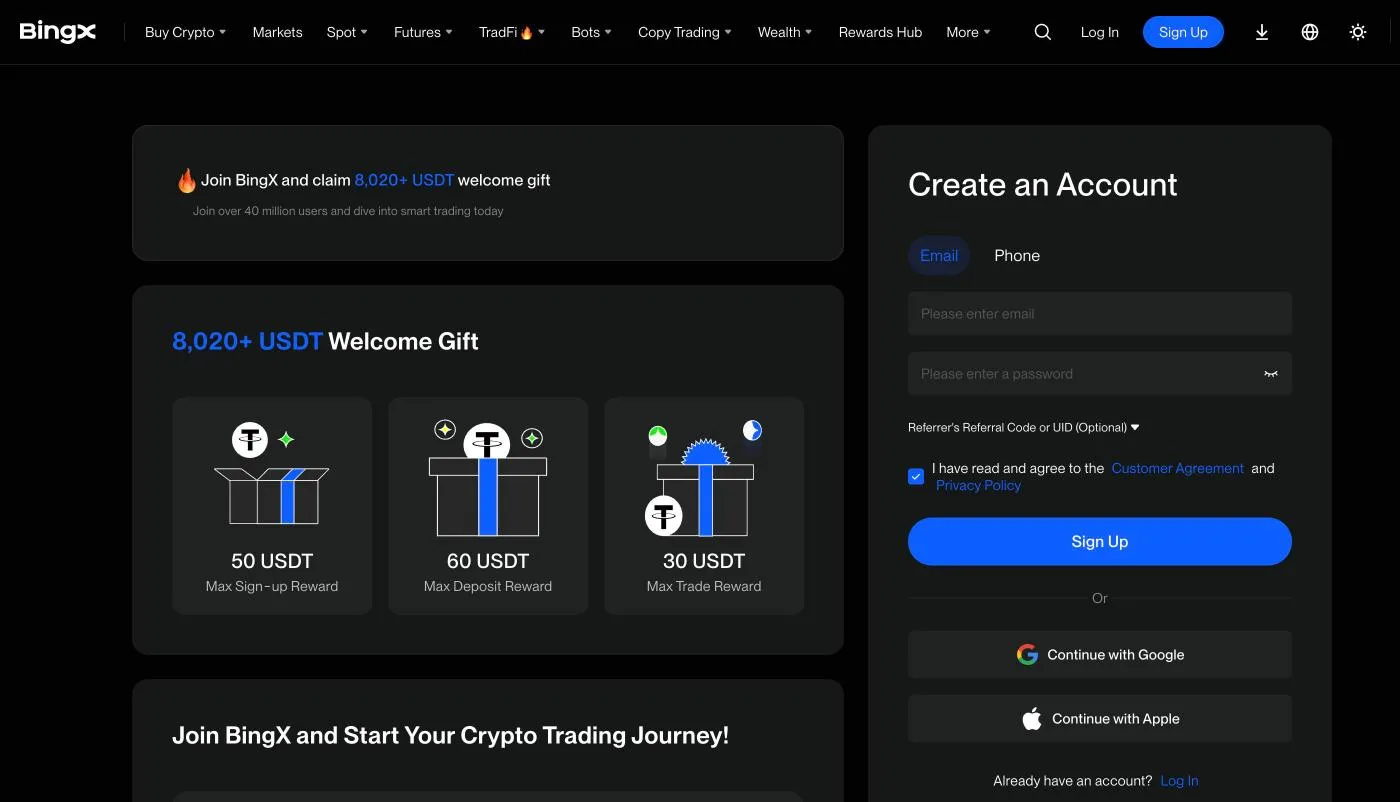
The flow is the same four steps at all three exchanges. We only name screens we confirmed in each exchange's official help or pages.
- 01Sign up with an email address or phone number
The BingX and MEXC sign-up pages have a field for an invitation code. You can sign up without one.
- 02Complete identity verification (KYC)
BingX's official table lists deposits and trading as unavailable for unverified accounts (checked 8 November 2026); check your account screen for the current treatment. Choose the country of residence shown on your ID.
- 03Deposit USDT or another coin
Choose the coin and network on the deposit screen and send to the address shown. Bitunix charges no deposit fee and deposits usually arrive in 3 to 30 minutes.
- 04Place an ENA/USDT spot order
At BingX, move funds to the spot account and buy on the ENA/USDT spot market. A market order fills at once; a limit order fills at your price.
The BingX official API shows a minimum order value of 1 USDT for ENA/USDT. Starting with a small order helps you avoid typing the wrong quantity.
- BingX's official page recommends setting up Google 2FA after sign-up
- The same page also recommends a passkey and an anti-phishing code
- Never share the verification codes sent to your email
BingX's official page also describes buying USDT by card or P2P and swapping it to ENA. Check which payment methods work from Japan on the app's purchase screen.
MEXC deposits and withdrawals: buying with yen and withdrawal times →
Sending crypto from a Japanese exchange and the screens to check
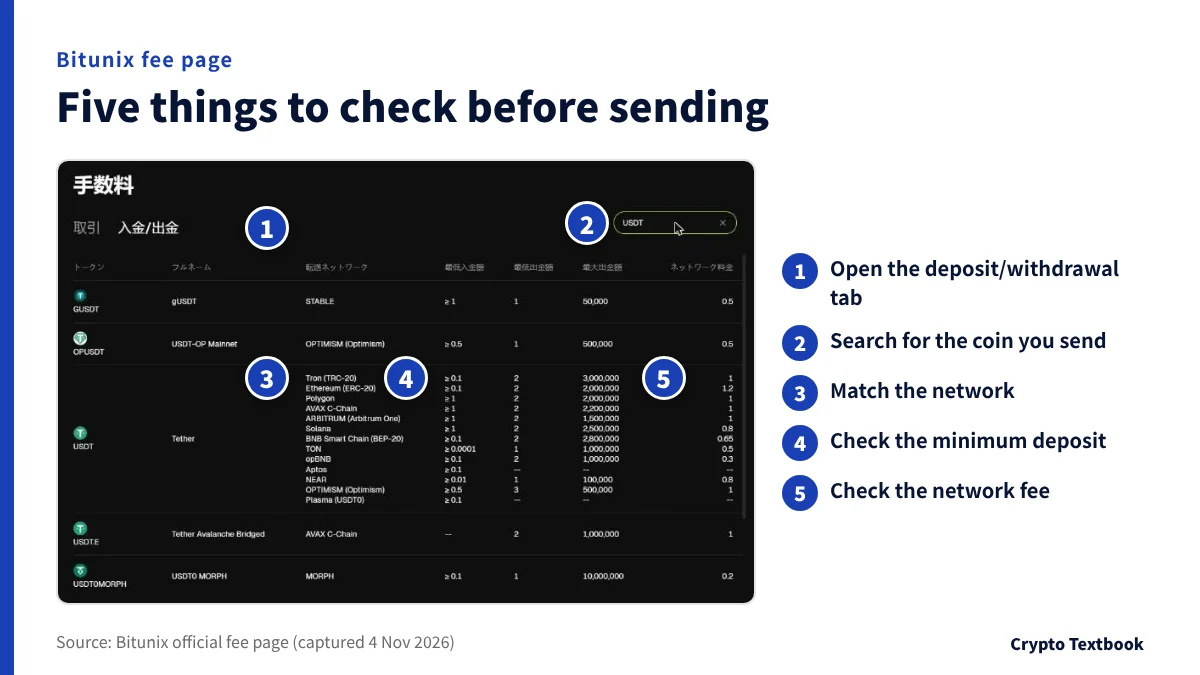
Because Japanese exchanges do not sell ENA, you send crypto bought in Japan to an overseas exchange. You then swap it to USDT and use the USDT to buy ENA.
- Buy the coin you will send with yen at a Japanese exchange
- Choose the same coin and network on the overseas deposit screen
- Copy the deposit address and paste it into the Japanese exchange's send screen
- Send a small amount first, then the rest after it arrives
The deposit and withdrawal tab of the Bitunix fee page shows the network, minimum deposit and network fee for each coin. Compare these three with the sending screen before you send.
| Common issue | How to avoid it |
|---|---|
| Wrong network | Choose the same network name at sender and receiver |
| Wrong address | After pasting, compare the first and last few characters |
| Below the minimum deposit | Check the minimum on the deposit screen; amounts below it may not be credited |
| Slow arrival | Look up the TxID (transaction ID) on a block explorer |
Japanese exchanges ask for details about the receiving exchange and the recipient when you send overseas. Transfers to unsupported destinations may not be possible.
The travel rule and checking destinations when sending from Japan to overseas exchanges →
Selling ENA and getting back to Japanese yen
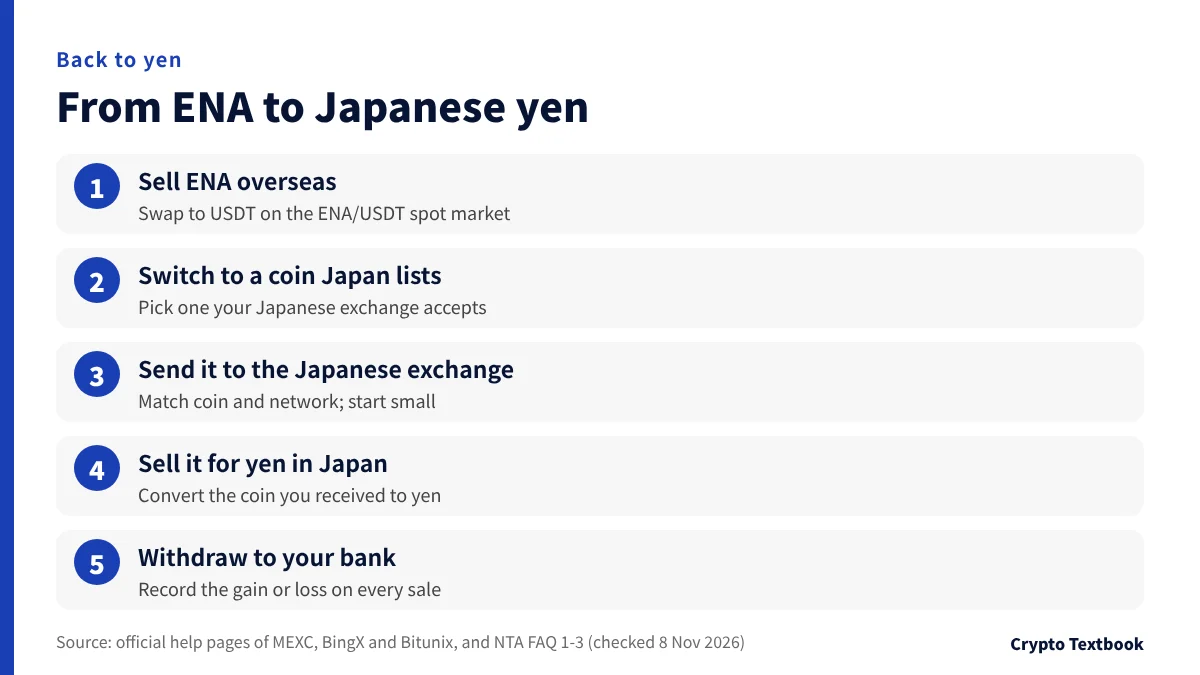
To get back to yen, reverse the buying steps. Sell ENA for USDT overseas, swap to a coin your Japanese exchange accepts, and send it.
- 01Sell ENA on the ENA/USDT spot market
The proceeds land in your spot account as USDT.
- 02Switch to a coin listed in Japan
Pick one your Japanese exchange lists and can receive on the same network.
- 03Send it to the Japanese exchange and sell for yen
Sell after it arrives. Test with a small amount first.
- 04Withdraw yen to your bank account
Check the withdrawal fee and timing in the Japanese exchange's guide.
A gain or loss arises both when you swap ENA to USDT and when you swap USDT to another coin. Record the date, quantity and yen value of every sale.
| Step | Cost |
|---|---|
| Sell ENA for USDT | Spot trading fee (taker: MEXC 0.05%, BingX 0.10%, Bitunix 0.10%) |
| Swap USDT to another coin | Spot trading fee again |
| Send to the Japanese exchange | Overseas withdrawal fee (fixed per coin and network) |
| Sell for yen and withdraw in Japan | Japanese exchange trading fee and bank withdrawal fee |
Bitunix deposits and withdrawals: fees, networks and limits →
ENA and tax in Japan: swaps with USDT count too
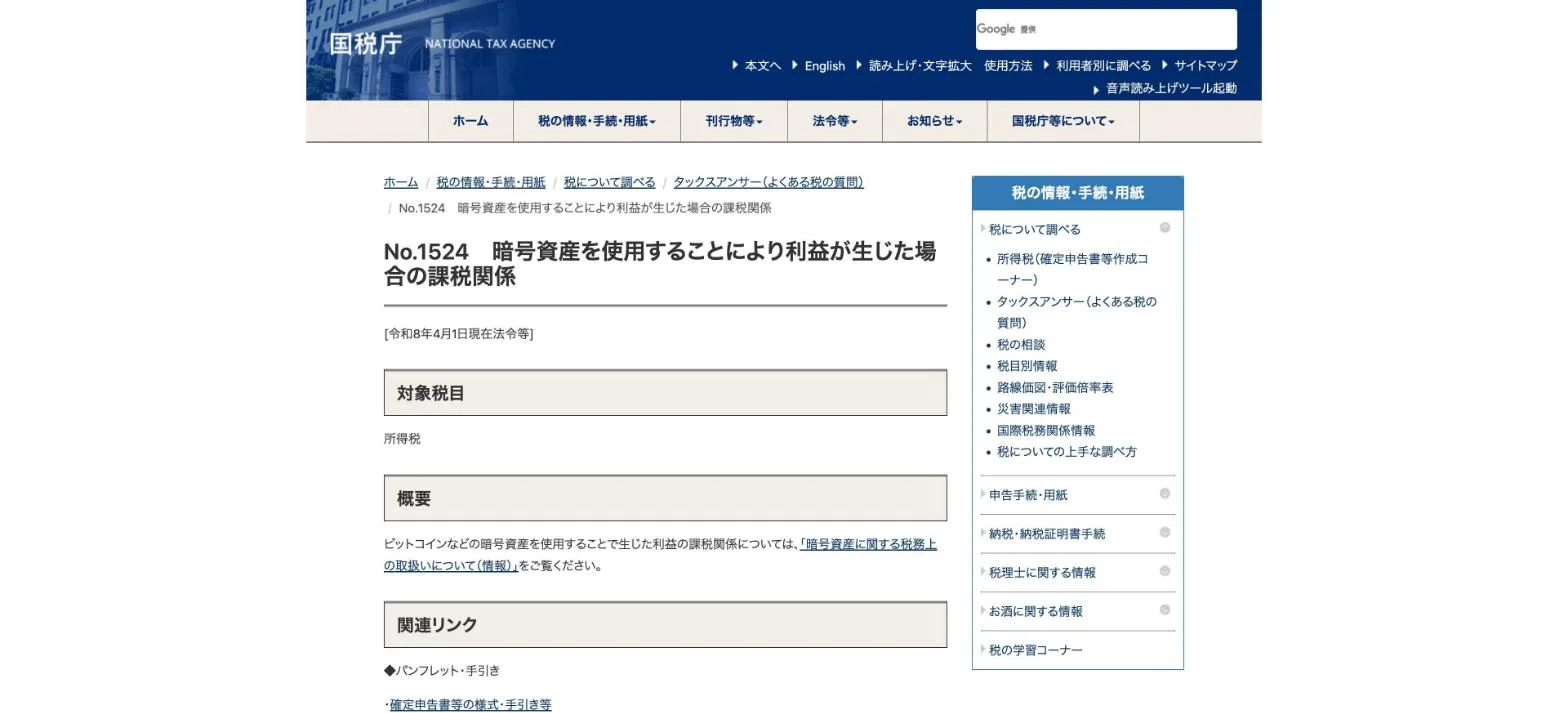
Profits from trading ENA on an overseas exchange are subject to Japanese income tax. The NTA FAQ treats crypto trading profit as miscellaneous income in principle.
| Situation | NTA FAQ treatment |
|---|---|
| Buying ENA with USDT | A swap between crypto-assets; calculate the gain or loss on the USDT given up (FAQ 1-3) |
| Selling ENA for USDT | Calculate the gain or loss on the ENA given up |
| Income category | Miscellaneous income in principle; above 3 million yen of revenue, record-keeping affects the category (FAQ 2-2) |
| Selling for yen in Japan | Calculate the gain or loss on the coin you sent (FAQ 1-1) |
※ Use either the total average method or the moving average method; if an individual does not choose, the total average method applies (note to FAQ 1-3).
NTA Tax Answer No.1524 also points readers to the NTA's information page on crypto-asset taxation. Download your overseas exchange history yourself at least once a year.
- Date and time of each trade and the coins involved
- Quantity and the yen value at the time
- Trading fees and withdrawal fees paid
- Records of transfers between Japanese and overseas exchanges (TxID)
Crypto tax basics in Japan: miscellaneous income and filing →
Risks to know before buying: unlocks, fake tokens and rules
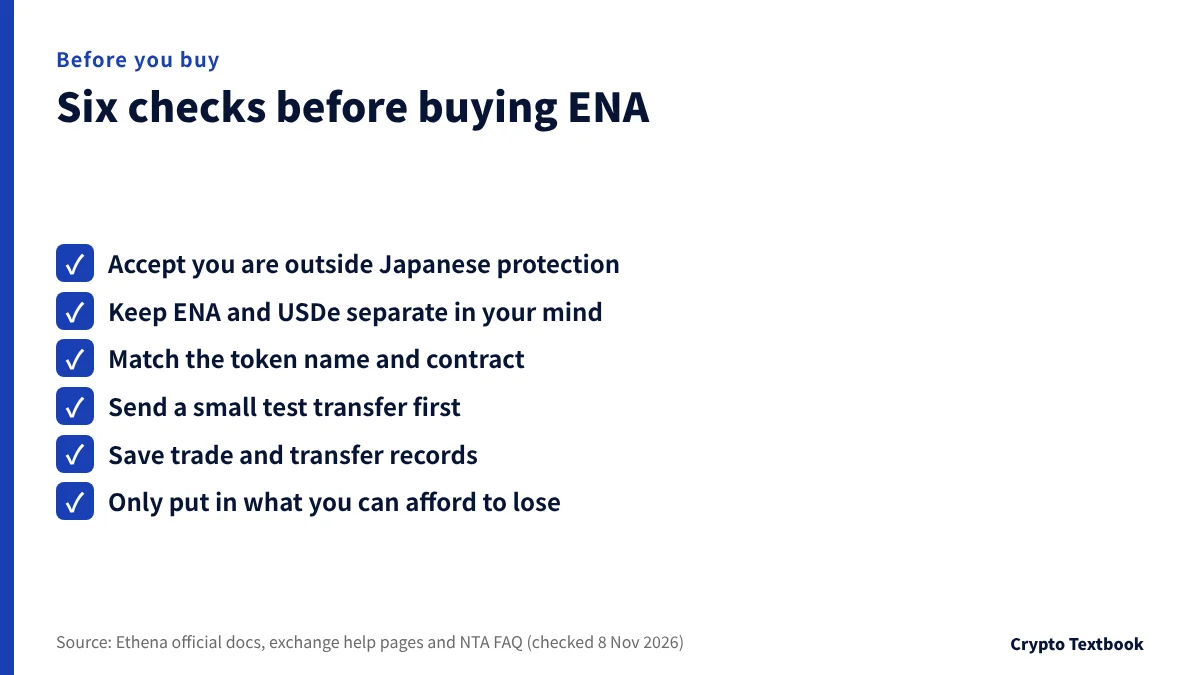
Start by accepting the price swings and the fact that you are buying outside Japanese rules. Then use official sources to check supply growth, fakes and delisting risk.
| Risk | How to check |
|---|---|
| Price swings | Prices move sharply and can fall below what you paid. Only use money you can afford to lose |
| Outside Japanese protection and JVCEA review | If an overseas exchange fails, Japanese rules such as segregation and trusts do not protect you |
| Supply growth from unlocks | The official chart shows unlocks continuing in stages until Q2 2028 |
| Risks tied to how USDe works | Read the seven USDe risks in Ethena's Risks documentation |
| Fake sites and fake tokens | Use only ethena.fi and the official X account listed in the docs, and match the contract |
| Delisting and regional restrictions | Read exchange announcements and the restricted regions in their terms regularly |
The ENA contract address on Ethereum is 0x57e114B691Db790C35207b2e685D4A43181e6061. We confirmed the same value in Ethena's documentation and the MEXC official API.
According to the documentation, ENA on most L2s is 0x58538e6A46E07434d7E7375Bc268D3cb839C0133. Solana, ZKSync and Zircuit use different addresses. When withdrawing, match the address for the network you chose against the official table.
Our view: what decides whether to buy ENA
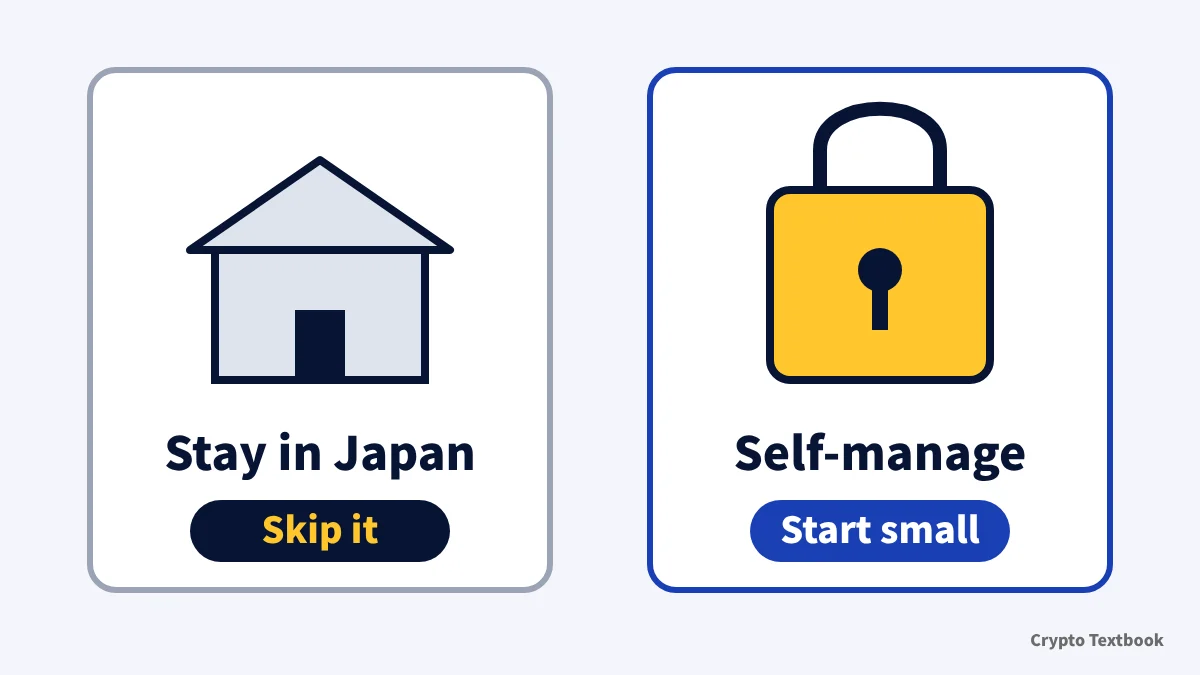
If you want to stay within registered Japanese exchanges and yen, skipping ENA is the safer choice. If you can manage an overseas account, transfers and tax records yourself, start with a small test transfer.
- To keep fees down, compare MEXC, where ENA/USDT has a 0% maker fee
- To buy with USDC or USDe as well as USDT, check the four pairs listed at MEXC
- On any exchange, test one deposit and one withdrawal with a small amount first
This is a summary of facts checked against primary sources on 8 November 2026, not a recommendation to buy ENA. Our advertising relationships are described on the advertising and risk disclosure page.
Frequently asked questions
Q. Where can I buy ENA?
A. As of 8 November 2026, official APIs show ENA spot trading at MEXC (four pairs including ENA/USDT), BingX and Bitunix (ENA/USDT). You buy it with crypto such as USDT, not with yen.
Q. Can I buy ENA on a Japanese exchange?
A. It is not listed at the seven registered Japanese exchanges we checked as of 8 November 2026, nor on the JVCEA list of 113 assets (updated 2 November). If a Japanese exchange starts handling it, the JVCEA new listing notices will show it.
Q. What is the difference between ENA and USDe?
A. ENA is used to vote on how Ethena is run and its price moves freely. USDe is a dollar-denominated synthetic dollar issued by Ethena and designed to stay near $1. Buying ENA does not give you USDe.
Q. Can USDe always be exchanged for $1?
A. There is no guarantee. Ethena's documentation says USDe is not the same as a fiat-backed stablecoin. Only whitelisted users who pass identity checks can mint and redeem; people who buy on an exchange trade at the market price.
Q. Can I buy ENA with a credit card?
A. BingX's official page describes buying USDT with Visa or Mastercard and swapping it to ENA on the ENA/USDT spot market. Check which payment methods work from Japan on the app's purchase screen.
Q. What is the ENA contract address?
A. ENA on Ethereum is 0x57e114B691Db790C35207b2e685D4A43181e6061. We confirmed the same value in Ethena's documentation and the MEXC official API (8 November 2026). Other chains may use different addresses.
Q. How do I convert ENA to Japanese yen?
A. Swap ENA to USDT overseas, swap to a coin your Japanese exchange lists, send it, and sell it for yen in Japan. Check which coins and networks the Japanese exchange accepts before sending.
Q. Is profit on ENA taxed in Japan?
A. Yes. The NTA classifies crypto trading profit as miscellaneous income in principle. Swapping USDT for ENA is also a taxable event (FAQ 1-3).
Sources
- Ethena official documentation | ENA (governance token, sENA, governance) (checked 8 November 2026) →
- Ethena official documentation | Tokenomics (allocation and vesting chart, checked 8 November 2026) →
- Ethena official documentation | How to Stake ENA (sENA and the 7-day cooldown, checked 8 November 2026) →
- Ethena official documentation | Ethena Overview, How USDe Works, Backing Assets Overview (checked 8 November 2026) →
- Ethena official documentation | Risks (funding, custodial, exchange failure and four more, checked 8 November 2026) →
- Ethena official documentation | Peg Arbitrage Mechanism and Reserve Fund (checked 8 November 2026) →
- Ethena official documentation | Key Addresses (ENA and USDe contracts; ENA total supply checked via a public Ethereum RPC on 8 November 2026) →
- Ethena | Terms of Service (operator Ethena (BVI) Limited, checked 8 November 2026) →
- MEXC official API | defaultSymbols and exchangeInfo (ENAUSDT and three more pairs, contract address, retrieved 8 November 2026) →
- BingX official API | Spot symbols (ENA-USDT, retrieved 8 November 2026) →
- Bitunix official API | Spot pair list (enausdt, retrieved 8 November 2026) →
- BingX | How to buy Ethena (ENA) (official page, checked 8 November 2026) →
- BingX | KYC Benefits and Advantages at Different Levels (help centre, published 7 June 2024, checked 7 November 2026) →
- BingX Academy | How to Deposit Crypto with BingX (deposit steps, checked 3 November 2026) →
- Bitunix | Fees (trading, and minimums and fees by network for deposits and withdrawals, checked 4 November 2026) →
- Bitunix | How to Deposit Crypto on Bitunix (help centre, checked 4 November 2026) →
- MEXC | How to sign up for a MEXC account (official Learn, checked 4 November 2026) →
- Financial Services Agency of Japan | Registered crypto-asset exchange service providers (as of 30 September 2026, 27 providers, checked 7 November 2026) →
- Japan Virtual and Crypto assets Exchange Association (JVCEA) | Crypto-assets handled by members (updated 2 November 2026, 113 assets, checked 8 November 2026) →
- Public APIs of registered Japanese exchanges (bitbank, GMO Coin, Coincheck, BitTrade, OKJ, bitFlyer) and the SBI VC Trade listing page (retrieved 8 November 2026) →
- e-Gov Law Search | Payment Services Act (Articles 63-2 and 63-11, checked 7 November 2026) →
- National Tax Agency of Japan | Tax treatment of crypto-assets (FAQ) 1-1, 1-3 and 2-2 (26 December 2025, checked 7 November 2026) →
- National Tax Agency of Japan | Tax Answer No.1524 Taxation of profits from using crypto-assets (checked 8 November 2026) →
FX Textbook is an independent information site, not an exchange or a provider of personal investment advice. Crypto-asset trading involves risk: price volatility, liquidation of leveraged positions, transfer mistakes and the operational risk of exchanges and service providers can cause you to lose some or all of your invested capital. No result is guaranteed.
NEXT STEP
Check MEXC, BingX and Bitunix fees and transfers on our exchange pages.
We list the official information we have confirmed. Compare fees and operator details before you sign up.
Exchanges related to this column
Fees, leverage, funding options and current offers are on each exchange page.