
You want to buy the crypto token VIRTUAL, but it does not show up in any Japanese exchange app. Its full name is Virtuals Protocol, and searching for the plain word virtual tends to bury it under unrelated results.
As of 8 November 2026, VIRTUAL appears neither on the Financial Services Agency register nor on the JVCEA members' list. Among the exchanges we cover, the official APIs of MEXC, BingX and Bitunix confirm VIRTUAL spot trading.
This article walks through sending crypto from Japan, buying VIRTUAL, converting back to yen, the tax rules and how to spot fake tokens.
Answer: buy Virtuals Protocol (VIRTUAL) on the spot markets of three overseas exchanges
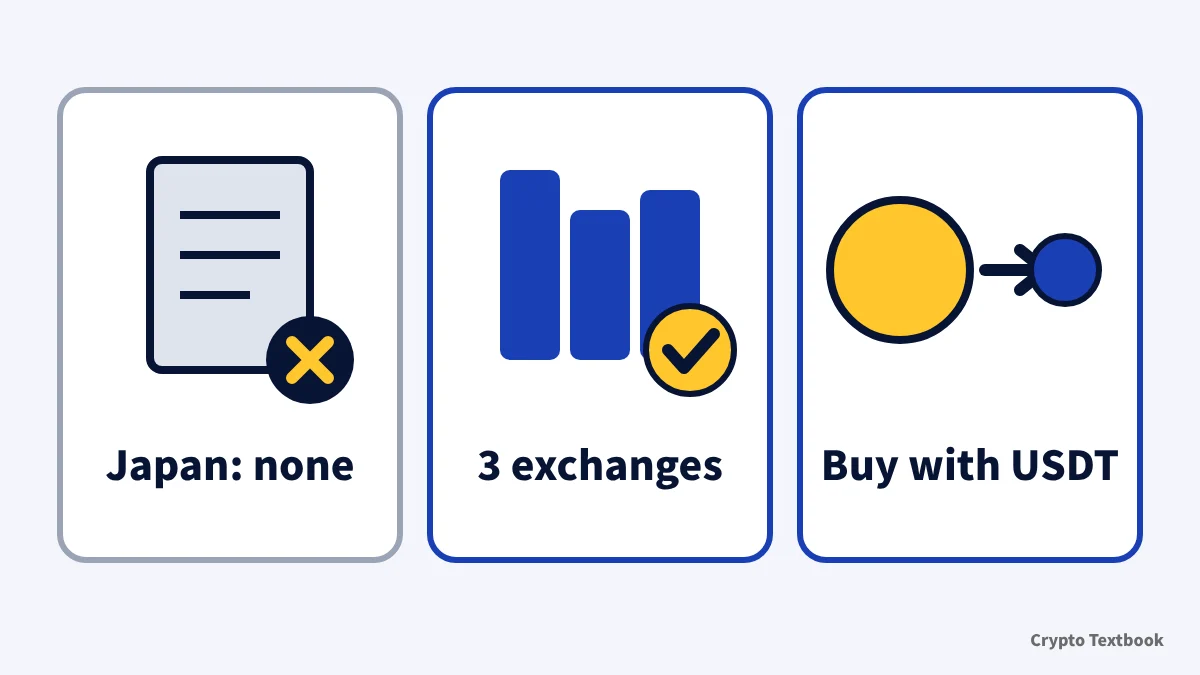
- VIRTUAL is the base token of Virtuals Protocol. Search by the ticker, not the everyday word virtual
- VIRTUAL is not on the FSA register (27 providers) or the JVCEA members' list (113 assets)
- MEXC offers VIRTUAL/USDT and VIRTUAL/USDC; BingX and Bitunix offer VIRTUAL/USDT (checked 8 November)
- You cannot buy it directly with yen. Send crypto bought in Japan, swap it to USDT, then buy
- None of the overseas exchanges listed here is registered with Japan's FSA. Japanese investor protection and JVCEA review do not apply
- Many look-alike tokens exist, including AI agent tokens. Confirm the real one by its contract address
We do not give price outlooks or timing advice. VIRTUAL moves sharply and can fall below what you paid. Only use money you can afford to lose.
What is Virtuals Protocol (VIRTUAL)? The base token for AI agents
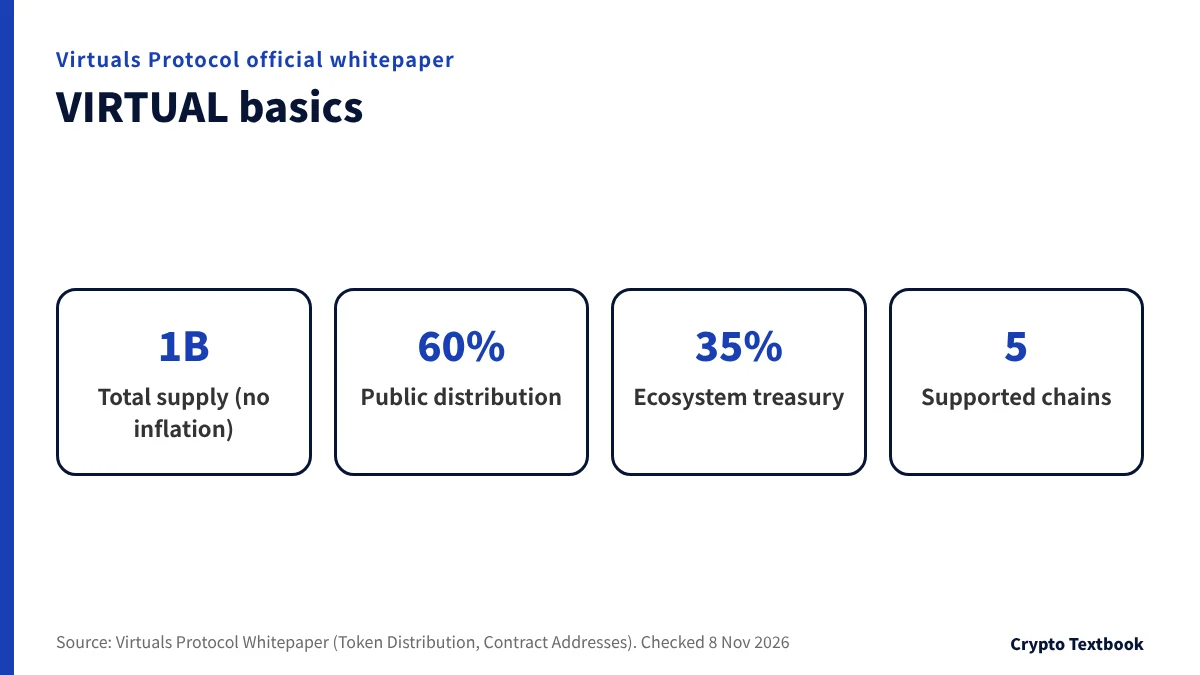
Virtuals Protocol builds infrastructure for AI agents. Its official whitepaper describes a system in which autonomous agents have an identity, capital, jobs and markets.
VIRTUAL is the base token used across Virtuals Protocol. The official documents say it is used to trade agent tokens and to pay between agents.
| Category | Amount (VIRTUAL) | Share |
|---|---|---|
| Public distribution | 600,000,000 | 60% |
| Ecosystem treasury (DAO-controlled) | 350,000,000 | 35% |
| Liquidity pool | 50,000,000 | 5% |
※ Total supply is 1 billion VIRTUAL with no future inflation. The official documents state that all tokens are fully unlocked and vested.
- The treasury sits in a DAO-controlled multisignature wallet
- Treasury emissions cannot exceed 10% a year for the next three years
- Using the treasury requires governance approval
VIRTUAL exists on five chains: Base, Ethereum, Solana, Robinhood Chain and Arc. Each chain has its own contract address, which a later section explains how to check.
The official website lists five pillars: identity and banking, physical labor, commerce, capital formation, and law and governance. The law and governance pillar was marked Coming Soon. This article does not cover performance or revenue claims.
VIRTUAL and AI agent tokens are different tokens
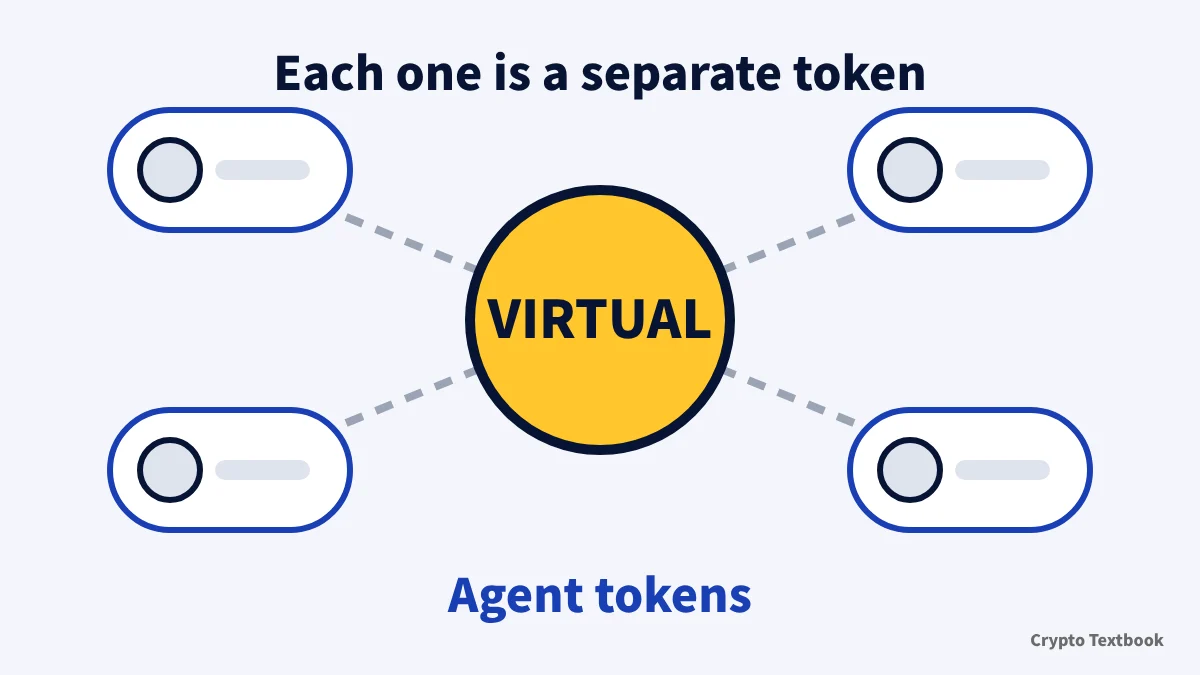
Virtuals Protocol has a platform for launching AI agent tokens. Each agent token trades paired with VIRTUAL. Even so, an agent token is a separate asset from VIRTUAL.
| Stage | What the official documents say |
|---|---|
| At launch | Trading starts on a bonding curve (automatic pricing) paired with VIRTUAL |
| When liquidity reaches 42,000 VIRTUAL | The token moves automatically to a Uniswap V2 pool; LP tokens are locked for 10 years |
| Trading fee | 1%: 70% to the agent creator, 30% to the Virtuals Treasury |
| Buying an agent token | Users swap USDC or other currencies into VIRTUAL first |
Agent tokens are also listed on overseas exchanges. In Bitunix's public API, AIXBT, whose full name is aixbt by Virtuals, was trading as a pair separate from VIRTUAL.
- Bitunix lists Luna by Virtual (LUNAVIRTUAL) and GAME by Virtuals (GAME) as not trading
- BingX also shows GAME-USDT as not trading (API, 8 November)
- A token with Virtual in its name is not necessarily VIRTUAL itself
veVIRTUAL is a voting balance you receive by locking VIRTUAL for up to two years. It is used for airdrop eligibility and governance votes, and it decays to zero by the unlock date.
Can you buy VIRTUAL in Japan? What registered exchanges list
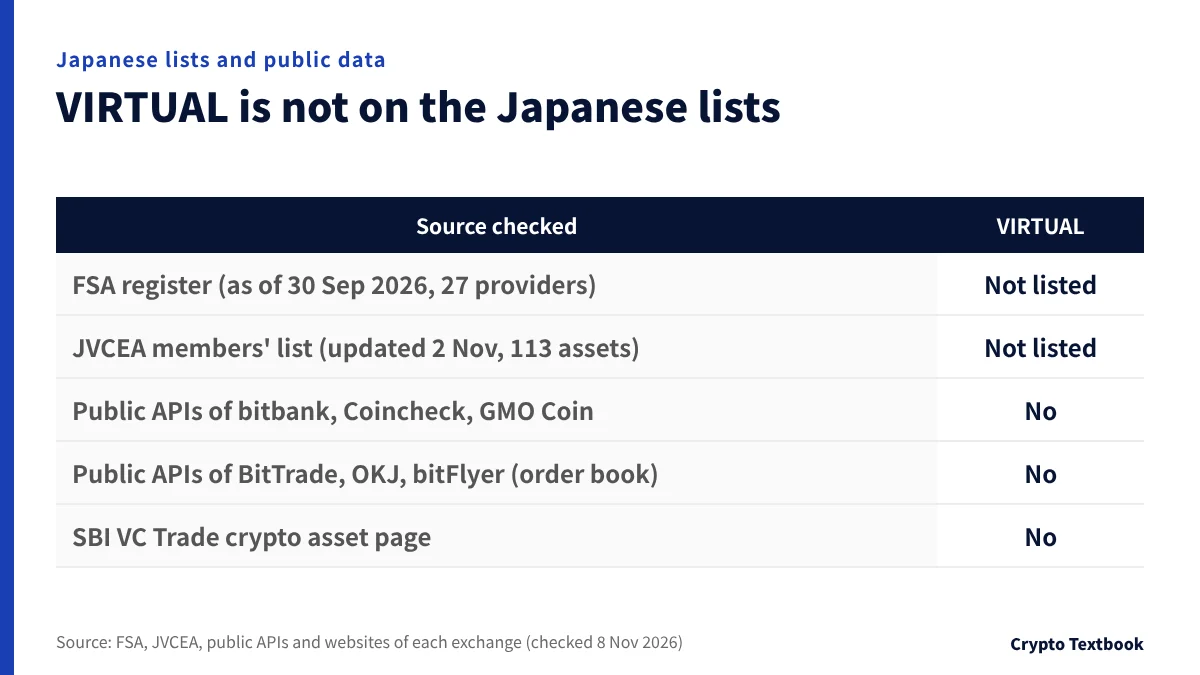
The FSA publishes a register showing which crypto assets each registered provider handles. The list of 27 providers as of 30 September 2026 does not include VIRTUAL.
We also checked whether any provider has added it since then. On 8 November we opened the JVCEA members' list and the public data of seven Japanese exchanges.
| Source checked | VIRTUAL |
|---|---|
| FSA register (as of 30 September 2026, 27 providers) | Not listed |
| JVCEA members' list (updated 2 November, 113 assets) | Not listed |
| Public APIs of bitbank, Coincheck and GMO Coin | No |
| Public APIs of BitTrade, OKJ and bitFlyer (order book) | No |
| SBI VC Trade crypto asset page | No |
※ The JVCEA list covers members such as Binance Japan, Rakuten Wallet and Zaif. Both lists are dated, so check the latest update before you buy.
Not being listed in Japan has three consequences.
- You buy it at an overseas exchange that is not registered with the FSA
- Japanese protections such as segregation and trust of customer assets under the Payment Services Act do not apply
- It has not passed the JVCEA review that Japanese providers go through before listing a new coin
The penalties in the Payment Services Act target those who run a crypto exchange business without registration. We did not find a provision that penalises users. You still lose the protection of Japanese rules if something goes wrong.
Can Japanese residents use BingX? Registration, warnings and protection explained →
Where to buy VIRTUAL: MEXC, BingX and Bitunix compared
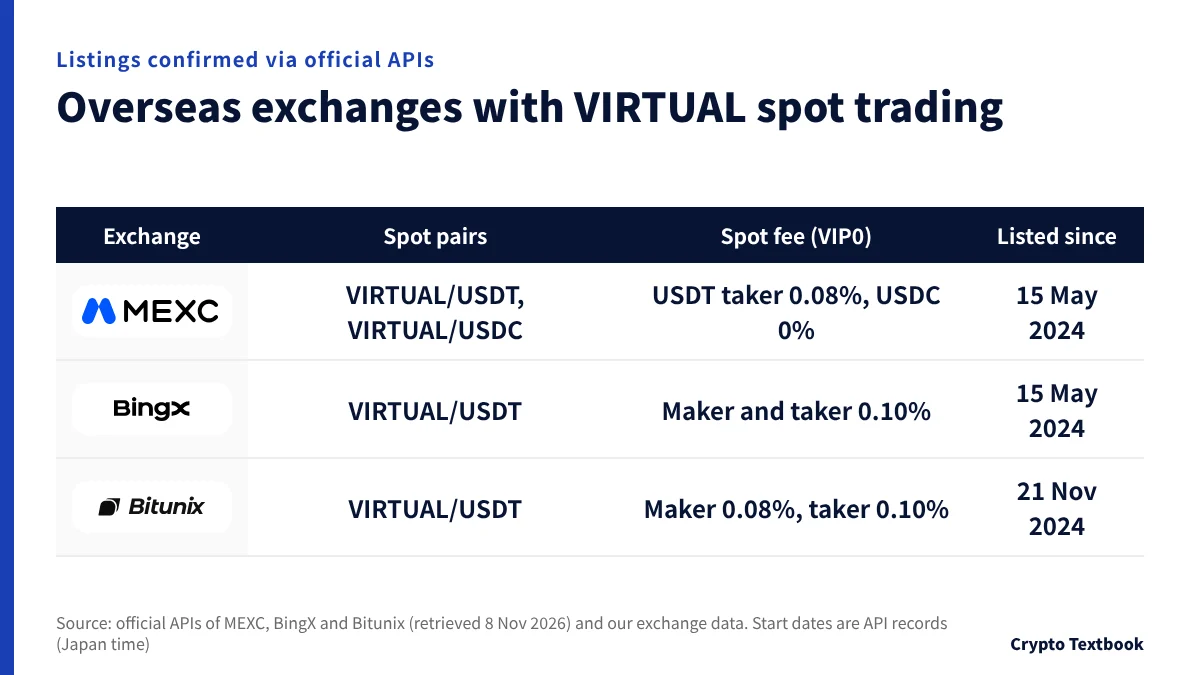
Among the overseas exchanges we cover, three show VIRTUAL spot trading in their official APIs. BYDFi has no public API and we could not load its pages, so it is not covered here.
| Exchange | VIRTUAL spot pairs | Spot fee (VIP0) | Listed since (API) |
|---|---|---|---|
| MEXC | VIRTUAL/USDT, VIRTUAL/USDC | USDT pair taker 0.08%; USDC pair 0% | 15 May 2024 |
| BingX | VIRTUAL/USDT | Maker and taker 0.10% | 15 May 2024 |
| Bitunix | VIRTUAL/USDT | Maker 0.08%, taker 0.10% | 21 November 2024 |
※ MEXC fees are API values; maker is 0% on both pairs. The general rate on its fee page is a spot taker fee of 0 to 0.05% (checked 3 September), so go by the order screen. MEXC added the USDC pair on 22 January 2025. The Bitunix date is the pair creation date recorded in its API.
The fee is a percentage of each trade. On a 100,000 yen purchase, 0.10% costs 100 yen and 0.08% costs 80 yen. Resting limit orders pay the maker rate; orders that fill at once pay the taker rate.
| Exchange | KYC levels | Withdrawal limit |
|---|---|---|
| MEXC | Primary KYC, Advanced KYC | 80 BTC and 200 BTC per day (checked 26 September) |
| BingX | Unverified, Advanced KYC | 20,000 and 5,000,000 USDT per 24h (unverified: deposits and trading unavailable per the official table, checked 8 Nov 2026) |
| Bitunix | KYC1, KYC2 | 500,000 and 5,000,000 USDT per 24h (checked 4 November) |
- MEXC: USDT and USDC pairs; the USDC pair shows a 0% fee in the API
- BingX: one VIRTUAL/USDT pair; minimum order 1 USDT (API)
- Bitunix: one VIRTUAL/USDT pair; no deposit fee, credited in about 3 to 30 minutes
Open the MEXC sign-up page (our referral link) →
How to buy VIRTUAL: four steps from sign-up to a spot order
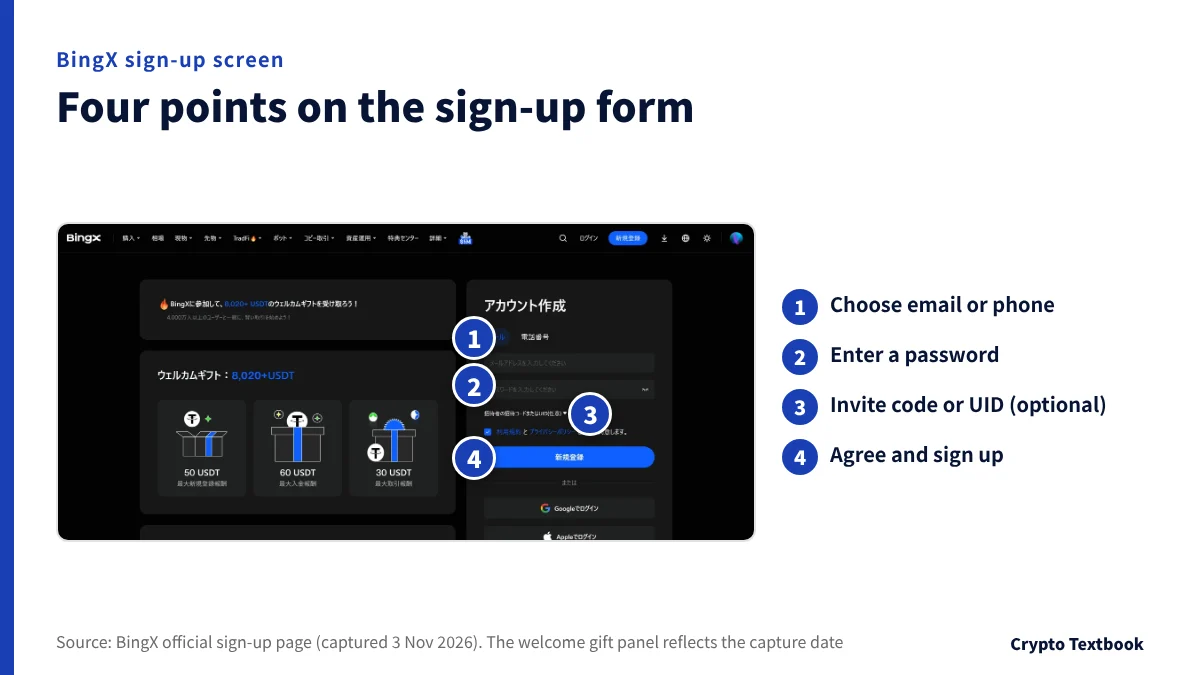
All three exchanges follow the same four steps. The screen names below come from the BingX official page on buying Virtuals Protocol and from each exchange's help centre.
- 01Sign up with an email address or phone number
The BingX sign-up form has an optional field for an invite code or UID. Tick the box agreeing to the terms of use and privacy policy, then sign up.
- 02Complete identity verification (KYC)
BingX's official table lists deposits and trading as unavailable for unverified accounts (checked 8 November 2026); check your account screen for the current treatment. Choose your country of residence exactly as it appears on your ID.
- 03Deposit USDT or another crypto
Choose the coin and network on the deposit screen and send to the address shown. On BingX, transfer the funds to your spot account after the deposit arrives.
- 04Place a VIRTUAL/USDT spot order
Select VIRTUAL/USDT on the spot screen and enter an amount. A limit order lets you set the price yourself.
- The BingX official page recommends setting up Google 2FA
- The same page also recommends a passkey and an anti-phishing code
- The welcome gift panel on the left reflects the capture date; check the rewards page for terms
The BingX official page also describes buying USDT with Visa, Mastercard or P2P and swapping it to VIRTUAL. Check which payment methods work from Japan on the app's purchase screen.
You can also swap on a decentralised exchange (DEX) on Base. That route leaves wallet security and gas fees entirely to you, so this article sticks to buying on exchanges.
BingX invite code and sign-up: the form and identity checks →
Sending crypto from a Japanese exchange
VIRTUAL is not on the Japanese lists, so you send crypto bought at a Japanese exchange to an overseas exchange. Once it arrives, swap it to USDT and use the USDT to buy VIRTUAL.
- Buy the coin you will send with yen at a Japanese exchange
- Choose the same coin and network on the overseas deposit screen
- Copy the deposit address and paste it into the Japanese exchange's send screen
- Send a small amount first, then the rest after it arrives
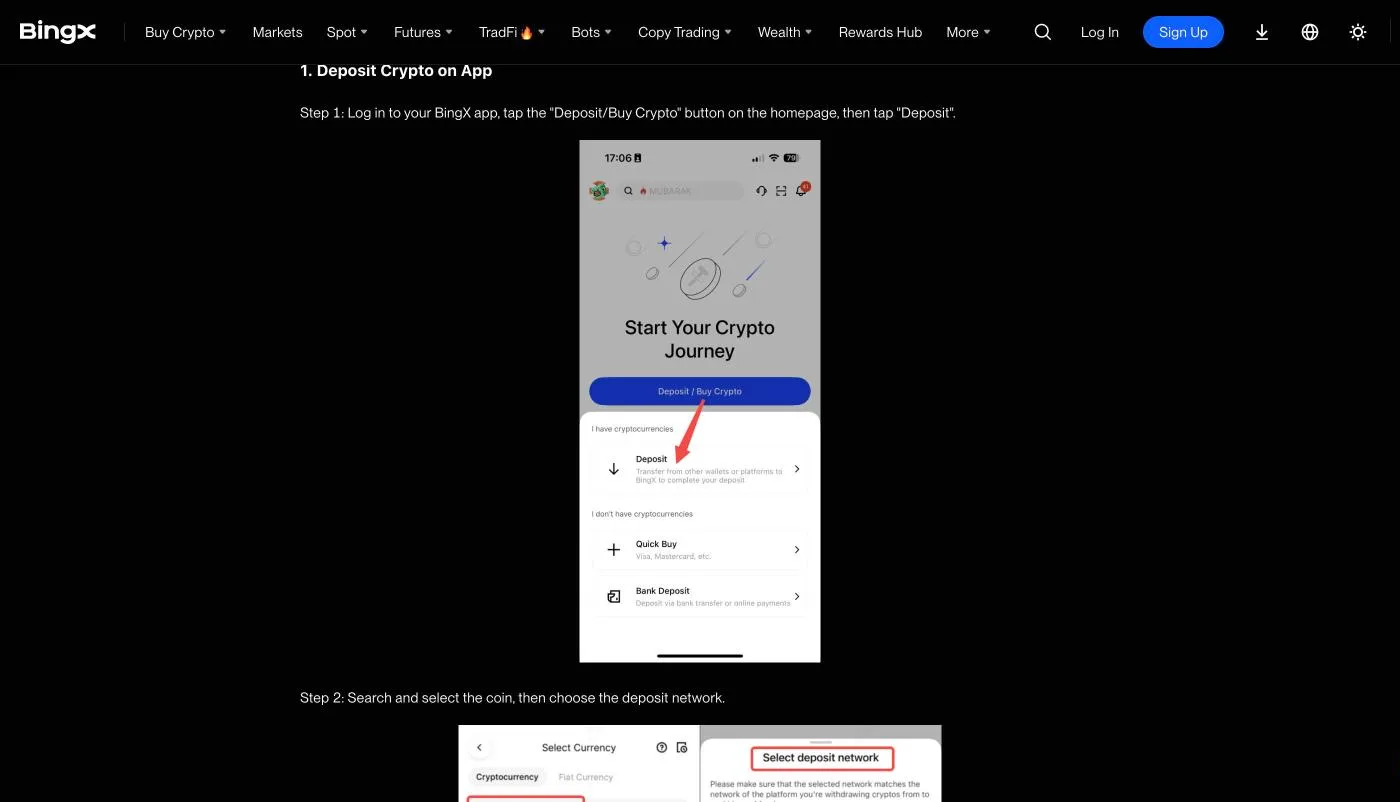
In the BingX app, tap Deposit / Buy Crypto on the home screen and choose Deposit. The next screens ask you to search for the coin and pick the same deposit network as the sender.
| What goes wrong | How to avoid it |
|---|---|
| Wrong network | Choose the same network name at the sender and the receiver |
| Wrong address pasted | After pasting, compare the first and last few characters |
| Below the minimum deposit | Check the minimum on the deposit screen; smaller amounts may not be credited |
| Slow arrival | Look up the TxID (transaction ID) on a block explorer |
Japanese exchanges ask for the receiving exchange and recipient details when you send abroad. Some destinations are not supported.
The travel rule and destination checks when sending from Japan →
Avoiding fake tokens: how to check the contract address
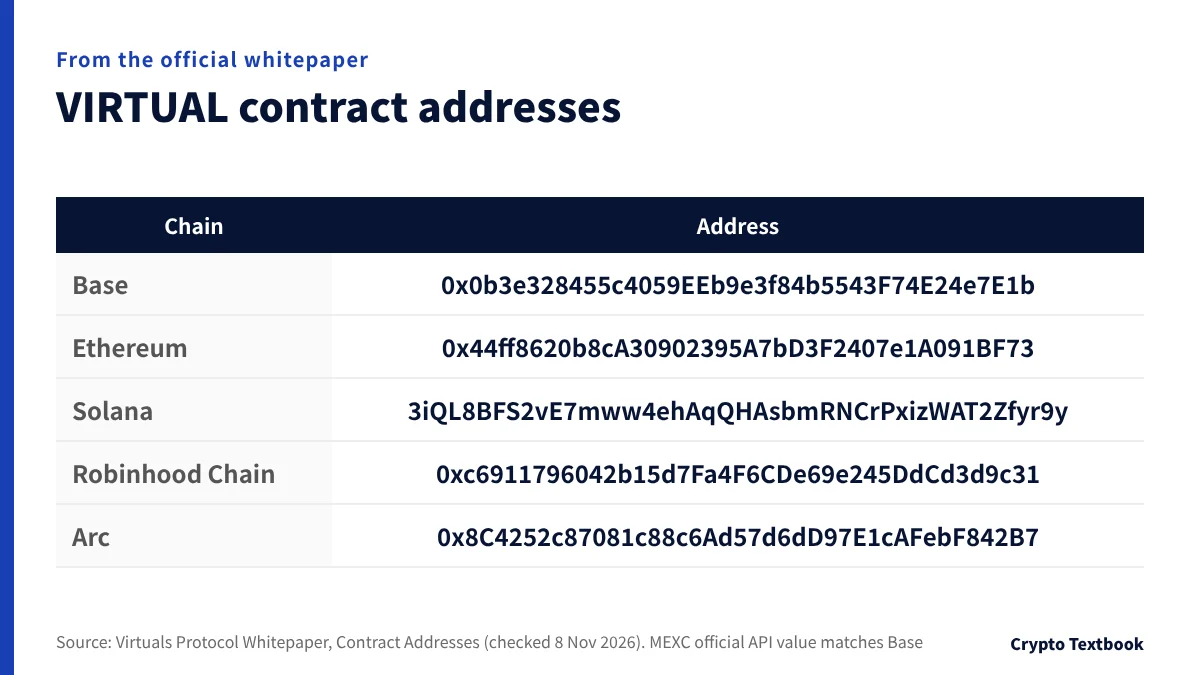
VIRTUAL exists on five chains, each with its own address. The official whitepaper asks users to interact only with verified addresses.
| Chain | Address |
|---|---|
| Base | 0x0b3e328455c4059EEb9e3f84b5543F74E24e7E1b |
| Ethereum | 0x44ff8620b8cA30902395A7bD3F2407e1A091BF73 |
| Solana | 3iQL8BFS2vE7mww4ehAqQHAsbmRNCrPxizWAT2Zfyr9y |
| Robinhood Chain | 0xc6911796042b15d7Fa4F6CDe69e245DdCd3d9c31 |
| Arc | 0x8C4252c87081c88c6Ad57d6dD97E1cAFebF842B7 |
※ The address MEXC's official API returns for VIRTUALUSDT and VIRTUALUSDC matched the Base row (retrieved 8 November).
A contract address is for checking that a token is genuine. The address you send funds to is the deposit address shown on the exchange's deposit screen.
| Cause | What the help centre says |
|---|---|
| Sent to a contract address | It is not a deposit address; assets sent to a smart contract cannot be recovered |
| Below the minimum deposit | Minimums vary by coin and network; smaller amounts are neither credited nor refunded |
| Wrong network or memo | Blockchain transfers cannot be reversed and funds may be lost |
The official whitepaper lists the website virtuals.io, the official X account (@virtuals_io) and the support portal support.virtuals.io. Ignore anyone who sends a DM offering to recover or release your funds.
Selling VIRTUAL and converting back to Japanese yen
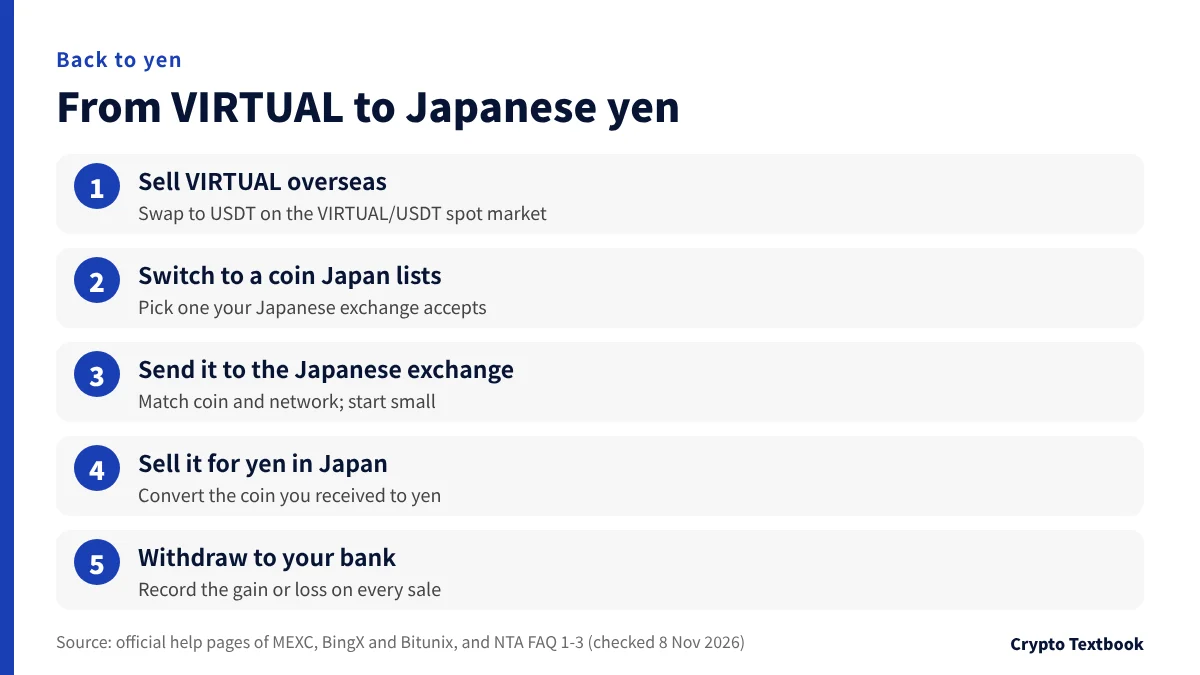
To get back to yen, reverse the buying steps. Sell VIRTUAL for USDT overseas, swap to a coin your Japanese exchange accepts, and send it.
- 01Sell VIRTUAL on the VIRTUAL/USDT spot market
The proceeds arrive in your spot account as USDT.
- 02Switch to a coin Japan lists
Pick one the Japanese exchange accepts on the same network.
- 03Send it to the Japanese exchange and sell for yen
Sell after it arrives. Start with a small amount.
- 04Withdraw yen to your bank
Check the withdrawal fee and timing in the Japanese exchange's guide.
| Step | Cost |
|---|---|
| Sell VIRTUAL for USDT | Spot trading fee (taker: MEXC 0.08%, BingX 0.10%, Bitunix 0.10%) |
| Swap USDT for another coin | Spot trading fee again |
| Send to a Japanese exchange | Overseas withdrawal fee (flat, by coin and network) |
| Sell for yen and withdraw in Japan | Japanese exchange trading fee and bank withdrawal fee |
A gain or loss arises when you swap VIRTUAL to USDT and again when you swap USDT to another coin. Record the date, amount and yen value of every sale.
VIRTUAL and tax: swaps with USDT are taxable too
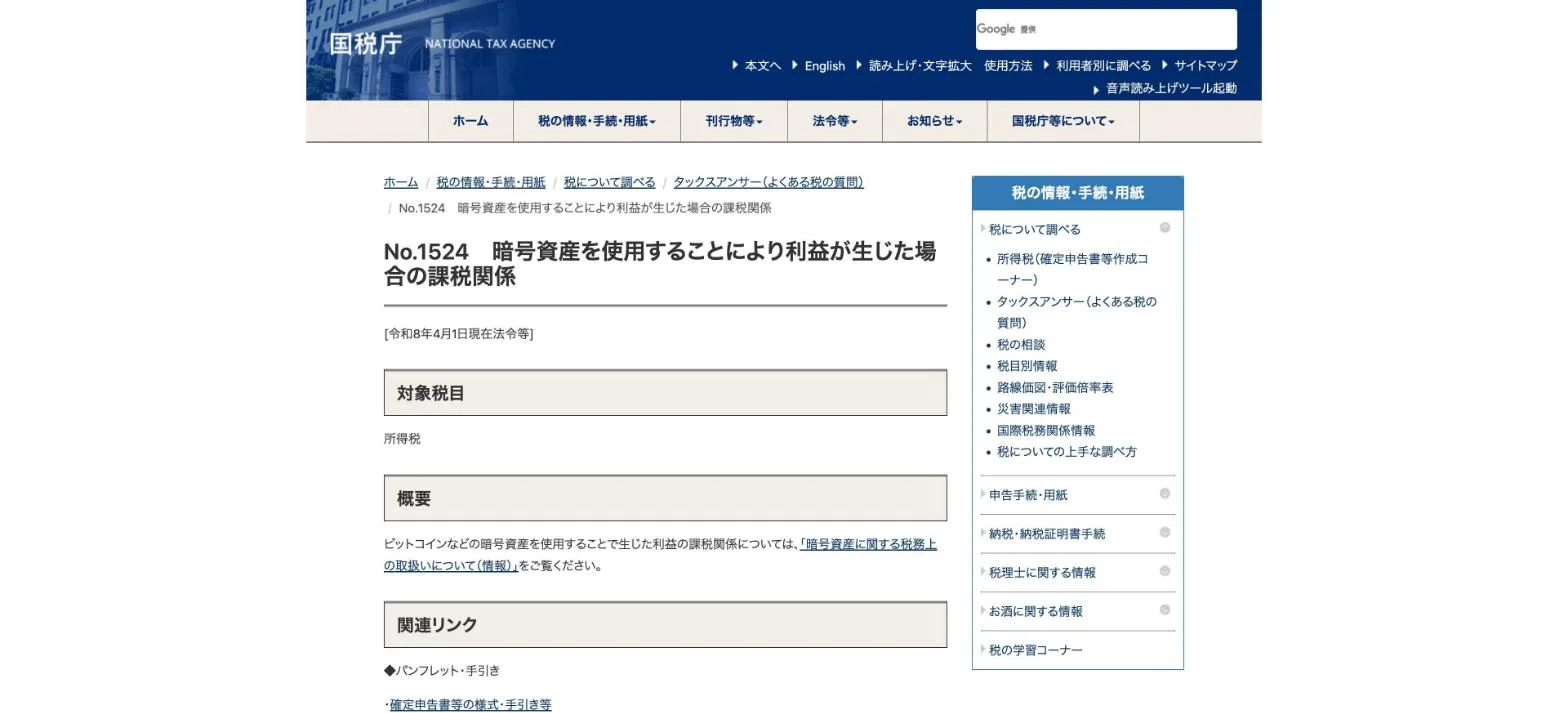
Profit from trading VIRTUAL on an overseas exchange is subject to Japanese income tax. The NTA FAQ classifies crypto trading profit as miscellaneous income in principle.
| Situation | NTA FAQ treatment |
|---|---|
| Buying VIRTUAL with USDT | A crypto-to-crypto swap; calculate the gain or loss on the USDT given up (FAQ 1-3) |
| Selling VIRTUAL for USDT | Calculate the gain or loss on the VIRTUAL given up |
| Income category | Miscellaneous income in principle; above 3 million yen of revenue, the category depends on bookkeeping (FAQ 2-2) |
| Selling for yen in Japan | Calculate the gain or loss on the coin you sent and sold (FAQ 1-1) |
※ Use either the total average method or the moving average method; individuals who do not choose use the total average method (note to FAQ 1-3).
NTA Tax Answer No.1524 links to the crypto calculation sheets you can use. Download your overseas exchange history yourself at least once a year.
- Date and time of each trade and the coins involved
- Amounts and their yen value at the time
- Trading and withdrawal fees paid
- Records of transfers between Japanese and overseas exchanges (TxID)
Crypto tax basics in Japan: miscellaneous income and filing →
Risks before you buy: price swings, look-alikes and issuer details
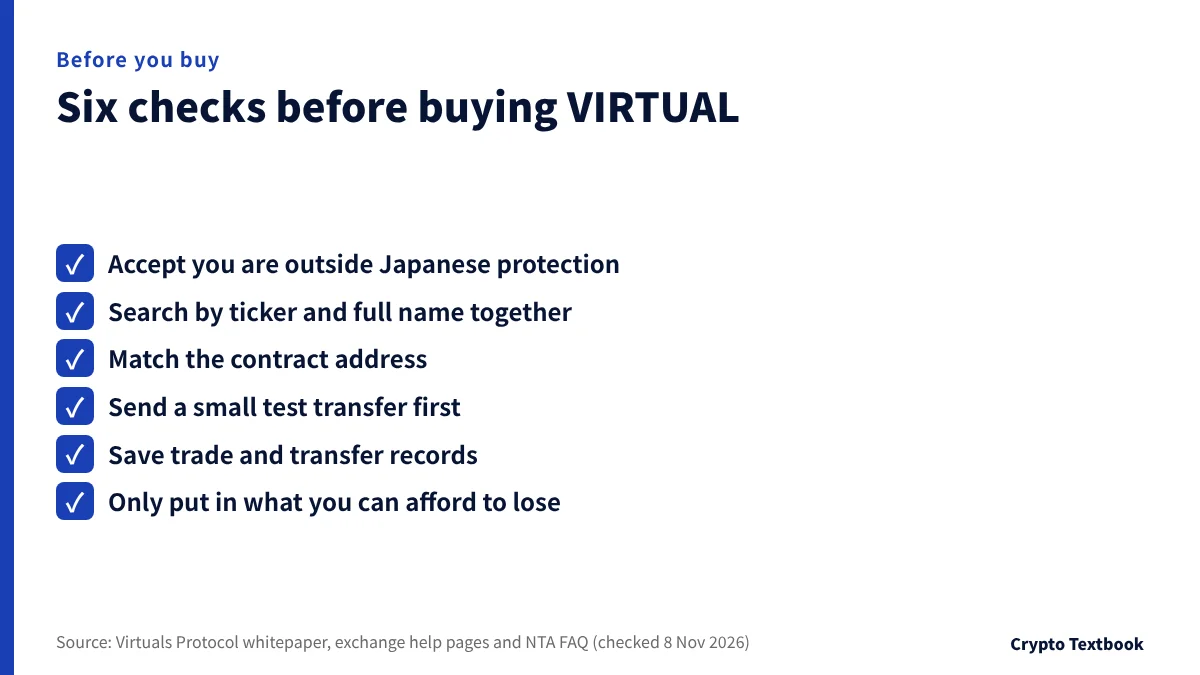
Start from two facts: the price moves sharply, and you are buying outside the Japanese system. Then use official documents to check look-alike tokens and issuer details.
| Risk | How to check |
|---|---|
| Price swings | The price moves sharply and can fall below what you paid; only use money you can afford to lose |
| Outside Japanese protection and JVCEA review | If an overseas exchange fails, segregation and trust rules in Japan do not protect you |
| Look-alike tokens | Do not confuse it with agent tokens; match the token name and contract address |
| Supply increases | The 35% treasury is capped at 10% a year for the next three years; read passed proposals too |
| Delisting and regional restrictions | Read exchange announcements and the restricted regions in the terms regularly |
| Smart contract bugs | Audit reports are public, but an audit does not guarantee safety |
The official whitepaper lists its core contributors and their backgrounds. However, the documents we read do not name a legal entity that issued VIRTUAL.
- The developer agreement names Virtuals Protocol as the service provider and is governed by Singapore law
- Passed proposals include establishing the Virtuals Foundation
- A proposal to stream up to 6% of supply to core contributor Virgen Labs on milestones also passed
- A proposal allocating 1% of supply to a sniper defence fund also passed
The project publishes smart contract audit reports and a Code4rena competitive audit. It states that it had paid over 30,000 dollars in bug bounties as of 5 August 2025.
Our verdict: deciding whether VIRTUAL is for you
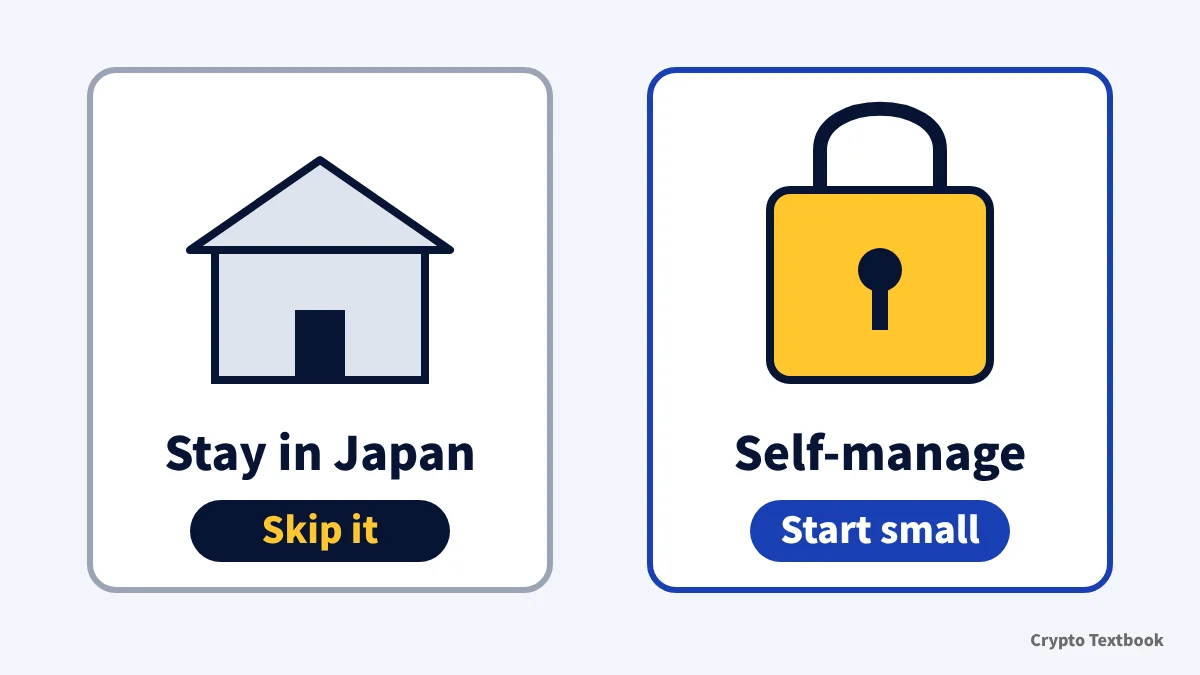
If you want to stay within registered Japanese exchanges and yen, skipping VIRTUAL is the safer choice. If you can manage overseas accounts, transfers and tax records yourself, start with a small test transfer.
- If you want to buy with USDC, look at MEXC, which has both pairs
- If you prefer not to keep funds at one exchange, consider the USDT pair at BingX or Bitunix too
- Whichever exchange you use, test one small deposit and one withdrawal first
A summary of facts checked against primary sources on 8 November 2026. It is not a recommendation to buy VIRTUAL. Our advertising relationships are explained on the advertising and risk disclosure page.
Frequently asked questions
Q. Where can I buy VIRTUAL crypto?
A. On the spot markets of MEXC, BingX and Bitunix. MEXC offers VIRTUAL/USDT and VIRTUAL/USDC; BingX and Bitunix offer VIRTUAL/USDT. We checked the official APIs on 8 November 2026. You cannot buy it with yen; use USDT or another crypto.
Q. Can I buy VIRTUAL on a Japanese exchange?
A. As of 8 November 2026, it is not on the FSA register (as of 30 September 2026) or the JVCEA members' list (updated 2 November). The public data of seven Japanese exchanges did not show it either.
Q. Are VIRTUAL and Virtuals Protocol the same?
A. Virtuals Protocol is the project name and VIRTUAL is the ticker of its token. Search for VIRTUAL on an exchange and confirm the full name shows Virtuals Protocol.
Q. Is VIRTUAL the same as agent tokens such as AIXBT?
A. No. Agent tokens are launched on Virtuals Protocol and trade paired with VIRTUAL. A token with Virtual in its name is not necessarily VIRTUAL itself.
Q. What is the VIRTUAL contract address?
A. According to the official whitepaper, the Base address is 0x0b3e328455c4059EEb9e3f84b5543F74E24e7E1b. Ethereum, Solana and two other chains have separate addresses. The MEXC official API value matched the Base address (checked 8 November).
Q. Can I buy VIRTUAL with a credit card?
A. The BingX official page describes buying USDT with Visa or Mastercard and swapping it to VIRTUAL on the VIRTUAL/USDT spot market. Check which payment methods work from Japan on the app's purchase screen.
Q. How do I convert VIRTUAL to Japanese yen?
A. Swap VIRTUAL to USDT overseas, swap to a coin your Japanese exchange lists, send it, and sell it for yen in Japan. Check which coins and networks the Japanese exchange accepts before sending.
Q. Is profit on VIRTUAL taxed in Japan?
A. Yes. The NTA classifies crypto trading profit as miscellaneous income in principle. Swapping USDT for VIRTUAL is also a taxable event (FAQ 1-3).
Sources
- Virtuals Protocol Whitepaper | $VIRTUAL Token: Base Asset for AI Agents (checked 8 November 2026) →
- Virtuals Protocol Whitepaper | $VIRTUAL Token Distribution and Tokenomics (supply and allocation, checked 8 November 2026) →
- Virtuals Protocol Whitepaper | Virtuals Protocol Contract Addresses (by chain, checked 8 November 2026) →
- Virtuals Protocol Whitepaper | About Virtuals Protocol and What Is Virtuals Protocol? (checked 8 November 2026) →
- Virtuals Protocol Whitepaper | Capital Formation Layer and Virtuals Launch Mechanics (agent tokenization, checked 8 November 2026) →
- Virtuals Protocol Whitepaper | $VIRTUAL Staking and veVIRTUAL, Governance with veVIRTUAL (checked 8 November 2026) →
- Virtuals Protocol Whitepaper | Important Links & Resources (official website, X and support, checked 8 November 2026) →
- Virtuals Protocol Whitepaper | Smart Contract Security Audits and Security Policy (checked 8 November 2026) →
- MEXC official API | defaultSymbols and exchangeInfo (VIRTUALUSDT and VIRTUALUSDC, retrieved 8 November 2026 00:18 JST) →
- BingX official API | Spot symbols (VIRTUAL-USDT, retrieved 8 November 2026) →
- Bitunix official API | Spot pair list (virtualusdt, retrieved 8 November 2026) →
- BingX | How to buy Virtuals Protocol (VIRTUAL) (official page, checked 8 November 2026) →
- BingX | How to deposit (help centre, checked 3 November 2026) →
- BingX | KYC Benefits and Advantages at Different Levels (help centre, published 7 June 2024, checked 7 November 2026) →
- Bitunix | What to Do If Your Bitunix Deposit Is Not Credited (help centre, updated 17 September 2026, checked 4 November 2026) →
- Bitunix | How to Deposit Crypto on Bitunix (help centre, checked 4 November 2026) →
- Financial Services Agency of Japan | Registered crypto-asset exchange service providers (as of 30 September 2026, 27 providers, checked 8 November 2026) →
- Japan Virtual and Crypto assets Exchange Association (JVCEA) | Crypto assets handled by members (updated 2 November 2026, 113 assets, checked 8 November 2026) →
- Public APIs of registered Japanese exchanges (bitbank, Coincheck, GMO Coin, BitTrade, OKJ, bitFlyer) and SBI VC Trade website (retrieved 8 November 2026) →
- e-Gov Law Search | Payment Services Act (Articles 63-2 and 63-11, checked 7 November 2026) →
- National Tax Agency of Japan | Tax treatment of crypto-assets (FAQ) 1-1, 1-3 and 2-2 (26 December 2025, checked 7 November 2026) →
- National Tax Agency of Japan | Tax Answer No.1524 Taxation of profits from using crypto-assets (law as of 1 April 2026, checked 8 November 2026) →
FX Textbook is an independent information site, not an exchange or a provider of personal investment advice. Crypto-asset trading involves risk: price volatility, liquidation of leveraged positions, transfer mistakes and the operational risk of exchanges and service providers can cause you to lose some or all of your invested capital. No result is guaranteed.
NEXT STEP
Check MEXC, BingX and Bitunix fees and transfers on our exchange pages.
We list the official information we have confirmed. Compare fees and operator details before you sign up.
Exchanges related to this column
Fees, leverage, funding options and current offers are on each exchange page.