
Bitunix fees come from trading fees and the network fee on withdrawals. The exchange adds no extra charge on deposits.
At VIP0 the base futures rates are 0.02% maker and 0.06% taker, and the spot rates are 0.08% maker and 0.10% taker. We checked them on the official fee page on 3 November 2026.
Rate tables, a 10,000 USDT worked example, funding and withdrawal fees follow.
Short answer: Bitunix fees are trading, funding and withdrawal
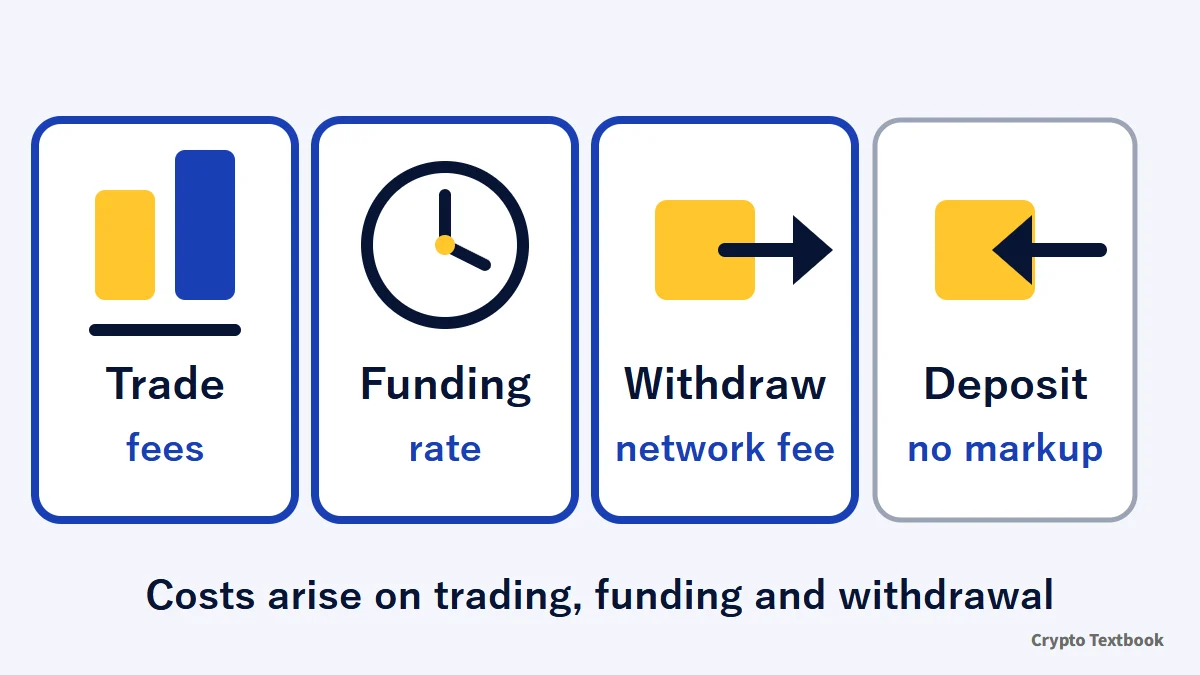
- Base futures rate (VIP0) is 0.02% maker and 0.06% taker
- Base spot rate (VIP0) is 0.08% maker and 0.10% taker
- Rates fall across nine VIP levels, and the futures maker rate is 0% at VIP8
- Futures funding is paid every 8 hours, only while you hold a position
- Withdrawals carry a network fee (USDT on TRC-20 is 1 USDT, minimum 2 USDT)
| Cost | Rate or amount | When it applies |
|---|---|---|
| Futures trading fee | 0.02% maker / 0.06% taker | On opening and on closing |
| Spot trading fee | 0.08% maker / 0.10% taker | On every fill |
| Funding | Rate changes each period (usually every 8 hours) | While a position is open |
| Withdrawal | USDT (TRC-20): 1 USDT | On every withdrawal |
| Deposit | No extra exchange charge | Blockchain fee is paid by the sender |
※ Bitunix can revise its rates. Check the fee page or your own account screen for the latest values before you place an order.
Bitunix spot and futures fees (VIP0 maker and taker)
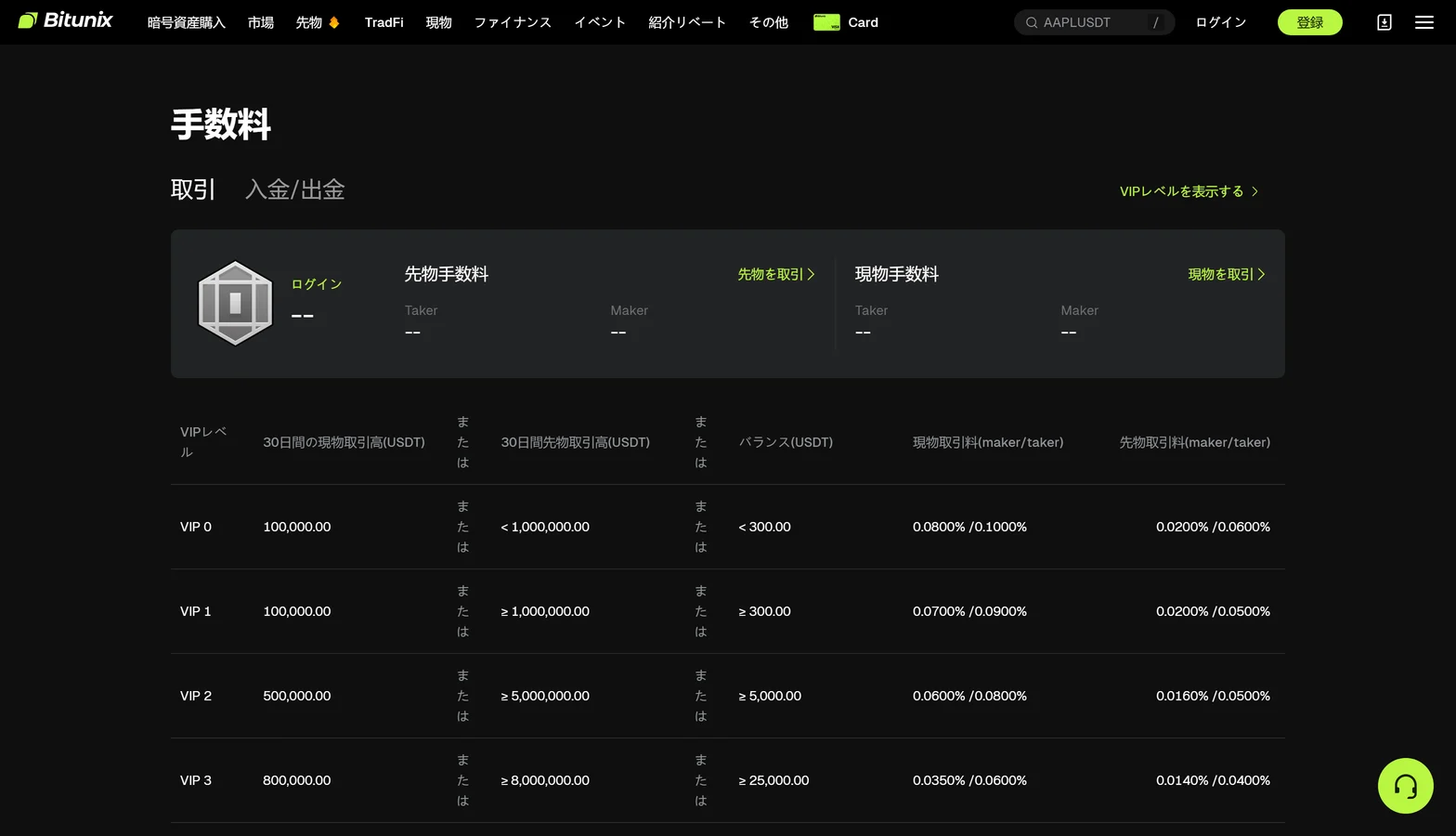
The fee depends on which side of the order book your order lands on. A market order that fills at once is a taker order. A limit order that rests on the book is a maker order.
A maker rests an order on the book and adds liquidity, so the rate is lower. The official help article says the same.
| Market | Maker | Taker |
|---|---|---|
| Spot (VIP0) | 0.0800% | 0.1000% |
| Futures (VIP0) | 0.0200% | 0.0600% |
※ A new account starts at VIP0. Open the fee page while logged in to see your own rate.
What the fee is charged on
A futures fee is charged on the size of the position, not on the margin. Per the official help article, the total is an opening fee plus a closing fee. Higher leverage means a larger position and a higher fee.
- Opening fee: opening price x quantity x rate
- Closing fee: closing price x quantity x rate
Bitunix VIP0 to VIP8 fee table and how to move up
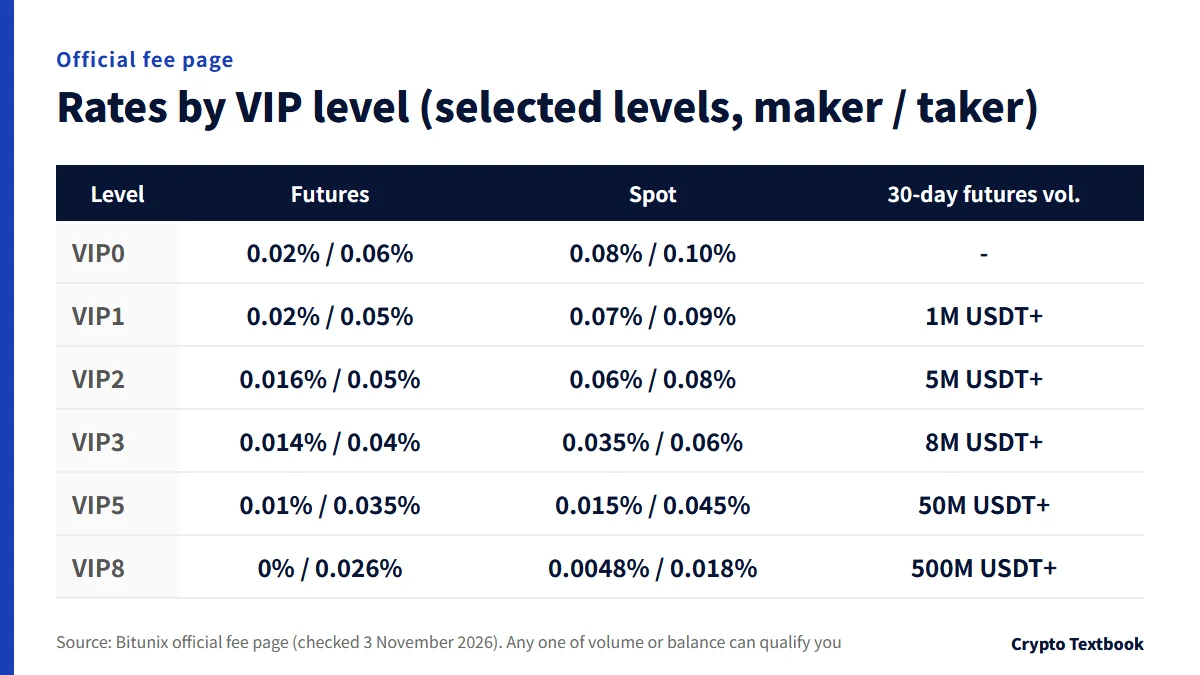
Here are the nine levels from the official fee page, split into futures and spot. Rates fall as the level rises.
| Level | Futures (maker / taker) | Spot (maker / taker) |
|---|---|---|
| VIP0 | 0.0200% / 0.0600% | 0.0800% / 0.1000% |
| VIP1 | 0.0200% / 0.0500% | 0.0700% / 0.0900% |
| VIP2 | 0.0160% / 0.0500% | 0.0600% / 0.0800% |
| VIP3 | 0.0140% / 0.0400% | 0.0350% / 0.0600% |
| VIP4 | 0.0120% / 0.0375% | 0.0200% / 0.0500% |
| VIP5 | 0.0100% / 0.0350% | 0.0150% / 0.0450% |
| VIP6 | 0.0080% / 0.0315% | 0.0125% / 0.0375% |
| VIP7 | 0.0060% / 0.0300% | 0.0100% / 0.0325% |
| VIP8 | 0.0000% / 0.0260% | 0.0048% / 0.0180% |
Numbers needed to move up (futures volume and balance)
| Level | 30-day futures volume | Balance |
|---|---|---|
| VIP1 | 1 million USDT or more | 300 USDT or more |
| VIP2 | 5 million USDT or more | 5,000 USDT or more |
| VIP3 | 8 million USDT or more | 25,000 USDT or more |
| VIP4 | 20 million USDT or more | 140,000 USDT or more |
| VIP5 | 50 million USDT or more | 700,000 USDT or more |
| VIP6 | 100 million USDT or more | 1,400,000 USDT or more |
| VIP7 | 200 million USDT or more | 2,400,000 USDT or more |
| VIP8 | 500 million USDT or more | Shown as 99,999,999,999 USDT or more |
※ The table also has a 30-day spot volume column (VIP2 is 500,000 USDT, VIP3 is 800,000 USDT, and so on). VIP0 and VIP1 show the same 100,000 USDT, so the table alone cannot tell them apart.
Three figures count: 30-day futures volume, 30-day spot volume and balance. Meeting any one makes you eligible, and the highest level of the three applies.
The level updates in real time, and an upgrade is kept for 90 days. On day 90 at 02:30 UTC the system re-checks your last 30 days. A VIP level earned through spot also gives the same futures rate.
This site's exchange page describes the VIP check as daily. The official FAQ (checked 3 November 2026) says the level updates in real time and is kept for 90 days, so this article follows the official wording.
VIP members at other exchanges can also apply by email. You send your UID and a screen showing your last 30 days of volume to the official VIP desk.
Worked example: 10,000 USDT of futures and spot trading
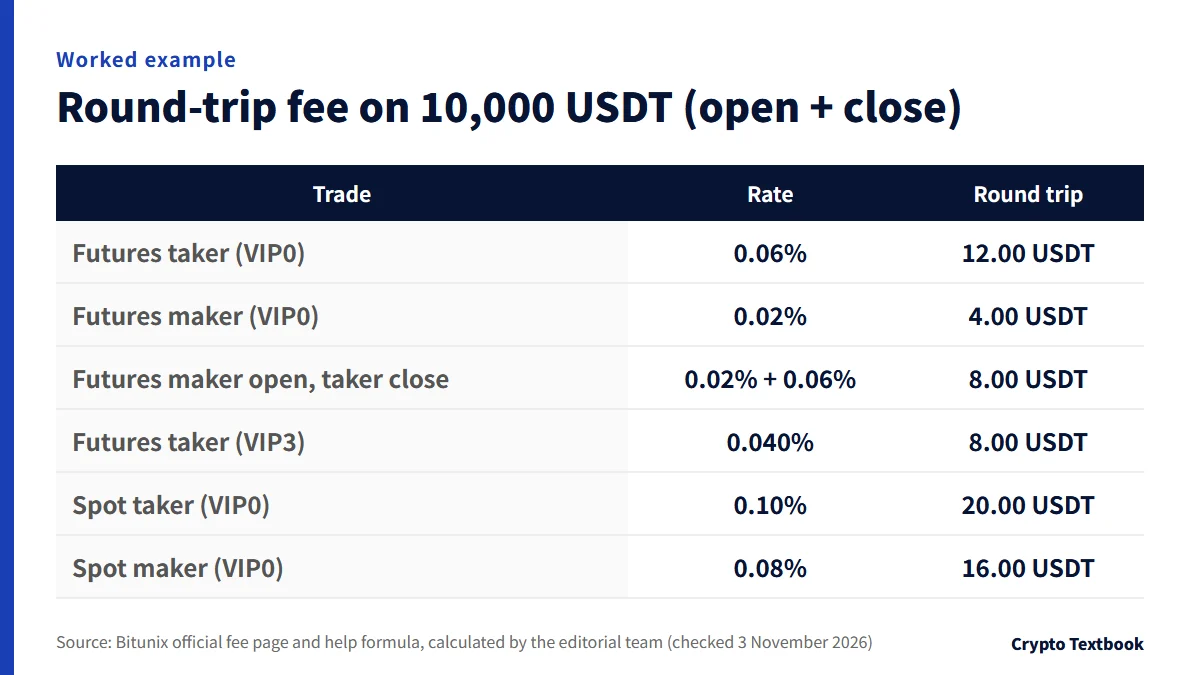
The formula follows the official help article: price x quantity x rate, charged once on opening and once on closing. The position is fixed at 10,000 USDT and closed at the same size.
| Trade | One way | Round trip (open + close) |
|---|---|---|
| Futures taker 0.06% (VIP0) | 6.00 USDT | 12.00 USDT |
| Futures maker 0.02% (VIP0) | 2.00 USDT | 4.00 USDT |
| Futures maker open, taker close | 2.00 + 6.00 USDT | 8.00 USDT |
| Futures taker 0.040% (VIP3) | 4.00 USDT | 8.00 USDT |
| Spot taker 0.10% (VIP0) | 10.00 USDT | 20.00 USDT |
| Spot maker 0.08% (VIP0) | 8.00 USDT | 16.00 USDT |
※ These are calculations from the rates. The amounts change if the fill price or quantity differs.
With leverage, fees are a larger share of margin
At 10x leverage, a 10,000 USDT position needs 1,000 USDT of margin. A 12.00 USDT taker round trip is 1.2% of that margin, and a 4.00 USDT maker round trip is 0.4%.
At 20x the margin is 500 USDT, and the same 12.00 USDT is 2.4%. The fee amount does not change; only its share of your own funds grows.
Leveraged trading can lose all or part of your margin depending on price moves. Fees and funding are costs on top of profit and loss.
Bitunix funding rate: a cost settled every 8 hours
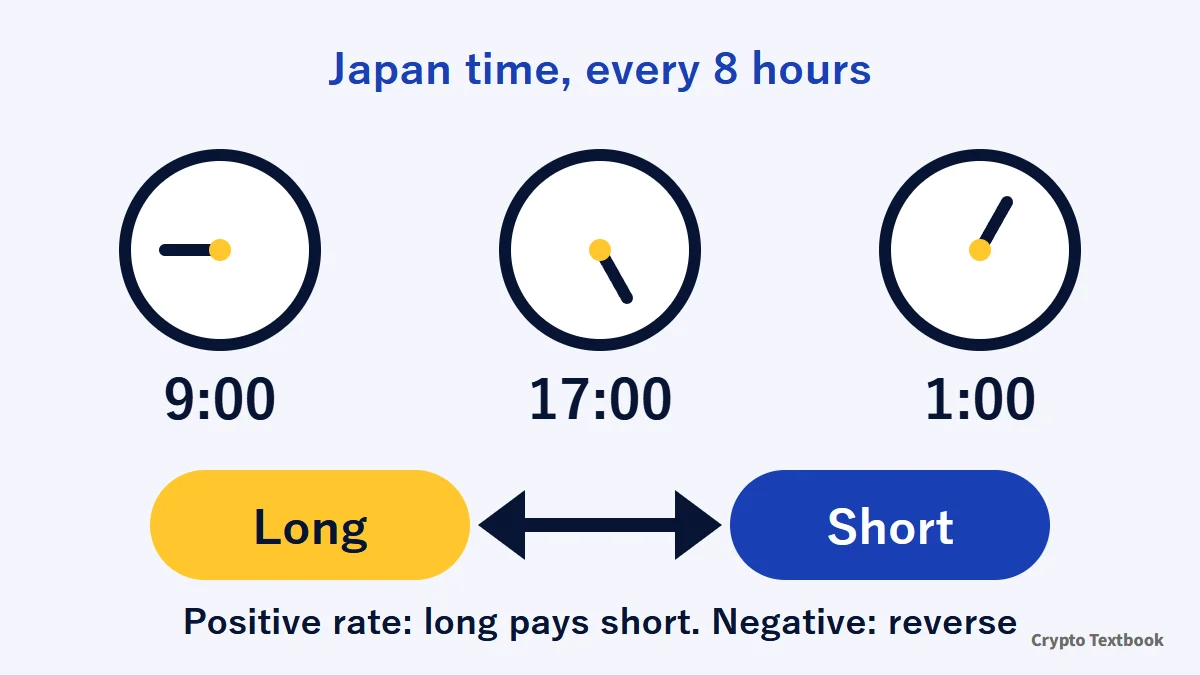
A perpetual contract has no expiry, so funding keeps its price close to the spot price. It is not a fee paid to the exchange. It moves between the long side and the short side.
When the funding rate is positive, longs pay shorts. When it is negative, shorts pay longs.
| Item | Official description |
|---|---|
| Formula | Position value x funding rate |
| When it is settled | Usually every 8 hours (00:00, 08:00 and 16:00 UTC) |
| Japan time | 9:00, 17:00 and 1:00 the next day |
| Who pays or receives | Only those holding a position at that moment |
| How the rate is set | Based on the previous period and fixed within the period |
※ The official article says the settlement time can change for some pairs. Check the screen of the pair you trade.
Example with an assumed 0.01% rate
Say you hold a 10,000 USDT long and the funding rate is 0.01%. One payment is 10,000 x 0.01%, which is 1 USDT.
If the rate stays the same and you hold through all three settlements, that is 3 USDT a day. The 0.01% is an assumed value for explanation; the real rate changes each period.
Close the position before a settlement time and nothing is charged for that round. The official article says the same.
Bitunix withdrawal and deposit fees: USDT depends on the network
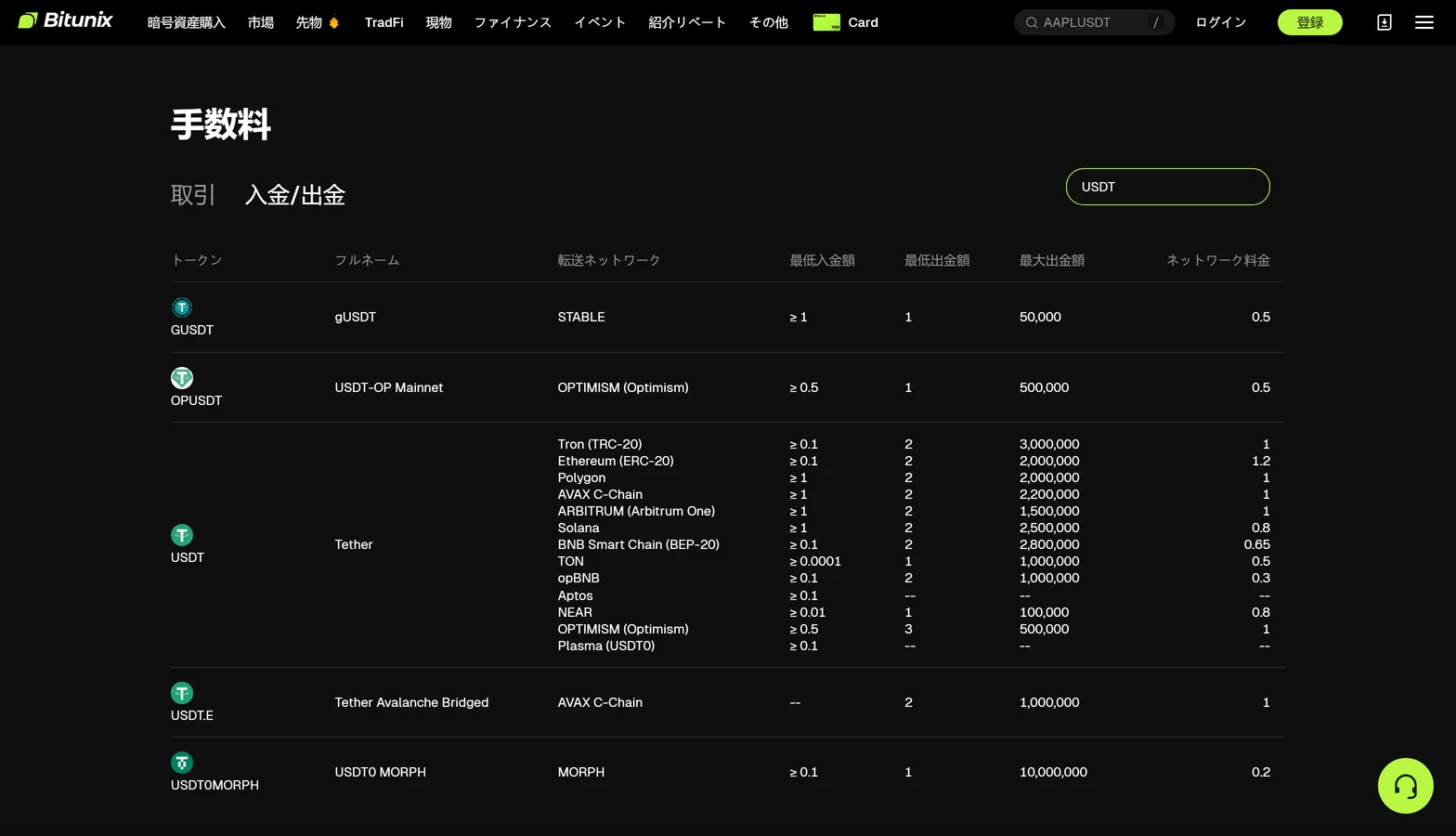
The official deposit FAQ says the exchange charges no extra deposit fee. The blockchain fee is paid by the sender. Deposits usually arrive in 3 to 30 minutes.
Withdrawals deduct a network fee that depends on the token and the network. The same USDT costs a different amount depending on the network you pick.
| Network | Minimum withdrawal | Network fee |
|---|---|---|
| Tron (TRC-20) | 2 USDT | 1 USDT |
| Ethereum (ERC-20) | 2 USDT | 1.2 USDT |
| BNB Smart Chain (BEP-20) | 2 USDT | 0.65 USDT |
| Solana | 2 USDT | 0.8 USDT |
| Polygon | 2 USDT | 1 USDT |
| opBNB | 2 USDT | 0.3 USDT |
※ The withdrawal table in the official help centre differs from the fee page, for example 2 USDT for ERC-20 and 0.5 USDT for BEP-20. The amount shown on the withdrawal screen takes priority.
The network fee is fixed regardless of the amount. Withdrawing 100 USDT on TRC-20 costs 1 USDT (1%); withdrawing 10,000 USDT costs 0.01%.
On the Bitcoin network, BTC has a minimum withdrawal of 0.00005 BTC, a fee of 0.000021 BTC and a maximum of 85 BTC (fee page, rechecked 3 November 2026). The help centre list shows different values, so confirm on the withdrawal screen.
Where people trip up
- Choosing a network the receiving side does not support, so the funds never arrive
- Leaving out the MEMO or Tag for coins such as XRP, so they credit elsewhere
- Sending to a wrong address: a completed withdrawal cannot be recovered by the exchange
- The basic security level has a daily withdrawal limit of about 10,000 USD (raised by extra verification and KYC)
How to lower Bitunix fees: what the official pages say
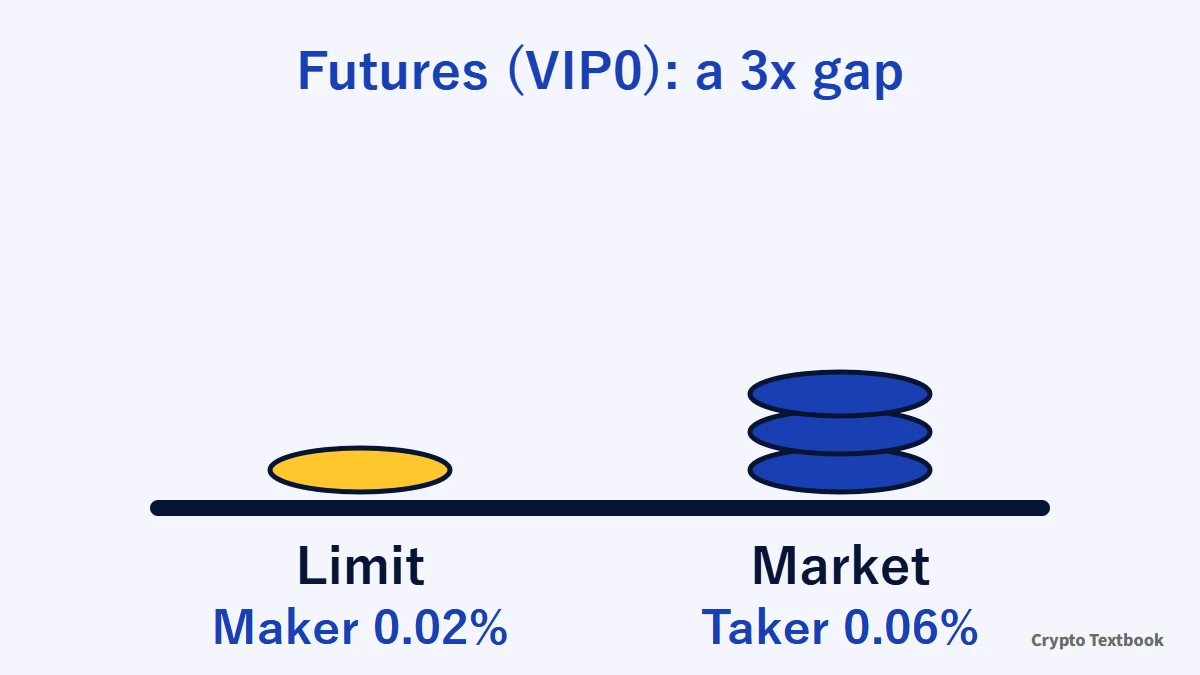
Bitunix documents three ways to lower fees.
- Fill with limit orders: VIP0 futures is 0.02% maker against 0.06% taker, a threefold gap (a limit order may not fill)
- Raise your VIP level: reach the volume or balance threshold and your rate falls
- Use a fee discount voucher: fees on eligible futures pairs are discounted automatically
You activate a fee discount voucher under My Rewards in the app. The official article says it has an expiry and a maximum deduction, and cannot be converted to spot balance or withdrawn.
At VIP1 the futures maker rate stays at 0.02% and only the taker rate drops to 0.05%.
Raising trade count or leverage to cut fees also raises the risk of loss. The rate is a result of your own trading volume.
How to check fees on the official screens
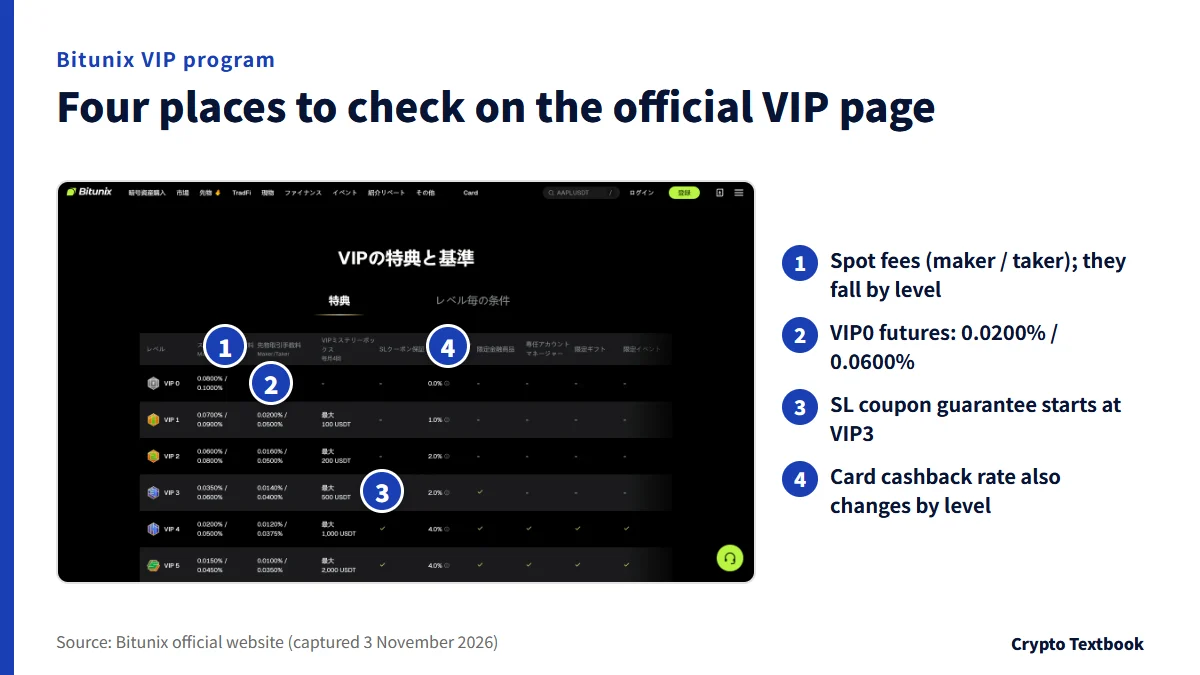
Treat the figures here as a guide. Check your own rate on the official screen before you order.
- 01Open the fee page
From the official site menu, go to Trade and then Fees.
- 02Read the VIP table on the Trading tab
When you log in, your own futures and spot maker and taker rates appear at the top.
- 03Search a coin on the Deposit/Withdraw tab
Enter the token to see the minimum amounts and fee for each network.
- 04Confirm on the withdrawal screen
The official help says the withdrawal screen amount takes priority.
You can see your own VIP level from the icon at the top right of the site, or the top left of the app. The VIP program page lists the perks for each level.
Editorial verdict: how to think about Bitunix fees by situation
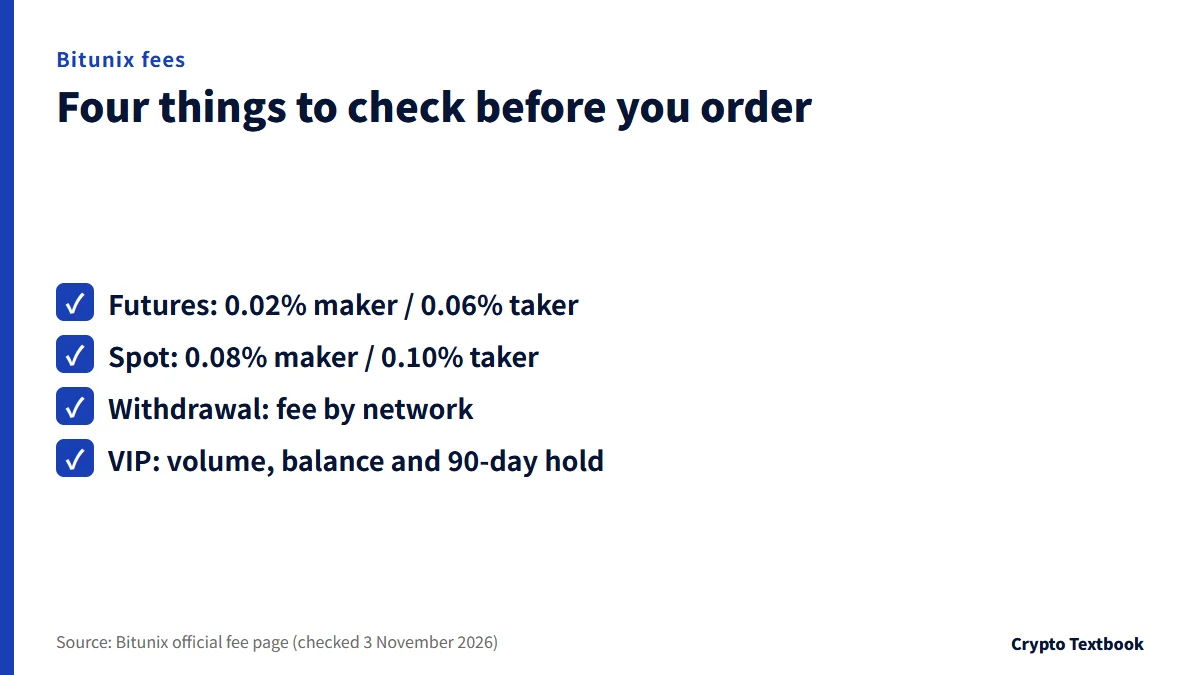
If you trade futures, look at the maker and taker gap and at funding. If you only trade spot, the VIP0 rates of 0.08% and 0.10% and the withdrawal network fee are enough. If you withdraw often, pick a cheaper network.
- Futures with many market orders: check the 0.06% taker rate and its share of margin (1.2% round trip at 10x)
- Futures held for a long time: count funding three times a day, apart from profit and loss
- Few spot trades: compare the withdrawal network fee more than the trading fee
- High volume: check the VIP thresholds and the 90-day hold
Bitunix is an overseas exchange without a Japanese crypto-asset exchange service licence, and it is not on the Financial Services Agency's registered list (as of 30 September 2026, 27 providers). You would trade outside the domestic rules that apply to registered providers, and futures can lose your entire margin.
Frequently asked questions
Q. How much are Bitunix fees?
A. At VIP0 the base futures rates are 0.02% maker and 0.06% taker, and the spot rates are 0.08% maker and 0.10% taker. We checked the official fee page on 3 November 2026. They fall as the VIP level rises.
Q. What is the difference between maker and taker on Bitunix?
A. A taker fills straight away against orders on the book, typically a market order. A maker leaves an order on the book and waits to be filled, typically a limit order. The maker rate is lower.
Q. How much is the Bitunix withdrawal fee?
A. It is a network fee per token and network. For USDT it is 1 USDT on TRC-20, 1.2 USDT on ERC-20 and 0.65 USDT on BEP-20 (fee page, 3 November 2026). Confirm the final amount on the withdrawal screen.
Q. Does Bitunix charge a deposit fee?
A. The official FAQ says the exchange charges no extra deposit fee. The blockchain fee is paid by the sender. Deposits usually arrive in 3 to 30 minutes, and congestion can delay them.
Q. What is the Bitunix funding rate?
A. It is a cost passed between longs and shorts to keep a perpetual contract near the spot price. It is usually settled every 8 hours (9:00, 17:00 and 1:00 Japan time) if you hold a position.
Q. Do Bitunix fees rise with leverage?
A. Fees are charged on position size, so a bigger leveraged position pays more. Their share of your margin also grows; a taker round trip at 10x is about 1.2% of margin.
Q. How do I raise my Bitunix VIP level?
A. You become eligible if any one of 30-day futures volume, 30-day spot volume or balance meets the threshold. The highest level applies and is kept for 90 days. The thresholds are on the official fee page.
Q. Where can I check Bitunix fees?
A. On the official site, go to Trade and then Fees. The Trading tab shows rates by level, and the Deposit/Withdraw tab shows minimums and fees by token. Log in to see your own rate.
Sources
- Bitunix | Fees (trading and deposit/withdrawal, official, checked 3 November 2026) →
- Bitunix | VIP program (fees and perks by level, official, checked and captured 3 November 2026) →
- Bitunix | FAQ about VIP (official help centre, checked 3 November 2026) →
- Bitunix | Trading Fees Explanation & Calculation - Bitunix Futures (official help centre, checked 3 November 2026) →
- Bitunix | Introduction to Futures Funding Rate (official help centre, checked 3 November 2026) →
- Bitunix | Fees, Minimum and Maximum Withdrawal Amount on Bitunix (official help centre, checked 3 November 2026) →
- Bitunix | Crypto Deposit FAQ (official help centre, checked 3 November 2026) →
- Bitunix | FAQ on Withdrawals (official help centre, checked 3 November 2026) →
- Bitunix | How to Use Bitunix Fee Discount & APR Boost Vouchers (official help centre, checked 3 November 2026) →
- Financial Services Agency of Japan | List of registered crypto-asset exchange service providers (as of 30 September 2026, 27 providers, checked 3 November 2026) →
FX Textbook is an independent information site, not an exchange or a provider of personal investment advice. Crypto-asset trading involves risk: price volatility, liquidation of leveraged positions, transfer mistakes and the operational risk of exchanges and service providers can cause you to lose some or all of your invested capital. No result is guaranteed.
NEXT STEP
Check Bitunix fees and rewards on the exchange page.
The exchange page collects base rates, leverage and new-user rewards with official check dates.
Exchanges related to this column
Fees, leverage, funding options and current offers are on each exchange page.