
Search for Bitunix reviews and you will find many highly rated referral pages, which does not help you judge the facts.
Official pages and the terms split the picture clearly. The proof of reserves is published, but no legal entity name appears in the terms, and assets sit outside deposit insurance and investor compensation.
This guide sets out the facts as of 3 November 2026 so you can decide for yourself.
Short answer: reserves and terms are checkable, the operating company is not
- A proof of reserves is published. Reserve ratios are BTC 156%, ETH 108% and USDT 105% (audit of 1 October 2026)
- No operating company name or place of registration appears in the terms or the risk disclosure
- Bitunix is not on Japan's list of registered crypto exchange providers (27 providers as of 30 September 2026), so Japanese user protection does not apply
- Japan is not in the official restricted-region list, but the list is only examples and changes
- Bitunix states that assets are outside deposit insurance and investor compensation, and that you may not recover everything if it fails
Bitunix centres on futures, and officially cites up to 200x leverage (the cap differs by instrument). If the market moves against you, forced liquidation can wipe out everything you deposited.
What Bitunix is: a crypto derivatives exchange founded in 2021
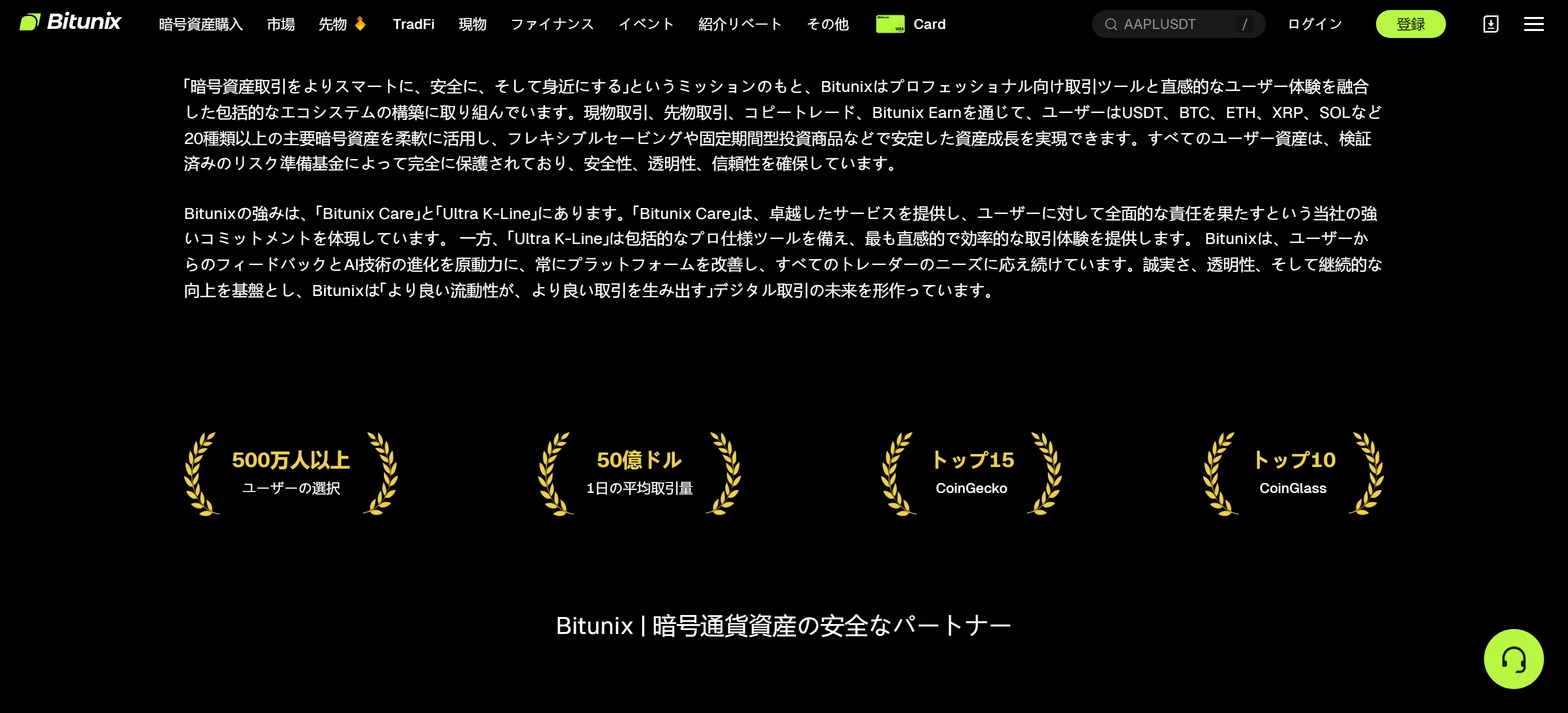
Bitunix was founded in 2021 and offers spot, futures, copy trading and Earn. Every figure on its official page is self-reported.
| Item | What the official page says |
|---|---|
| Founded | 2021 |
| Countries and users | 150+ countries, 5 million+ users |
| Average daily volume | USD 5 billion |
| Self-reported rankings | Top 15 on CoinGecko, top 10 on CoinGlass |
| Pairs and leverage | 1,200+ pairs, up to 200x |
| Support | 24/7, Chinese, English and Spanish, average response under 30 seconds |
※ We have not verified these figures independently. Japanese-language support is not part of this statement.
- Help-centre articles are in English; only the interface language can be set to Japanese
- The official page quotes a Trustpilot rating and user comments
- The company chose to publish them, so we do not treat them as evidence of reputation
Fees and leverage: the numbers to read alongside safety
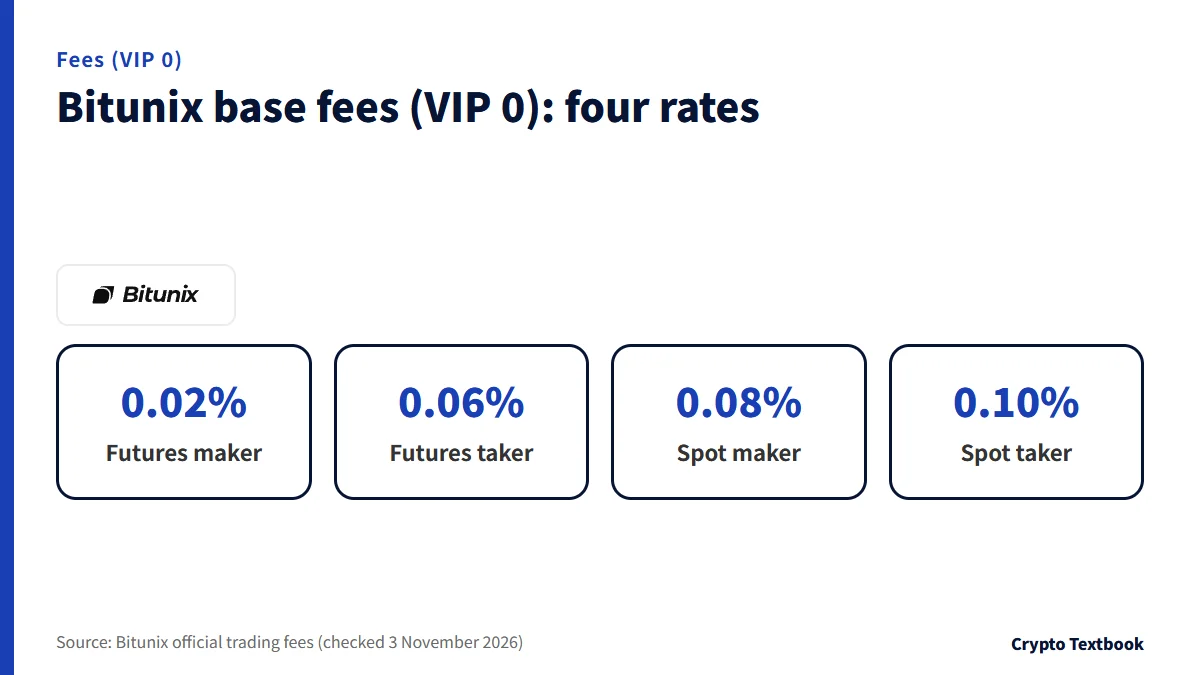
Bitunix sets your VIP level from 30-day volume or balance, and fees fall in steps.
| VIP level | 30-day futures volume | Spot maker / taker | Futures maker / taker |
|---|---|---|---|
| VIP 0 | Under 1,000,000 USDT | 0.08% / 0.10% | 0.02% / 0.06% |
| VIP 1 | 1,000,000 USDT or more | 0.07% / 0.09% | 0.02% / 0.05% |
| VIP 2 | 5,000,000 USDT or more | 0.06% / 0.08% | 0.016% / 0.05% |
| VIP 3 | 8,000,000 USDT or more | 0.035% / 0.06% | 0.014% / 0.04% |
※ The VIP level is set by any one of spot volume, futures volume or balance. The table shows only the futures-volume condition.
For example, suppose a 10,000 USDT futures order fills once (illustrative figures). At VIP 0 the taker fee is 6 USDT and the maker fee is 2 USDT.
- A maker fee applies when a resting order fills; a taker fee when you fill immediately
- Perpetual futures also carry a funding rate separate from fees (explained in the official help)
- Maximum leverage is officially stated as 200x (BTC/USDT and ETH/USDT perpetual futures; it differs by instrument)
Bitunix fees: VIP 0 to 8 rates, worked examples and withdrawal costs →
Reading the proof of reserves: the official figures and how to verify
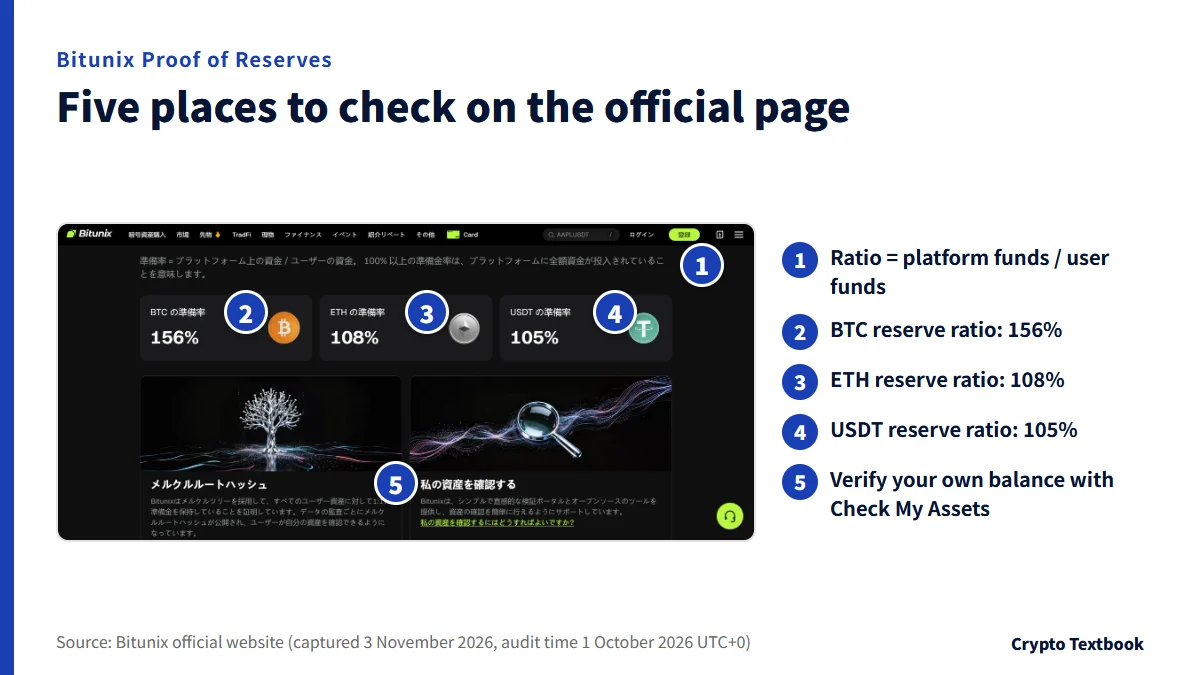
A proof of reserves shows whether an exchange holds assets matching customer balances. The official reserve ratios at the 1 October 2026 audit were as follows.
| Asset | Reserve ratio | How to read it |
|---|---|---|
| BTC | 156% | Holds 1.56 times customer assets |
| ETH | 108% | Holds 1.08 times customer assets |
| USDT | 105% | Holds 1.05 times customer assets |
※ The ratio is platform funds divided by user funds. At 100% or more, the platform says it holds the full amount.
Bitunix says it uses a Merkle tree, a data structure that condenses individual balances, to show 1:1 reserves.
- 01Log in and open the audit overview
Go from the proof of reserves page to My Audit. Login is required.
- 02Press Verify Now
Choose an audit report and check that your own account is included.
- 03Verify with the open-source tool if needed
Download the data file and compute it locally. A match shows a success message.
Only BTC, ETH and USDT are shown. Other assets and total liabilities cannot be checked from the page. Accounts created after an audit have no record in that audit (official help).
The limits of asset protection: what the risk disclosure says
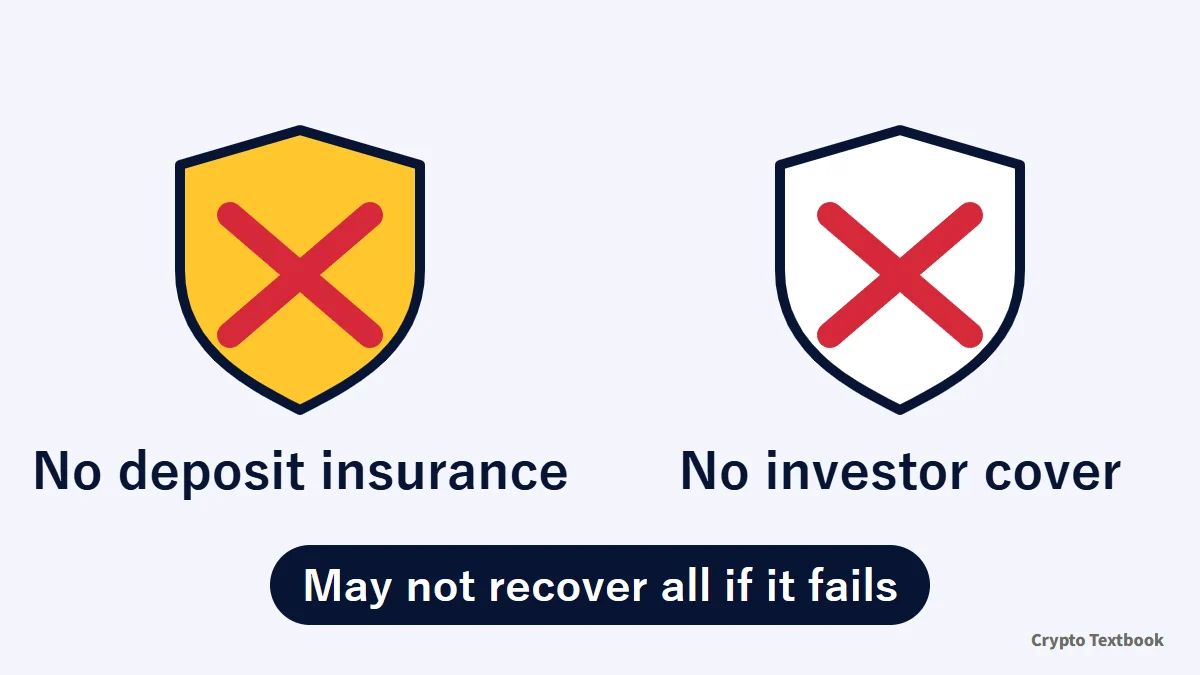
Before asking whether reserves exist, check what is not protected. Bitunix's Risk Disclosure (updated 20 July 2026) says the following.
| Item | Risk disclosure |
|---|---|
| Bank and deposits | Bitunix is not a bank or deposit-taking institution, and account assets are not deposits |
| Deposit insurance | No deposit insurance scheme protects the assets |
| Investor compensation | No investor compensation scheme applies except where law expressly requires it |
| If it fails | You may not recover all or part of your assets, and recovery may be delayed |
| Third parties | Payment, custody and liquidity providers are involved, and their failures may fall outside Bitunix's liability |
The About page mentions a 1:1 reserve plus a 5 million insurance, but gives no currency and no insurance details. The Risk Disclosure takes priority.
- Hot and cold wallets are described as separated (About page)
- Custody is described as linked to COBO and Fireblocks (About page)
- A Hacken audit is mentioned; we could not confirm the audit report
These security statements are self-reported. What we can confirm is that the terms and risk disclosure set out the limits of protection.
Can you use it from Japan: registration, restricted regions and withdrawal limits
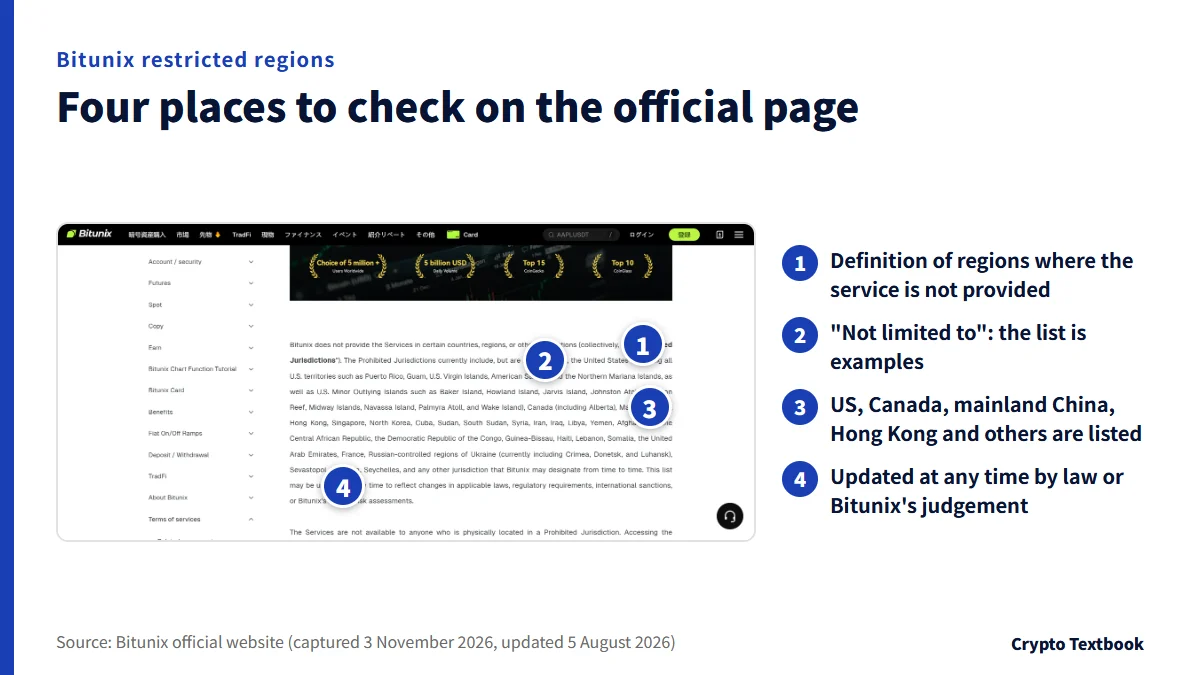
Crypto exchange services in Japan require registration with the Financial Services Agency (FSA). Bitunix is not on the FSA's registered-provider list (27 providers as of 30 September 2026), and not on its list of warned unregistered operators.
Japanese user-protection rules do not apply, though absence from a warning list is not proof of safety. France's AMF published the site on 12 March 2025 as an unauthorised crypto-asset derivatives provider.
The official restricted-region list (updated 5 August 2026) includes the US, Canada, mainland China, Hong Kong, Singapore, France, Malaysia and the UAE. Japan is not listed.
- The list says it is not limited to those places and can change at any time
- Hiding your location with a VPN is prohibited and can lead to suspension or closed positions
- Not being registered in Japan is a separate matter from eligibility under the terms
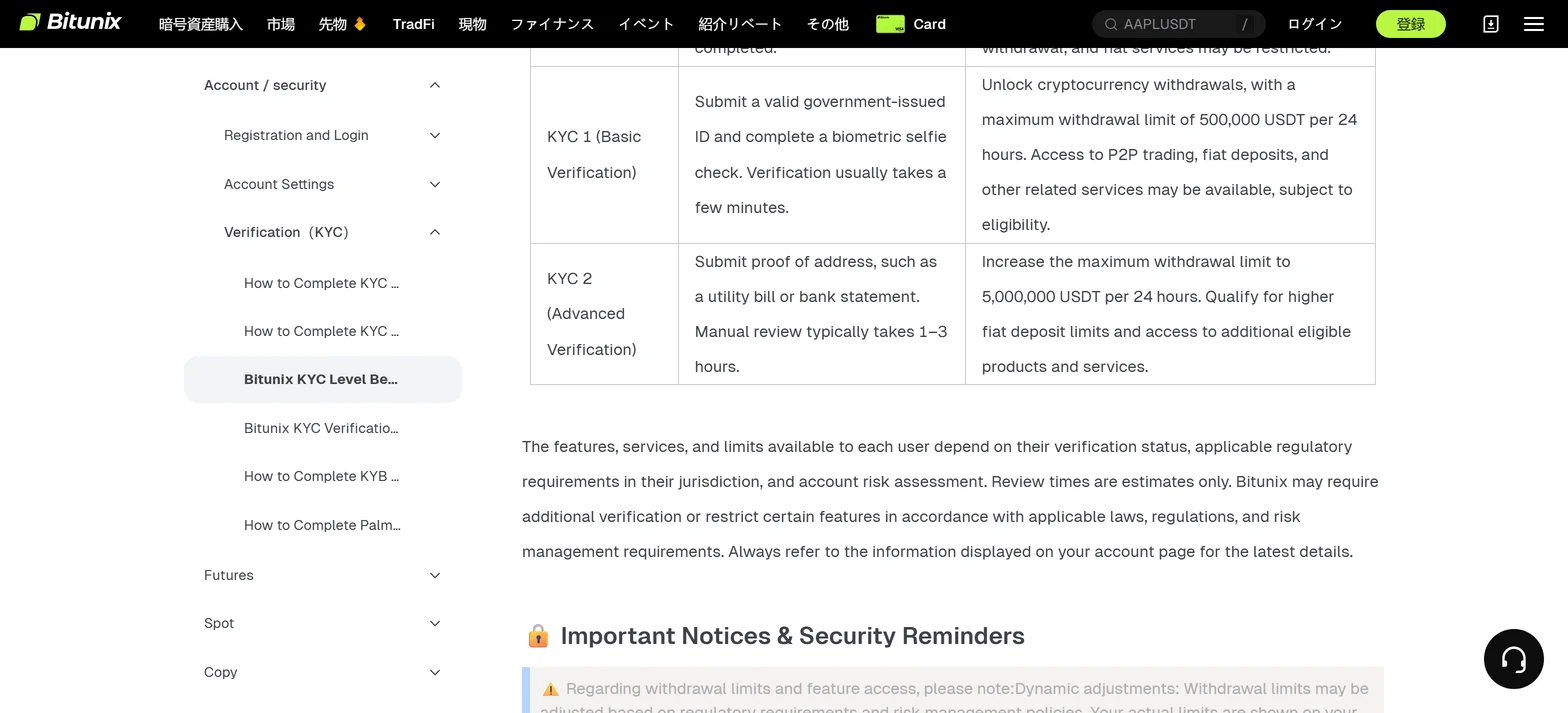
| Level | What you submit | Withdrawal limit (24 hours) |
|---|---|---|
| Unverified | Nothing | Some trading, withdrawal and fiat services restricted |
| KYC 1 | Government ID and a face check (a few minutes) | 500,000 USDT |
| KYC 2 | Proof of address (review takes 1 to 3 hours) | 5,000,000 USDT |
※ Limits vary with regional rules and account risk. Your account page takes priority. The withdrawal FAQ puts an account with one security method at about 10,000 USD a day.
KYC and limits explained (beginner guide) →
How the same check looked for BingX (FSA and restricted regions) →
Checking common reputation points against official information
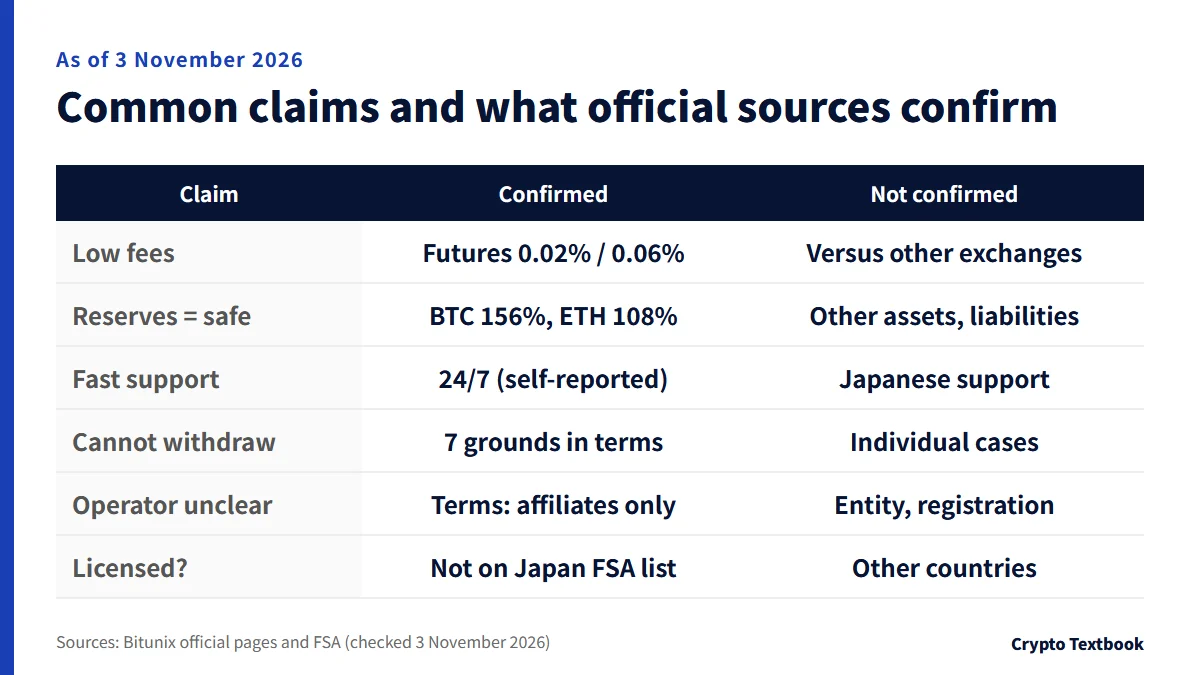
We turned the points that review articles repeat into what official sources can confirm. Testimonials and user comments are not used as sources.
| Common claim | What official sources confirm | What cannot be confirmed |
|---|---|---|
| Fees are low | Futures 0.02% maker and 0.06% taker (VIP 0) | Whether it is cheaper than others depends on conditions |
| Reserves make it safe | BTC 156%, ETH 108%, USDT 105% | Other assets and total liabilities |
| Support is fast | 24/7, average response under 30 seconds (self-reported) | Whether Japanese is supported |
| Withdrawals blocked or frozen | Seven grounds for suspension in the terms | The facts of individual cases |
| Operator is unclear | Terms say only Bitunix and its affiliates | Entity name, registration place, licence number |
| Is it licensed | Not on Japan's FSA registered list (as of 30 September 2026) | Other countries' registrations (none stated officially) |
※ Registrations in the US, Canada and elsewhere cited by other sites do not appear on the official pages, and we have not checked regulator registers, so we do not state them.
When withdrawals stall or an account is restricted: terms and steps
The terms allow suspending an account, restricting withdrawals and freezing assets on grounds such as these (User Agreement 5.5, updated 23 July 2026).
| Example ground | What the terms say |
|---|---|
| Faulty information | You supplied inaccurate, incomplete or misleading information |
| Suspected illegality | Suspected money laundering, terrorist financing, sanctions breach or fraud |
| Breach of terms | You breached the terms or related documents |
| Compliance | Compliance requirements are not met |
| Security | Unauthorised access or a government investigation affects the account |
※ These are examples, and the list ends with any other case Bitunix reasonably considers necessary.
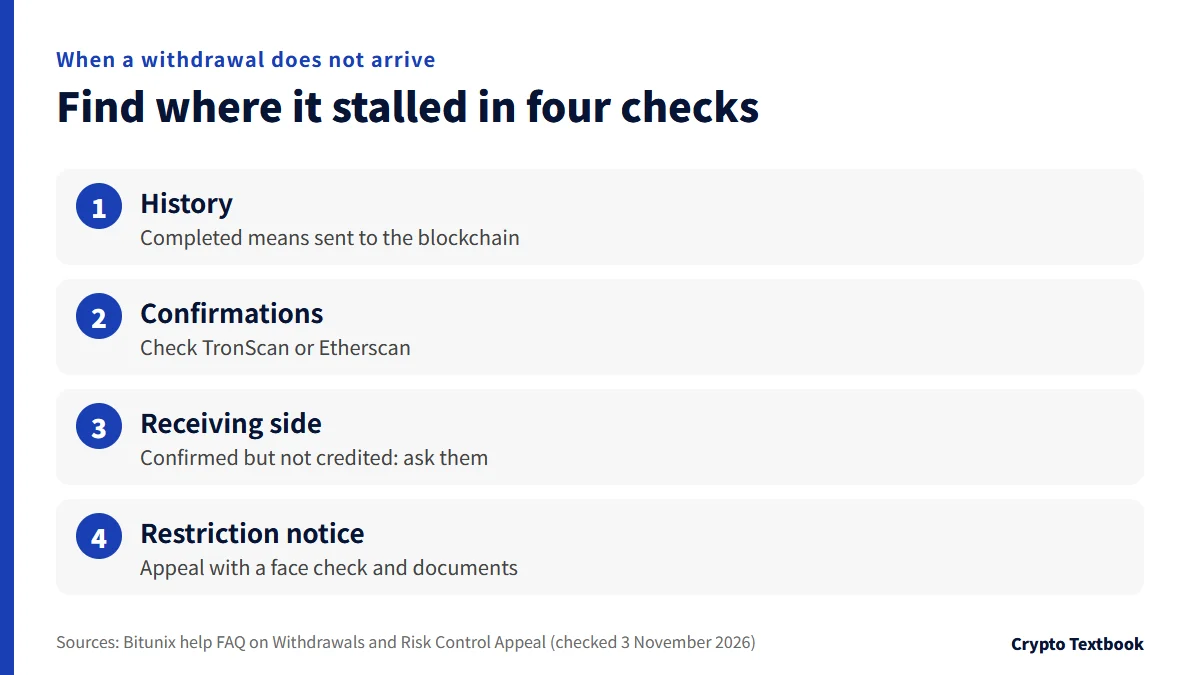
If a withdrawal has not arrived, work through four checks. The first three are the official FAQ's three stages, and a Completed status is separate from the receiving side crediting it.
- 01Check Bitunix's withdrawal history
If it says Completed, the transfer has been sent to the blockchain.
- 02Check blockchain confirmations
Use TronScan or Etherscan to see the confirmation count.
- 03Ask the receiving side
If it is confirmed but not credited, contact the receiving exchange.
- 04For a restriction notice, file an appeal
On an account risk review and restriction notice, appeal with a face check and documents.
Most often it is an unfilled order or a withdrawal in progress (official help). If neither applies, contact support with your registered email and UID.
A five-minute check before signing up: which official pages to read
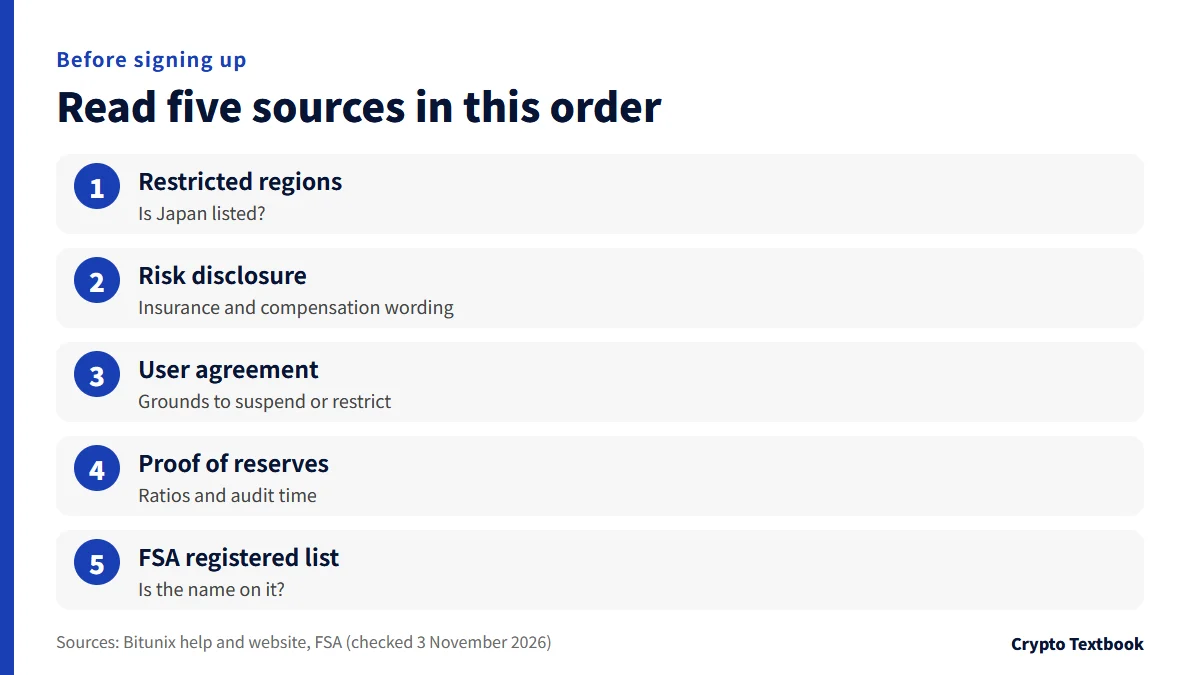
Every check in this guide can be repeated by reading four official pages and one FSA document. If an update date is newer, review the content again.
| What to check | Where to look | What to look for (version checked) |
|---|---|---|
| Eligible countries | Help: Restricted Regions and User Eligibility Notice | Whether Japan is listed (updated 5 August 2026) |
| Limits of protection | Help: Risk Disclosure | Deposit insurance and investor compensation wording (updated 20 July 2026) |
| Terms | Help: User Agreement | Grounds to suspend or restrict an account (updated 23 July 2026) |
| Reserves | Official Proof of Reserves page | Reserve ratios and audit time (1 October 2026) |
| Japanese registration | FSA registered-provider list (PDF) | Whether the name appears (as of 30 September 2026) |
Start with restricted regions, which decide whether you can use it, then the limits of protection, the terms, reserves and Japanese registration.
The restricted-region list and the terms are updated. Even after depositing, review the update dates every few months.
Safety checks before you start: protecting the account, and tax
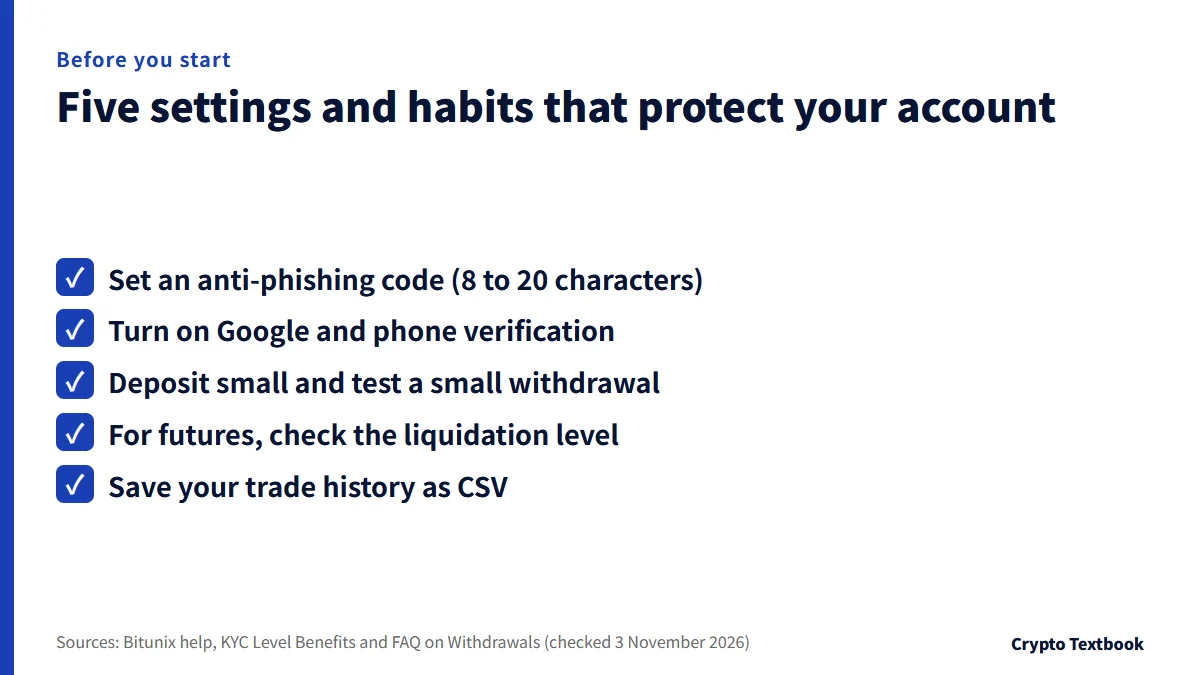
- Set an anti-phishing code (8 to 20 letters and digits). It appears in genuine emails
- Enable Google Authenticator and phone verification. More methods raise the withdrawal limit
- Deposit a small amount first and test a small withdrawal before adding more
- For futures, check the liquidation level before opening a position
- Save your trade and deposit history as CSV regularly
Profits on overseas exchanges are taxable income for Japanese residents. The National Tax Agency treats profits from selling crypto assets as miscellaneous income in principle (Tax Answer No.1524).
- Employees must file a return if non-salary income exceeds 200,000 yen a year
- Do not keep all your assets on one exchange
- If an exchange withdraws or restricts service, getting your history can become hard
Crypto tax: from how much, the 200,000 yen rule and rates →
Will overseas exchange profits be found? CARF and tax audits →
Editorial verdict: how to decide by your situation
Bitunix publishes a proof of reserves and its terms. Against that, it names no operating company, has no Japanese registration and sits outside deposit insurance. Decide how much to use by what you can afford to lose.
| Your situation | What to check |
|---|---|
| You want to try futures with a small amount | Check the liquidation level and deposit only what you can lose |
| You want to hold a large balance | Weigh the unknown operator heavily and spread funds |
| You value Japanese protection | Choose a domestic exchange registered with the FSA |
| You already use it | Re-check the restricted regions, terms and risk disclosure dates regularly |
This summarises facts confirmed from official pages and public authority records as of 3 November 2026. It does not guarantee safety or recommend any trade. This site has advertising and affiliate relationships, described on the advertising and risk disclosure page.
Frequently asked questions
Q. Is Bitunix's reputation really good?
A. Many articles rate it highly, but some outlets earn referral fees, as this site does. What official sources confirm is a published proof of reserves and its terms. No entity name appears in the terms, and assets sit outside deposit insurance. Decide on verifiable facts, not ratings.
Q. Is Bitunix safe?
A. We cannot say it is safe. The official reserve ratios are BTC 156%, ETH 108% and USDT 105% (audit of 1 October 2026). The risk disclosure also says assets are outside deposit insurance and investor compensation, and may not be fully recovered if it fails.
Q. Is Bitunix registered with the Japanese FSA?
A. No. It is not on the registered-provider list checked on 3 November 2026 (as of 30 September 2026, 27 providers). It is also absent from the warning list, but the FSA notes that operators not listed may still be unregistered.
Q. Who operates Bitunix?
A. The terms say only Bitunix and its affiliates, with no entity name or place of registration. The About page says it was founded in 2021. We could not confirm other sites' registration claims from primary sources.
Q. Can people in Japan use Bitunix?
A. Japan is not in the official restricted-region list (updated 5 August 2026), but the list can change. The interface can be set to Japanese, while help-centre articles are in English.
Q. What if a Bitunix withdrawal does not arrive?
A. A Completed status means the transfer was sent to the blockchain. Check confirmations and whether the receiving side credited it. If a restriction notice arrives, appeal through the official steps.
Q. Can I trust Bitunix's proof of reserves?
A. The figures are published by Bitunix, and we have not confirmed third-party verification. Users can check whether their own assets are included. The ratios cover only BTC, ETH and USDT.
Q. What are Bitunix's fees?
A. At VIP 0, spot is 0.08% maker and 0.10% taker, and futures is 0.02% maker and 0.06% taker (checked 3 November 2026). Higher VIP levels lower them.
Sources
- Bitunix | About Bitunix (official, checked and captured 3 November 2026) →
- Bitunix | Proof of Reserves (official, audit time 1 October 2026 UTC+0, checked and captured 3 November 2026) →
- Bitunix | How to Verify My Assets on Bitunix? (official help centre, updated 14 May 2026, checked 3 November 2026) →
- Bitunix | Risk Disclosure (updated 20 July 2026, checked 3 November 2026) →
- Bitunix | User Agreement (updated 23 July 2026, checked 3 November 2026) →
- Bitunix | Restricted Regions and User Eligibility Notice (updated 5 August 2026, checked 3 November 2026) →
- Bitunix | Bitunix KYC Level Benefits (official help centre, updated 16 October 2026, checked 3 November 2026) →
- Bitunix | FAQ on Withdrawals (official help centre, updated 13 August 2026, checked 3 November 2026) →
- Bitunix | How to Submit a Risk Control Appeal (Web) (official help centre, updated 17 August 2026, checked 3 November 2026) →
- Bitunix | Trading fees (official, VIP 0, checked 3 November 2026) →
- Financial Services Agency of Japan | List of registered crypto-asset exchange service providers (as of 30 September 2026, PDF, checked 3 November 2026) →
- Financial Services Agency of Japan | Unregistered overseas operators that received a warning (PDF, checked 3 November 2026) →
- Autorite des marches financiers (AMF, France) | www.bitunix.com blacklist (published 12 March 2025, checked 3 November 2026) →
- National Tax Agency of Japan | Tax Answer No.1524, taxation of profits from using crypto assets (checked 3 November 2026) →
FX Textbook is an independent information site, not an exchange or a provider of personal investment advice. Crypto-asset trading involves risk: price volatility, liquidation of leveraged positions, transfer mistakes and the operational risk of exchanges and service providers can cause you to lose some or all of your invested capital. No result is guaranteed.
NEXT STEP
Check Bitunix fees, leverage and deposits on the exchange page.
We list the official information we have confirmed. Compare conditions and operator details before opening an account.
Exchanges related to this column
Fees, leverage, funding options and current offers are on each exchange page.