
BYDFi lists spot at 0.10% and futures at 0.02% maker and 0.06% taker. The spot pair list also shows 0.08% on some rows, so it is hard to tell which rate applies to you.
The official page and help article, checked on 8 November 2026, give no reason for the 0.08%. The only note says rates can differ by event or by user region.
After reading, you can estimate what a 1,000 USDT trade costs and know where to confirm the rate in your own trade history.
In short: spot 0.10%, futures 0.02% / 0.06%; check history for 0.08%
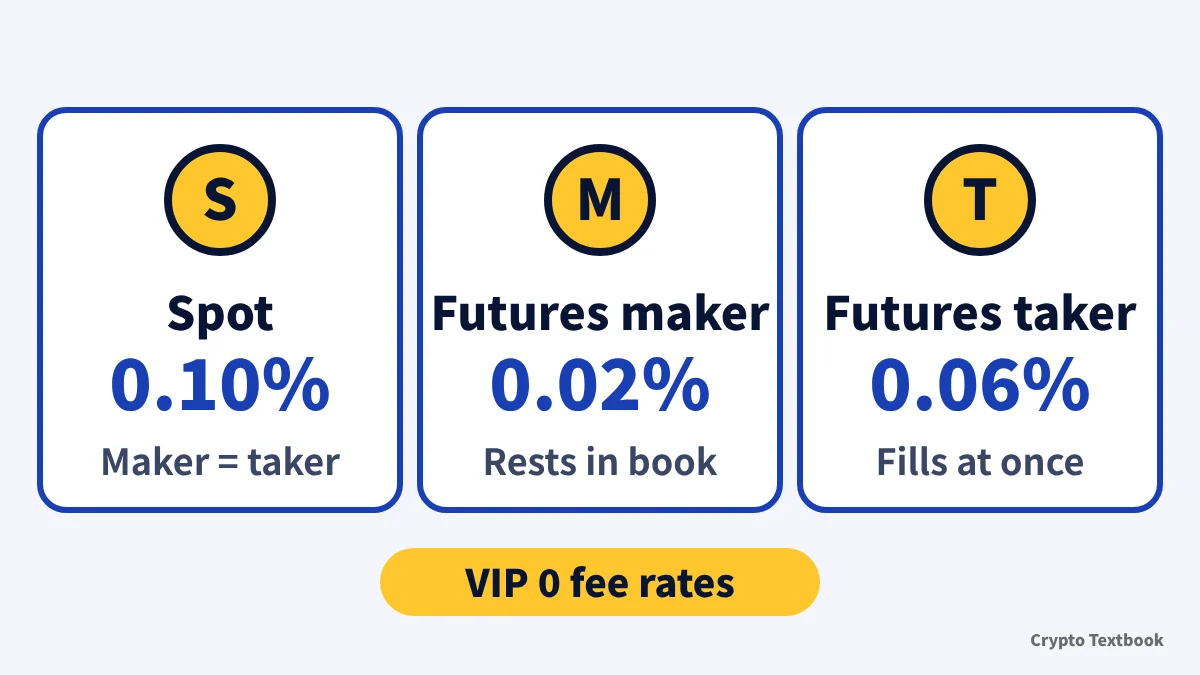
- Spot is 0.10% for both maker and taker, on the top card and in the VIP table
- The spot pair list also shows 0.0800% with 0.1000% struck through
- Futures are 0.02% maker and 0.06% taker (USDT-M and COIN-M)
- The 0.1% spot rate is the same at VIP 0 to 7; only futures fall
- Deposits are free; withdrawals are a flat fee per network (1 USDT on TRC20)
- Futures also carry funding, paid or received while you hold the position
Crypto futures move sharply, and forced liquidation can wipe out all or part of your margin. The higher the leverage, the sooner losses outweigh fees.
Reading the official fee page, and what to do with 0.08%
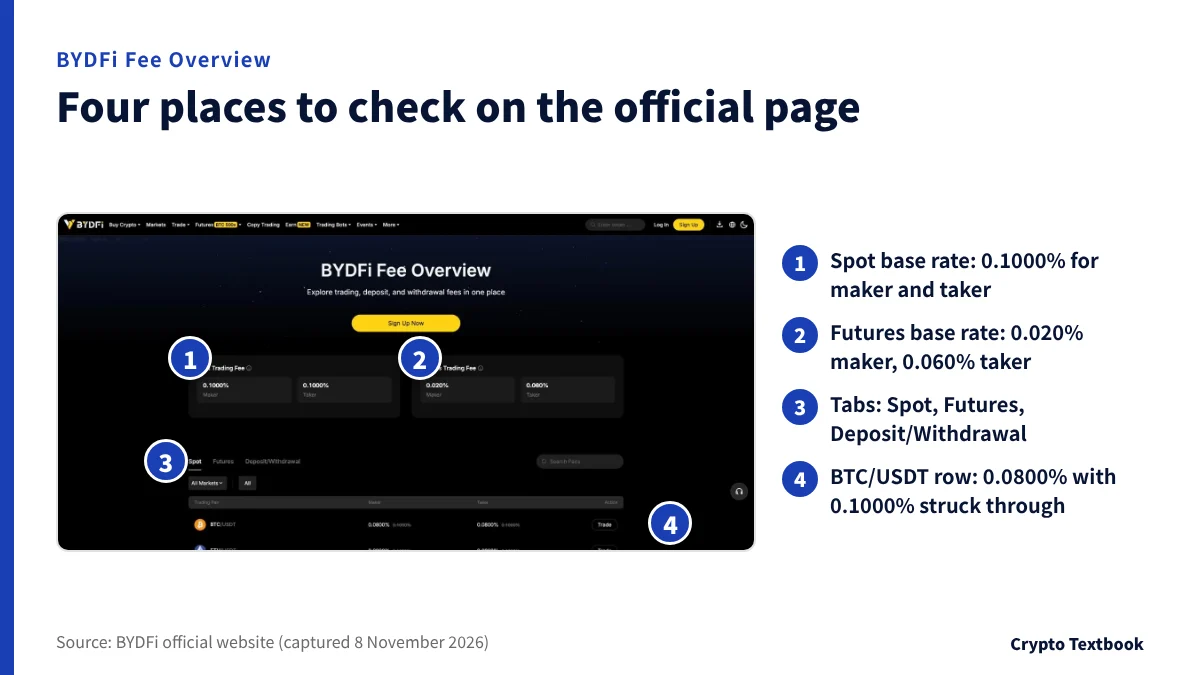
The fee overview can be read without logging in. The two cards at the top show the base rates, and the list below shows rates per pair.
- 01Read the base rates on the cards
Spot shows 0.1000%. Futures show 0.020% maker and 0.060% taker.
- 02Switch tabs for each product
There are three: Spot, Futures and Deposit/Withdrawal. Futures has a dropdown for the contract type.
- 03Read the pair rows
BTC/USDT and similar rows show 0.0800% with 0.1000% struck through next to it.
Of everything checked, only the 0.08% on the list breaks from 0.1%. The spot table in the fee-calculation help (updated 29 October 2026) says 0.1%, and the VIP table shows 0.1% / 0.1% for spot at every level from VIP 0 to 7. No page explains the 0.08%.
The note at the bottom of the page reads: maker and taker rates may differ depending on platform events and the user's region, so refer to your actual trade history.
Check the fee column in your trade history after a fill to see whether 0.08% applied to you. Until then, estimating at 0.10% keeps real costs from exceeding your estimate.
Maker and taker: the futures taker rate is three times higher
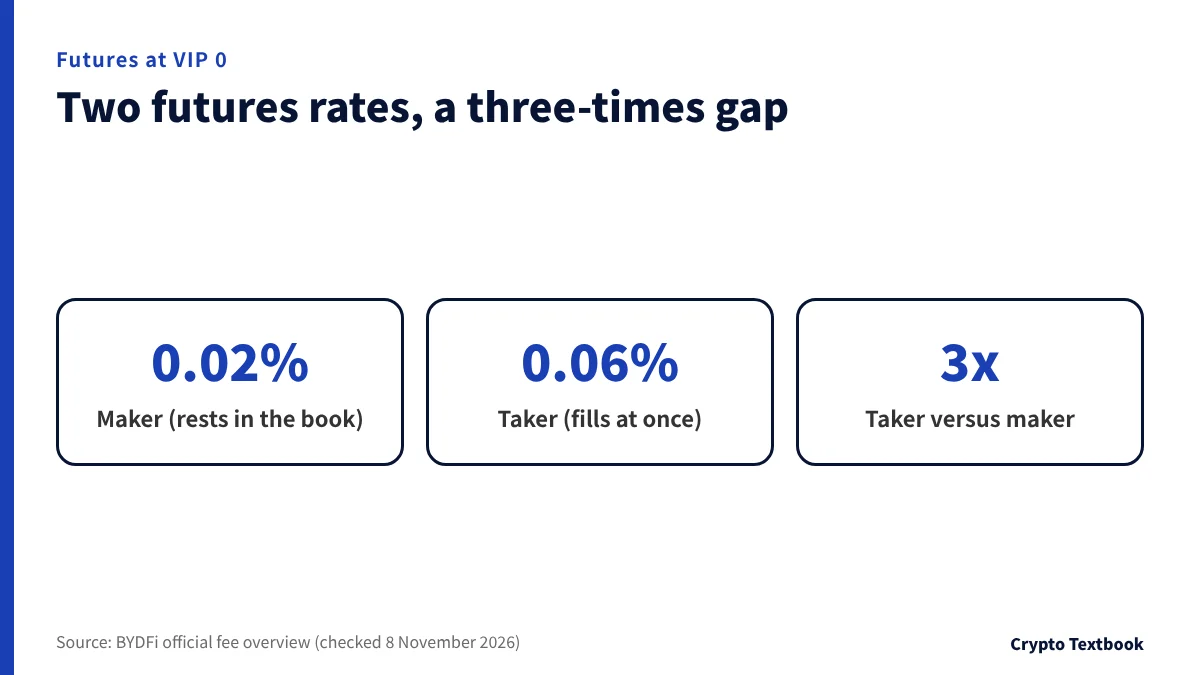
A maker order rests in the order book until it fills. A taker order fills at once against an order already in the book.
At VIP 0, futures cost 0.02% as maker and 0.06% as taker, a three-times gap. Opening 10,000 USDT of position costs 2 USDT as maker and 6 USDT as taker.
In the official help table, USDT-M, COIN-M and futures grid all use the same 0.02% and 0.06%. Spot is 0.10% for both sides, so how you place a spot order does not change the fee.
- On the official futures list, perpetuals such as BTCUSDT and ETHUSDT carry a "special fee rate" label
- Orders that are unfilled or cancelled carry no fee (official help)
- Trading fees are charged in USDT (official help, spot example)
A limit order that matches the book immediately is a taker. Only the part that rests in the book and fills later is a maker.
VIP 0 to 7: spot stays flat, only futures fall
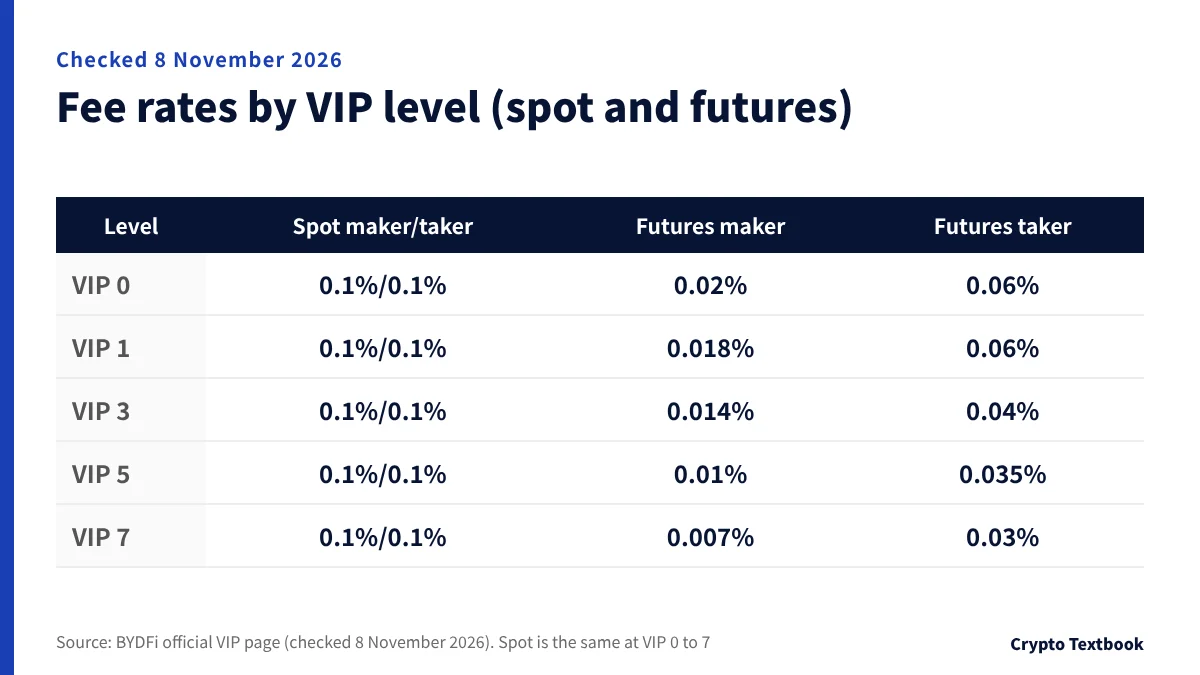
VIP level is scored on 30-day spot volume, 30-day futures volume and asset holdings. The highest level of the three becomes your final level.
| Level | Futures maker | Futures taker |
|---|---|---|
| VIP 0 | 0.02% | 0.06% |
| VIP 1 | 0.018% | 0.06% |
| VIP 2 | 0.016% | 0.05% |
| VIP 3 | 0.014% | 0.04% |
| VIP 4 | 0.012% | 0.04% |
| VIP 5 | 0.01% | 0.035% |
| VIP 6 | 0.008% | 0.032% |
| VIP 7 | 0.007% | 0.03% |
| Level | Spot (30 days) | Futures (30 days) | Holdings |
|---|---|---|---|
| VIP 1 | 100K USDT or more | 10M USDT or more | 50K USDT or more |
| VIP 2 | 500K USDT or more | 20M USDT or more | 100K USDT or more |
| VIP 3 | 1M USDT or more | 30M USDT or more | 250K USDT or more |
| VIP 4 | 2M USDT or more | 50M USDT or more | 750K USDT or more |
| VIP 5 | 5M USDT or more | 100M USDT or more | 2M USDT or more |
| VIP 6 | 10M USDT or more | 200M USDT or more | 5M USDT or more |
| VIP 7 | 100M USDT or more | 5B USDT or more | 50M USDT or more |
- The level refreshes daily at 11:00 Japan time and holds until 10:59 the next day
- If a refresh fails, the previous day's level carries over
- The highest level among the three criteria is the final level
Take a 10,000 USDT futures position, opened and closed. At VIP 0 two taker fills cost 12.0 USDT and two maker fills cost 4.0 USDT. At VIP 3 that falls to 8.0 taker and 2.8 maker, and at VIP 7 to 6.0 taker and 1.4 maker (this site's calculation from the rates above).
The benefits tab also lists 24-hour withdrawal limits by verification stage. At VIP 0 they are 50,000 USDT unverified, 200,000 basic, 500,000 advanced and 800,000 institutional.
The official FAQ says that without KYC, some services such as deposits, withdrawals and trading may be restricted under your region's rules. Whether a resident of Japan can use an unverified account has not been confirmed.
A fee row on this site's BYDFi exchange page says fees fall step by step with VIP level. On the 8 November 2026 official VIP table only futures fall; spot stays at 0.1% at every level.
Worked examples (assumed figures): 1,000 and 10,000 USDT
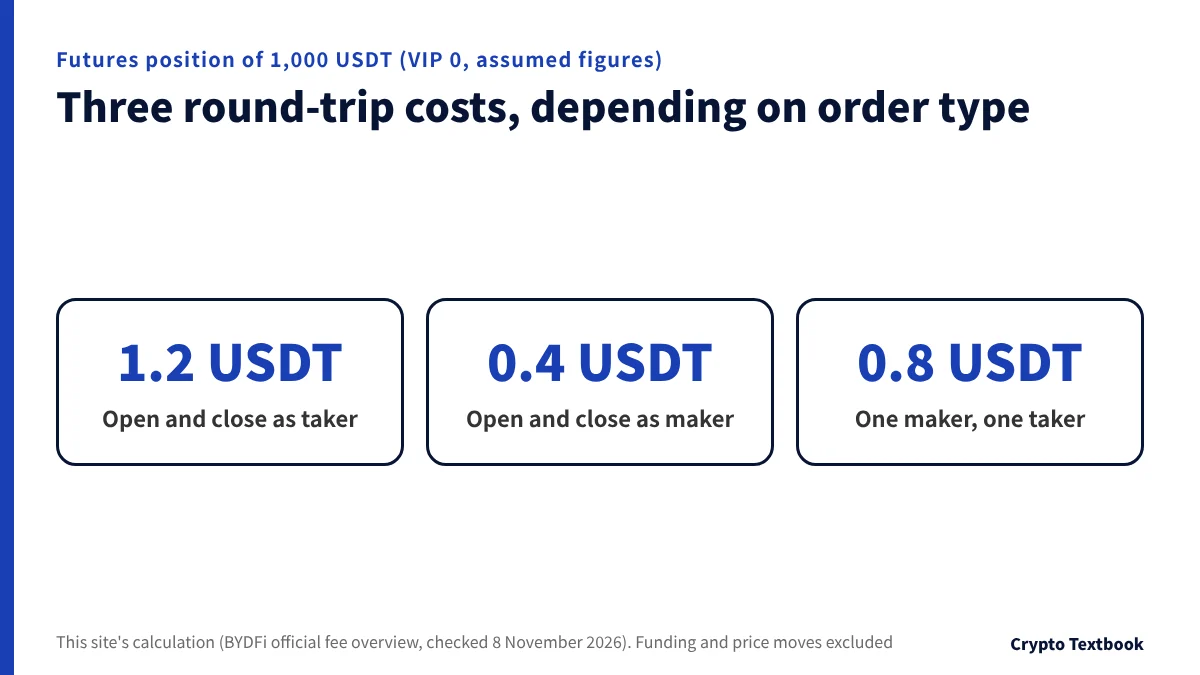
The fee is the rate times the position size (notional), not times your margin. The table uses assumed figures and excludes price moves and funding.
| Trade | Rate | 1,000 USDT | 10,000 USDT |
|---|---|---|---|
| Buy spot once | 0.10% | 1.0 USDT | 10.0 USDT |
| Buy and sell spot | 0.10% x 2 | 2.0 USDT | 20.0 USDT |
| For reference: buy and sell at 0.08% | 0.08% x 2 | 1.6 USDT | 16.0 USDT |
| Futures round trip as taker | 0.06% x 2 | 1.2 USDT | 12.0 USDT |
| Futures round trip as maker | 0.02% x 2 | 0.4 USDT | 4.0 USDT |
| Open as maker, close as taker | 0.02% + 0.06% | 0.8 USDT | 8.0 USDT |
In the official help example, BTC is 40,000 USDT and a market buy of 0.5 BTC costs 20,000 USDT. The 0.1% fee is 20 USDT.
The higher the leverage, the larger the fee against your margin
Fix the margin at 100 USDT and trade a round trip as taker (assumed figures). The higher the leverage, the larger the round-trip fee is against your margin.
- 1x: 100 USDT position, 0.12 USDT fee (0.12% of margin)
- 10x: 1,000 USDT position, 1.2 USDT (1.2%)
- 50x: 5,000 USDT position, 6.0 USDT (6.0%)
- 100x: 10,000 USDT position, 12.0 USDT (12.0%)
At 100x, the round-trip fee alone uses 12.0% of your margin. Losses from price moves and forced liquidation are separate risks.
Funding rate: the cost of holding a futures position
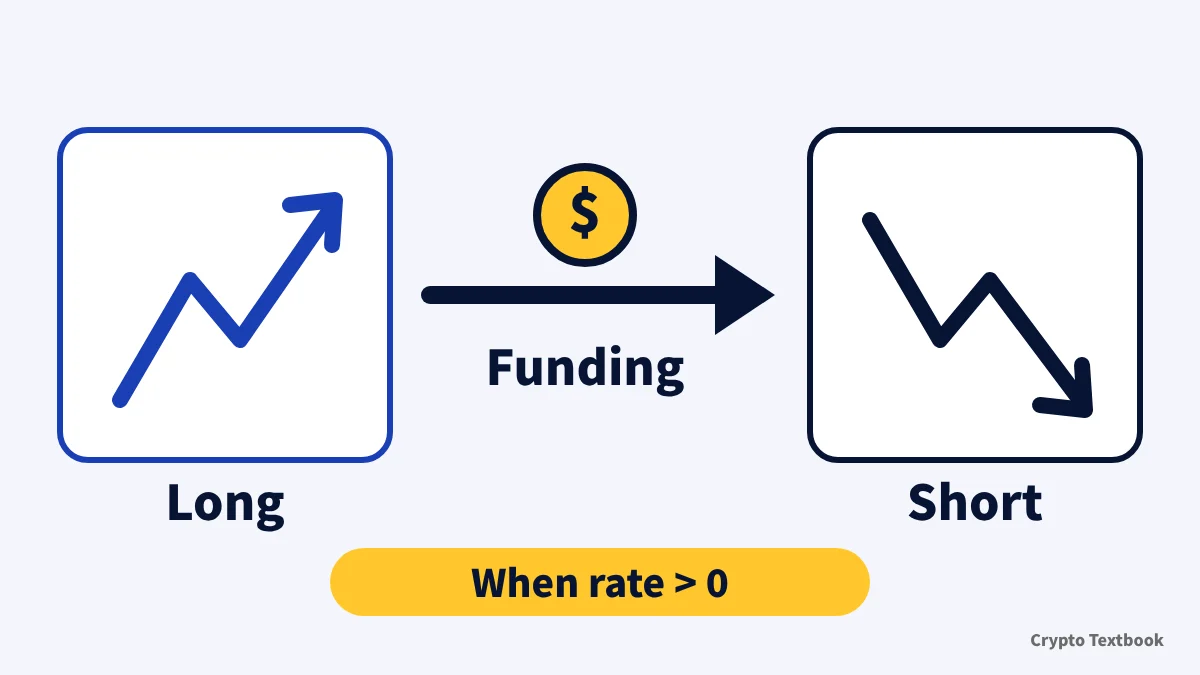
Perpetual futures have no expiry, so funding keeps their price close to spot. It is a cost exchanged between longs and shorts.
When the funding rate is positive, longs pay shorts. When it is negative, shorts pay longs.
| Item | What the official help says |
|---|---|
| Who is charged | Only people holding a position at the funding time. Close before it and you pay or receive nothing |
| Times (8-hour example) | 08:00, 16:00 and 00:00 (UTC+8). In Japan time that is 9:00, 17:00 and 1:00 (this site's conversion) |
| Composite interest rate | 0.01% (0.06% on the quote currency, 0.03% on the base currency, three times a day) |
| USDT-M formula | Position value x funding rate |
| Isolated margin | Deducted from position margin |
| Cross margin | Deducted from available balance, or from the position if that is short |
Assume a contract on an 8-hour interval, a 1,000 USDT position and a steady 0.01% rate. One funding time costs 0.1 USDT, one day (three times) 0.3 USDT, seven days 2.1 USDT and thirty days 9.0 USDT. The 0.01% is the official composite interest rate used as an assumed value, in this site's calculation.
The official formula adds a premium index to the composite rate. Treat 0.01% as a rough guide and read the live rate on the contract page. The official help also warns that funding deductions pull the liquidation price closer to the mark price.
Deposits are free, withdrawals are flat: fees by network
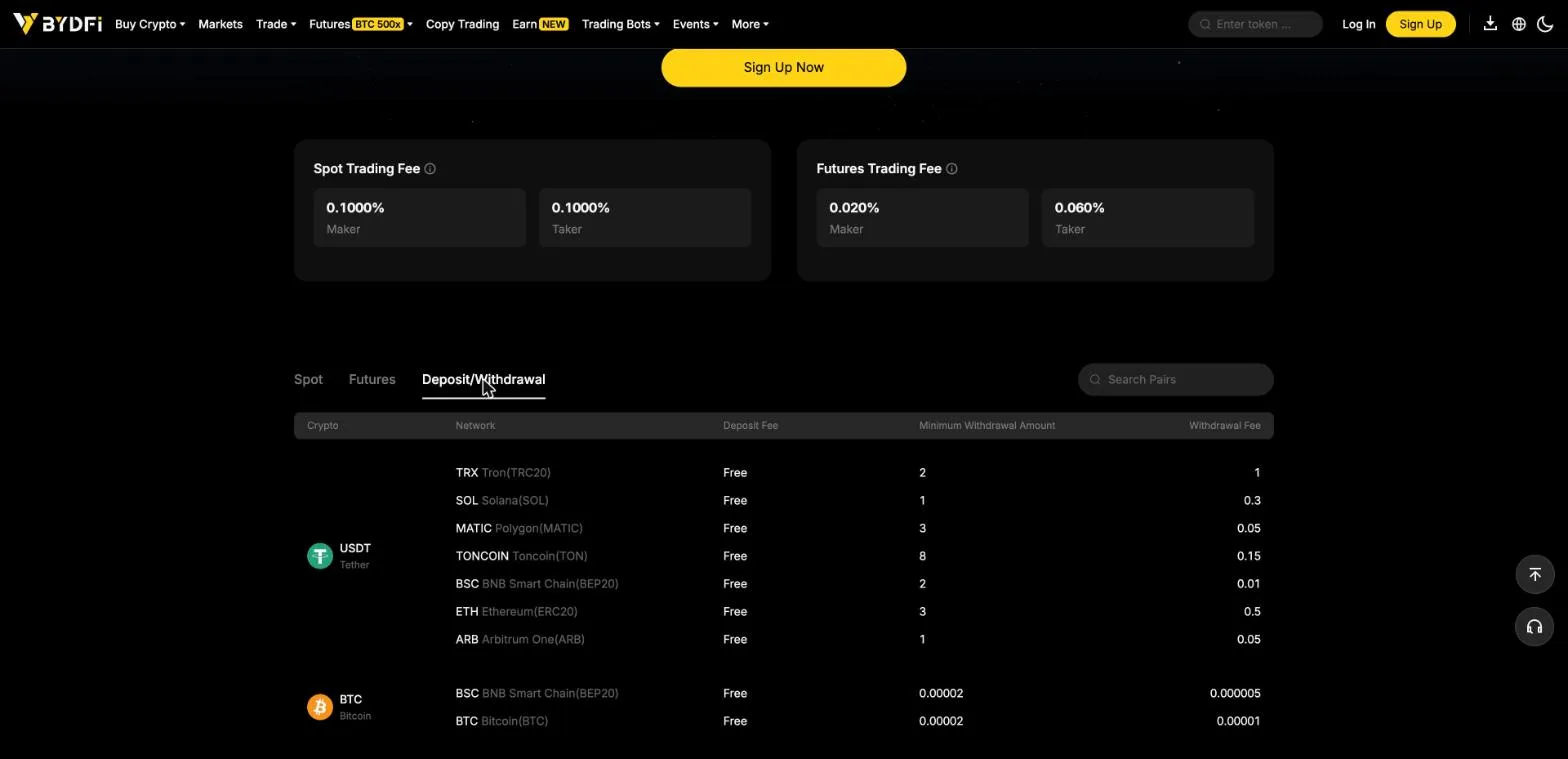
BYDFi charges no deposit fee (official help, updated 30 September 2026). A withdrawal takes a flat amount that depends on the network.
| Network (USDT) | Minimum withdrawal | Withdrawal fee |
|---|---|---|
| Tron (TRC20) | 2 USDT | 1 USDT |
| Solana | 1 USDT | 0.3 USDT |
| Polygon | 3 USDT | 0.05 USDT |
| Toncoin (TON) | 8 USDT | 0.15 USDT |
| BNB Smart Chain (BEP20) | 2 USDT | 0.01 USDT |
| Ethereum (ERC20) | 3 USDT | 0.5 USDT |
| Arbitrum One | 1 USDT | 0.05 USDT |
| Token | Network | Min. withdrawal | Withdrawal fee |
|---|---|---|---|
| BTC | Bitcoin | 0.00002 | 0.00001 |
| BTC | BNB Smart Chain (BEP20) | 0.00002 | 0.000005 |
| ETH | Ethereum (ERC20) | 0.0001 | 0.00004 |
| ETH | Arbitrum One | 0.0001 | 0.0000035 |
| ETH | BNB Smart Chain (BEP20) | 0.0005 | 0.0002 |
Because the fee is flat, small withdrawals carry the heaviest share (this site's calculation).
- Send 20 USDT on TRC20: 1 USDT fee, 5.0%
- Send 20 USDT on ERC20: 0.5 USDT, 2.5%
- Send 20 USDT on BEP20: 0.01 USDT, 0.05%
- Send 100 USDT: 1.0% on TRC20, 0.01% on BEP20
Fees can change with network congestion, and the official help tells you to check the withdrawal page before you submit. Withdrawals to another BYDFi user's address are free.
Deposit basics and choosing a network (beginner guide) →
Sending from a Japanese exchange abroad: the Travel Rule (column) →
Costs missing from the fee page: grid, recurring buys, convert
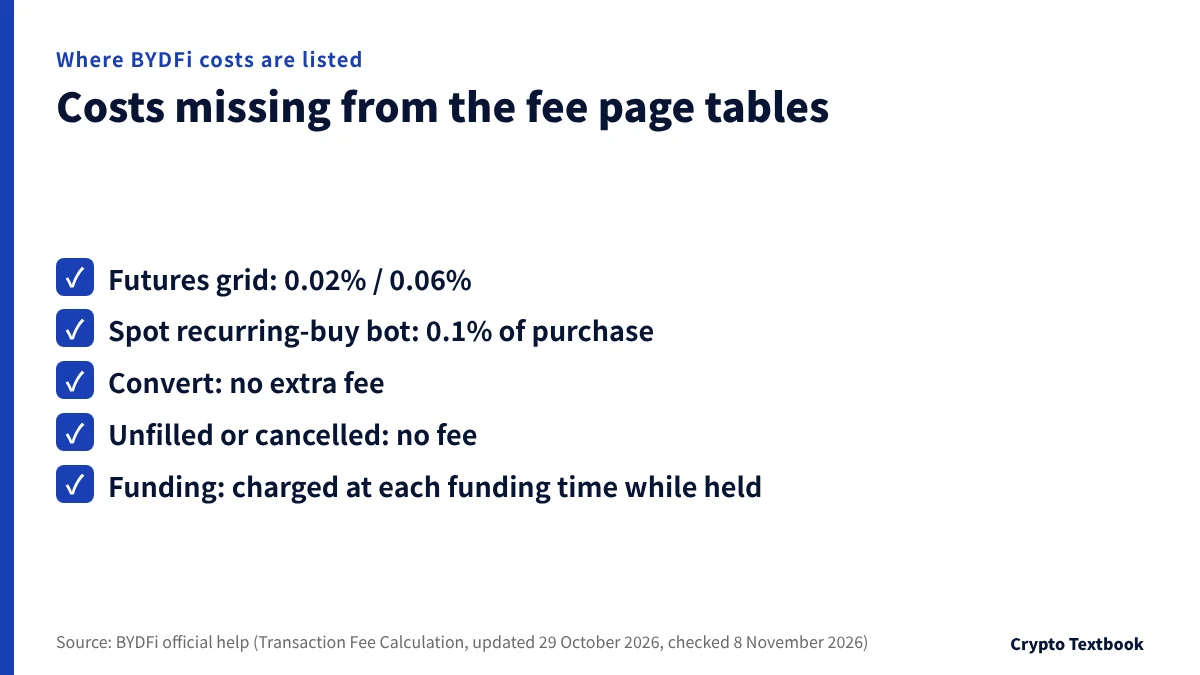
Costs missing from the fee page tables can be confirmed in the official help, Transaction Fee Calculation (updated 29 October 2026).
- Futures grid trading: 0.02% maker, 0.06% taker. An order that rests in the book is a maker; one that fills at once is a taker
- Spot recurring-buy bot: 0.1% of the purchase amount
- Convert: no extra fee. The quoted price is the final amount
- Unfilled or cancelled orders: no fee
The fee page and help article checked contain no rate for leveraged tokens or copy trading. Confirm those on the official screens before you use them.
Editorial verdict: the order to estimate your costs
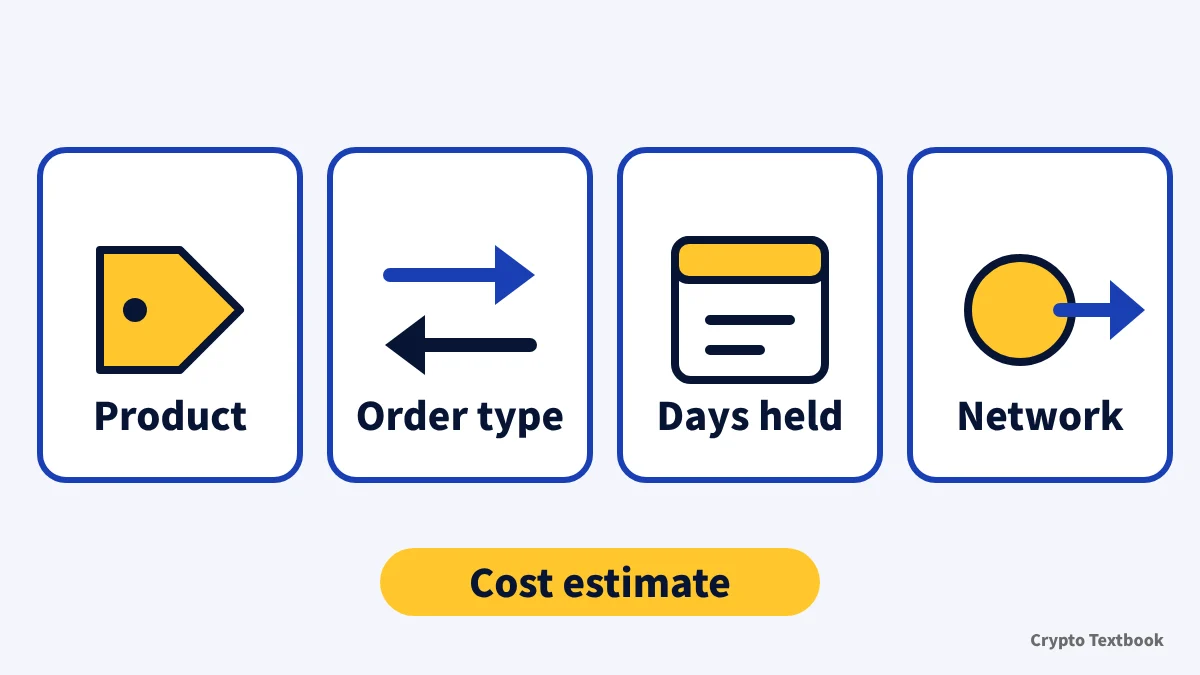
If you only trade spot, multiply 0.10% by how often you trade and confirm any 0.08% in your history. If you trade futures, count how many orders can rest as maker and how many days you hold. If you withdraw small amounts often, pick the network with the smallest flat-fee share before you send.
- 01Confirm the product and rate
Spot or futures decides which table applies.
- 02Count the maker fills
A futures order that rests in the book pays 0.02% instead of 0.06%.
- 03Check holding days and funding
Funding is charged three times a day for each day you hold.
- 04Choose the withdrawal network
Work out the flat fee as a share of the amount before you send.
Open the BYDFi sign-up page (this site's referral link) →
BYDFi exchange page (fees, leverage and products) →
Identity verification (KYC) stages and withdrawal limits (beginner guide) →
Frequently asked questions
Q. How much are BYDFi trading fees?
A. On the official page of 8 November 2026, spot is 0.10% for both maker and taker. Futures are 0.02% maker and 0.06% taker. Futures fall as your VIP level rises, but spot stays the same from VIP 0 to 7.
Q. Why does BYDFi show both 0.08% and 0.10% for spot?
A. The official page gives no reason. Its note says rates can differ by platform event or user region and points you to your actual trade history. Estimate at 0.10% and confirm in your history whether 0.08% applied.
Q. What is the difference between maker and taker on BYDFi?
A. A maker fee applies when your order rests in the book and fills later. A taker fee applies when it fills at once against the book. At VIP 0 the futures taker rate is three times the maker rate; spot is 0.10% for both.
Q. Does BYDFi charge a deposit fee?
A. No. The official help, updated 30 September 2026, says deposits carry no fee. The sending exchange or wallet may charge its own withdrawal fee.
Q. How much is the BYDFi withdrawal fee?
A. It is a flat amount per token and network. In the 8 November 2026 table, USDT costs 1 on TRC20, 0.5 on ERC20 and 0.01 on BEP20. Check the withdrawal page before you submit.
Q. How do I raise my BYDFi VIP level?
A. BYDFi scores 30-day spot volume, 30-day futures volume and holdings, and applies the highest level. VIP 1 needs 100,000 USDT of spot volume, 10 million USDT of futures volume or 50,000 USDT held. It refreshes daily at 11:00 Japan time.
Q. What is the BYDFi funding rate?
A. It is the cost longs and shorts exchange while a perpetual position is open. Only positions held at the funding time are charged. When the rate is positive, longs pay shorts.
Q. Do BYDFi futures fees fall with VIP level?
A. Yes. On the official VIP table, maker falls from 0.02% at VIP 0 to 0.007% at VIP 7, and taker from 0.06% to 0.03%. Spot stays at 0.1% at every level.
Sources
- BYDFi | Fee Overview (official, spot, futures and deposit/withdrawal, checked and captured 8 November 2026) →
- BYDFi | BYDFi VIP (official, requirements, benefits and VIP level rules, checked and captured 8 November 2026) →
- BYDFi | Transaction Fee Calculation (official help, updated 29 October 2026, checked 8 November 2026) →
- BYDFi | How Are Funding Rates and Funding Fees Calculated? (official help, published 1 September 2026, checked 8 November 2026) →
- BYDFi | Deposit & Withdrawal Fees (official help, updated 30 September 2026, checked 8 November 2026) →
- BYDFi | BYDFi KYC Verification FAQ (official help, updated 3 November 2026, checked 8 November 2026) →
FX Textbook is an independent information site, not an exchange or a provider of personal investment advice. Crypto-asset trading involves risk: price volatility, liquidation of leveraged positions, transfer mistakes and the operational risk of exchanges and service providers can cause you to lose some or all of your invested capital. No result is guaranteed.
NEXT STEP
Check BYDFi fees, leverage and products on the exchange page.
Spot, futures and copy trading terms, organised from the official pages.
Exchanges related to this column
Fees, leverage, funding options and current offers are on each exchange page.