
This article checks which Bitunix futures contracts allow 200x and how far price must move to trigger liquidation, using the official help centre and API.
Only 5 of 794 trading pairs allow 200x. The cap falls as a position grows, and liquidation runs in order: cancel open orders, partial close, full close.
Liquidation prices by leverage are worked out with hypothetical numbers (checked 8 November 2026).
Short answer: 200x applies to 5 of 794 pairs, and caps fall as positions grow
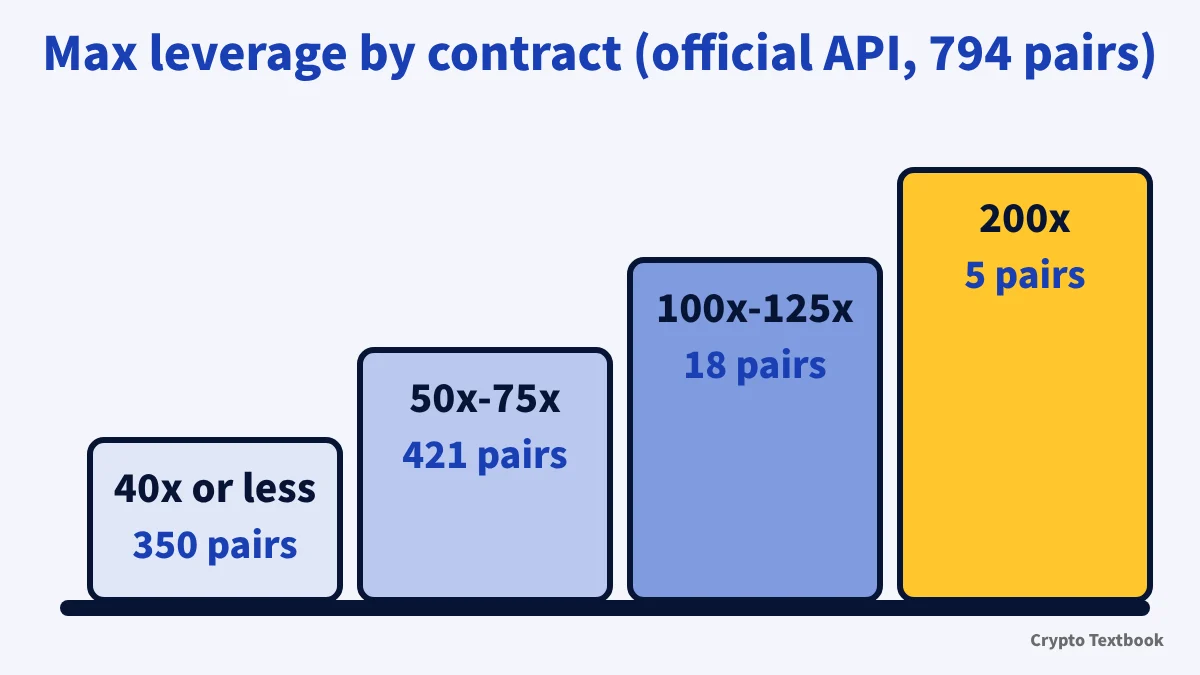
- 200x applies to 5 perpetual contracts: BTCUSDT, ETHUSDT and three gold or silver pairs
- Caps run from 5x to 200x by contract. SOL and XRP are 100x, DOGE and BNB are 75x
- The larger the position, the lower the leverage you can set (tiered risk limit)
- Liquidation runs in order: cancel open orders, partial close, full close
- VIP0 fees are 0.02% maker and 0.06% taker. Funding is usually every 8 hours
- Demo trading (50,000 USDT of virtual funds) works in the app without KYC
Maximum leverage differs by contract: five pairs at 200x, and caps that fall by tier
The official blog says the cap on BTC/USDT and ETH/USDT was raised from 125x to 200x. It applies within position size and risk limits.
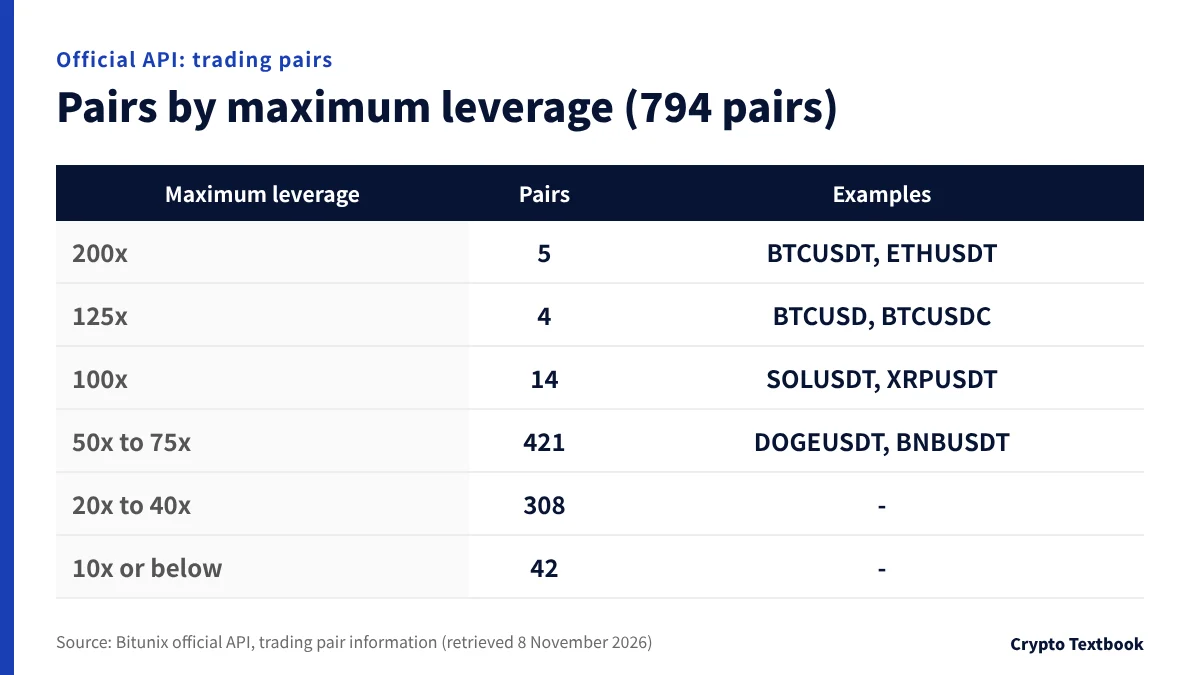
Counting the caps in the official API pair list (794 pairs, 8 November 2026) gives five pairs at 200x. They are BTCUSDT and ETHUSDT, plus XAUUSDT, XAGUSDT and PAXGUSDT, which relate to gold and silver.
| Maximum leverage | Pairs | Examples |
|---|---|---|
| 200x | 5 | BTCUSDT, ETHUSDT, XAUUSDT |
| 125x | 4 | BTCUSD, BTCUSDC, ETHUSDC |
| 100x | 14 | SOLUSDT, XRPUSDT |
| 50x to 75x | 421 | DOGEUSDT, BNBUSDT (75x) |
| 20x to 40x | 308 | - |
| 10x or below | 42 | - |
※ The help page "What is futures trading?" (updated 28 October 2026) still says up to 125x. Check the cap for each contract on the trading screen.
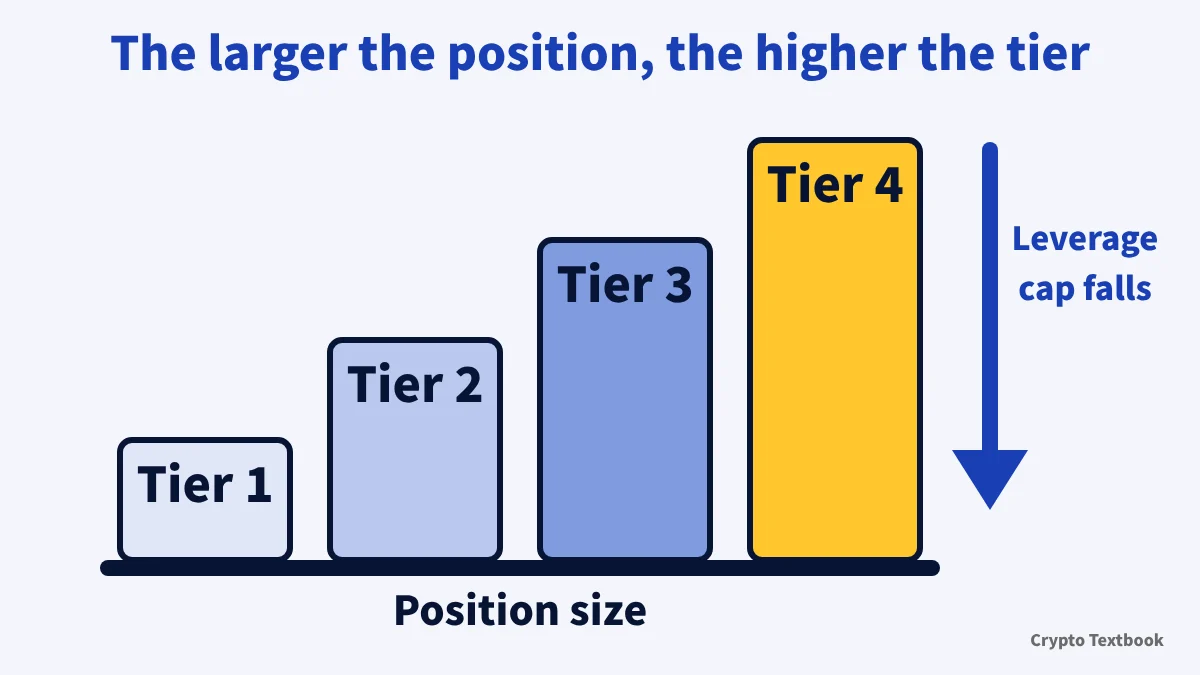
Bitunix futures use a tiered risk limit. Each tier sets a notional value limit, a maximum leverage and a maintenance margin rate.
- Official help example for BTC perpetuals: choosing 50x puts you in tier 3, with a limit of 2,500,000 USDT
- The larger the position, the higher the maintenance margin rate and the lower the leverage you can set
- Adding to a position can move it into a higher tier and lower the leverage you can use
- Counting: isolated margin counts long and short on each contract separately, cross margin adds both directions
The example figures come from the help page updated 28 May 2026. The current tier table opens from the icon next to the pair name on the trading screen.
Cross and isolated margin: how far a loss can reach
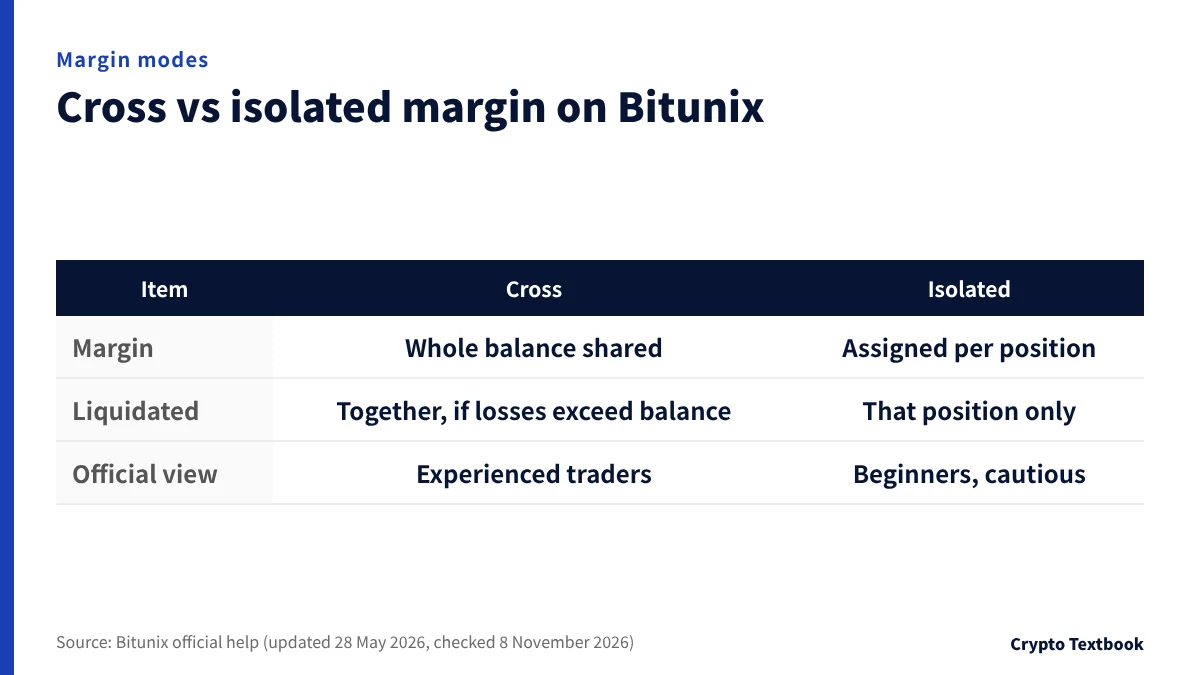
There are two margin modes, cross and isolated. On the web trading screen, use "Cross/Isolated" on the right. In the app, use "Margin Mode".
| Item | Cross | Isolated |
|---|---|---|
| Margin | Whole futures balance shared by all positions | Only the amount assigned to each position |
| What is liquidated | Positions together, once losses exceed the balance | Only that position's margin |
| Official positioning | For experienced traders confident in risk management | For beginners and cautious traders |
Leverage is changed on the order panel. The Order Leverage feature (updated 22 May 2026) lets you change it while open limit or trigger orders stay in place.
Multi-assets mode lets you post tokens other than USDT, such as BTC or ETH, as margin. Fees and PnL settle in USDT, so a negative USDT balance becomes a debt. Interest applies once the debt exceeds 20,000 USDT.
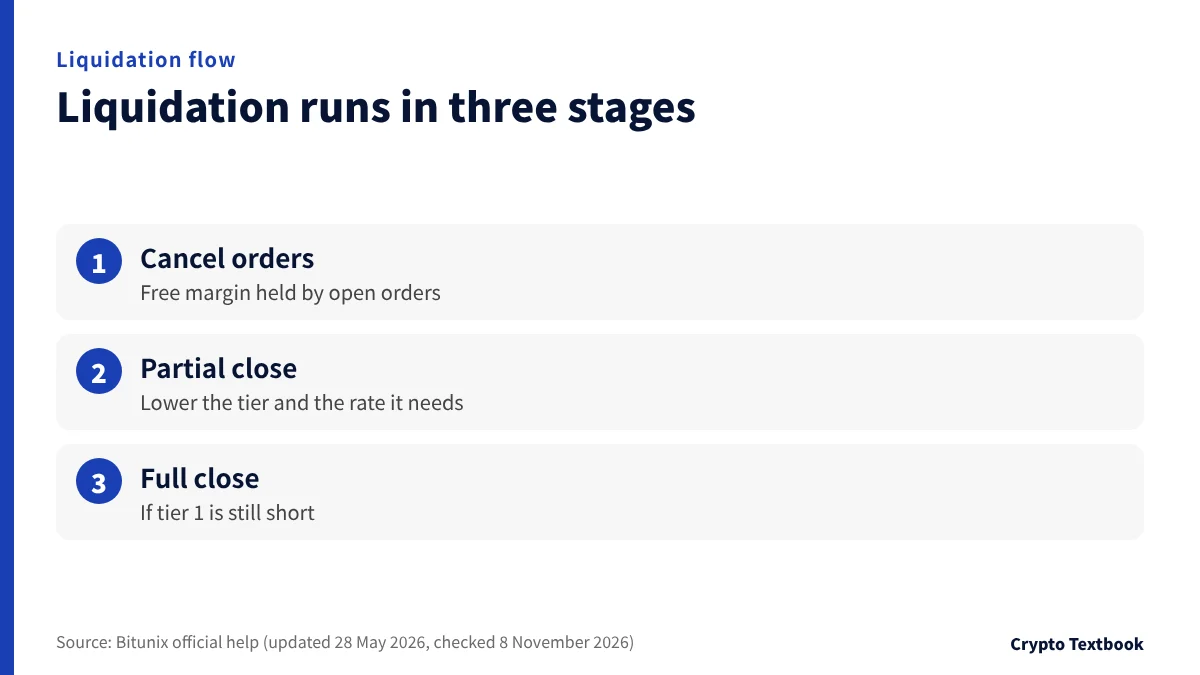
Liquidation in three stages: cancel orders, partial close, full close
Liquidation happens when your available margin falls below the maintenance margin. Maintenance margin is entry price x size x maintenance margin rate.
- 01Cancel open orders
This frees margin that was reserved for orders and tests whether the position can be kept.
- 02Partially close if the tier is 2 or higher
Reducing the position lowers the tier and the maintenance margin rate it needs.
- 03Fully close if tier 1 is still short
The partial close uses a FOK order. If it fails, the whole position is liquidated.
In the help example, a BTC position of 5,000,000 USDT in tier 4 is cut to the tier 3 limit of 2,500,000 USDT. The amount closed is 2,500,000 USDT, and its profit or loss goes into the account balance.
Bitunix describes liquidation as a way to keep the account out of debt. The futures help pages do not say what happens if the balance still turns negative. They also do not say whether the mark price or the last price triggers liquidation.
Futures can wipe out all of your margin in a short time. Bitunix's risk disclosure (updated 20 July 2026) says that in sharp moves you may be unable to close before liquidation, and that the liquidation price and the actual execution price can differ.
Liquidation price by leverage: a worked example with hypothetical numbers
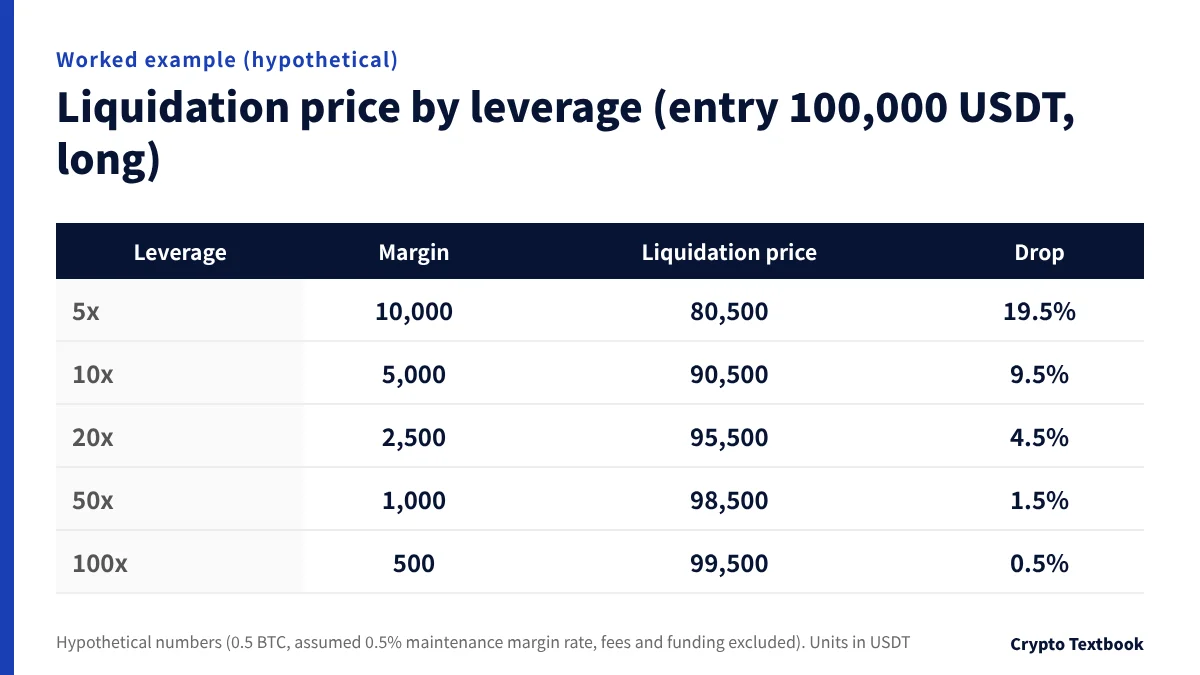
This uses hypothetical numbers. A long of 0.5 BTC opened at 100,000 USDT has a notional value of 50,000 USDT, in isolated margin.
The maintenance margin rate is assumed to be 0.5%, the value the help page uses for BTC at 100x. Fees and funding are excluded, and the formula is entry x (1 - 1/leverage + maintenance margin rate).
| Leverage | Margin | Liquidation price | Drop from entry |
|---|---|---|---|
| 5x | 10,000 USDT | 80,500 USDT | 19.5% |
| 10x | 5,000 USDT | 90,500 USDT | 9.5% |
| 20x | 2,500 USDT | 95,500 USDT | 4.5% |
| 50x | 1,000 USDT | 98,500 USDT | 1.5% |
| 100x | 500 USDT | 99,500 USDT | 0.5% |
※ The help example (100x, 500 USDT margin) states 99,505 USDT, but the same formula gives 99,500 USDT. This article uses the formula's result.
Raising leverage from 5x to 100x shrinks the distance to liquidation from 19.5% to 0.5%. At 200x, 1/200 is also 0.5%, so a 0.5% rate would leave no room. In practice each tier uses its own maintenance margin rate, so a 200x calculation needs the rate from the tier table.
In cross margin, the same 0.5 BTC long moves with account balance.
- Account balance 1,000 USDT: liquidation price 98,500 USDT (1.5% below entry)
- Account balance 5,000 USDT: liquidation price 90,500 USDT (9.5% below entry)
Fees: the higher the leverage, the bigger the share of margin
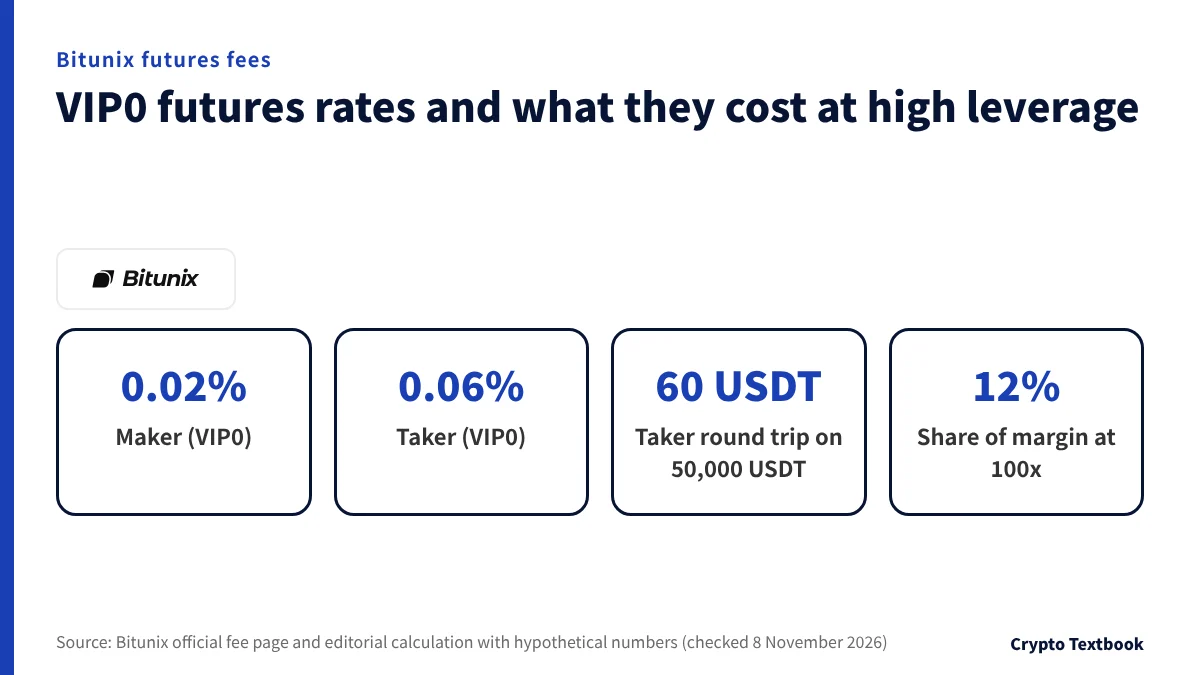
The base futures rate (VIP0) is 0.02% maker and 0.06% taker. The fee page (checked 3 November 2026) and the order panel (checked 8 November) show the same values.
Fees apply to position size, not margin, once when you open and once when you close. A notional of 50,000 USDT traded as taker both ways costs 60 USDT (hypothetical numbers).
- 10x (5,000 USDT margin): 1.2% of margin
- 50x (1,000 USDT margin): 6% of margin
- 100x (500 USDT margin): 12% of margin
- 200x (250 USDT margin): 24% of margin
Opening and closing as maker still costs 20 USDT, which is 4% of margin at 100x. A futures bonus can pay for margin and fees. It cannot be withdrawn, and moving funds out of the futures account makes it expire (official help, updated 28 May 2026).
Bitunix new-user rewards (futures bonus conditions) →
Bitunix referral code (fUys): new-user reward conditions and what happens if you forget →
Funding: paid every 8 hours on position value times the rate
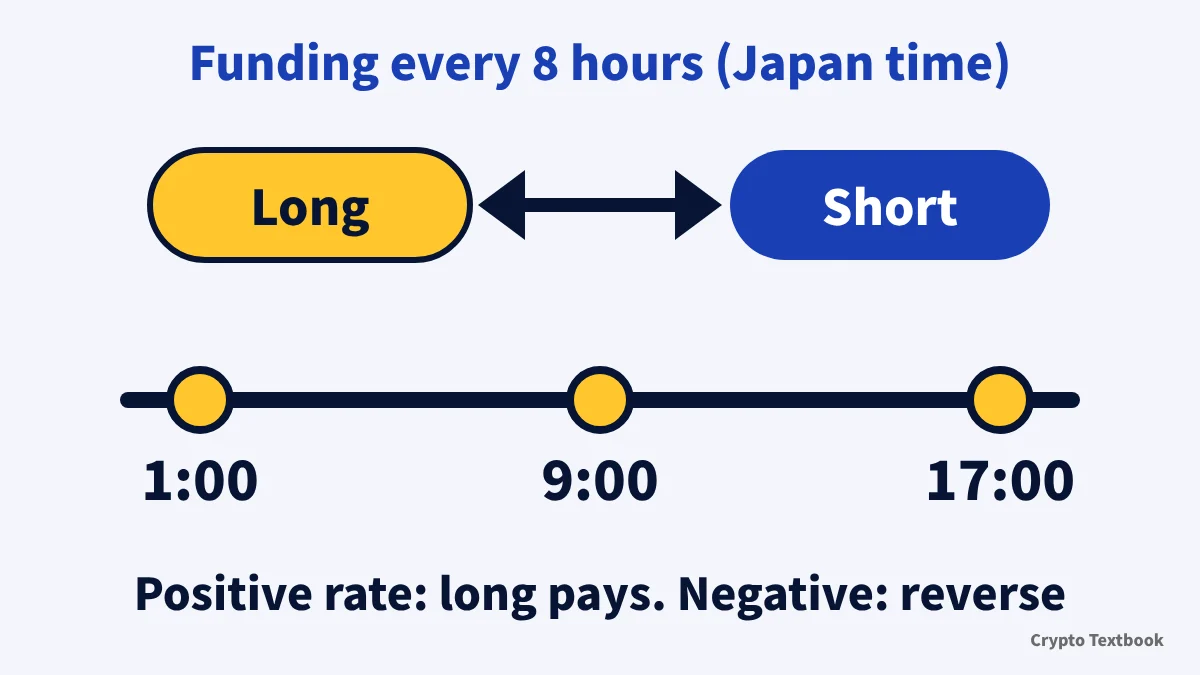
Perpetual contracts have no expiry, so funding pulls the contract price toward spot. The funding amount is position value times the funding rate. A positive rate means longs pay, and a negative rate means shorts pay.
Settlement is usually every 8 hours, at 00:00, 08:00 and 16:00 UTC. That is 9:00, 17:00 and 1:00 in Japan, and some contracts use different times. You pay or receive only if you hold the position at settlement.
With hypothetical numbers, a position value of 50,000 USDT and a rate of +0.01% means a long pays the following.
- Each time: 5 USDT
- One day (3 times): 15 USDT
- Seven days (21 times): 105 USDT
The rate changes each period, and you can check it on screen before you order. In cross margin, funding comes out of the futures account balance. In isolated margin, it comes from the futures balance too. If that is short, open orders are cancelled to free funds, and if there are none it is charged to the position.
Demo trading: 50,000 USDT of virtual funds, including liquidation
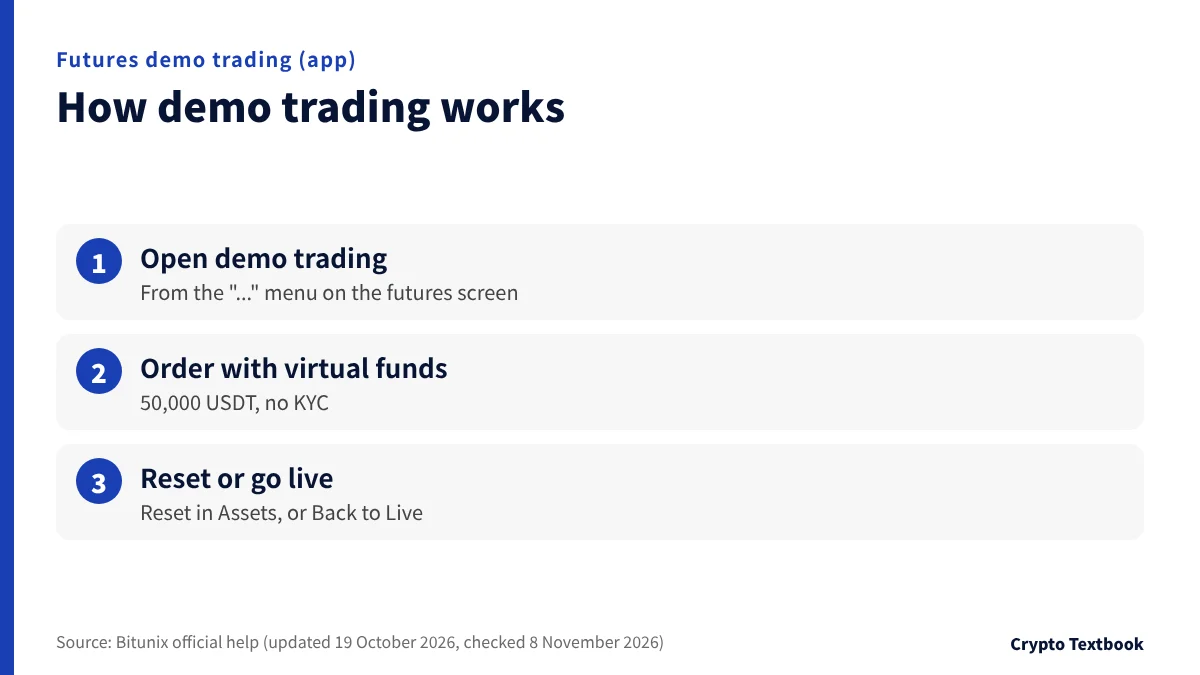
The Bitunix app has demo trading for futures. Tap "..." at the top right of the futures screen, open Quick Access and choose Demo Trading. No KYC is needed, only a login.
- USDT-margined perpetuals only. Cross and isolated margin work as in live trading
- Liquidation follows the live rules with no simplification. Funding is recorded at live rates
- No slippage, and orders do not touch the order book, so fills differ from live
- No deposits, withdrawals or transfers, and one demo account per master account
- Demo volume does not count toward live VIP progress, and copy trading and grid bots are unavailable
Bitunix copy trading: how to follow a trader and the 10x leverage cap →
The virtual balance is 50,000 USDT, and you can reset it by hand from Assets. The FAQ on the same help page also mentions 5,000 USDT, so check the figure on screen before you reset.
The page is split on fees: the overview says VIP0 rates, while the notes say rates follow your live VIP level. Check that the "Demo" label is showing before you order. Tap "Back to Live" at the top right to return.
Six checks before an order, and how to think by situation
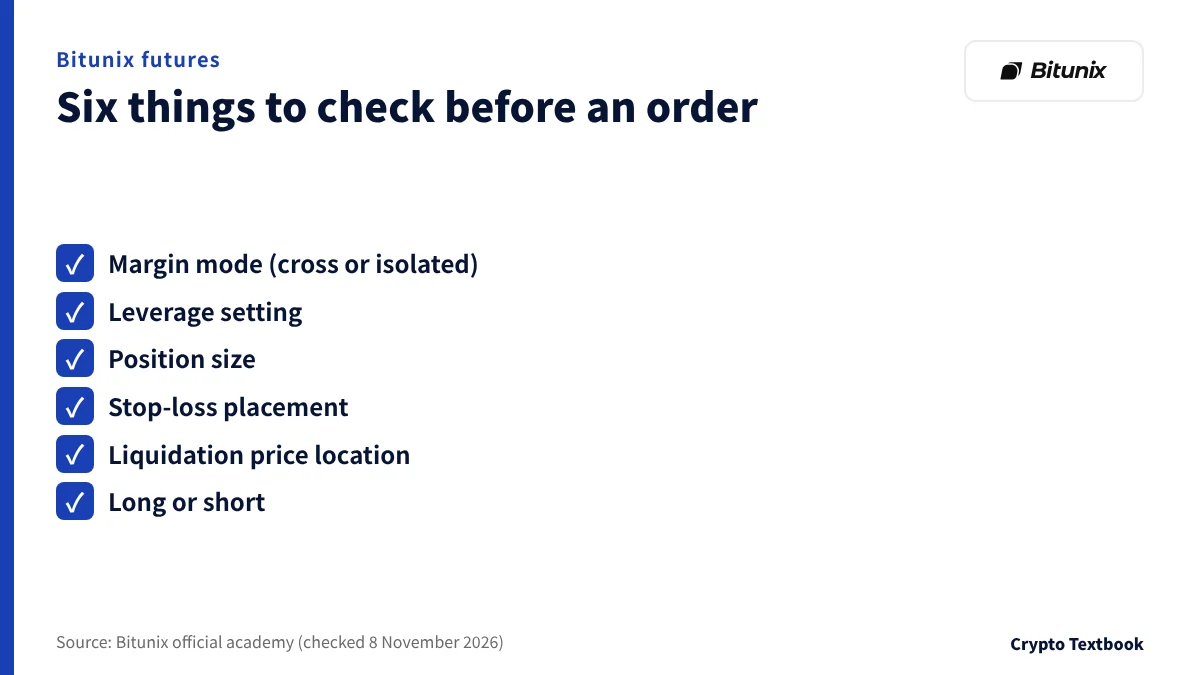
The official academy lists six items to scan in ten seconds before you confirm an order.
- Margin mode (cross or isolated)
- Leverage setting
- Position size
- Stop-loss placement
- Liquidation price location
- Long or short
The official blog says a stop-loss should not sit only near the liquidation price. It belongs where the trade idea is wrong. You set stop-loss and take-profit with TP/SL on the order panel, and a market stop-loss can fill away from its price in sharp moves.
A paid Guaranteed Stop Loss also exists. It aims to close at the preset price, and it currently covers BTCUSDT, ETHUSDT, SOLUSDT and XRPUSDT. A fee applies only when it triggers and fills, and Bitunix says it does not guarantee profit.
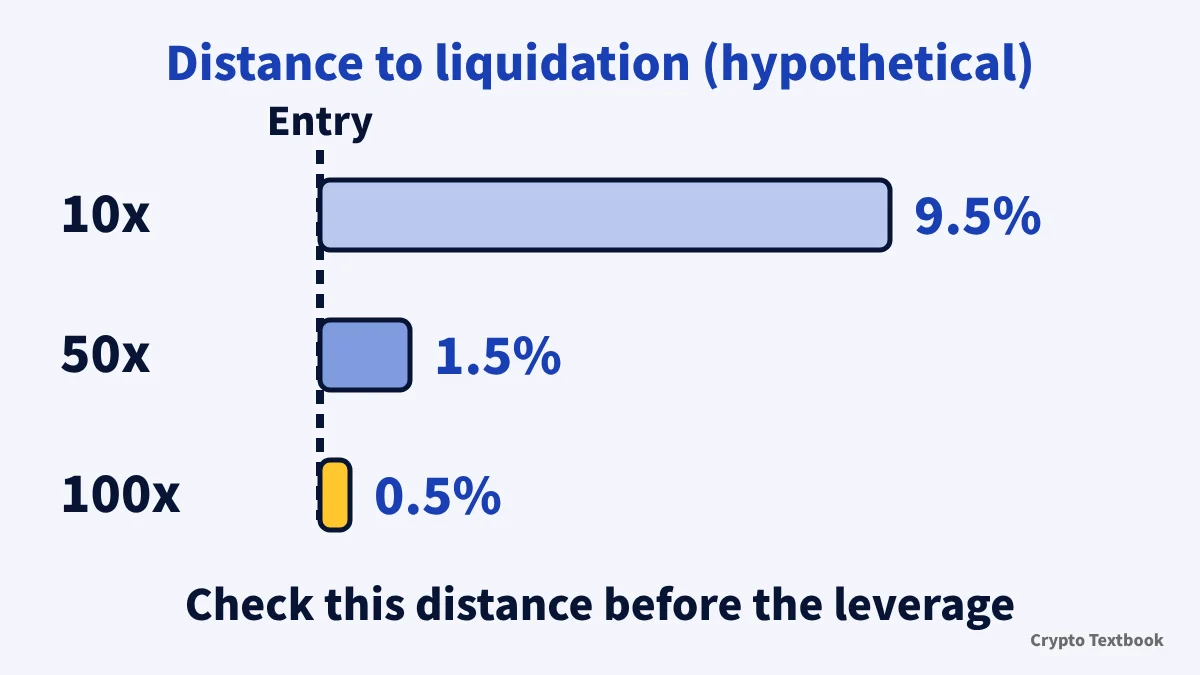
If futures are new to you, start with demo trading and isolated margin, and look at the distance to liquidation before the leverage. Only five pairs offer 200x, and the cap falls on large positions. Before you trade, check how many percent away your liquidation price sits.
- First time on futures: try demo trading (50,000 USDT) with isolated margin and low leverage
- Several positions: cross shares the whole account as collateral, so check first that losses can spread
- Holding for long: funding applies every 8 hours, so count it apart from profit and loss
- High leverage: check the cap and maintenance margin rate for your position size in the tier table
Frequently asked questions
Q. What is the maximum leverage on Bitunix?
A. BTC/USDT and ETH/USDT perpetuals go up to 200x, within position size and risk limits, and large positions get lower caps. As of 8 November 2026, five contracts in the official API show 200x.
Q. Does every Bitunix contract allow 200x?
A. No. Of 794 trading pairs in the official API, five show 200x, and most sit between 20x and 75x. SOL and XRP were 100x, and DOGE and BNB were 75x.
Q. What is liquidation on Bitunix?
A. It is the system closing your position when available margin falls below the maintenance margin. It first cancels open orders, then partially closes to lower the tier if it is 2 or higher, and fully closes if that is not enough.
Q. How is the liquidation price calculated on Bitunix?
A. Maintenance margin is entry price x size x maintenance margin rate. For an isolated long, the liquidation price is roughly entry x (1 - 1/leverage + maintenance margin rate). Fees and funding are not in that formula, so the real price can differ a little.
Q. Can my balance go negative on Bitunix futures?
A. Bitunix describes liquidation as a way to keep the account out of debt. The futures help pages do not say what happens if the balance still turns negative, and in sharp moves a position may not close at the liquidation price.
Q. How often is Bitunix funding charged?
A. Usually every 8 hours at 00:00, 08:00 and 16:00 UTC (9:00, 17:00 and 1:00 in Japan). Some contracts use different times. You pay or receive only if you hold the position at settlement.
Q. Does Bitunix have demo trading for futures?
A. Yes. Open Demo Trading from the "..." menu at the top right of the futures screen in the app. You get 50,000 USDT of virtual funds with no KYC, on USDT-margined perpetuals only, and liquidation follows the live rules.
Sources
- Bitunix | Bitunix Futures—Liquidation Mechanism and Tiered Risk Limit (official help centre, updated 28 May 2026, checked 8 November 2026) →
- Bitunix | Bitunix Futures-Tiered Maintenance Margin Rate Rules (official help centre, updated 28 May 2026, checked 8 November 2026) →
- Bitunix | Forced Liquidation in Futures Trading and Its Calculation Rules (official help centre, updated 28 May 2026, checked 8 November 2026) →
- Bitunix | Introduction to Futures Funding Rate (official help centre, updated 28 May 2026, checked 8 November 2026) →
- Bitunix | Futures Margin Modes: Cross Margin vs Isolated Margin (official help centre, updated 28 May 2026, checked 8 November 2026) →
- Bitunix | Bitunix Futures - Introduction to Combined Margin (official help centre, updated 28 May 2026, checked 8 November 2026) →
- Bitunix | How to Use the Order Leverage Feature (official help centre, updated 22 May 2026, checked 8 November 2026) →
- Bitunix | Trading Fees Explanation & Calculation (Bitunix Futures) (official help centre, updated 28 May 2026, checked 8 November 2026) →
- Bitunix | Bitunix Demo Trading Guide (App) (official help centre, updated 19 October 2026, checked 8 November 2026) →
- Bitunix | Bitunix Futures - Guaranteed Stop Loss Guide (official help centre, checked 8 November 2026) →
- Bitunix | What is Bitunix Futures Bonus ? (official help centre, updated 28 May 2026, checked 8 November 2026) →
- Bitunix | Risk Disclosure (official, updated 20 July 2026, checked 8 November 2026) →
- Bitunix | Bitunix Leverage Explained: How Leverage Works in Futures Trading (official blog, updated 21 August 2026, checked 8 November 2026) →
- Bitunix | Bitunix USDC-M Futures: 200x BTC & ETH Leverage (official blog, updated 13 September 2026, checked 8 November 2026) →
- Bitunix | Official API: trading pair information, trading_pairs (794 pairs, retrieved 8 November 2026) →
- Bitunix | Fees (official, VIP0 futures maker / taker, checked 3 November 2026) →
FX Textbook is an independent information site, not an exchange or a provider of personal investment advice. Crypto-asset trading involves risk: price volatility, liquidation of leveraged positions, transfer mistakes and the operational risk of exchanges and service providers can cause you to lose some or all of your invested capital. No result is guaranteed.
NEXT STEP
Check Bitunix fees, leverage and rewards on the exchange page.
The exchange page collects base rates, leverage and new-user rewards with official check dates.
Exchanges related to this column
Fees, leverage, funding options and current offers are on each exchange page.