













Your account says "up to 1:2000", yet the leverage you can actually use is lower. That gap confuses many first-time traders.
It comes from five conditions: account type, instrument, equity, trading volume and time of day. On XS EQ accounts, for example, the cap for FX majors falls to 1:1000 once equity passes USD 3,000 (checked 17 November 2026).
We check each condition against the official pages of XS, AXIORY, Axi and Exness. The 10-broker table lives in our comparison column; this guide explains why the cap moves.
Short answer: five conditions set your leverage limit
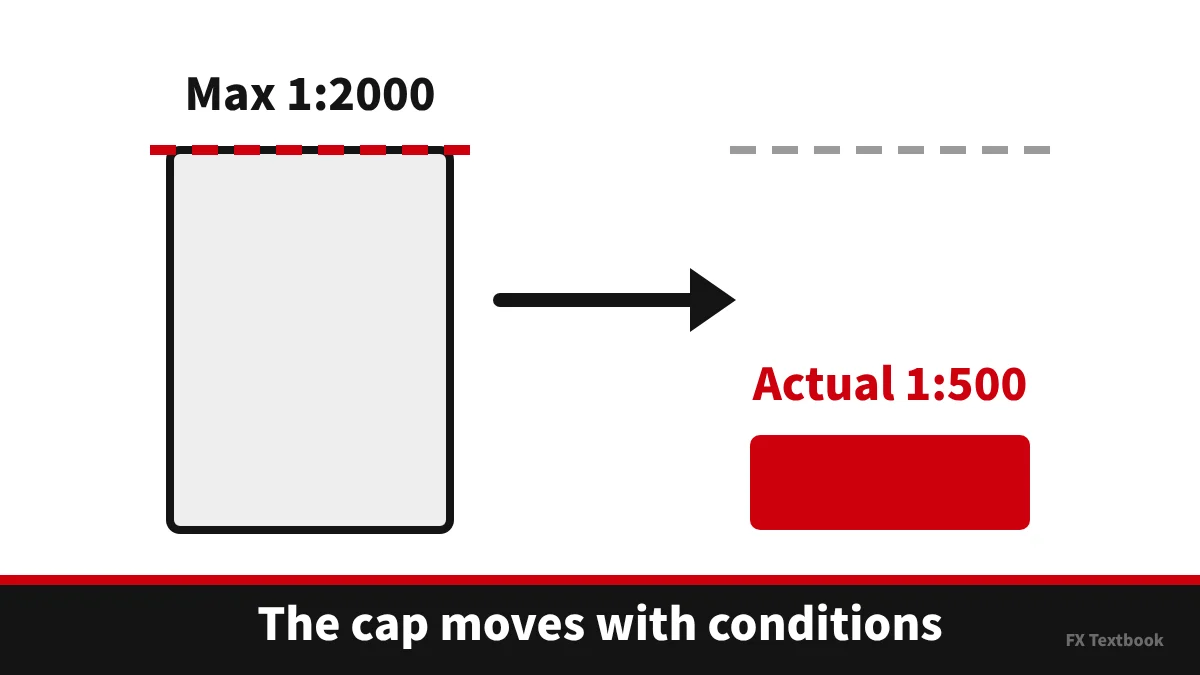
- Maximum leverage is a ceiling; what you can use depends on conditions
- The conditions are account type, instrument, equity, volume and time of day
- At XS and AXIORY the cap falls as equity grows
- Around news and weekends, new positions are capped near 1:200
- Rules differ by broker, so read the official tier table before opening an account
| Condition | What changes | Official example |
|---|---|---|
| Account type | EQ uses equity, LT uses lots | XS |
| Instrument | FX, gold, oil and shares differ | XS (shares fixed at 1:5) |
| Equity | The cap falls as equity rises | XS, AXIORY |
| Volume | The cap steps down as open lots grow | XS (LT accounts) |
| Time of day | New positions near 1:200 around news and weekends | XS, Axi, Exness |
Our comparison column lists maximum leverage for 10 brokers. This guide explains why the cap falls and how to read it.
Forex leverage compared: up to 2000x, unlimited and the limits
Leverage trading can lose some or all of the funds you deposit. A lower cap does not remove that risk.
Maximum leverage is a ceiling: actual leverage and the margin formula
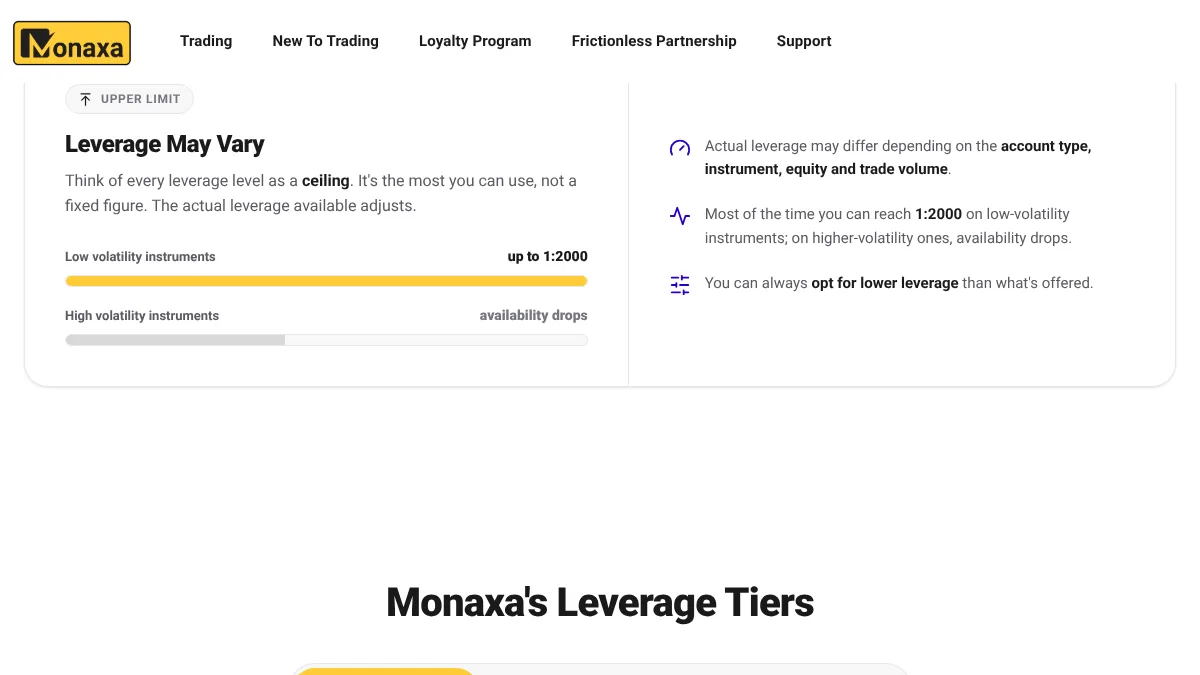
Monaxa's official page calls the leverage shown a ceiling, not a fixed figure. Actual leverage depends on account type, instrument, equity and trade volume.
Leverage tells you how many times your margin you can trade. A lower ratio means the same position needs more margin.
The MT5 help computes FX margin as lots × contract size ÷ leverage. Hold 1 lot of EUR/USD (contract size 100,000) at 1.10 and the position is worth USD 110,000.
| Leverage | Margin for 1 lot |
|---|---|
| 1:2000 | USD 55 |
| 1:1000 | USD 110 |
| 1:500 | USD 220 |
| 1:200 | USD 550 |
Condition 1: the account type changes how limits are set
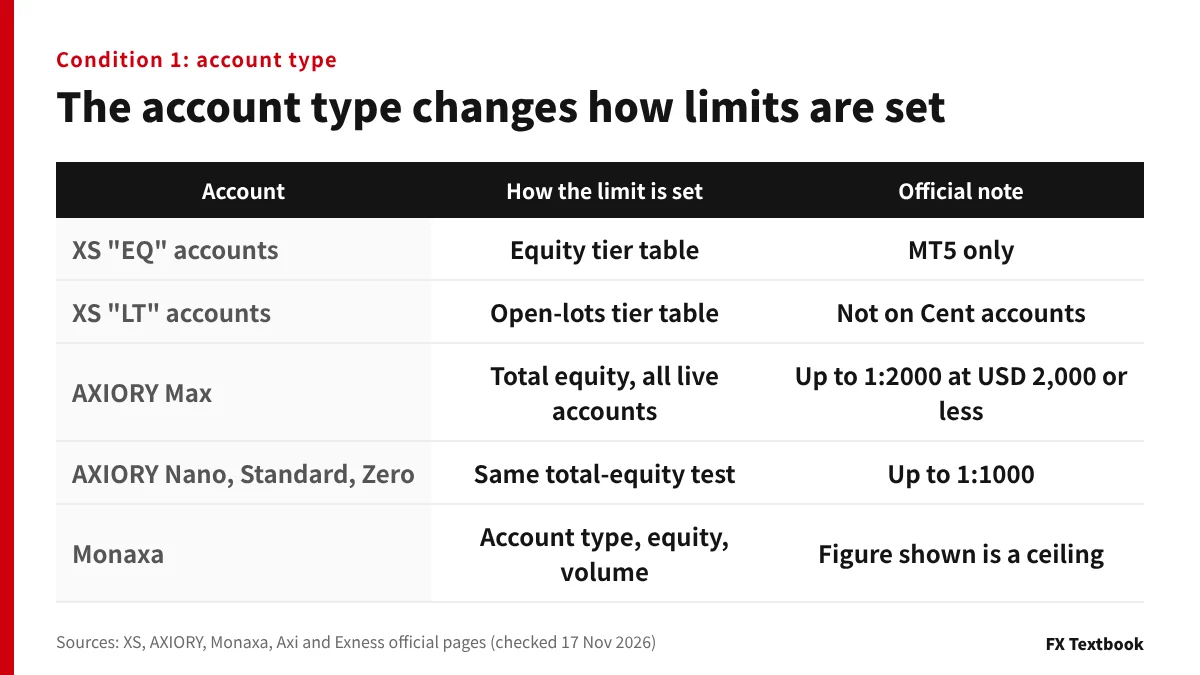
XS signals the method in the account name. Accounts ending in "EQ" use equity; accounts ending in "LT" use open lots.
AXIORY lets you pick from 13 leverage values, from 1:1 to 1:2000. The highest value you can pick depends on account type and total equity.
- XS EQ accounts run on MT5 only (XS official)
- XS LT accounts run on MT4 and MT5, except Cent accounts (XS official)
- AXIORY Max goes up to 1:2000; the other three accounts up to 1:1000
Similar account names can use different methods. Before you open one, check the suffix and the platform.
Condition 2: the cap falls as equity grows (XS and AXIORY)
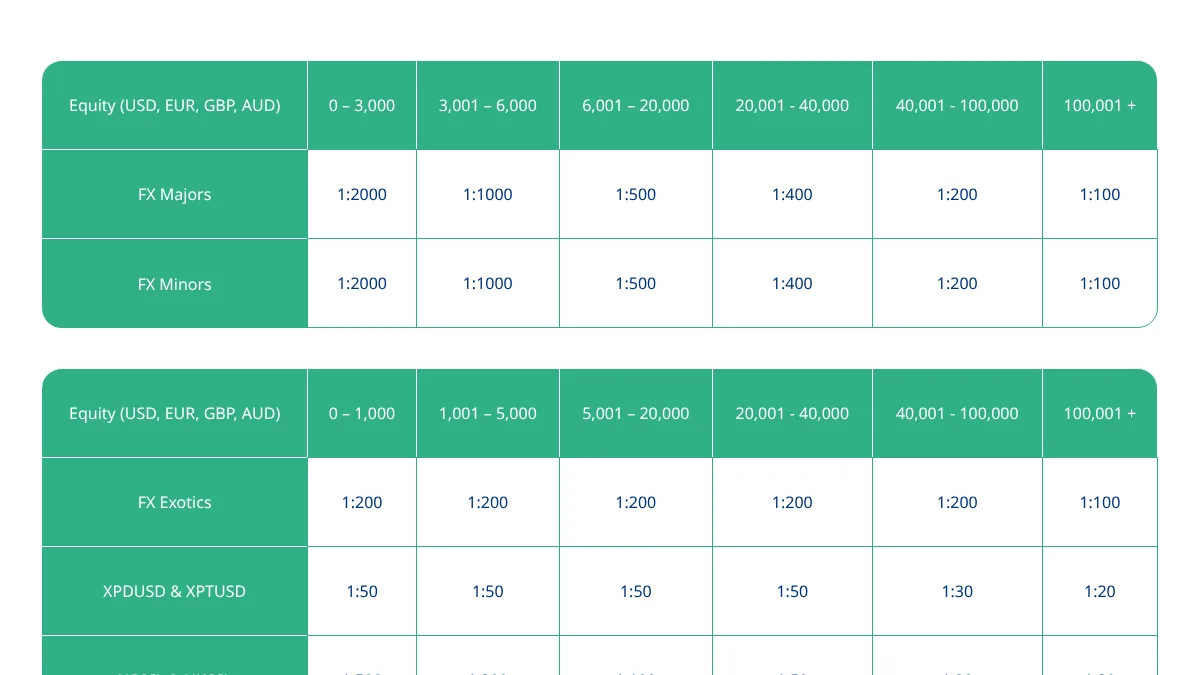
Equity is your balance plus floating profit or loss. XS says that as equity increases, the maximum leverage offered decreases.
| Equity (USD, EUR, GBP, AUD) | FX majors cap |
|---|---|
| 0 – 3,000 | 1:2000 |
| 3,001 – 6,000 | 1:1000 |
| 6,001 – 20,000 | 1:500 |
| 20,001 – 40,000 | 1:400 |
| 40,001 – 100,000 | 1:200 |
| 100,001 + | 1:100 |
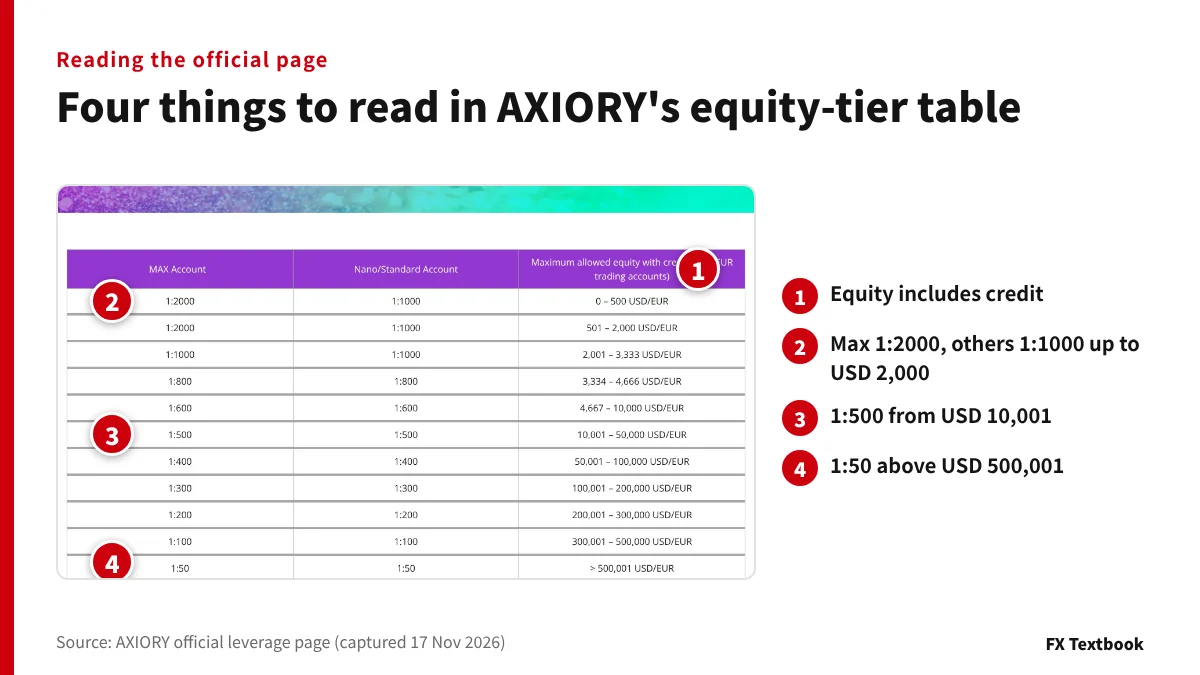
AXIORY adds up the equity of all live accounts, except Wallet accounts. Credit counts toward the total.
| Total equity (USD/EUR) | Max | Nano, Standard, Zero |
|---|---|---|
| 0 – 2,000 | 1:2000 | 1:1000 |
| 2,001 – 3,333 | 1:1000 | 1:1000 |
| 3,334 – 4,666 | 1:800 | 1:800 |
| 4,667 – 10,000 | 1:600 | 1:600 |
| 10,001 – 50,000 | 1:500 | 1:500 |
| Above 500,001 | 1:50 | 1:50 |
AXIORY tests all live accounts together, not each account. If you hold several, read your tier from the combined total.
Condition 3: the cap differs by instrument (USD 7,000 example)
Even at the same equity, caps differ by instrument. On an XS EQ account with USD 7,000 of equity, the official tables give these ratios.
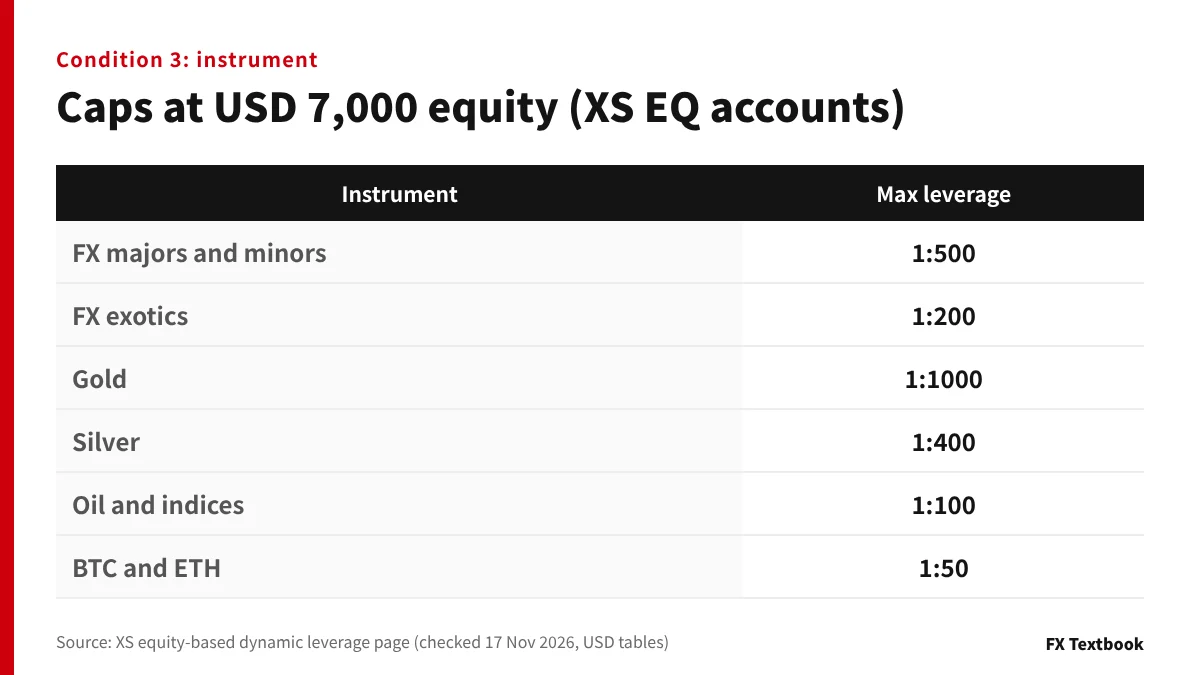
- Shares are fixed at 1:5
- Crypto other than BTC and ETH is fixed at 1:10
- HK50, CNA50 and USDXY are fixed at 1:50
Gold and silver use separate tables per account currency; the USD table is used here. Monaxa also says low-volatility instruments reach 1:2000 while high-volatility ones get a lower cap.
Condition 4: the cap falls as trading volume grows (XS LT accounts)
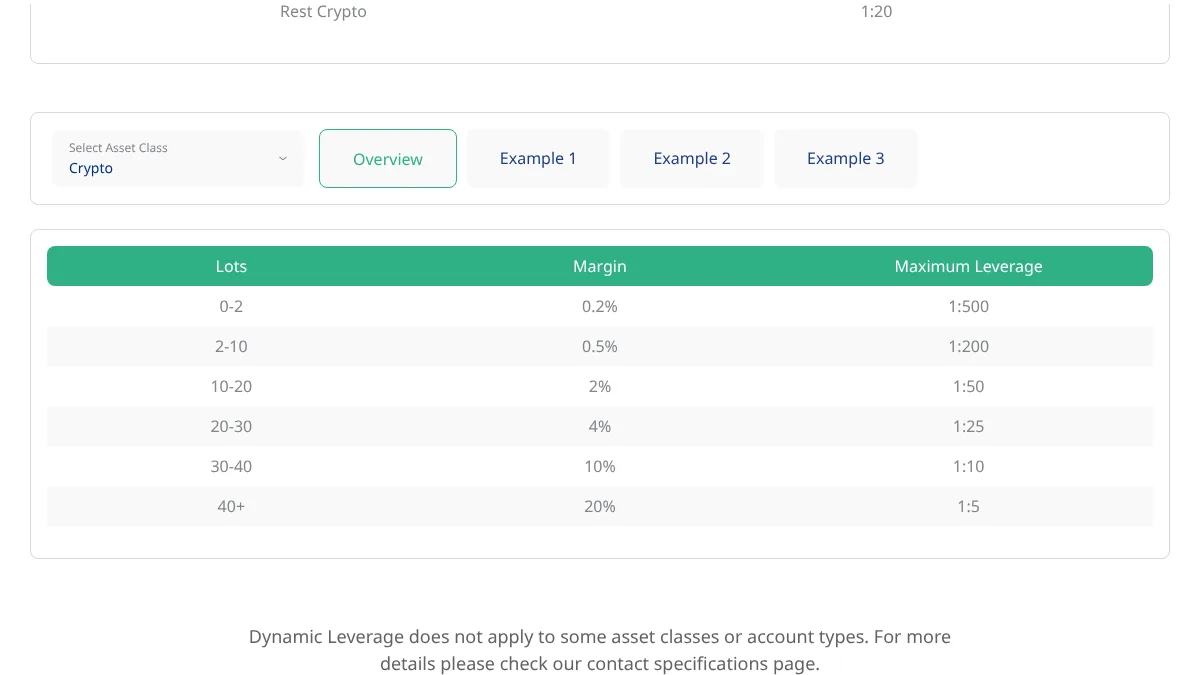
On XS LT accounts the cap falls as open lots increase. In the crypto table, 0 to 2 lots is 1:500, 2 to 10 lots is 1:200 and above 40 lots is 1:5.
The tiers apply band by band, not to every lot at once. XS's own example holds 15 lots of BTC/USD (a hypothetical USD 40,000 price).
| Band and size | Leverage | Margin |
|---|---|---|
| 0–2 (2 lots) | 1:500 | USD 160 |
| 2–10 (8 lots) | 1:200 | USD 1,600 |
| 10–20 (5 lots) | 1:50 | USD 4,000 |
| Total (15 lots) | — | USD 5,760 |
If all 15 lots were at 1:500, margin would be USD 1,200. The tiered rule gives USD 5,760, about 4.8 times as much.
XS says dynamic leverage does not apply to some asset classes or account types. Check the contract specifications page for details.
Condition 5: new positions drop around news and weekends (HMR)
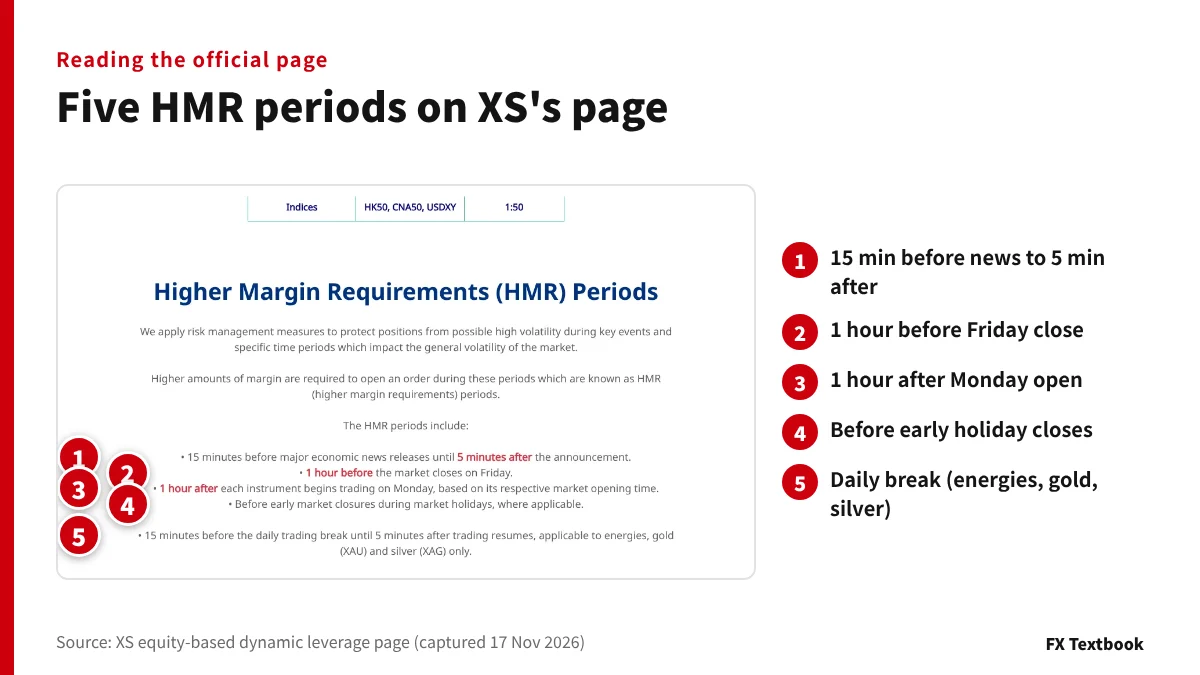
HMR means a temporary rise in required margin. Only positions opened during the window face the lower cap.
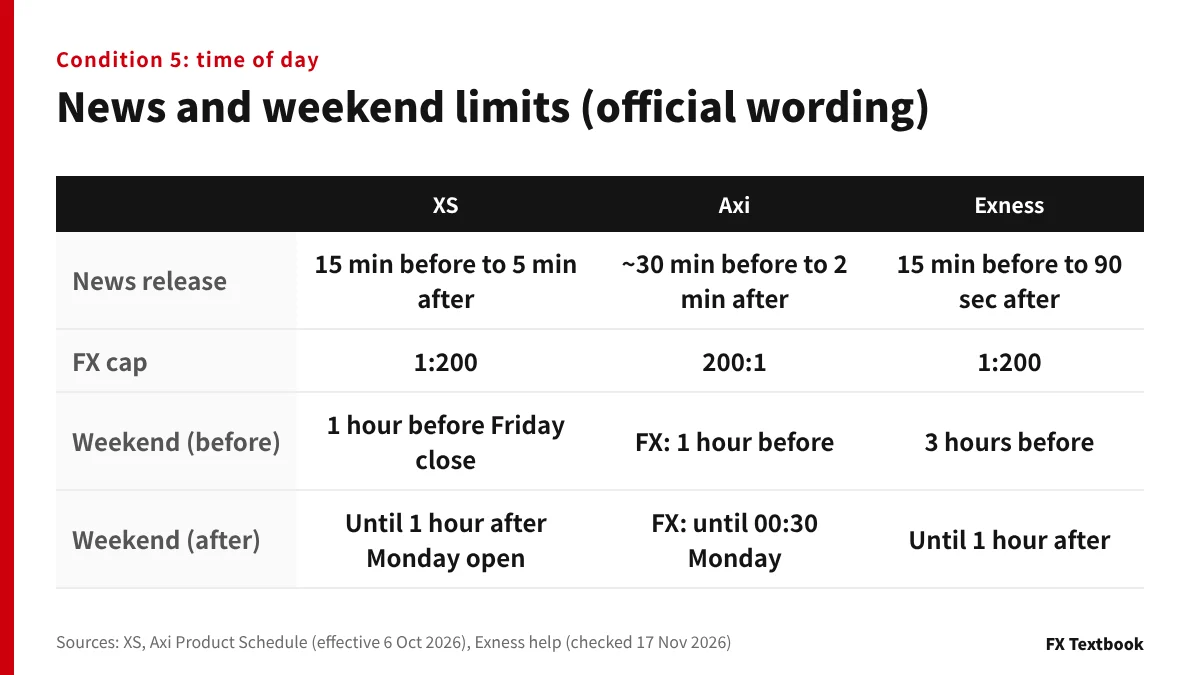
- XS says margin on positions opened before the window does not change
- When the window ends, positions opened inside it are recalculated normally
- XS says closing one side of a hedge in the window can fail without enough free margin
- Axi says it may change HMR windows and caps without notice
- Exness uses your account leverage if it is lower than the HMR cap
The Axi figures come from the AxiTrader LLC MT4 and MT5 Product Schedule (effective 6 October 2026). Times are platform time, and trading hours differ by product.
Margin example: how much balance and news windows change it (hypothetical)
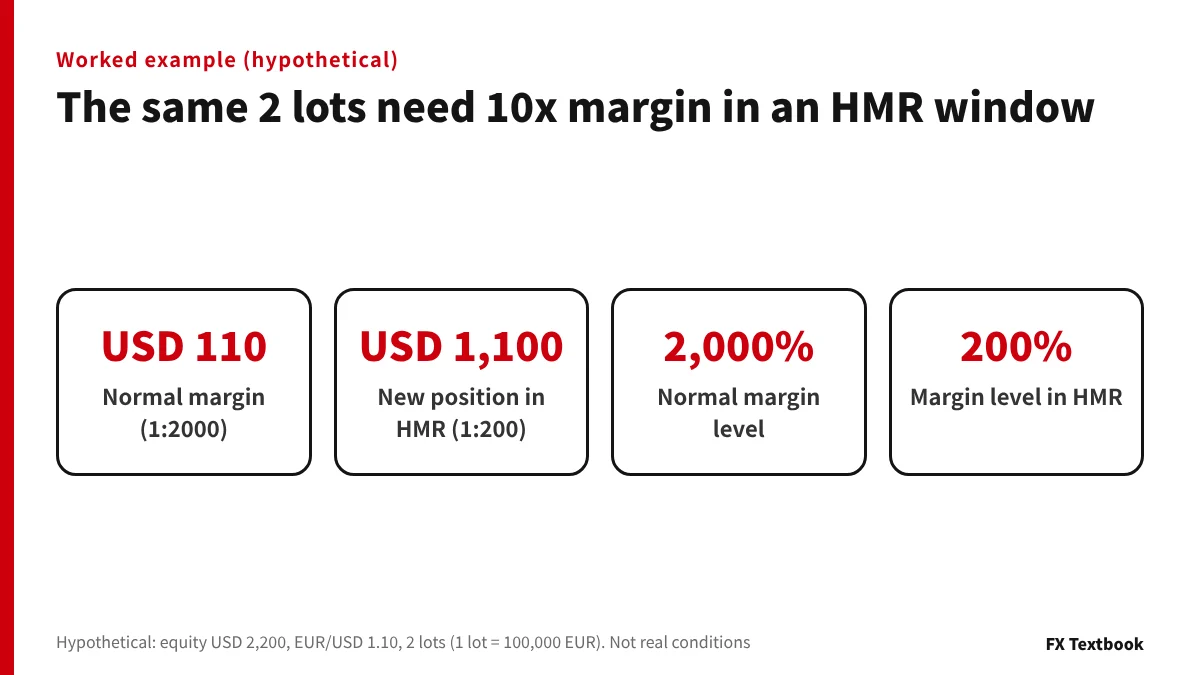
We use an XS EQ account. EUR/USD is 1.10, 1 lot is 100,000 EUR and spreads are ignored. Every figure is hypothetical.
| Equity | Cap | Margin for 1 lot |
|---|---|---|
| USD 2,500 | 1:2000 | USD 55 |
| USD 5,000 | 1:1000 | USD 110 |
| USD 7,000 | 1:500 | USD 220 |
| USD 30,000 | 1:400 | USD 275 |
At USD 2,500, one lot uses about 2.2% of equity. At USD 7,000 it uses about 3.1%.
| Equity USD 2,200, 2 lots | Margin | Margin level |
|---|---|---|
| Normal (1:2000) | USD 110 | 2,000% |
| New position in HMR (1:200) | USD 1,100 | 200% |
Margin level is equity divided by required margin. The level that triggers forced closing differs by broker, so check that separately.
When you hit a cap: notices, raising it again and adjustment mode
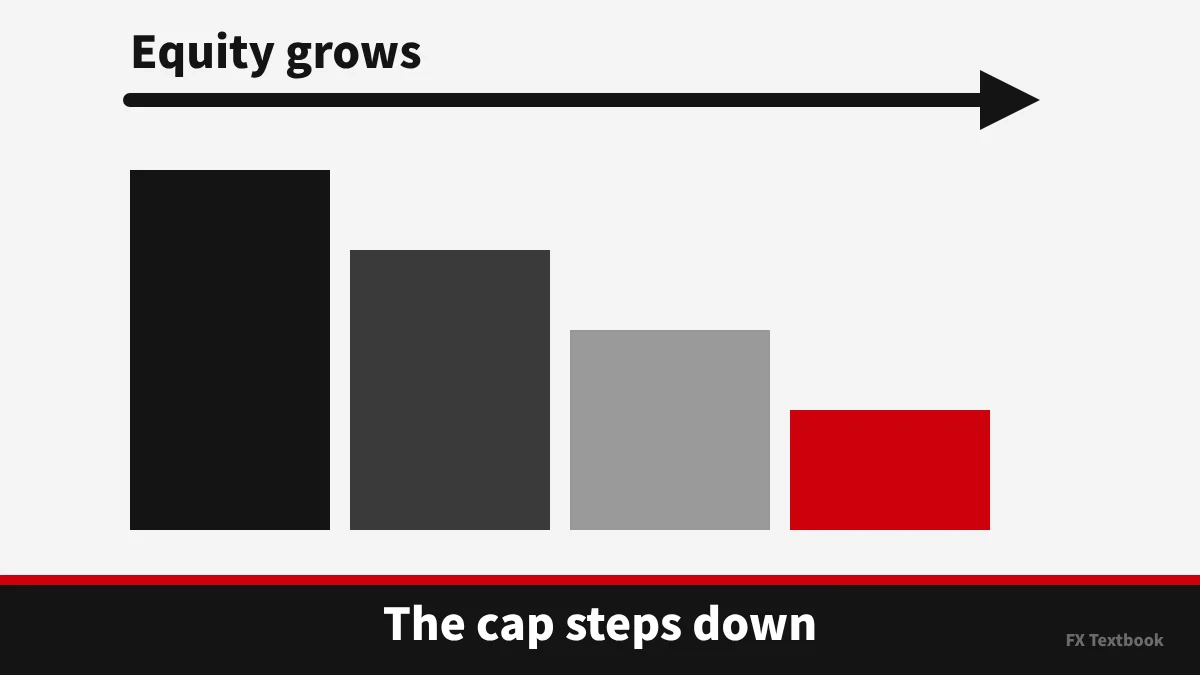
- AXIORY says it changes the leverage of accounts that reach a tier and notifies you of every change
- AXIORY's Top Leverage option sets your account to the highest leverage your equity allows
- AXIORY's page says it may change leverage in special circumstances such as high-impact news
- Your Wallet account balance does not count toward your leverage tier
- Monaxa says you can always pick a lower leverage than offered
Check each broker's terms for how a lowered cap is restored. The way to raise it again differs by broker.
A lower cap does not change the stop-out level. Each broker and account sets it in its own terms, so check the broker pages.
Where to check on official pages, and our verdict
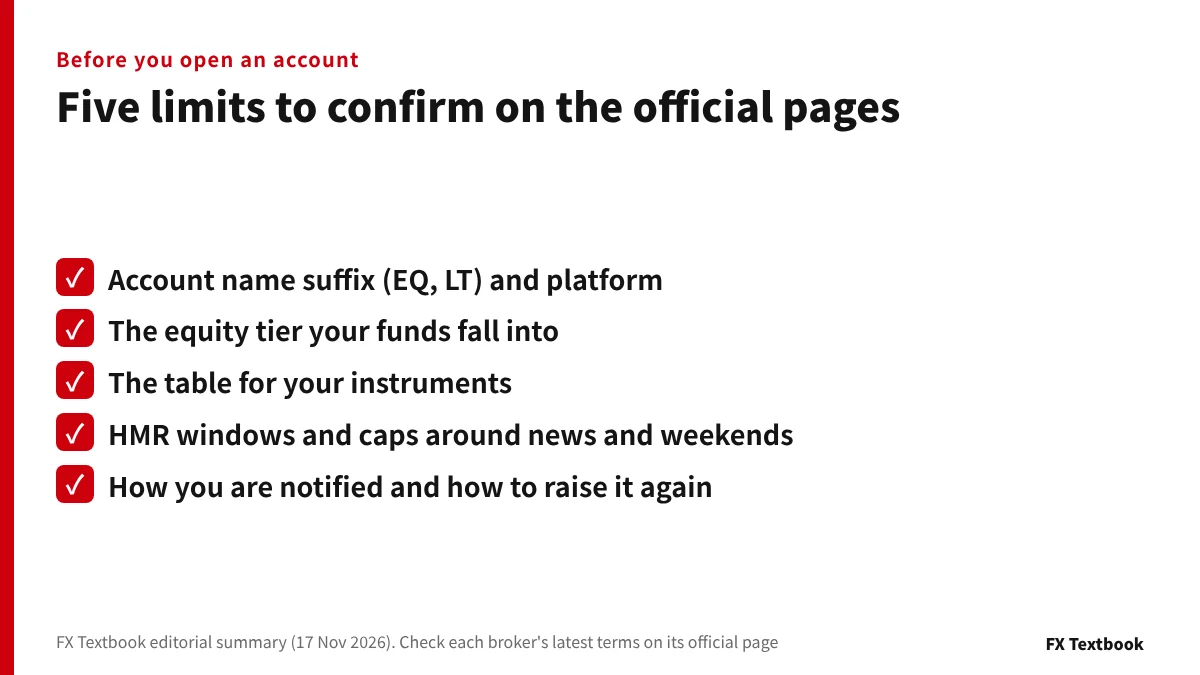
| Broker | Where to look |
|---|---|
| XS | Accounts → Dynamic leverage |
| AXIORY | Trading conditions → Leverage |
| Monaxa | The Leverage page |
| Axi | The HMR section of the Product Schedule |
| Exness | Help: Higher margin requirements (HMR) |
Look at where your funds sit in the tier table, not at the 2000x headline. With a few thousand dollars, read the first tier; with tens of thousands, read the third tier or lower. If you place orders around news or weekends, check the HMR window and cap first.
FX and CFDs can lose some or all of the funds you deposit. This guide explains how the rules work and is not a recommendation to trade.
Frequently asked questions
Q. What are forex leverage limits?
A. They are rules that lower the maximum leverage depending on conditions. The conditions are account type, instrument, equity, volume and time of day. Brokers differ, so check the official tier tables.
Q. Why does leverage fall as my balance grows?
A. XS says maximum leverage decreases as account equity increases. AXIORY says high leverage carries bigger loss risk, so it limits leverage based on equity.
Q. Can I always use 1:2000?
A. Not always. On XS EQ accounts FX majors reach 1:2000 only up to USD 3,000 of equity, and AXIORY Max reaches it up to USD 2,000. Instruments and time of day also matter.
Q. Does leverage drop around news releases?
A. At some brokers, yes. XS caps new FX positions at 1:200 from 15 minutes before to 5 after, Exness from 15 minutes before to 90 seconds after, and Axi from about 30 minutes before to 2 after.
Q. What happens to open positions when a limit applies?
A. XS says margin on positions opened before an HMR window does not change. AXIORY changes the leverage of accounts that reach a tier and notifies you.
Q. Is gold or crypto leverage the same as FX?
A. Not necessarily. On an XS EQ account with USD 7,000 of equity, FX majors are 1:500, gold 1:1000 and BTC and ETH 1:50. Shares are fixed at 1:5.
Q. Can I lower my leverage myself?
A. At some brokers you can. Monaxa says you can pick lower leverage than offered, and AXIORY offers 13 values from 1:1 to 1:2000. The highest value you can pick depends on equity and other conditions.
Q. Where can I see the limit on my account?
A. Check the broker's official pages and your account screen. XS has tier tables under Dynamic leverage and AXIORY under Leverage. Exness shows HMR periods on its terminal chart.
Sources and conditions
FX Textbook is edited from official platform documentation, broker-published information and applicable terms where available. Account conditions, services and rules can change. Confirm the current terms in the broker's registration flow before you act.
FX Textbook is an independent information site, not a broker or provider of personal investment advice. Forex and CFDs involve risk. You may lose some or all of your invested capital. No trading result is guaranteed.
NEXT STEP
Next: compare each broker's account conditions
Account types and leverage terms for each listed broker, laid out on the same items. Check which tier your funds fall into before you open an account.