













You want to try an offshore forex account with a small amount, but you are not sure how much is enough.
Trade size matters more than the deposit. The XS Standard account has no minimum deposit, and its minimum lot is 0.01 (checked 16 November 2026).
This guide covers how to think about and calculate a small start. By the end you can work out the margin for an order on JPY 10,000 and the profit or loss when the price moves by 1 yen.
Short answer: a small start depends on trade size, not deposit size
- The deposit floor comes from the account terms and the minimum for each deposit method
- On standard accounts the minimum lot is often 0.01 (1,000 units)
- A cent account trades in units 1/100 of a standard account
- On JPY 10,000, a 0.01 lot needs JPY 150 of margin (hypothetical figures)
- Small accounts can still hit stop-out and lose the amount deposited
For a side-by-side list of minimum deposits by broker, see our comparison column. This guide sticks to how to judge and calculate a small start.
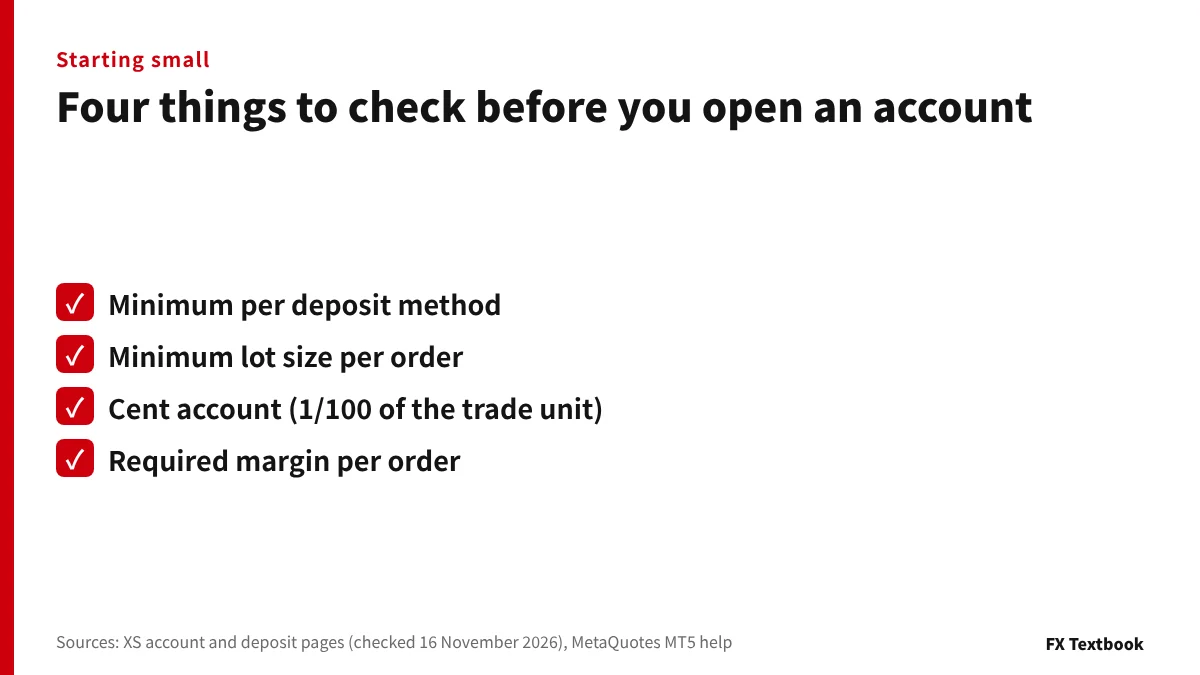
Four things to check when starting forex with a small amount
| Item | What it sets | Official example |
|---|---|---|
| Minimum per deposit method | The smallest single deposit | XS local bank transfer JPY 1,000 |
| Minimum lot | The smallest order | XS Standard account 0.01 lot |
| Cent account | The size of the trade unit | XS: 1 cent lot = 0.01 standard lot |
| Required margin | Money needed to open an order | Volume x contract size / leverage |
Method minimums and margin set the money floor. Minimum lot and cent accounts decide how far your balance moves on each order.
Minimum per deposit method: separate from the account terms
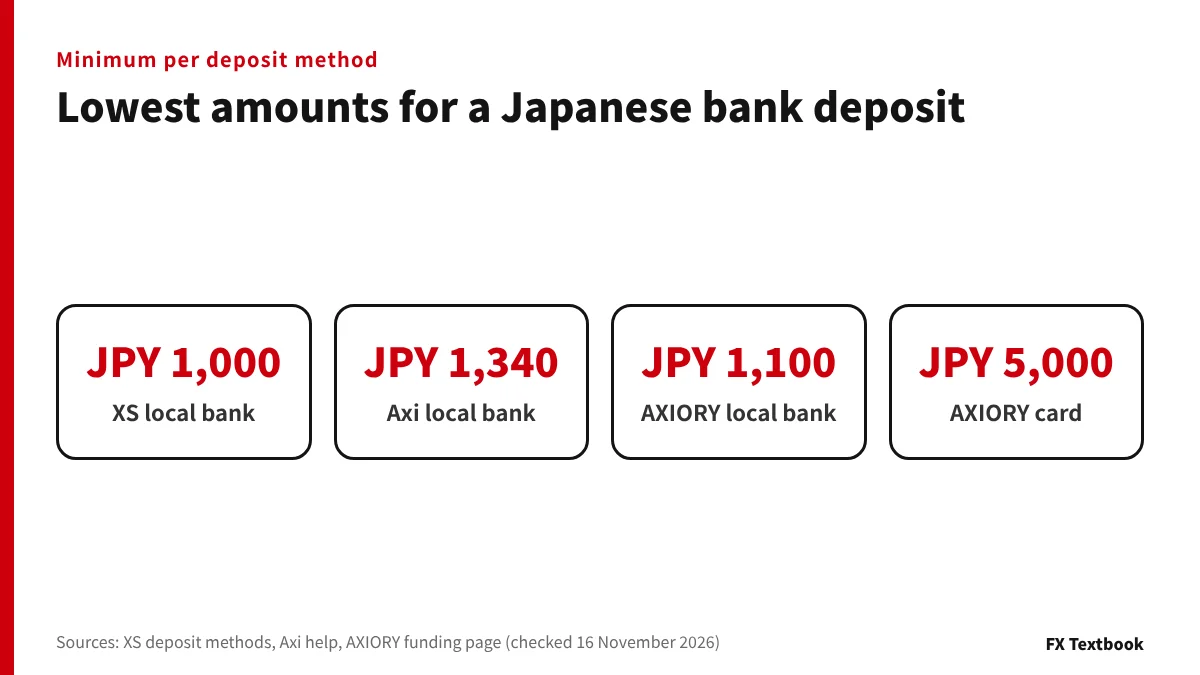
Even when an account shows no minimum deposit, each payment method keeps its own floor. The XS Standard account has no minimum, yet a local bank transfer starts at JPY 1,000.
| Broker | Method | Minimum for the method |
|---|---|---|
| XS | Local bank transfer | JPY 1,000 |
| XS | Peska Wallet | JPY 1,000 |
| XS | Cryptocurrency | USD 50 |
| Axi | Local Money Transfer (Japan) | JPY 1,340 |
| Axi | Bitwallet | JPY 1,340 |
| AXIORY | Local bank transfer | JPY 1,100 |
| AXIORY | Credit or debit card | JPY 5,000 |
Axi separates the initial deposit for an account from the minimum for each payment method. The Standard account has no set initial deposit, so the JPY 1,340 local bank minimum is the floor.
Fees weigh more on small amounts. AXIORY charges JPY 1,000 per local bank withdrawal under JPY 20,000.
What is the minimum lot? 0.01 lot is 1,000 units
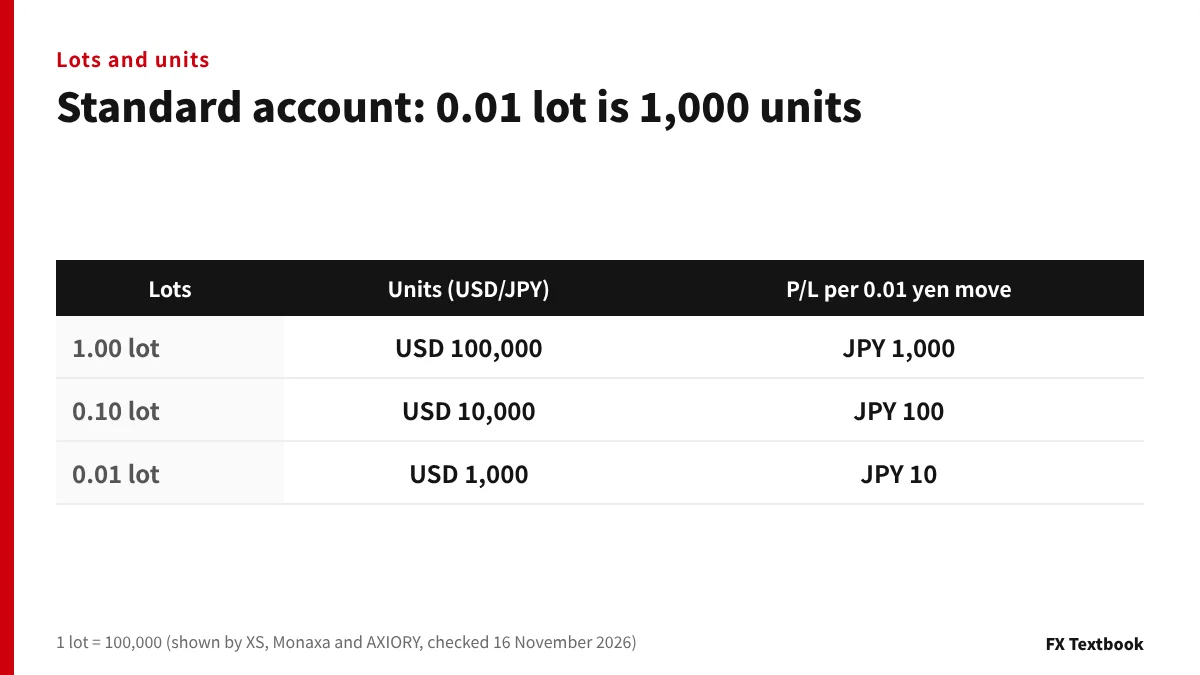
A lot is the unit of order size. One standard lot is 100,000 units, and the XS, Monaxa and AXIORY account pages all show 1 lot = 100,000.
| Lots | Units (USD/JPY) | P/L per 0.01 yen move |
|---|---|---|
| 1.00 lot | USD 100,000 | JPY 1,000 |
| 0.10 lot | USD 10,000 | JPY 100 |
| 0.01 lot | USD 1,000 | JPY 10 |
Each account sets its own minimum lot. The XS Standard account allows 0.01 lot. The XS Micro account lists a lot size of Micro 1,000 USD and a minimum of 0.1 lot.
The Axi product schedule lists USDJPY (MT4) at USD 100,000 per lot with a minimum of 0.01 lot (official document retrieved 14 November 2026).
What is a cent account? Trade units 1/100 of a standard account
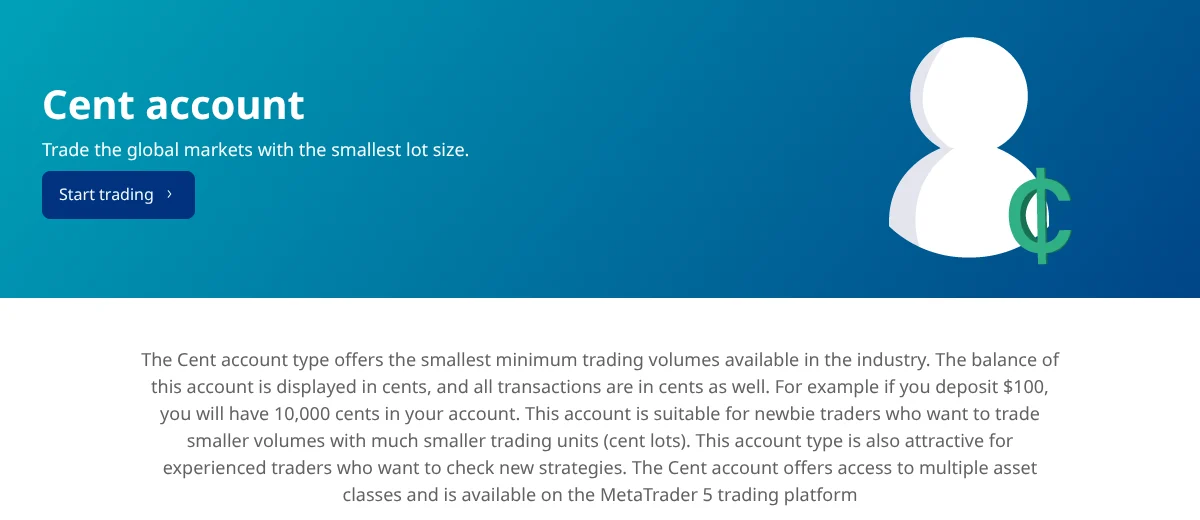
A cent account shows the balance and trades in cents (USD 1 = 100 cents). XS says that a deposit of USD 100 appears as 10,000 cents in the account.
XS lists the Cent lot size as 100,000 USC, equal to USD 1,000. The same 0.01 lot therefore places an order 1/100 the size of a standard account.
| Account | Size of 1 lot | Minimum lot | Official deposit terms |
|---|---|---|---|
| XS Cent | 100,000 USC (USD 1,000) | 0.01 | No minimum |
| Monaxa Cent | Contract size 1,000 | 0.01 | USD 15 (first) |
The DecodeFX official account page lists a minimum deposit of USD 1 for the CENT account.
The XS Cent account runs on MT5 only and has no demo version. The Monaxa Cent account has a maximum leverage of 1:1000 and covers forex and metals.
Margin calculation: JPY 10,000 and 0.01 lot (hypothetical figures)
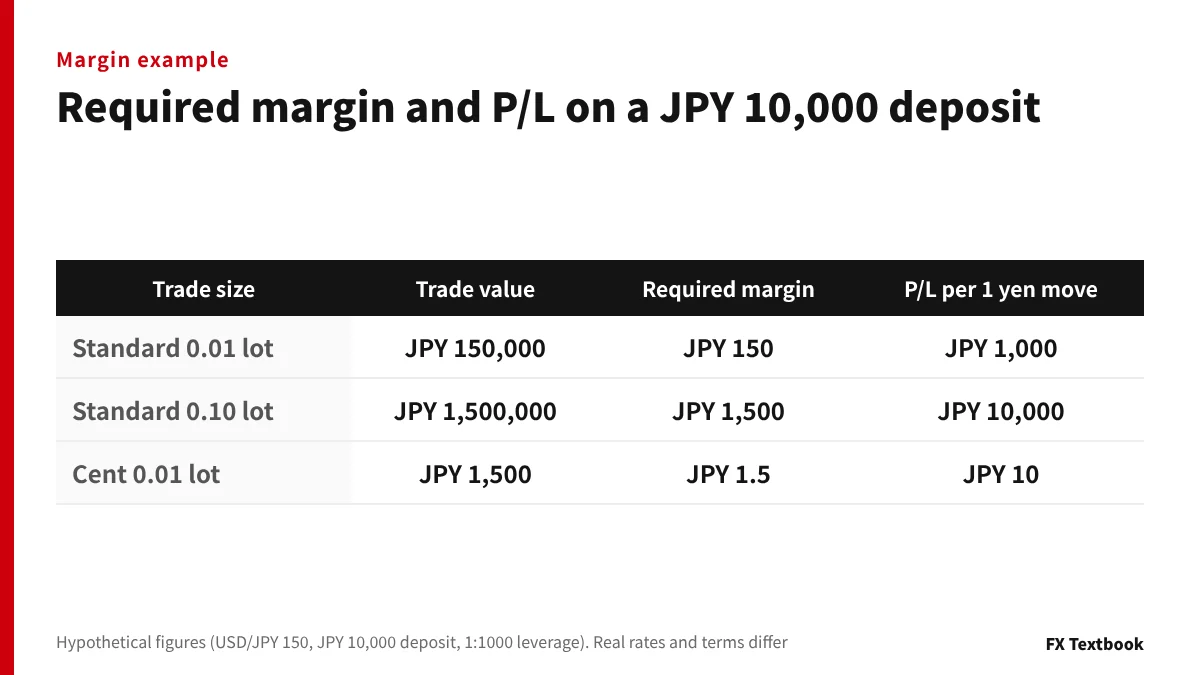
Required margin is volume x contract size / leverage. The MT5 help from MetaQuotes uses this formula for forex. Multiply by the rate to convert it to yen.
The figures below assume USD/JPY at 150, a JPY 10,000 deposit and 1:1000 leverage. They are hypothetical and will differ from real rates and terms.
| Trade size | Trade value | Required margin | P/L per 1 yen move |
|---|---|---|---|
| Standard 0.01 lot | JPY 150,000 | JPY 150 | JPY 1,000 |
| Standard 0.10 lot | JPY 1,500,000 | JPY 1,500 | JPY 10,000 |
| Cent 0.01 lot | JPY 1,500 | JPY 1.5 | JPY 10 |
With a standard 0.10 lot, a 1 yen move against you costs JPY 10,000, almost the whole deposit.
At 1:100 leverage, a 0.01 lot needs JPY 1,500 of margin. The XS Cent page lists dynamic leverage, so check the actual figure on the order screen.
Small accounts can still hit stop-out and lose money
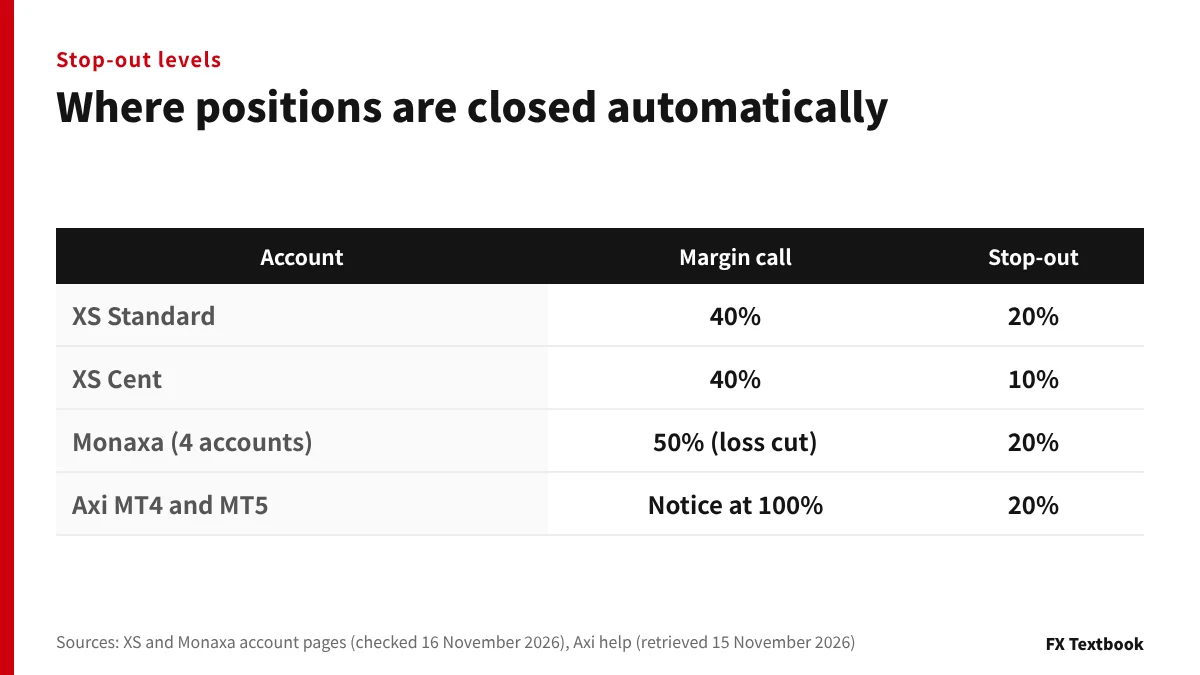
The margin level is equity divided by used margin. When it falls to the level set by the broker, positions close automatically.
| Account | Margin call | Stop-out |
|---|---|---|
| XS Standard | 40% | 20% |
| XS Cent | 40% | 10% |
| Monaxa (4 accounts) | 50% (labelled loss cut) | 20% |
| Axi (MT4 and MT5) | Notice at 100% | 20% |
Using the hypothetical figures above with a standard 0.10 lot and a 20% stop-out, positions close after a move of about 0.97 yen, for a loss of about JPY 9,700.
With a 0.01 lot, the same terms allow a move of about 9.97 yen before closing. In fast markets, closing can happen at a worse price than the set level.
Forex and CFDs use leverage, and even a small account can lose the full amount deposited. Negative balance protection depends on each broker's terms, conditions and exceptions.
Small-start terms at our listed brokers (official wording, not a ranking)
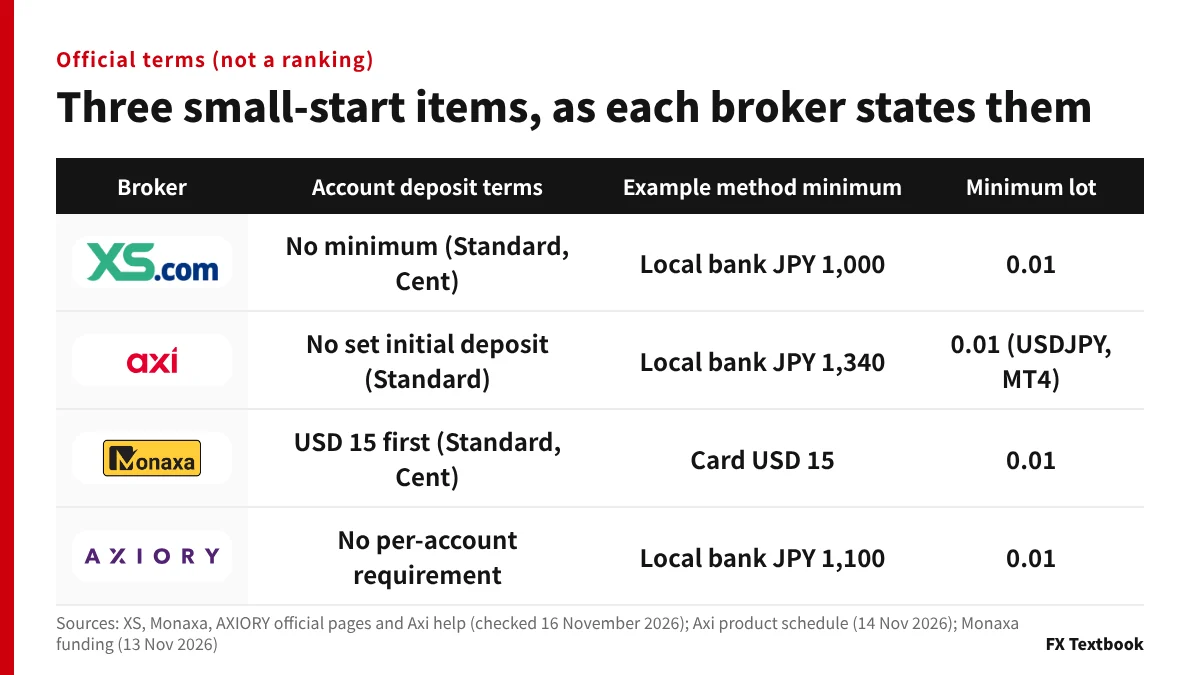
| Broker | Account deposit terms | Example method minimum | Minimum lot |
|---|---|---|---|
| XS | No minimum (Standard, Cent) | Local bank JPY 1,000 | 0.01 (Micro 0.1) |
| Axi | No set initial deposit (Standard) | Local bank JPY 1,340 | 0.01 (USDJPY, MT4) |
| Monaxa | USD 15 first deposit (Standard, Cent) | Card USD 15 | 0.01 |
| AXIORY | No per-account requirement | Local bank JPY 1,100 | 0.01 |
This is not a ranking. Each broker appears with the same items, in its own official wording. HFM's deposit terms by account are in our HFM column.
Cautions for small accounts: spreads, withdrawal fees and products
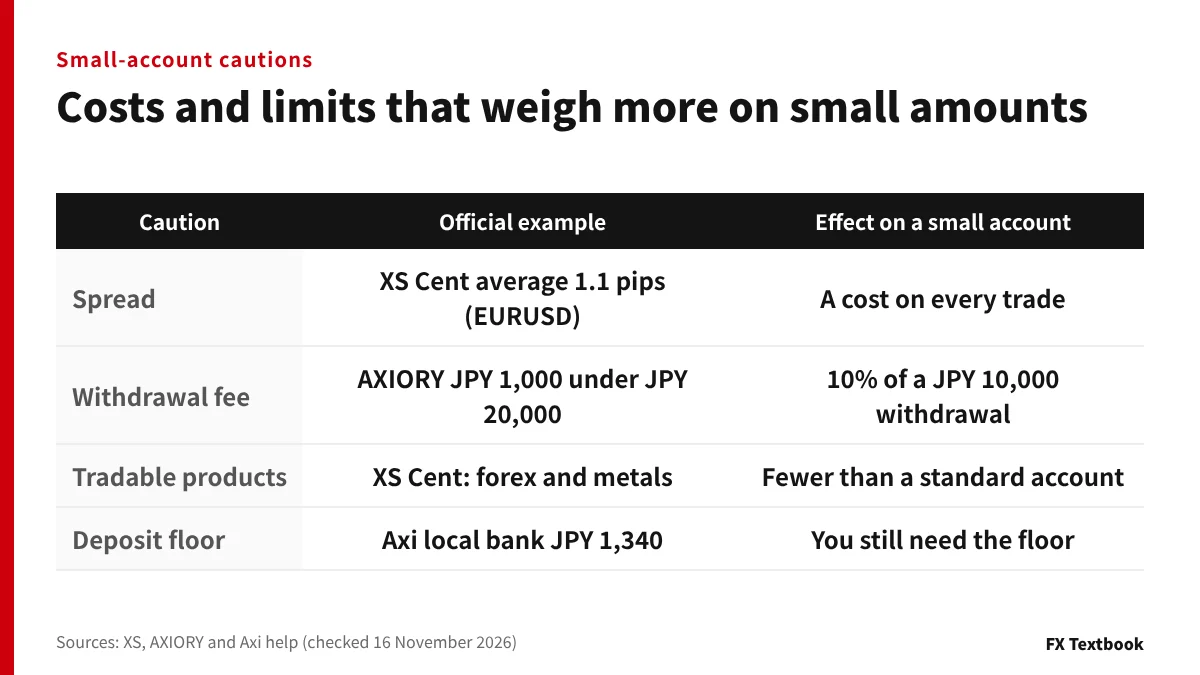
On a small account, costs take a larger share. Check spreads and withdrawal fees before you deposit.
| Caution | Official example | Effect on a small account |
|---|---|---|
| Spread | XS Cent average 1.1 pips (EURUSD) | A cost on every trade |
| Withdrawal fee | AXIORY JPY 1,000 under JPY 20,000 | 10% of a JPY 10,000 withdrawal |
| Tradable products | XS Cent: forex and metals | Fewer than a standard account |
| Deposit floor | Axi local bank JPY 1,340 | You still need the floor |
On USD/JPY, 1 pip is 0.01 yen. If the USD/JPY spread were 1.1 pips, a standard 0.01 lot would cost about JPY 11 per trade.
On a cent 0.01 lot, the same 1.1 pips costs about JPY 0.11. Small costs still add up as you trade more often.
To practise the platform without depositing, a demo account is another option. The XS Cent account has no demo version, so practise on a demo of another account type.
How to check on the official site: five places on the account page
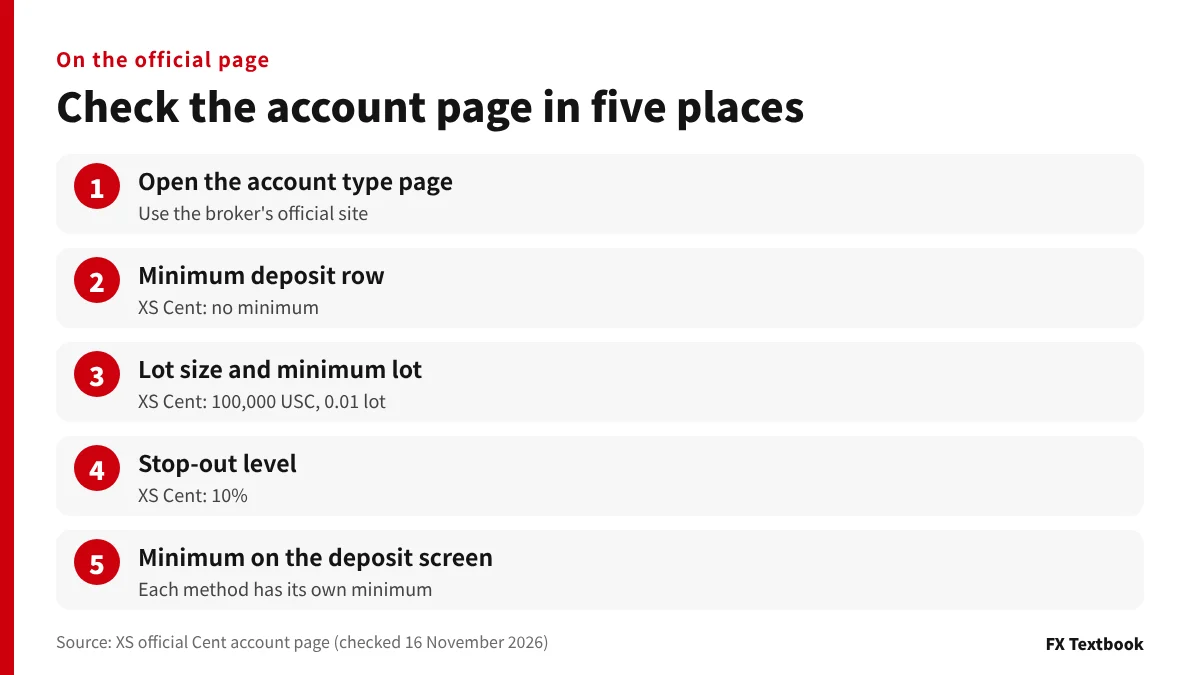
- 01Open the account type page
Open the page for the account you plan to use on the broker's official site.
- 02Read the minimum deposit row
The XS Cent account shows no minimum.
- 03Read the lot size and minimum lot
The XS Cent account shows Standard Cent (100,000) USC and 0.01 lot.
- 04Read the stop-out level
The XS Cent account shows 10%.
- 05Check the deposit screen
Each method has its own floor. Check the screen before you submit a request.
The figures in this guide reflect the official pages on 16 November 2026. Terms change, so check the same rows again before you open an account.
With a deposit of around JPY 10,000, first confirm that a 0.01 lot moves JPY 1,000 for every 1 yen. Check the trade unit in the cent account contract size, and the deposit floor in the minimum for each payment method.
Frequently asked questions
Q. How much money do I need to start offshore forex?
A. It depends on the account terms and the minimum for your deposit method. The XS Standard account has no minimum deposit, and a local bank transfer starts at JPY 1,000 (checked 16 November 2026). To keep trading you also need room for margin and losses.
Q. Can I trade forex with JPY 10,000?
A. On paper, yes. With USD/JPY at 150 and 1:1000 leverage as hypothetical figures, a 0.01 lot needs JPY 150 of margin. A 1 yen move against you costs JPY 1,000, and JPY 10,000 at 0.10 lot.
Q. What is a cent account?
A. An account that shows the balance and trades in cents, so trade units are 1/100 of a standard account. XS lists the Cent lot size as 100,000 USC. A USD 100 deposit appears as 10,000 cents.
Q. How many units is 0.01 lot?
A. One standard lot is 100,000 units, so 0.01 lot is 1,000 units. On USD/JPY a 0.01 yen move changes the result by JPY 10. Some accounts, such as XS Micro, have a minimum of 0.1 lot.
Q. Can a small account avoid stop-out?
A. No. When the margin level falls below the stop-out level (20% on the XS Standard account and 10% on Cent), positions close automatically. In fast markets you can lose the amount deposited.
Q. How much does the spread cost on a small trade?
A. On USD/JPY, 1 pip is 0.01 yen. A hypothetical 1.1 pip spread costs about JPY 11 on a standard 0.01 lot and about JPY 0.11 on a cent 0.01 lot (hypothetical figures). The cost adds up as you trade more often.
Q. How is a method minimum different from an initial deposit?
A. An initial deposit is the amount an account needs before you start trading. A method minimum is the floor for a single deposit. The Axi Standard account has no set initial deposit, and its local bank transfer starts at JPY 1,340.
Sources and conditions
FX Textbook is edited from official platform documentation, broker-published information and applicable terms where available. Account conditions, services and rules can change. Confirm the current terms in the broker's registration flow before you act.
FX Textbook is an independent information site, not a broker or provider of personal investment advice. Forex and CFDs involve risk. You may lose some or all of your invested capital. No trading result is guaranteed.
NEXT STEP
Next: compare account terms by broker
Account types, minimum lots and funding terms for each listed broker, laid out on the same items.