













Comparing forex spreads is confusing when one broker quotes an average, another a minimum, and a third adds commission on top.
Two rules fix it: compare averages with averages and minimums with minimums, and add round-turn commission to 0.0-pip accounts. Among fixed-amount commissions, Axi Elite's USD 3.5 round turn (0.35 pips on 1 lot of EUR/USD) is the smallest of the 10 brokers we list.
By the end you can work out the cost of 1 lot on EUR/USD and USD/JPY and narrow down accounts to fit how often you trade (published values as of 29 October 2026).
Conclusion: compare spreads on the same basis, with commission
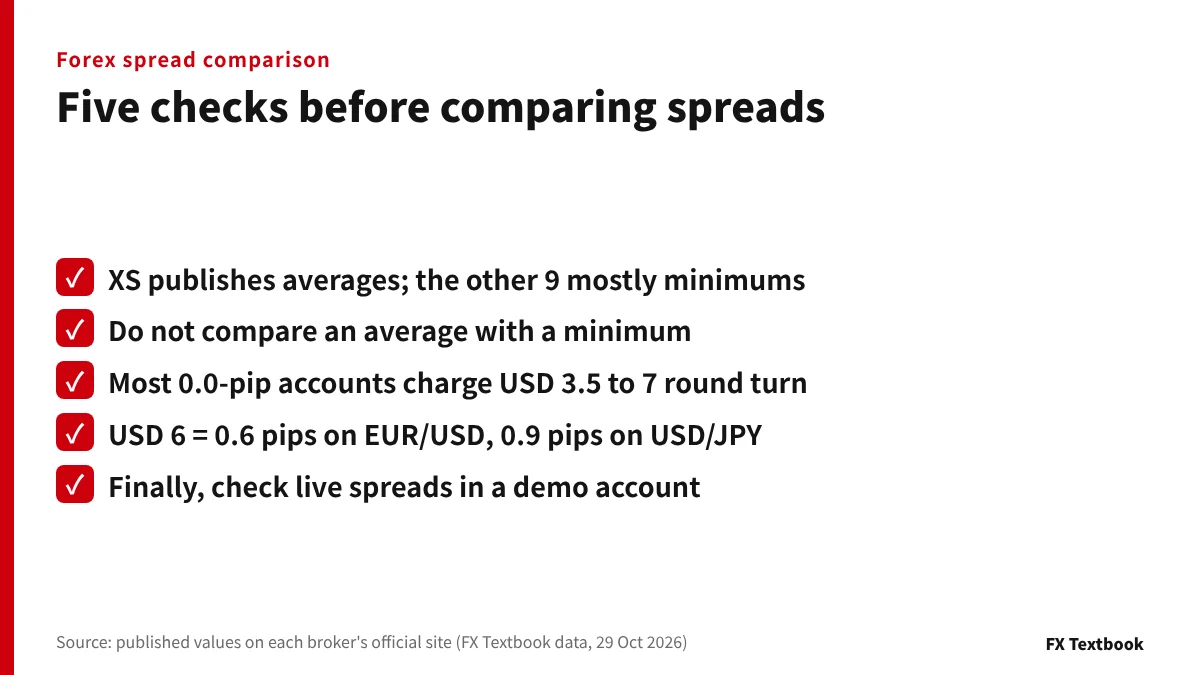
- XS publishes averages; the other 9 brokers mostly publish "from" minimums
- An average of 1.1 pips and a minimum of 0.6 pips cannot be ranked
- Most accounts from 0.0 pips charge USD 3.5 to 7 per round turn
- USD 6 round turn is 0.6 pips on EUR/USD and 0.9 pips on USD/JPY
- Before deciding, watch the live spread in a demo account's Market Watch
| What you want to know | Value among the 10 | Account |
|---|---|---|
| Smallest published value, no commission | From 0.0 pips | Vantage Premium (USD 3,000 single first deposit) |
| Next-smallest value, no commission | From 0.1 pips | Exness Pro (minimum deposit varies by region) |
| Smallest fixed-amount commission | 0.0 pips + USD 3.5 round turn | Axi Elite (first deposit USD 25,000) |
| Commission account with USD 0 minimum | 0 pips + USD 6 round turn | HFM Zero (minimum deposit USD 0) |
| Account published as an average | 1.1 pips average | XS Standard (EUR/USD) |
※ These are published values, not the spread you will get on a given order. Minimums are the floor reached in calm markets.
Forex and CFDs are leveraged products and you can lose some or all of the money you deposit. This article lists account conditions; it does not give trading advice or indicate profits.
What is a spread? Counting pips and the value of 1 lot
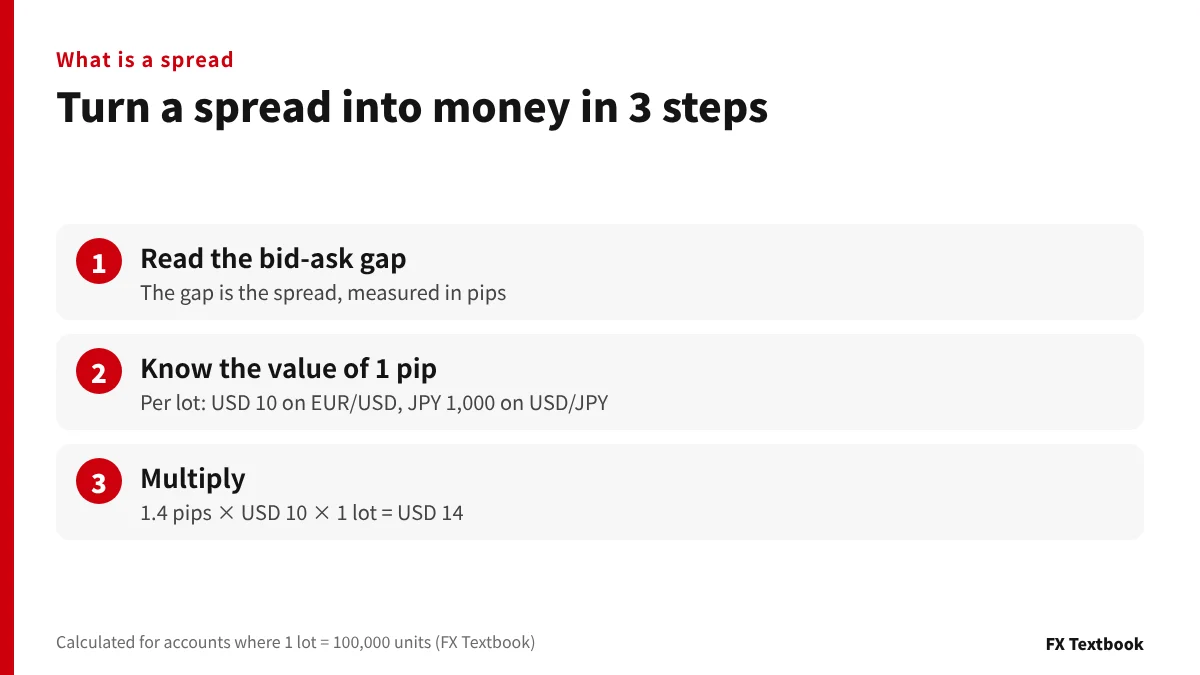
The spread is the gap between the buy price (ask) and the sell price (bid) at the same moment. If you buy and sell straight away, you lose that gap. You pay it on every trade, so it is a real trading cost.
Spreads are measured in pips. On USD-quoted pairs such as EUR/USD, 1 pip is USD 0.0001. On JPY-quoted pairs such as USD/JPY, 1 pip is JPY 0.01.
| Pair or account | Size of 1 pip | Value of 1 pip per lot |
|---|---|---|
| EUR/USD | USD 0.0001 | USD 10 (100,000 units) |
| USD/JPY | JPY 0.01 | JPY 1,000 (100,000 units) |
| Trading 0.1 lot | Same | USD 1 on EUR/USD, JPY 100 on USD/JPY |
| HFM Cent (1 lot = 1,000 units) | Same | USD 0.1 on EUR/USD |
※ Lot size depends on the account. Contract sizes for CFDs such as gold differ by symbol, so check the symbol specification in your platform.
The formula is spread (pips) × value of 1 pip × lots. One lot of EUR/USD at 1.4 pips costs USD 14.
Spread and profit or loss
A new position starts at a loss equal to the spread. Buy EUR/USD on a 1.4-pip account and the price must rise 1.4 pips just to break even.
Japanese vs offshore broker spreads: units, fixed vs variable
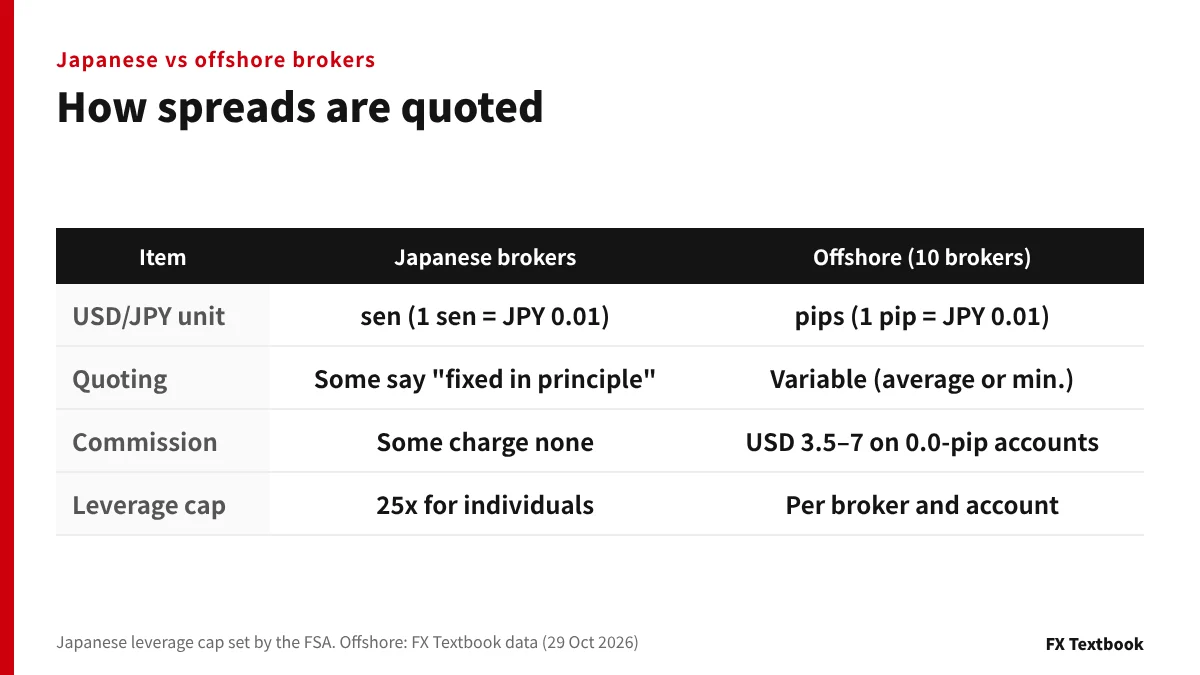
Japanese brokers quote USD/JPY spreads in sen. One sen is JPY 0.01, the same as 1 pip at an offshore broker, so 0.2 sen reads as 0.2 pips.
| Item | Japanese brokers | Offshore (10 brokers we list) |
|---|---|---|
| USD/JPY unit | sen (1 sen = JPY 0.01) | pips (1 pip = JPY 0.01) |
| How spreads are shown | Some quote "fixed in principle (with exceptions)" | Variable, published as average or minimum |
| Commission | Some charge none | About USD 3.5 to 7 round turn on 0.0-pip accounts |
| Leverage cap for individuals | 25x (FSA rule) | Per broker and account (1:1000 to unlimited) |
※ We do not publish figures for individual Japanese brokers. Put both in pips and add commission and trading conditions before comparing.
Why offshore spreads can look wider
On commission-free accounts, the broker's margin is built into the spread. XS explains on its contract specifications page that charts show pre-markup prices by default.
Commission accounts keep the markup small and charge per lot instead. Set against Japanese brokers on spread alone, commission-free accounts look wide and commission accounts look tight.
Fixed and variable spreads
All 10 brokers publish variable spreads. The spread moves with the market and the time of day, and the published figure is an average or a floor. Even accounts labelled fixed may have exceptions for fast markets in their terms.
Forex spread comparison table 1: commission-free accounts
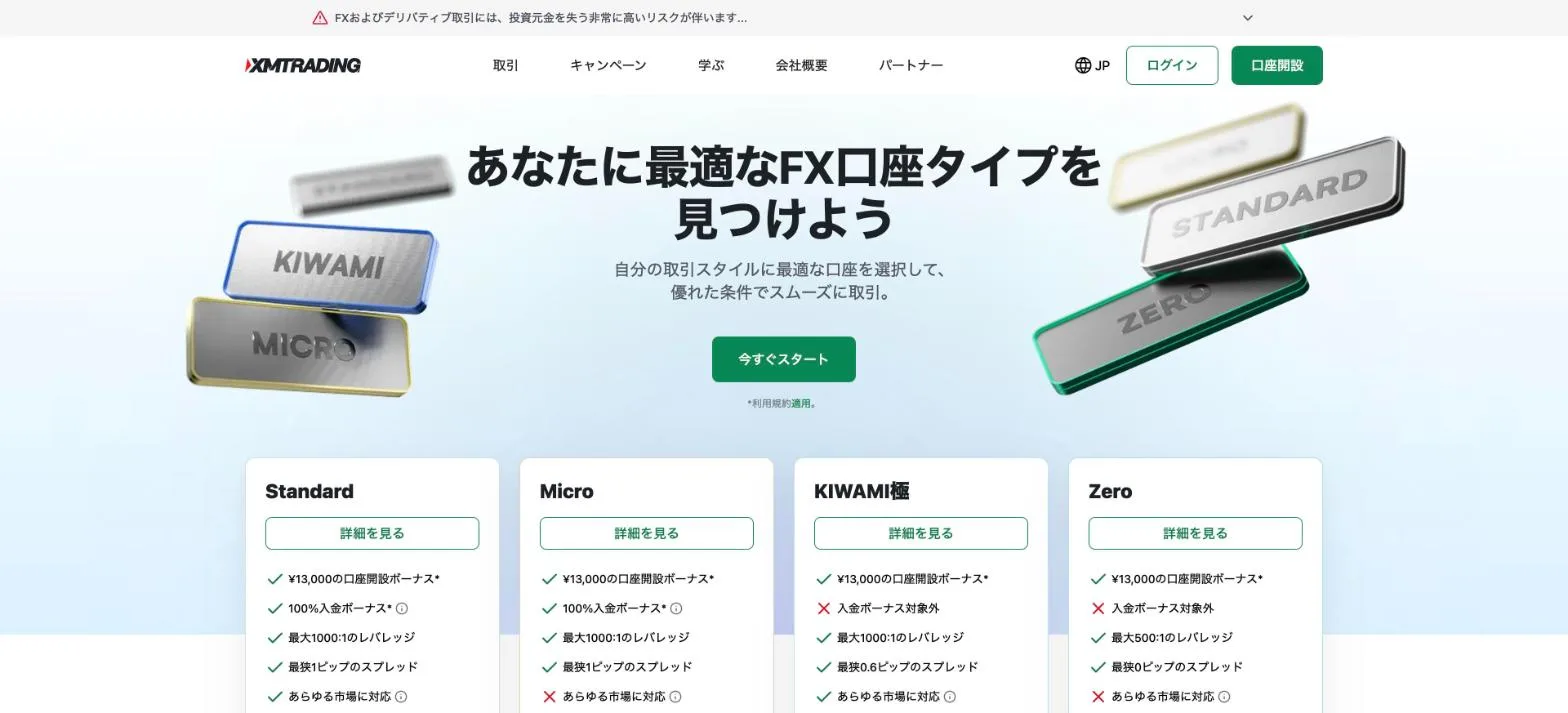
On commission-free accounts the spread is the only trading cost.
| Broker and account | Published spread | Basis | Minimum deposit |
|---|---|---|---|
| XS Standard | 1.1 pips | Average (EUR/USD) | No minimum |
| XS Cent | 1.1 pips | Average (EUR/USD) | No minimum |
| XS Pro | 0.7 pips | Average (EUR/USD) | USD 500 |
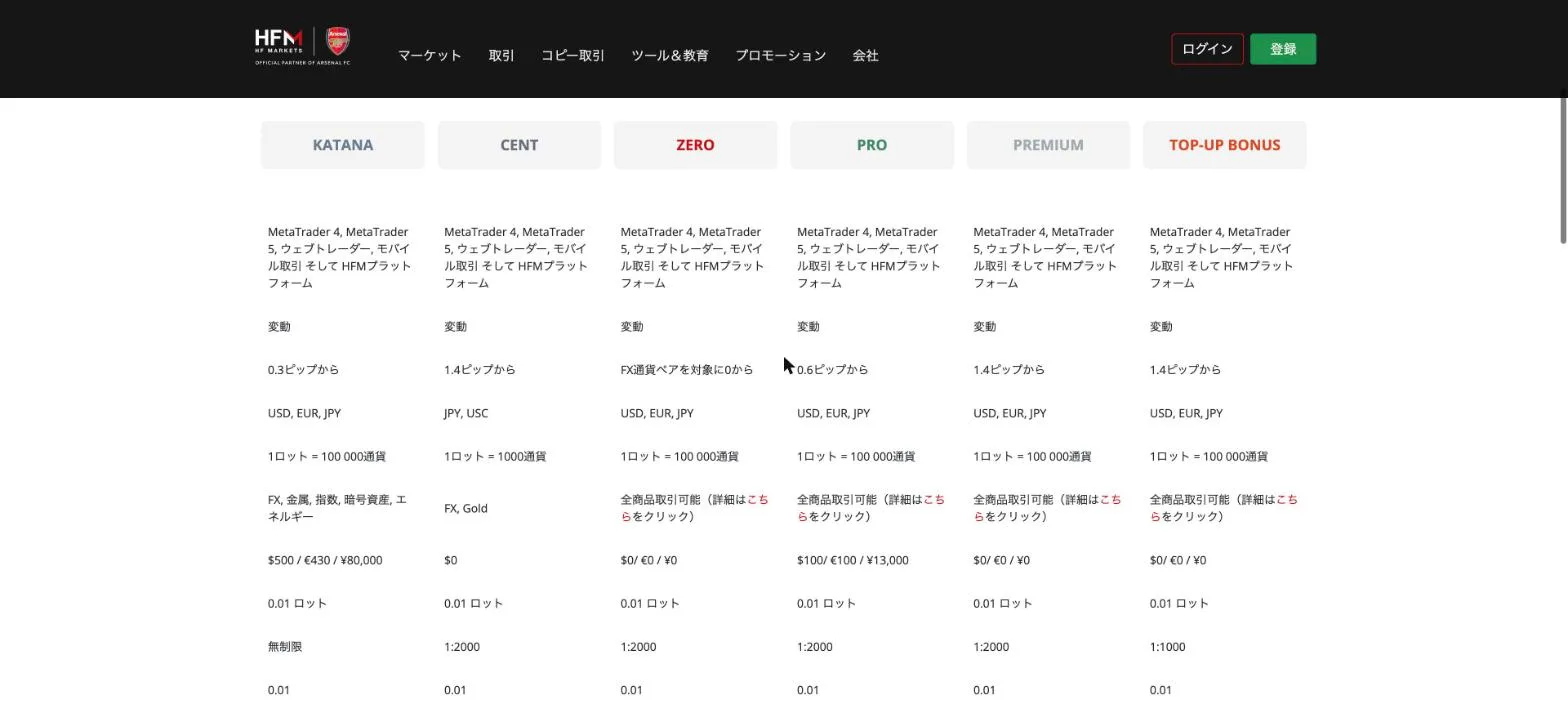
| HFM Premium | From 1.4 pips | Minimum | USD 0 |
| HFM Cent | From 1.4 pips | Minimum | USD 0 |
| HFM Pro | From 0.6 pips | Minimum | USD 100 |
| HFM KATANA | From 0.3 pips | Minimum | USD 500 |
| HFM Top-Up Bonus | From 1.4 pips | Minimum | USD 0 |
| Axi Standard | From 0.7 pips | Minimum (EUR/USD) | No set minimum (payment-method minimums only) |
| XMTrading Standard | From 1.0 pips | Minimum | From USD 5 |
| XMTrading Micro | From 1.0 pips | Minimum | From USD 5 |
| XMTrading KIWAMI | From 0.6 pips | Minimum | From USD 5 |
| Exness Standard Cent | From 0.3 pips | Minimum | Varies by region |
| Exness Standard | From 0.2 pips | Minimum | Varies by region |
| Exness Pro | From 0.1 pips | Minimum | Varies by region |
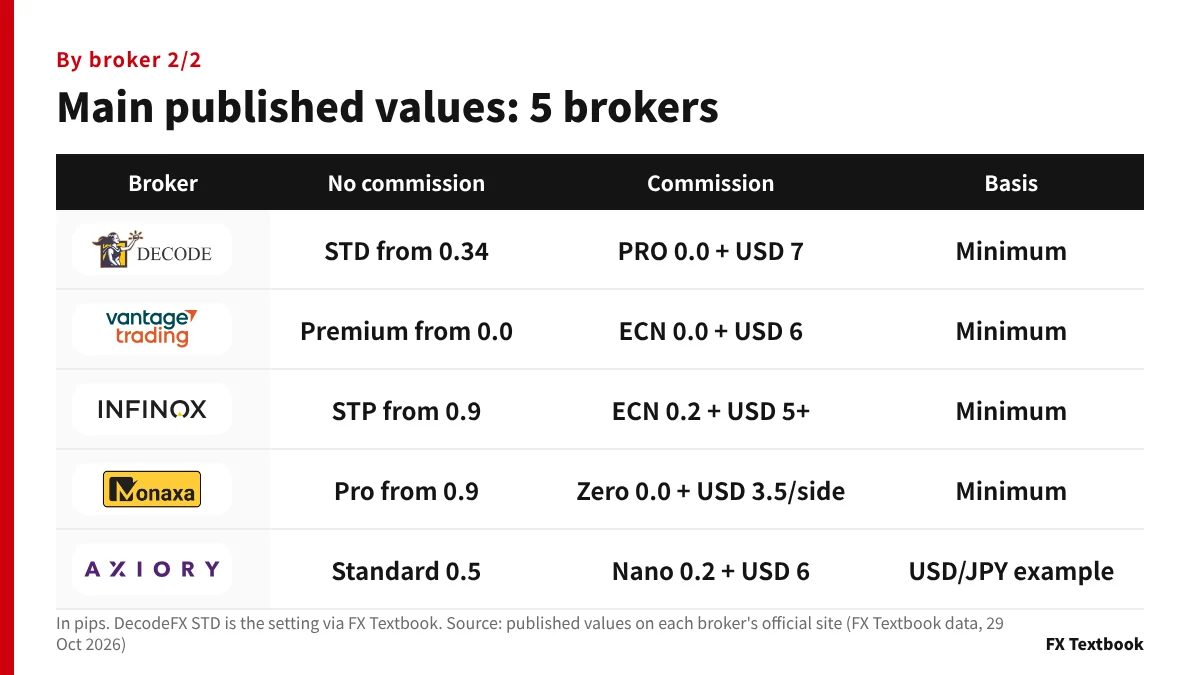
| DecodeFX STD | From 0.34 pips | Minimum (setting via FX Textbook) | USD 100 |
| DecodeFX CENT | From 1.7 pips | Minimum | USD 1 |
| Vantage Standard | From 1.5 pips | Minimum | From JPY 5,000 / USD 50 |
| Vantage Premium | From 0.0 pips | Minimum | USD 3,000 single first deposit |
| INFINOX STP | From 0.9 pips | Minimum | USD 50 (official, checked 17 Oct) |
| Monaxa Standard | From 1.8 pips | Minimum | USD 15 |
| Monaxa Pro | From 0.9 pips | Minimum | USD 50 |
| Monaxa Cent | From 1.8 pips | Minimum | USD 15 |
| AXIORY Standard | 0.5 pips on USD/JPY | Official cost example | Payment-method minimums only |
※ HFM and XMTrading values also match their official pages captured on 29 October 2026. DecodeFX STD varies by introducing partner and has no common official value. Exness's help centre lists no minimum deposit for Standard accounts, and Axi's official account page (checked 17 Oct) shows Standard at 0.68 pips.
The smallest minimum is Vantage Premium, from 0.0 pips. It is based on a single first deposit of USD 3,000.
Next come Exness Pro (from 0.1 pips) and Standard (from 0.2 pips). Exness minimum deposits vary by region. HFM KATANA starts from 0.3 pips with a USD 500 minimum deposit.
Forex spread comparison table 2: low-spread commission accounts
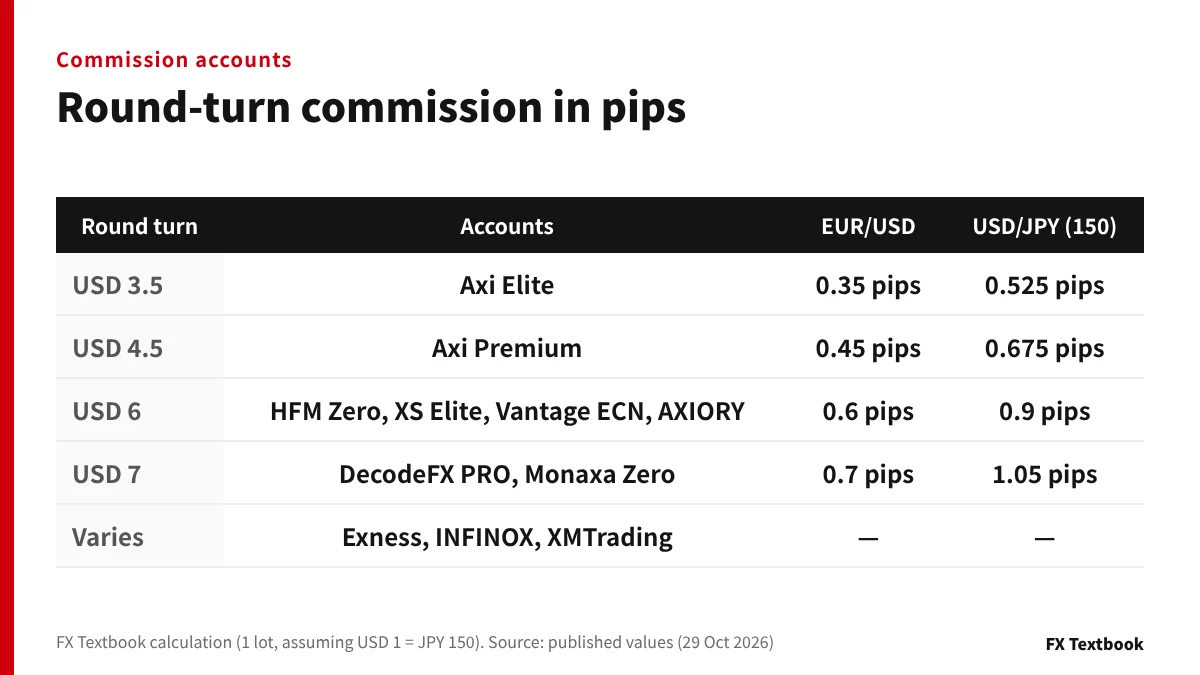
Accounts from 0.0 pips trade a tighter spread for a per-lot commission. Brokers charge per side (opening or closing) or per round turn (both).
| Broker and account | Spread + commission (as published) | Round turn | Total on EUR/USD |
|---|---|---|---|
| XS Elite | Average 0.1 pips + USD 6 round turn | USD 6 | About 0.7 pips (average) |
| XS VIP | Average 0.1 pips + custom commission | Custom | Not calculated |
| HFM Zero | From 0 pips + USD 6 round turn on FX | USD 6 | From 0.6 pips |
| Axi Premium | From 0.0 pips + USD 4.5 round turn | USD 4.5 | From 0.45 pips |
| Axi Elite | From 0.0 pips + USD 3.5 round turn | USD 3.5 | From 0.35 pips |
| XMTrading Zero | From 0 pips + USD 10 per USD 100,000 traded | Depends on volume | Not calculated |
| Exness Raw Spread | From 0.0 pips + up to USD 3.50 per side | Up to USD 7 | Up to 0.7 pips |
| Exness Zero | From 0.0 pips + from USD 0.05 per side | From USD 0.1 | From 0.01 pips |
| DecodeFX PRO | From 0.0 pips + USD 7 per standard lot | USD 7 | From 0.7 pips |
| Vantage ECN | From 0.0 pips + JPY 900 / USD 6 round turn | USD 6 (JPY 900 on JPY accounts) | From 0.6 pips |
| INFINOX ECN | From 0.2 pips + from USD 5 round turn | From USD 5 | From 0.7 pips |
| Monaxa Zero | From 0.0 pips + USD 3.50 per side | USD 7 | From 0.7 pips |
| AXIORY Nano | 0.2 pips on USD/JPY (cost example) + USD 3 per side | USD 6 | USD/JPY example; see below |
| AXIORY Tera | 0.2 pips on USD/JPY (cost example) + USD 3 per side | USD 6 | USD/JPY example; see below |
※ DecodeFX's official account page (checked 26 Sep 2026) shows PRO commission as USD 5 round turn, a different basis from the setting via FX Textbook (USD 7 per lot). AXIORY's official account page (checked 20 Oct 2026) does not list the Tera account.
Among fixed amounts, Axi Elite at USD 3.5 and Premium at USD 4.5 round turn are the smallest. Elite needs a USD 25,000 first deposit and Premium USD 500.
Exness Zero starts from USD 0.05 per side and rises by symbol. Check the commission on major pairs in your platform's symbol specification.
XMTrading Zero charges by the value traded. The dollar value of 1 lot moves with the exchange rate, so we have not converted it.
Commission-free vs commission accounts: STP and ECN types
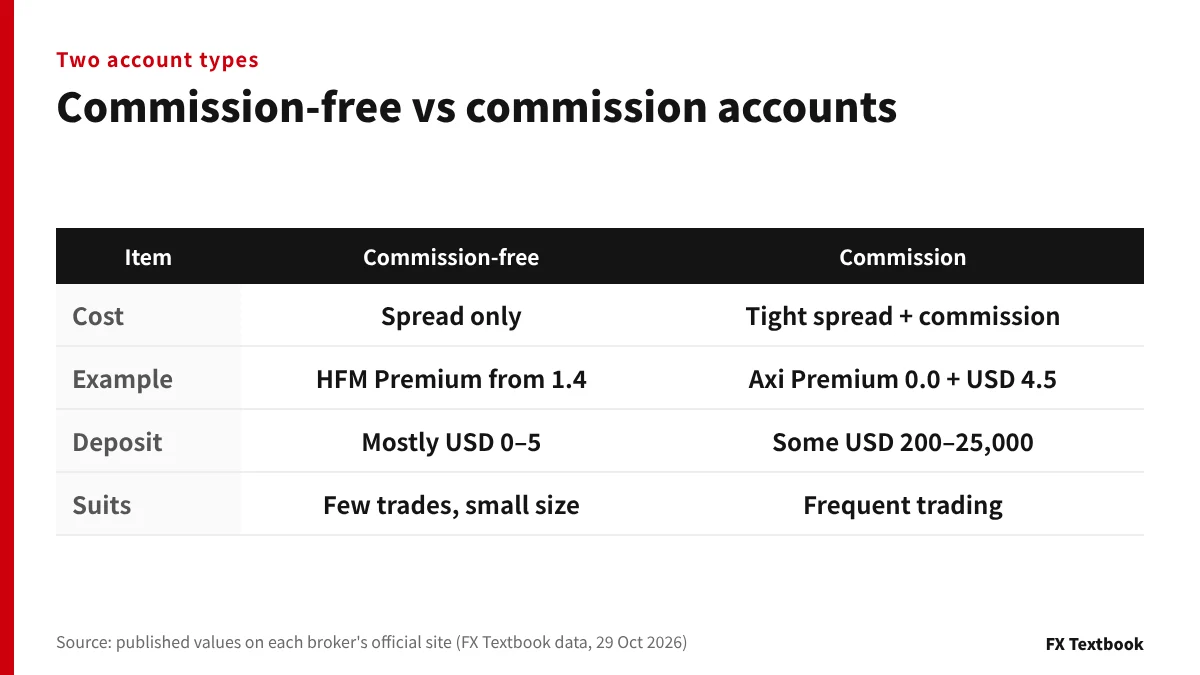
Forex accounts either build the cost into the spread with no commission, or narrow the spread and charge commission separately. The first type is often called STP and the second ECN.
| Item | Commission-free | Commission |
|---|---|---|
| Cost structure | Spread only | Tight spread + per-lot commission |
| Published examples | HFM Premium from 1.4 pips; XS Standard 1.1 pips average | HFM Zero from 0 pips + USD 6; Axi Premium from 0.0 pips + USD 4.5 |
| Deposit threshold | Many start from USD 0 to 5 | Axi Premium USD 500, Elite USD 25,000; Monaxa Zero USD 200 |
| Cost predictability | The spread moves, so each trade costs more or less | With a fixed commission, only the spread part moves |
| Suits | Fewer trades, trying small sizes | Frequent trading, managing total cost |
Some commission-free accounts also start from 0.0 pips, such as Vantage Premium. Judge by the commission line and the deposit threshold, not the account name.
Bonus-eligible accounts are mostly commission-free. HFM's 20% deposit bonus applies to the Top-Up Bonus account, published from 1.4 pips.
Dealing desk and no dealing desk (STP and ECN)
With a dealing desk (DD), the broker takes the other side of client orders. With no dealing desk (NDD), orders are passed to outside liquidity providers, called STP or ECN.
Some brokers, such as INFINOX, name accounts STP and ECN. The name alone does not show how orders are executed. We have not tested each broker's order handling, so check the execution model in the terms.
Average vs minimum spreads: how each broker publishes
An average spread smooths the gaps recorded over a period. A minimum spread is written as "from" or "as low as" and shows the floor in calm markets.
Setting XS's 1.1-pip average beside HFM's 1.4-pip minimum does not tell you which is tighter. On the same account, the minimum always comes out below the average.
| Broker | Basis of published value | Pair specified |
|---|---|---|
| XS | Average | EUR/USD |
| HFM | Minimum (variable) | None (Zero: "from 0 on FX pairs") |
| Axi | Minimum | EUR/USD (Standard) |
| XMTrading | Minimum (as low as) | None |
| Exness | Minimum | None |
| DecodeFX | Minimum (setting via FX Textbook) | None |
| Vantage | Minimum | None |
| INFINOX | Minimum (gold published as "from") | None |
| Monaxa | Minimum | None |
| AXIORY | Minimum + official cost example | USD/JPY (cost example) |
※ Our broker data records INFINOX's account values as gold averages (STP 17 and ECN 10 points). Its official account types page (checked 20 Oct 2026) shows from 15 and 8 cents.
Averages can cover different periods
XS's contract specifications show the previous trading day's average. If two averages cover different periods or hours, they are not like for like either. Read the note beside each figure before lining them up.
First line up averages with averages and minimums with minimums. Next add round-turn commission to commission accounts. Finally watch the pair you trade in a demo account.
Where to check spreads on each broker's official site
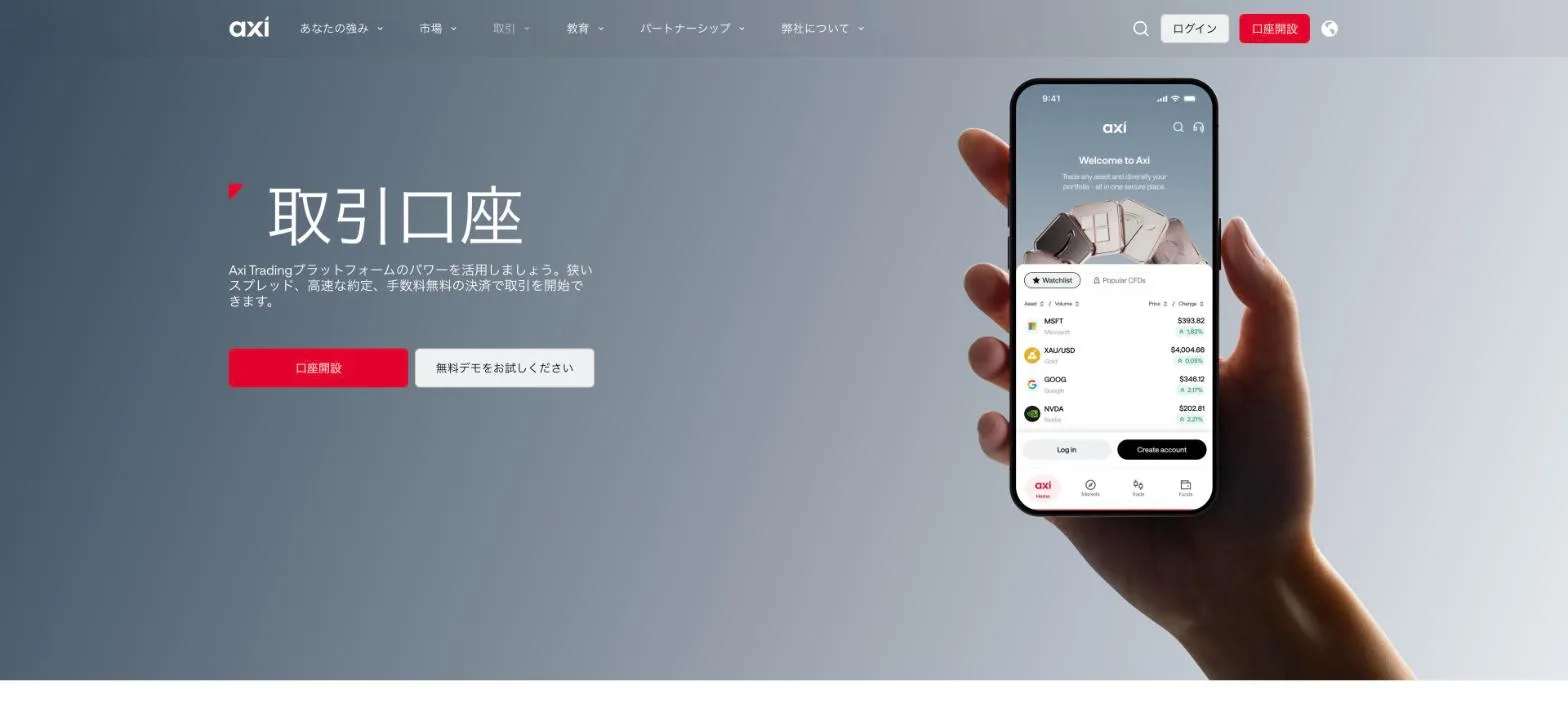
The pages and lines in the table below let you check the latest value yourself before opening an account.
| Broker | Page | What to look at |
|---|---|---|
| XS | Account types and contract specifications | Average per account; contract specs show the previous trading day's average |
| HFM | Account comparison | The spread row ("variable", "from ... pips") |
| Axi | Trading accounts | The EUR/USD figure for Standard |
| XMTrading | Account types | Each account's "as low as" figure |
| Exness | Help centre: trading account types | The main site needs a login from Japan, so use the help centre |
| DecodeFX | Trading accounts | STD varies by partner; check after opening |
| Vantage | Trading page of the Japan site | JPY and USD accounts show commission differently |
| INFINOX | Account types | Gold shown as "from ... cents" |
| Monaxa | Account types | The minimum spread row |
| AXIORY | Spreads and fees | Per-account tables are images; use the cost example figures |
- Whether the figure says average, from or as low as
- Which pair it applies to (if none, a floor on main symbols)
- Whether commission is per side or round turn, in USD or JPY
- When the value dates from, such as a check date or previous trading day
Official figures change without notice. If the check date on our broker page looks old, compare it with the official page.
Calculating cost with commission: EUR/USD vs USD/JPY
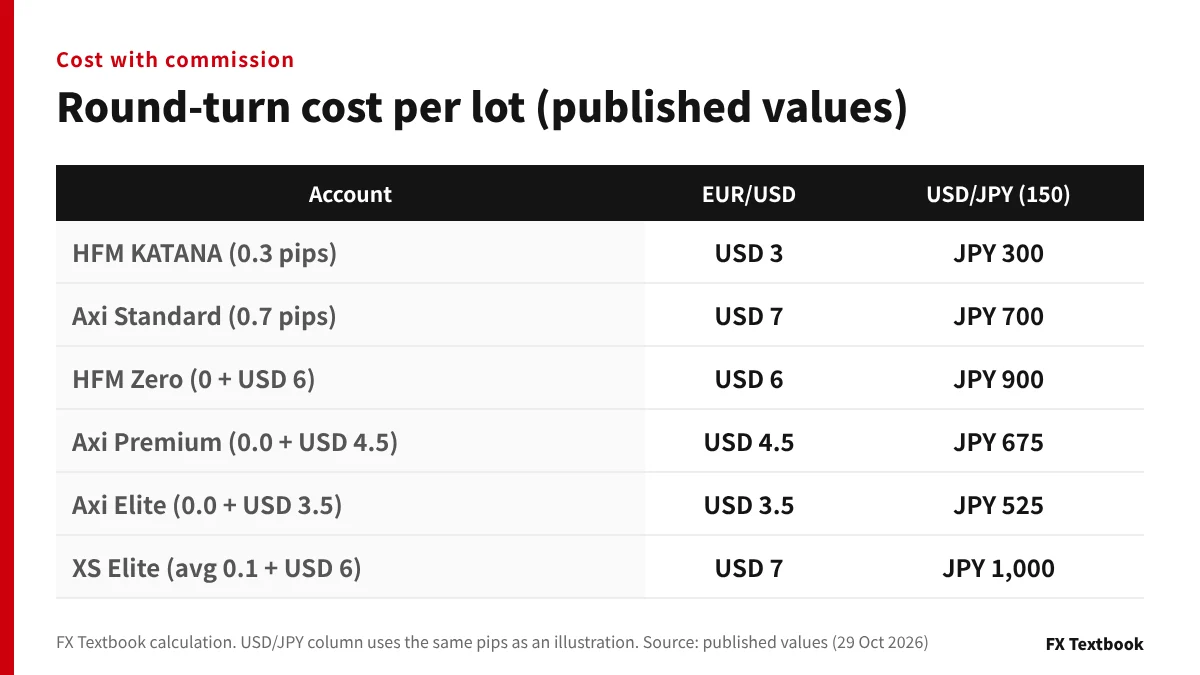
Cost with commission is the spread in money plus the round-turn commission. How a USD commission converts into pips depends on the pair.
- 01Turn the spread into money
Per lot, 1 pip is USD 10 on EUR/USD and JPY 1,000 on USD/JPY.
- 02Turn commission into pips
On EUR/USD, USD 1 = 0.1 pips. On USD/JPY at JPY 150 to the dollar, USD 1 = 0.15 pips.
- 03Add them
HFM Zero at 0 pips costs USD 6 on EUR/USD and JPY 900 (0.9 pips) on USD/JPY.
| Account (published value) | 1 lot EUR/USD | 1 lot USD/JPY (USD 1 = JPY 150) |
|---|---|---|
| HFM KATANA (0.3 pips, no commission) | USD 3 | JPY 300 |
| HFM Pro (0.6 pips, no commission) | USD 6 | JPY 600 |
| Axi Standard (0.7 pips, no commission) | USD 7 | JPY 700 |
| HFM Zero (0 pips + USD 6) | USD 6 | JPY 900 |
| Vantage ECN JPY account (0.0 pips + JPY 900) | USD 6 | JPY 900 |
| Axi Premium (0.0 pips + USD 4.5) | USD 4.5 | JPY 675 |
| Axi Elite (0.0 pips + USD 3.5) | USD 3.5 | JPY 525 |
| XS Elite (average 0.1 pips + USD 6) | USD 7 | JPY 1,000 |
※ Most brokers do not say which pair their published value applies to. The USD/JPY column shows how the maths works; it is not a USD/JPY spread published by the broker.
JPY vs USD accounts: the weight of commission
Vantage ECN charges JPY 900 round turn on JPY accounts and USD 6 on USD accounts. Which is heavier in yen depends on the exchange rate.
| USD 1 = | USD account: USD 6 | JPY account: JPY 900 |
|---|---|---|
| JPY 140 | JPY 840 | JPY 900 |
| JPY 150 | JPY 900 | JPY 900 |
| JPY 160 | JPY 960 | JPY 900 |
At exactly JPY 150 both are JPY 900. The weaker the yen, the lighter a commission fixed in yen becomes.
How the gap grows with trading volume
Trading 0.1 lot five times a day for 20 days a month adds up to 10 lots. If a commission-free account actually trades at 1.4 pips, that costs USD 140 a month on EUR/USD.
If a commission account trades at 0.2 pips plus USD 6, that is USD 8 per lot, or USD 80 a month. The USD 60 gap widens as you trade more.
| Cost per lot | 1 lot a month | 10 lots a month | 50 lots a month |
|---|---|---|---|
| USD 3.5 (Axi Elite, published) | USD 3.5 | USD 35 | USD 175 |
| USD 6 (HFM Zero, published) | USD 6 | USD 60 | USD 300 |
| USD 8 (assumed 0.2 pips + USD 6) | USD 8 | USD 80 | USD 400 |
| USD 14 (assumed 1.4 pips, no commission) | USD 14 | USD 140 | USD 700 |
The spreads above (1.4 and 0.2 pips) are illustrative. Real spreads change with the time and market. Swaps and funding fees are not included.
Costs beyond the spread: swaps and funding fees
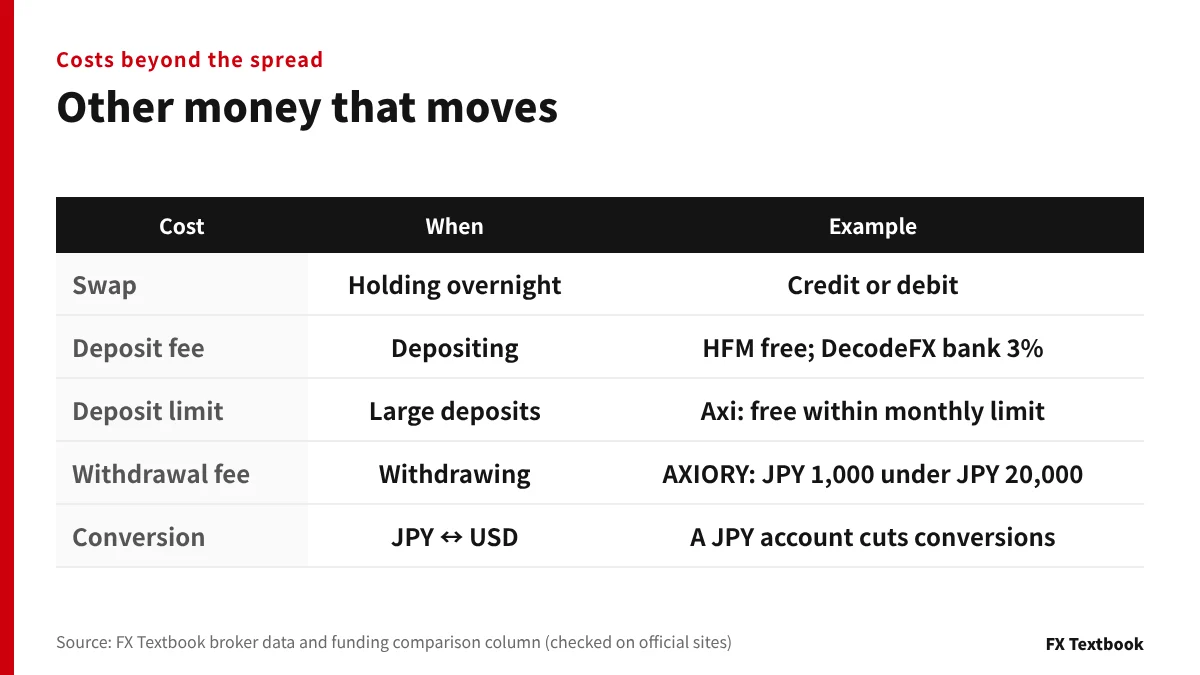
Spread and commission are not the only money that moves. Holding a position overnight adds a swap. Some brokers also charge for deposits or withdrawals.
| Cost | When it applies | Examples at listed brokers |
|---|---|---|
| Swap | Holding a position overnight | Credit or debit depending on the pair and direction |
| Deposit fee | Paying money in | HFM charges nothing on its 7 methods; DecodeFX charges 3% on domestic bank transfer only |
| Deposit limit | Many or large deposits | Axi charges no deposit fee within its monthly limit |
| Withdrawal fee | Taking money out | AXIORY: JPY 1,000 per withdrawal under JPY 20,000 (free from JPY 20,000) |
| Currency conversion | Switching between JPY and USD | HFM offers JPY accounts; Vantage JPY accounts charge commission in yen (JPY 900 round turn) |
※ Your bank or e-wallet may charge its own fee on top of the broker's.
The longer you hold, the more swaps outweigh spread differences. If you trade rarely, compare swap and funding terms in the same way.
Spreads by instrument: USD/JPY, EUR/USD and gold
Three brokers name the pair behind their figure: XS (EUR/USD average), Axi (EUR/USD minimum) and AXIORY (USD/JPY cost example). The other seven publish minimums without naming a pair.
| Pair | Broker and account | Value |
|---|---|---|
| EUR/USD | XS Standard / Pro / Elite | Average 1.1 / 0.7 / 0.1 pips |
| EUR/USD | Axi Standard | From 0.7 pips |
| USD/JPY | AXIORY Standard | 0.5 pips (cost example) |
| USD/JPY | AXIORY Nano / Tera | 0.2 pips + USD 6 round turn (cost example) |
Gold (XAUUSD) and silver (XAGUSD)
Brokers quote gold in pips, dollars or cents. Converting adds error, so we show each as published.
| Broker and account | Gold spread | Basis |
|---|---|---|
| XS (USD 6 round-turn account) | 0.87 pips (USD 8.7 per lot) | Previous trading day's average |
| Axi Standard | From USD 0.18 | Indicative minimum |
| Axi Premium | From USD 0.081 | Indicative minimum |
| INFINOX STP | From 15 cents | Variable |
| INFINOX ECN | From 8 cents | Variable |
XS silver is 3.3 pips on Elite, 3.9 pips on Pro and 4.3 pips on Standard and Cent. These are previous-day averages from the official contract specifications (checked 6 October 2026).
Stock index, oil and crypto CFDs
Spreads on stock index, oil and crypto CFDs also differ by symbol. We do not collect published values for these symbols. Contract size varies by symbol too, so check both in your platform's symbol specification.
Gold trading at offshore brokers compared: spreads, leverage and commission
Broker by broker: accounts and spreads at all 10
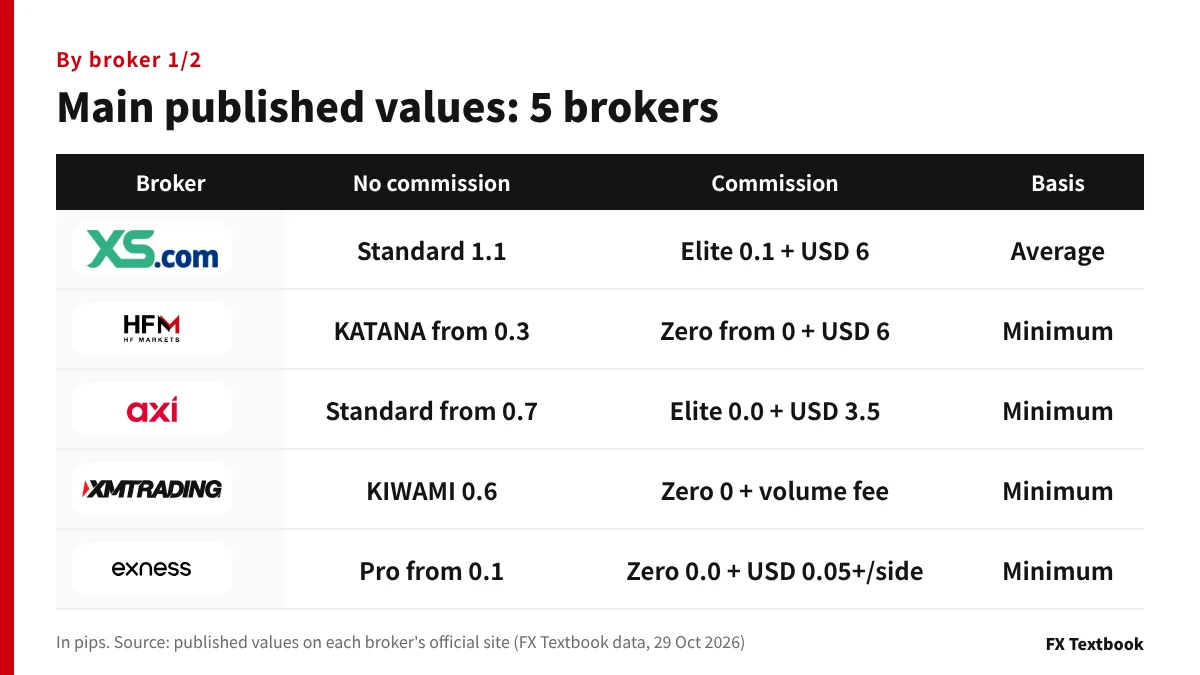
No ranking. Figures are the same published values as in the tables above.
XS
- The only one of the 10 to publish EUR/USD averages
- Standard averages 1.1 pips with no minimum deposit
- Elite averages 0.1 pips plus USD 6, about 0.7 pips in total
- Silver averages per account are in the contract specifications
HFM
- Five commission-free accounts plus Zero with commission
- KATANA from 0.3 pips with a USD 500 minimum deposit
- Zero from 0 pips plus USD 6 round turn, minimum deposit USD 0
- Cent: 1 lot = 1,000 units, trades FX and gold
Axi
- Standard from 0.7 pips on EUR/USD, no commission
- Premium USD 4.5 and Elite USD 3.5 per round turn
- First deposit: Premium USD 500, Elite USD 25,000
- Gold on Standard from USD 0.18 (official)
XMTrading
- Standard and Micro from 1.0 pips, KIWAMI from 0.6 pips
- KIWAMI has no commission and starts from USD 5
- Zero charges USD 10 per USD 100,000 traded
- Up to 10 live accounts per person (official)
Exness
- Commission-free Pro from 0.1 pips, Standard from 0.2 pips
- Raw Spread charges up to USD 3.50 per side
- Zero from USD 0.05 per side, varying by symbol
- Per-side fees double for a round turn
- All five accounts offer up to 1:2000 (unlimited under conditions)
DecodeFX
- STD from 0.34 pips with the FX Textbook setting
- PRO from 0.0 pips plus USD 7 per standard lot
- CENT from 1.7 pips with a USD 1 minimum deposit
- All three accounts offer up to 1:2000
Vantage Trading
- Standard from 1.5 pips, deposits from JPY 5,000
- ECN from 0.0 pips plus JPY 900 round turn (USD 6 on USD accounts)
- Premium from 0.0 pips with no commission, USD 3,000 first deposit
INFINOX
- STP from 0.9 pips; ECN from 0.2 pips plus from USD 5
- Gold from 15 cents on STP and 8 cents on ECN (official)
- Both accounts offer up to 1:1000 on MT4 and MT5
Monaxa
- Standard and Cent from 1.8 pips, Pro from 0.9 pips
- Zero from 0.0 pips plus USD 3.50 per side, minimum deposit USD 200
- Cent offers up to 1:1000 (the other three up to 1:2000)
AXIORY
- Per-account spread tables are images; we use the cost example
- USD/JPY example: Standard 0.5 pips, Nano and Tera 0.2 pips
- Nano and Tera charge USD 3 per side (USD 6 round turn)
- Max has no commission and leverage up to 1:2000
When forex spreads widen: times and events
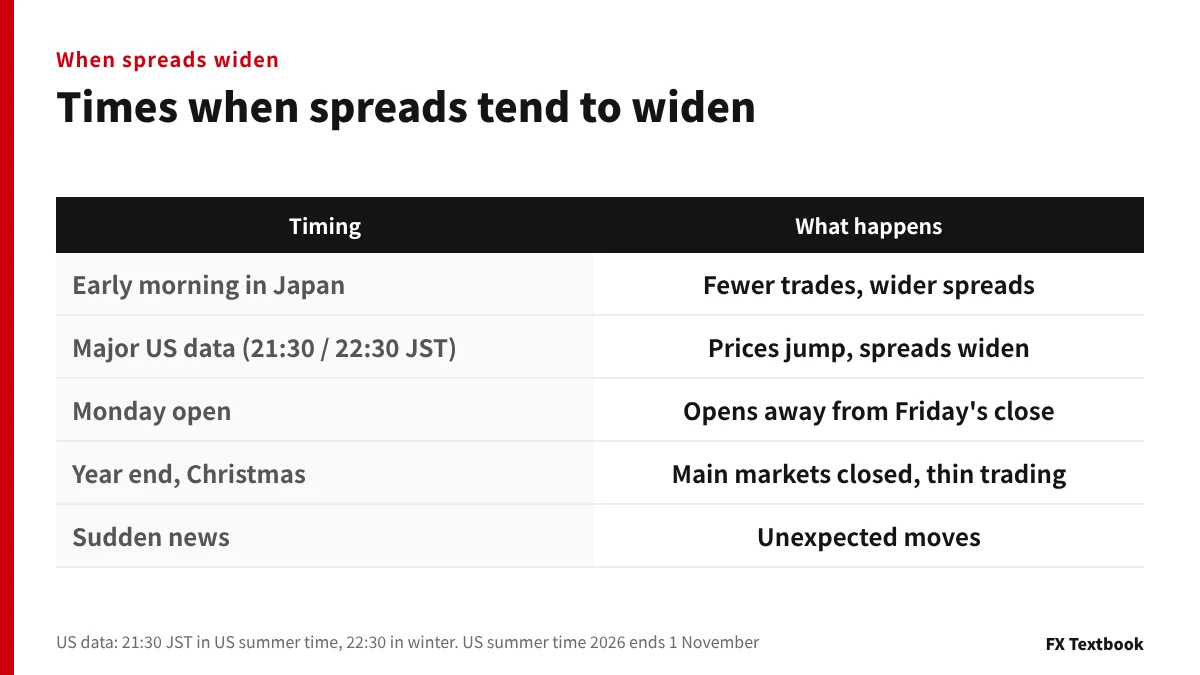
Variable spreads widen when few people are trading or prices move fast. Spreads near the published minimum appear when the market is busy.
| Timing | What tends to happen | What to check |
|---|---|---|
| Early morning in Japan (after New York closes, before Tokyo opens) | Fewer trades and wider spreads | The spread in Market Watch |
| Around major US data releases | Prices jump and spreads widen | Release time (21:30 JST in US summer time, 22:30 in winter) |
| Monday open | Opens away from the previous close | The spread when a gap opens |
| Year end and Christmas | Main markets closed, thin trading | Broker holiday notices |
| Sudden news | Unexpected moves widen spreads | Your position size |
| Around a broker's daily break and the change of day | Thin trading | Your broker's trading hours notice |
※ US summer time ends on 1 November 2026, so from 2 November US data is usually released at 22:30 JST.
The change-of-day process is called rollover. Its time differs by broker, so read your broker's notice on trading hours once after opening an account.
A "from" value is a floor. At these times your order may fill at a wider spread than the published one.
How to check live spreads yourself
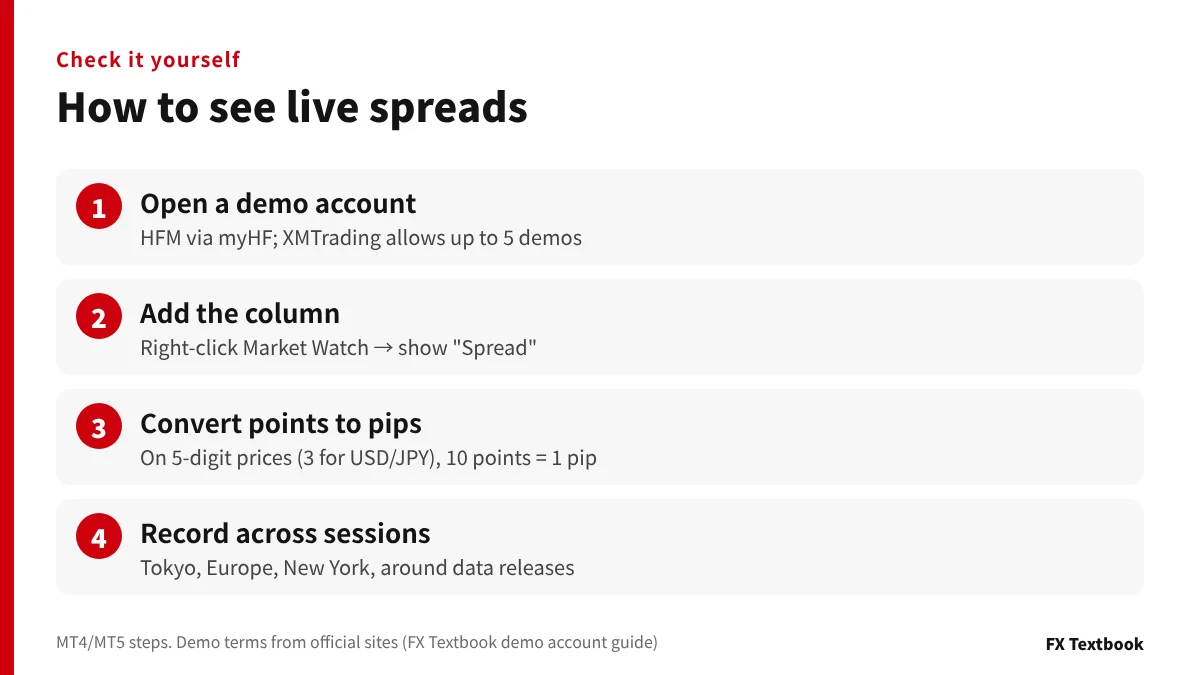
Published values help you shortlist accounts. Before deciding, watch the spread on the pairs you trade in a demo account.
- 01Open a demo account
HFM demos are created in the myHF area. XMTrading allows up to five demo accounts per person.
- 02Add the spread column
Right-click Market Watch in MT4 or MT5 and add the "Spread" column.
- 03Convert the units
The spread column shows points. On 5-digit prices (3 digits for USD/JPY), 10 points equal 1 pip.
- 04Record across sessions
Note the spread in Tokyo, Europe and New York hours and around data releases. Check commission in your trade history.
XS's contract specifications page says charts show pre-markup prices by default while Market Watch shows your account's prices. Check your own spread in Market Watch.
Pitfall checklist for choosing an account by spread
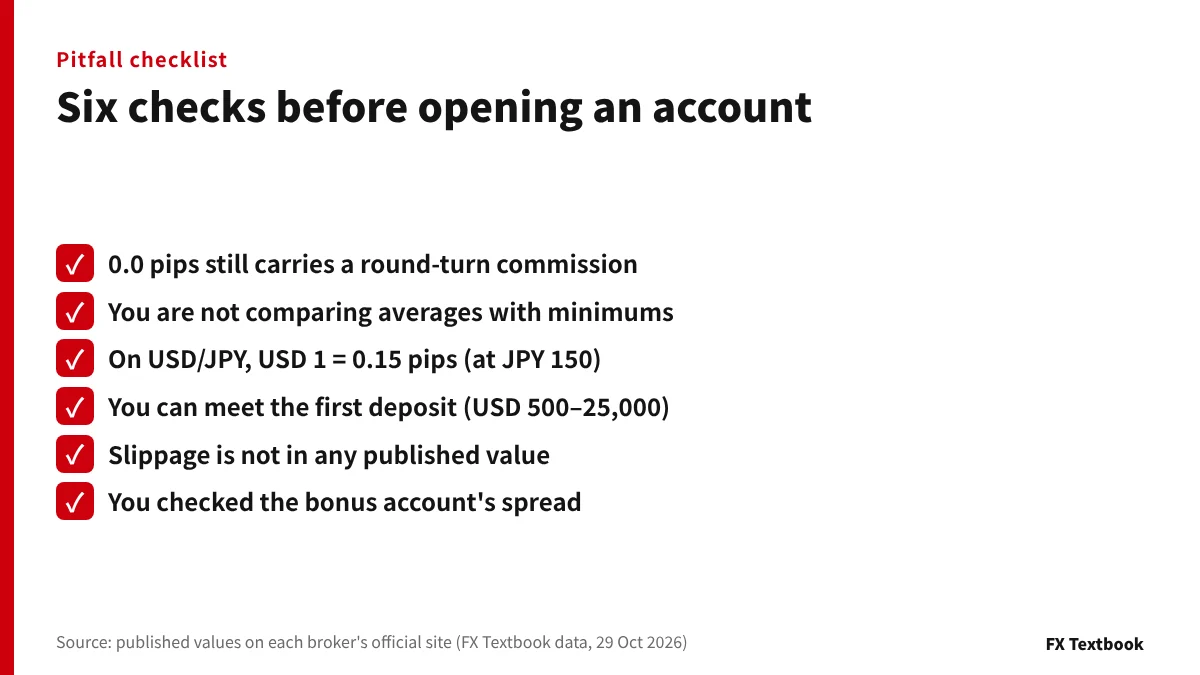
| Pitfall | What happens | How to check |
|---|---|---|
| Assuming 0.0 pips is free | You miss a USD 3.5 to 7 round-turn commission | The commission line and whether it is per side or round turn |
| Comparing averages with minimums | You pick the wrong account as tighter | The basis of each published value |
| Converting USD/JPY commission at USD 1 = 0.1 pips | You underestimate commission | At JPY 150, USD 1 = 0.15 pips |
| Ignoring the first deposit | You cannot meet the account condition | Axi Premium USD 500, Vantage Premium USD 3,000 and so on |
| Ignoring slippage | Fill price differs from the price you saw | Fill prices in your trade history |
| Ignoring the bonus account's spread | Conditions differ from the regular account | HFM Top-Up Bonus from 1.4 pips |
| Assuming cent accounts cost the same in money | 1 lot is worth one hundredth | HFM Cent: 1 lot = 1,000 units |
Slippage is a price difference separate from the spread. No broker's published value includes it, so test it in a demo account and with small trades.
If you plan to scalp or use automated trading, read the conditions in the terms. Even tight-spread accounts may restrict how you trade.
By trading style: which accounts' spreads to check first
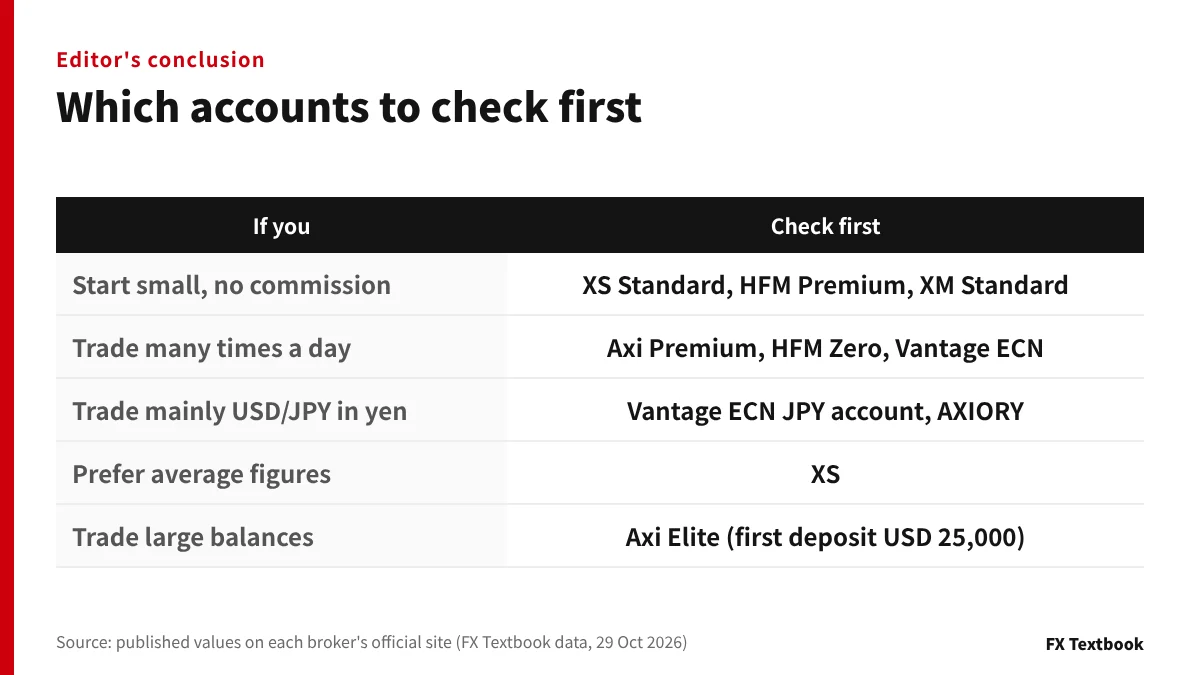
| If you | Check first | Why (published values) |
|---|---|---|
| Want to start small with no commission | XS Standard, HFM Premium, XMTrading Standard | Minimum deposit: none, USD 0, from USD 5 |
| Trade many times a day | Axi Premium, HFM Zero, Vantage ECN | USD 4.5, USD 6 and JPY 900 round turn give a clear total |
| Trade mainly USD/JPY and manage in yen | Vantage ECN JPY account, AXIORY | Vantage charges in yen; AXIORY publishes a USD/JPY cost example |
| Prefer average figures | XS | Publishes EUR/USD averages |
| Trade large balances and want low commission | Axi Elite | USD 3.5 round turn, USD 25,000 first deposit |
Using more than one account
You can hold both a commission-free and a commission account at one broker. XMTrading allows up to 10 live accounts per person (official, checked 20 October 2026).
If you trade a few times a month and hold for longer, pick a commission-free account by minimum deposit and published spread. If you trade many times a day, compare totals including commission. If you trade mainly USD/JPY, convert USD commission at USD 1 = 0.15 pips.
Account conditions for each broker are set out in the same format in our broker directory.
Frequently asked questions
Q. Which forex broker has the tightest spread?
A. Brokers publish on different bases, so there is no single answer. The smallest commission-free minimum is Vantage Premium from 0.0 pips (USD 3,000 first deposit). With a fixed-amount commission, Axi Elite at 0.0 pips plus USD 3.5 round turn is the smallest. On averages, XS Standard is 1.1 pips.
Q. Are there forex brokers with zero spreads?
A. Yes. Eight of the 10 brokers we list, all except XS and INFINOX, have accounts from 0.0 pips. Most charge USD 3.5 to 7 per round turn. Vantage Premium is the commission-free one from 0.0 pips. And 0.0 pips is a minimum, not a spread you will always get.
Q. Are spreads tighter at Japanese or offshore brokers?
A. They are quoted differently, so they cannot be compared as they stand. Japanese brokers quote USD/JPY in sen, and 1 sen equals 1 pip. Some offshore accounts charge commission separately, so put both in pips and add commission first. Japanese brokers cap leverage for individuals at 25x.
Q. How many pips is a round-turn commission?
A. On USD-quoted pairs such as EUR/USD, USD 1 per lot is 0.1 pips. On USD/JPY at JPY 150 to the dollar, USD 1 is 0.15 pips. A USD 6 round turn is 0.6 pips on EUR/USD and 0.9 pips on USD/JPY.
Q. When do forex spreads widen?
A. Typically in the early morning in Japan, around US data releases, at the Monday open and over year end. US data usually comes out at 21:30 JST in US summer time and 22:30 in winter. US summer time 2026 ends on 1 November.
Q. Where can I see live spreads?
A. In MT4 or MT5, right-click Market Watch and add the "Spread" column. It shows points; on 5-digit prices, 10 points equal 1 pip. You can check this in a demo account too. Some brokers show different prices on charts and in Market Watch, so use Market Watch.
Q. Do any offshore brokers offer fixed spreads?
A. We have not found a fixed-spread account at any of the 10 brokers we list (checked October 2026). All publish variable spreads as an average or a minimum.
Q. Can beginners use tight-spread accounts?
A. Yes, but check the deposit threshold and commission first. Axi Premium needs USD 500 and Vantage Premium USD 3,000 as a first deposit. To start small, compare commission-free accounts with minimum deposits of USD 0 to 5. On an account like HFM Cent, where 1 lot is 1,000 units, the money involved is one hundredth.
Sources and conditions
- XS account types (checked 2 August 2026) →
- XS contract specifications: metals (checked 6 October 2026) →
- XS metals trading (checked 20 October 2026, captured 29 October) →
- HFM account comparison (checked 1 September 2026, captured 29 October) →
- Axi trading accounts (checked 10 September 2026) →
- Axi precious metals CFDs (checked 20 October 2026) →
- XMTrading account types (checked 10 August 2026, captured 29 October) →
- Exness Help Center: trading account types (checked 3 September 2026) →
- DecodeFX trading accounts (checked 4 August and 26 September 2026) →
- Vantage Trading trading page (checked 3 August 2026) →
- INFINOX account types (checked 20 October 2026) →
- Monaxa account types (checked 2 September 2026) →
- AXIORY account types (checked 19 September and 20 October 2026) →
- Broker directory (published spreads, commission and check dates) →
- Advertising, affiliate relationships and risk disclosure →
FX Textbook is an independent information site, not a broker or provider of personal investment advice. Forex and CFDs involve risk. You may lose some or all of your invested capital. No trading result is guaranteed.
NEXT STEP
Narrowed the field? Check the conditions by account type.
Spread basis, commission, minimum deposit, leverage and platforms are set out in the same format for each broker.
Brokers covered in this column
Account types, trading conditions and current offers are on each broker page.