














If an order on payrolls or FOMC day did not fill where you expected, the trading conditions changed under you. Knowing how they change ahead of time keeps you calm the next time.
Four things shift: the spread, the fill price, the margin on new positions and how stop outs happen. Exness, Axi, XS and Monaxa publish rules that cut leverage on new trades around releases.
The next U.S. payrolls report is due on 6 November 2026 at 22:30 Japan time (BLS, checked 30 October). By the end you will know what to check before a release and how to size what you hold.
Short answer: four conditions that change on payrolls day
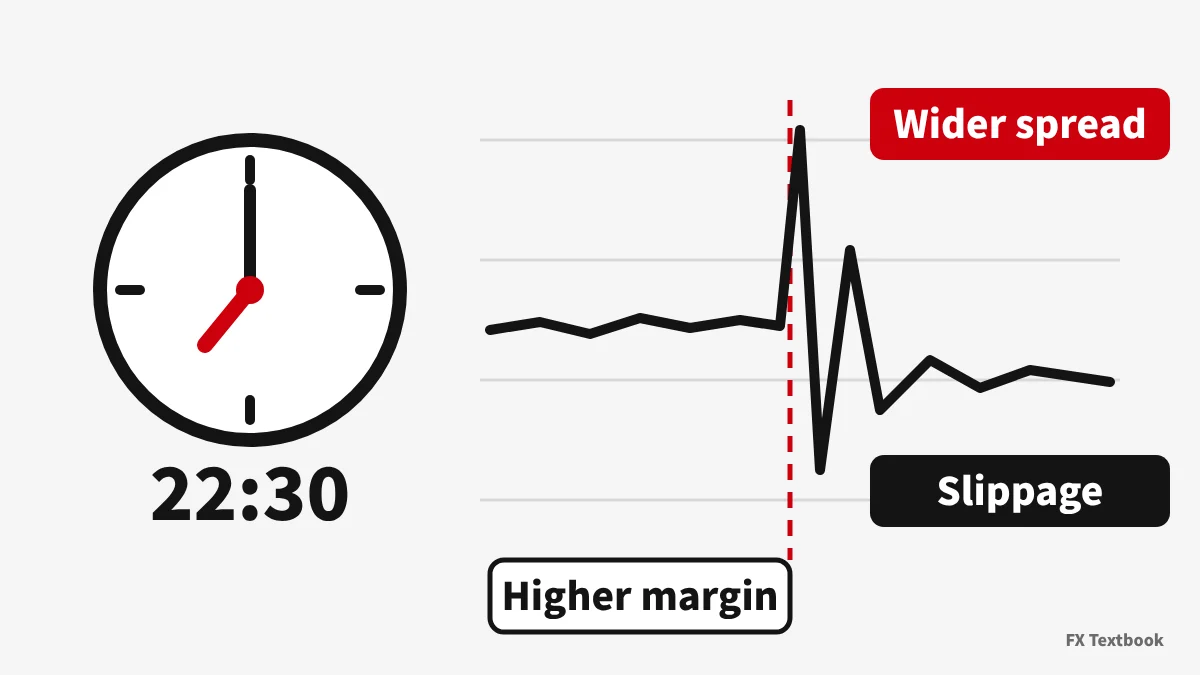
- Spread: widens around releases. Exness lists news releases as a cause
- Fills: market orders slip and instant execution brings requotes. Stop losses are not guaranteed either
- Margin: Exness, Axi, XS and Monaxa cut leverage on new trades to levels such as 1:200 around releases
- Stop out: when prices jump, forced closures run past the level before your stop helps
None of this is a broker fault. Each broker's help centre describes it as a rule. Holding through a release without knowing it shows up as a close that fails or a loss bigger than planned.
This article covers trading conditions at release time only. It does not forecast prices or suggest when to buy or sell. Forex and CFD trading can lose part or all of the money you deposit.
U.S. payrolls schedule: 22:30 Japan time from November
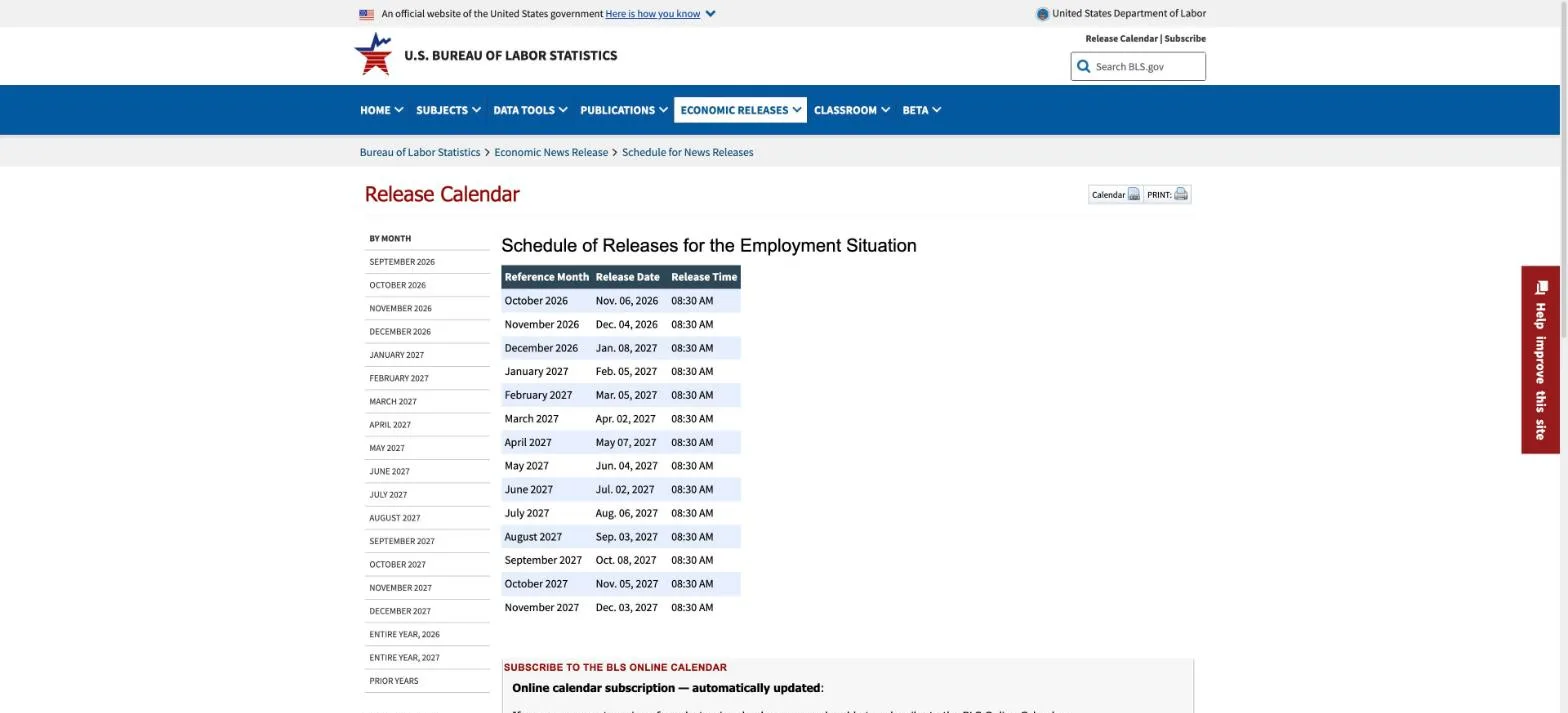
The U.S. Bureau of Labor Statistics (BLS) publishes the Employment Situation every month. Its official schedule lists every release at 08:30 AM.
| Reference month | Release date (U.S.) | Japan time |
|---|---|---|
| October 2026 | Fri 6 Nov | Fri 6 Nov, 22:30 |
| November 2026 | Fri 4 Dec | Fri 4 Dec, 22:30 |
| December 2026 | Fri 8 Jan 2027 | Fri 8 Jan, 22:30 |
| January 2027 | Fri 5 Feb 2027 | Fri 5 Feb, 22:30 |
| February 2027 | Fri 5 Mar 2027 | Fri 5 Mar, 22:30 |
U.S. daylight saving time ended on 1 November 2026. It returns on 14 March 2027, so the March report on 2 April moves back to 21:30 Japan time.
- U.S. CPI for October: Tue 10 Nov, 22:30 Japan time
- U.S. CPI for November: Thu 10 Dec, 22:30 Japan time
The schedule shows only 08:30 AM. As in our economic indicators guide, we treat it as U.S. Eastern time.
Economic indicators basics: payrolls, CPI, FOMC and converting times to Japan time
FOMC schedule: 8-9 December, statement in the Japanese night
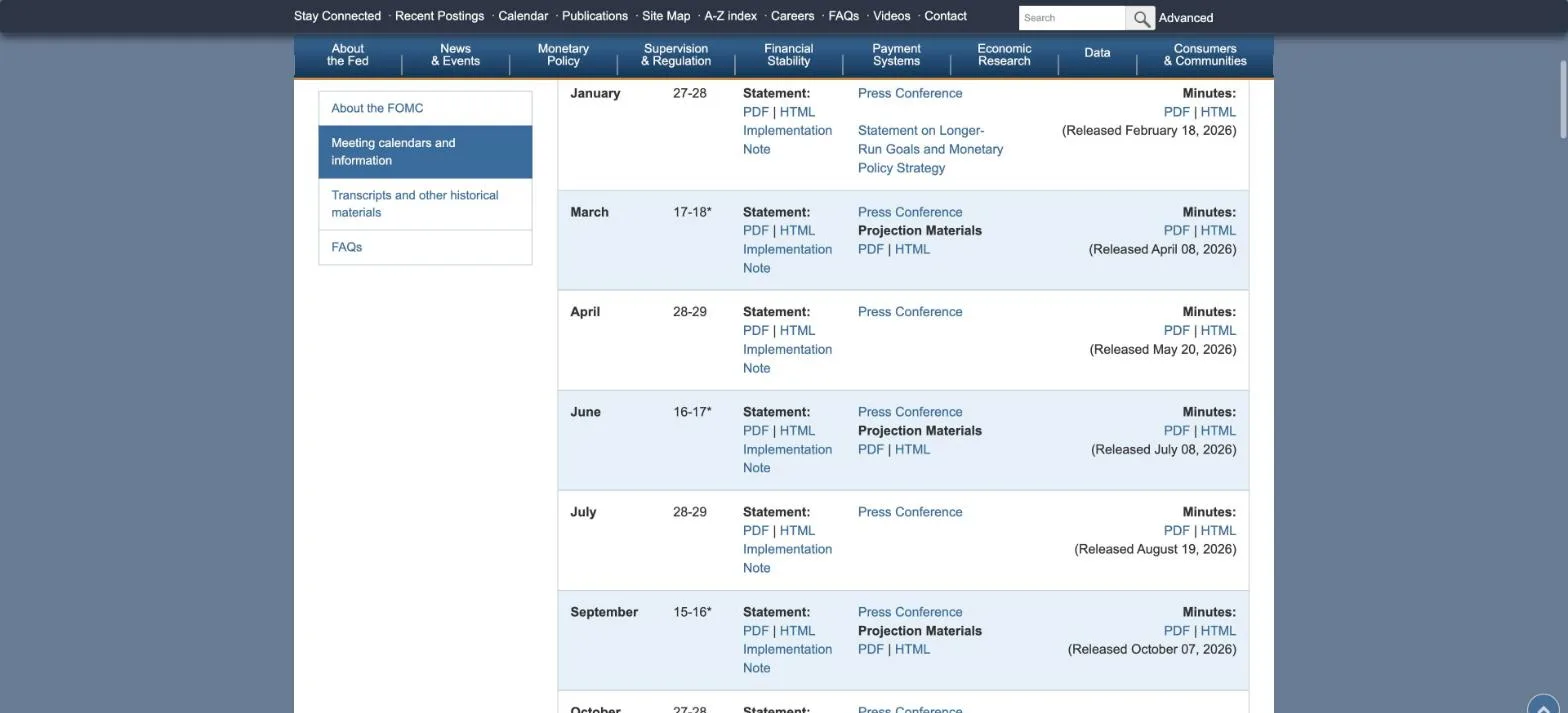
The Federal Open Market Committee (FOMC) sets U.S. monetary policy. The Federal Reserve calendar lists eight meetings in 2026.
| Meeting | Dates (U.S.) | Economic projections |
|---|---|---|
| January | 27-28 | No |
| March | 17-18 | Yes |
| April | 28-29 | No |
| June | 16-17 | Yes |
| July | 28-29 | No |
| September | 15-16 | Yes |
| October | 27-28 | No |
| December | 8-9 | Yes |
The statement of 28 October came out at 2:00 p.m. Eastern. Daylight time was still in force, so it was 3:00 on 29 October in Japan.
If 9 December also uses 2:00 p.m., winter time makes it 4:00 on 10 December in Japan. The calendar does not give the time.
U.S. afternoon releases land in the early hours of the next day in Japan. Minutes follow about three weeks after each meeting.
Why spreads widen around releases, and what it costs
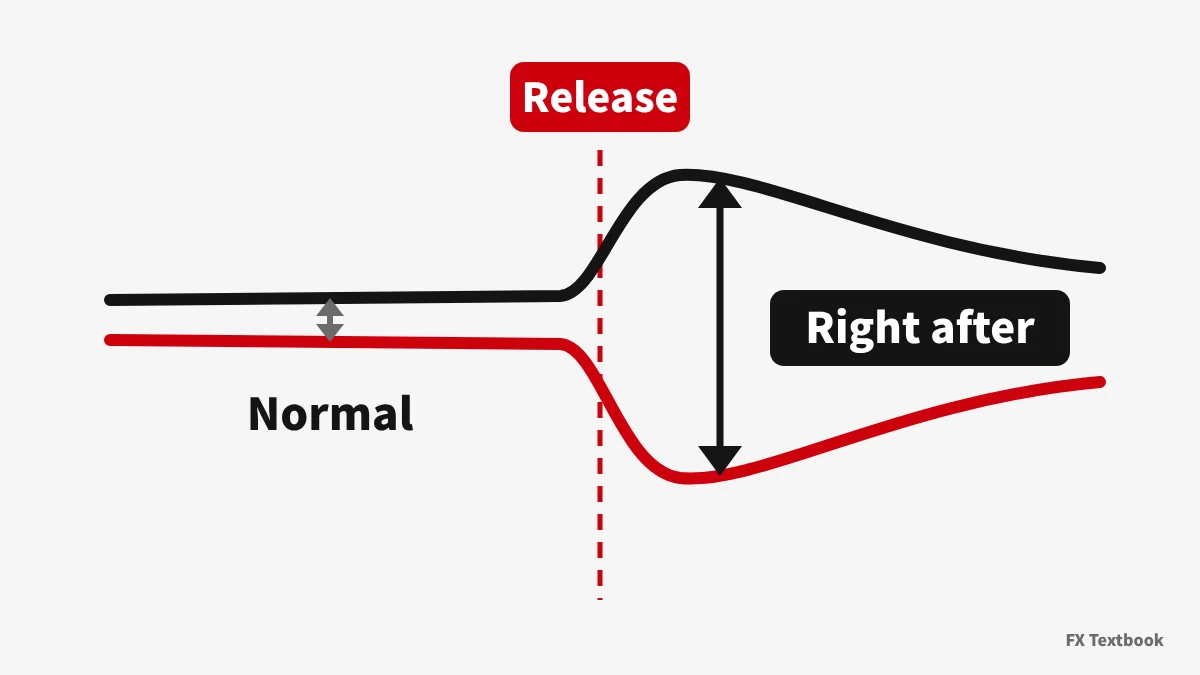
The spread is the gap between the bid and the ask. Exness's help centre names four main causes of wider spreads.
- High market volatility
- News releases
- Unexpected economic events
- Market opening and closing times
| Broker | What the official site says about spreads |
|---|---|
| Exness | Floating spreads (stable spreads on some pairs). Website figures are the previous day's average and can differ from the platform |
| Axi | No fixed spreads. They vary with liquidity, volatility and the position |
| XS | Floating on all accounts. They can widen when liquidity drops, including rollover |
Example: what a wider spread costs
| Spread (illustrative) | 1 lot | 0.1 lot |
|---|---|---|
| 1.0 pips | JPY 1,000 | JPY 100 |
| 3.0 pips | JPY 3,000 | JPY 300 |
| 10.0 pips | JPY 10,000 | JPY 1,000 |
The spread is an instant loss the moment you open a trade. Exness's help centre uses it to explain why a new order starts in the red.
No broker we checked publishes how far spreads widen. In MT5, right-click Market Watch, open Columns and choose Spread (Exness help).
Fill gaps: slippage and requotes
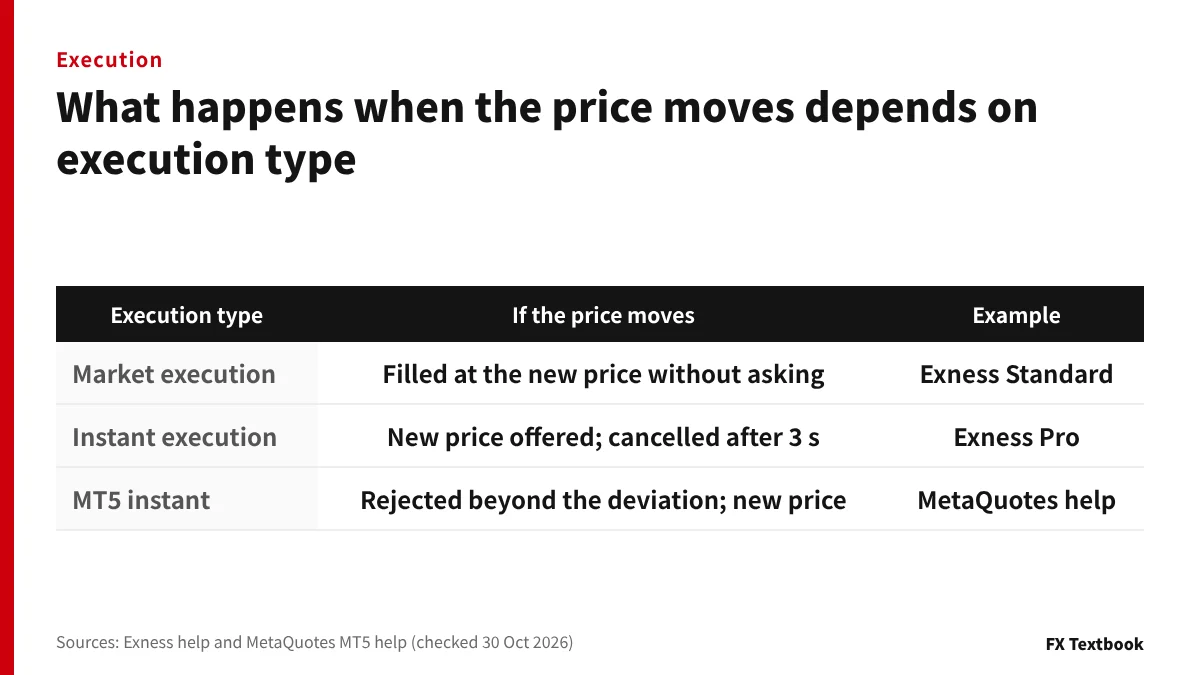
Slippage is the difference between the price you asked for and the price you got. Exness says it can happen on market and pending orders on every account type.
| Item | Exness official example |
|---|---|
| Requested price | Buy EURUSD at 1.35601 |
| Fill price | 1.35700 |
| Slippage | 9.9 pips |
Slippage can also go in your favour. Exness offers instant execution on Pro accounts only; when the price moves, a new quote shows for 3 seconds and the order is cancelled unless you accept.
Axi lists news releases, fast markets, holidays, weekends and large orders as times when slippage is likely, and suggests these steps in MT5.
| Axi's suggestion | What it means |
|---|---|
| Set a deviation | Use the MT5 deviation field to set accepted slippage in points. A higher value fills more often in volatile periods |
| Avoid volatile times | Slippage is likelier at major news and market opens |
| Check connection and load | Use a stable connection and close unused charts, indicators and EAs |
| Use limit orders | Limit orders fill only at your price or better |
Exness says MT4 Pro accounts can get requotes in volatile markets even with market orders. MT5 and its own platforms may see fewer.
Stop losses slip: stops are not guaranteed
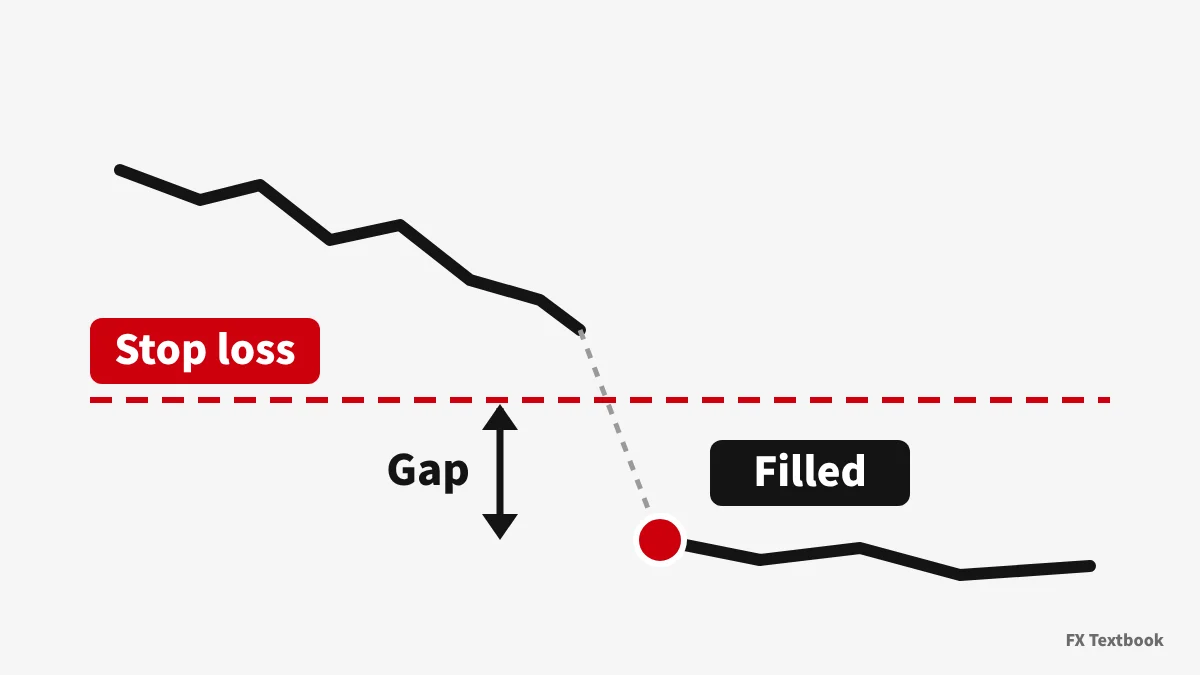
Axi's help centre answers that stop losses are not guaranteed. Stops, take profits and pending orders fill at the available price, which can differ from the level you set.
Exness ties the direction of slippage to the order type. Limit orders never slip against you, and stop orders never slip in your favour.
| Item | Exness official example |
|---|---|
| Buy and stop | Buy EURUSD at 1.35601, stop at 1.35580 |
| Price gap | 1.35590 to 1.35480 |
| Stop fill | 1.35480 (10 pips worse than set) |
Exness slippage rule: set price within a band
Exness applies a slippage rule to pending orders. Within the band for the instrument, the order fills at your set price; beyond it, at the market price.
| Instrument | Band filled at set price |
|---|---|
| EURUSD | 0-8 pips |
| USDJPY | 0-8 pips |
| GBPJPY | 0-15 pips |
| AUDJPY | 0-8 pips |
| XAUUSD | 0 to 3x the spread |
In the stop example above, the 10-pip gap is wider than the EURUSD band of 8 pips, so the stop filled at the market price.
MetaQuotes says MT5 trailing stops run in the platform, not on the server. If you close the platform over a release, the trailing stop does not follow the price.
Forex order types: market, limit, stop, OCO and IFD in MT4 and MT5
Margin around releases: HMR lowers leverage on new trades
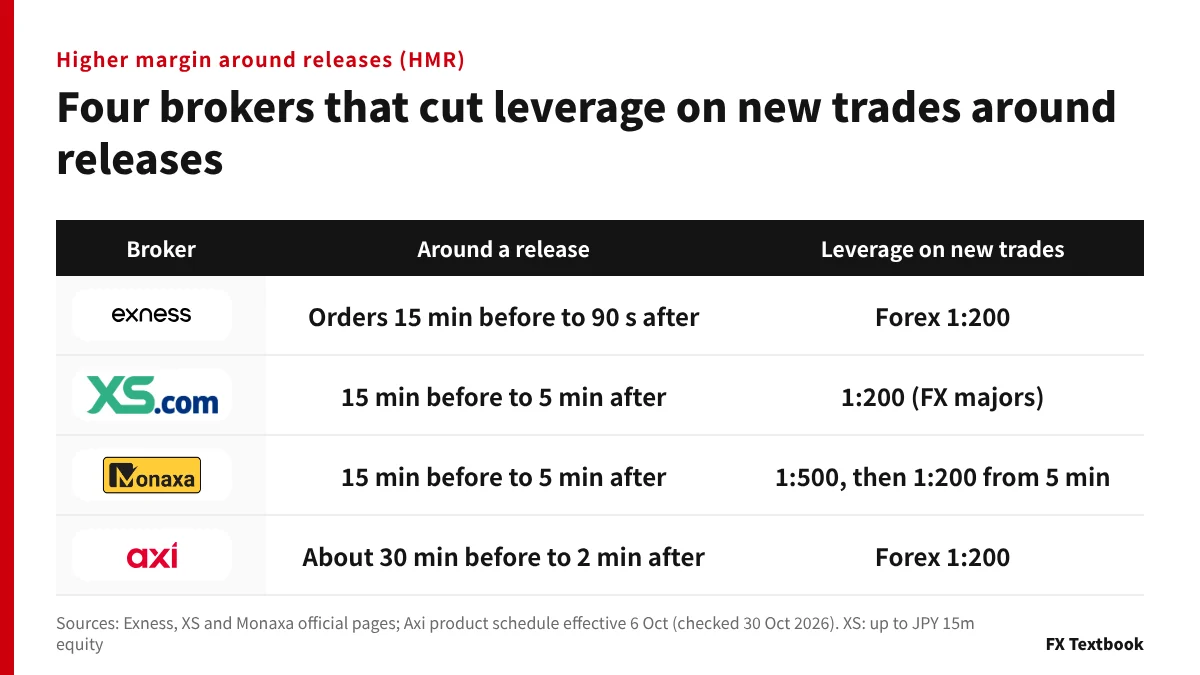
Higher margin requirements (HMR) raise the margin on new positions for set periods. At all four brokers they apply to new positions only, not to positions already open.
| Broker | Around a release | Payrolls on 6 Nov | Leverage on new trades |
|---|---|---|---|
| Exness | Orders 15 min before to 90 s after | 22:15-22:31:30 | Forex 1:200 |
| XS | 15 min before to 5 min after | 22:15-22:35 | 1:200 (FX majors) |
| Monaxa | 1:500 from 15 min, 1:200 from 5 min | 22:15-22:35 | Lowest 1:200 |
| Axi | About 30 min before to 2 min after | 22:00-22:32 | Forex 1:200 |
Non-forex instruments get even lower leverage in HMR
| Instrument (Exness) | Leverage during HMR |
|---|---|
| Forex (all) | 1:200 |
| Gold (XAU) | 1:100 to 1:1000 |
| Silver (XAG) | 1:50 to 1:200 |
| Oil (USOIL, UKOIL) | 1:20 |
| U.S. indices (US30, USTEC, US500) | 1:50 to 1:100 |
| Stocks | 1:5 |
| Equity (XS, JPY) | FX majors in HMR | Gold in HMR |
|---|---|---|
| 0 to 9 million | 1:200 | 1:200 |
| Over 9 to 15 million | 1:200 | 1:100 |
| Over 15 million | 1:100 | 1:50 |
Example: margin for the same 1 lot
| Leverage | Margin for 1 lot of USD/JPY |
|---|---|
| 1:2000 (example of a normal cap) | USD 50 |
| 1:500 (Monaxa, from 15 min before) | USD 200 |
| 1:200 (forex at all four around releases) | USD 500 |
On an account normally run at 1:2000, one extra lot during HMR needs ten times the margin: USD 500. Without enough free margin, the order does not go through.
For HFM, we have not found a separate page setting margin around releases (checked 26 September 2026). Its account page notes that leverage may be adjusted.
Exness says HMR may be extended as a risk management decision. Axi's product schedule calls its windows and leverage indicative and subject to change without notice.
Exness leverage: unlimited leverage conditions and restricted periods
Hedged into a release: HMR can block closing one side
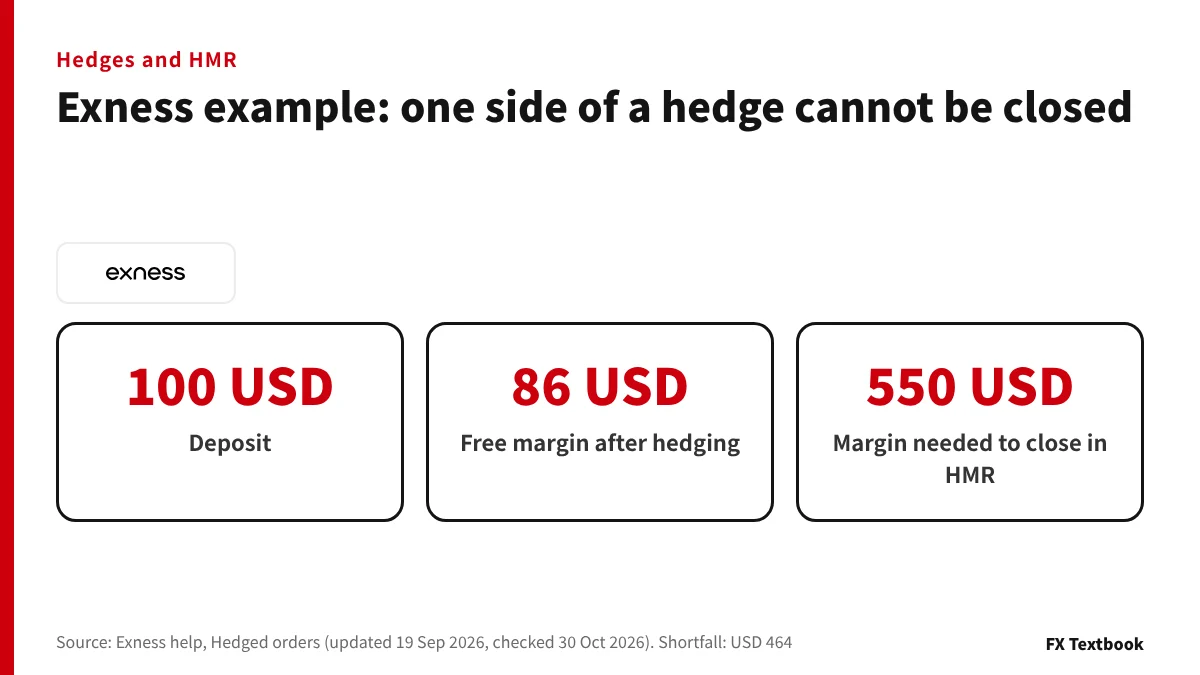
A hedge means holding a buy and a sell on the same instrument at once. Closing one side puts margin on the side that remains. During HMR, that margin is calculated at the higher level.
| Exness official example | Amount |
|---|---|
| Deposit | USD 100 |
| Buy and sell 1 lot EURUSD (1:2000) | Free margin USD 86 |
| Close the sell after leverage drops to 1:200 | USD 550 margin needed for the buy |
| Shortfall | USD 464 (cannot close) |
XS also says that closing one side of a hedge during HMR may fail if there is not enough margin left.
HFM's official FAQ says a full hedge of equal size in one account needs zero margin. Close one side and the rest returns to normal margin at once.
| HFM FAQ example | Margin |
|---|---|
| Buy 1 lot EURUSD + sell 0.4 lot | Zero for the 0.4 lot; normal for the other 0.6 lot |
| Close one side of a full hedge | The remaining position returns to normal margin at once |
This section covers margin on hedges within one account only. Hedging across accounts or on bonus accounts may be banned by the broker's terms.
Chained stop outs: price jumps past the level
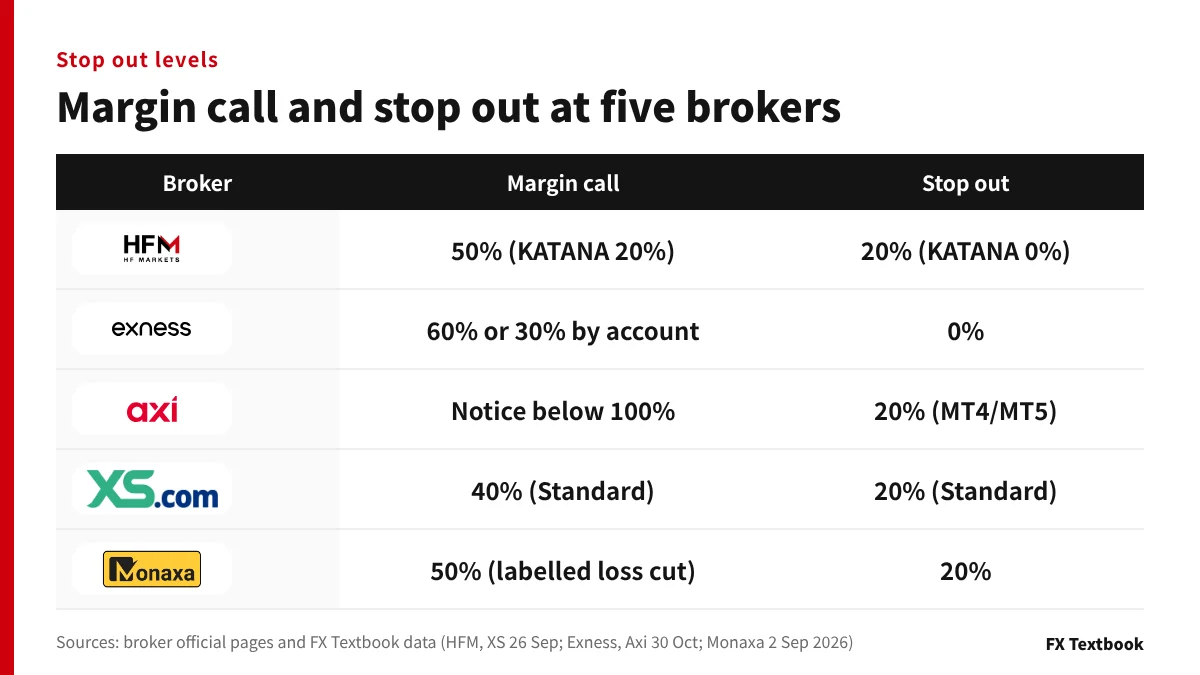
A stop out closes positions automatically when the margin level falls to the broker's limit. The margin level is equity divided by used margin, times 100.
Axi says MT4 and MT5 accounts have the largest losing position closed first once the margin level falls below 20%. Its product schedule also sets the liquidation level for Standard, Premium and Elite accounts at 20%.
Example: losses when the price gaps
| Condition (illustrative) | 20% stop out | 0% stop out |
|---|---|---|
| Balance | JPY 100,000 | JPY 100,000 |
| Position | 1 lot USD/JPY (1 pip = JPY 1,000) | Same |
| Used margin | JPY 15,000 | JPY 15,000 |
| Stop out point | Equity JPY 3,000 (97 pips against) | Equity JPY 0 (100 pips against) |
| A 120-pip gap | Loss JPY 120,000; balance minus JPY 20,000 | Same |
When a release makes prices jump, the stop out fills beyond its level. A stop loss in place does not change that.
Exness says a negative balance after a stop out is reset to zero automatically. In the example, the JPY 20,000 is not charged, but the JPY 100,000 deposited is lost.
| Exness official example | Amount |
|---|---|
| Account balance | USD 100 |
| Loss realised by the stop out | USD 150 |
| Balance right after | Minus USD 50 |
| Automatic process (shown as D-null) | Reset to USD 0 |
Exness says that if you deposit while equity is negative and the balance is positive, the negative part comes out of the deposit.
Forex stop out calculation: the margin level formula and broker levels compared
Weekends and holidays: Friday HMR and the Monday gap
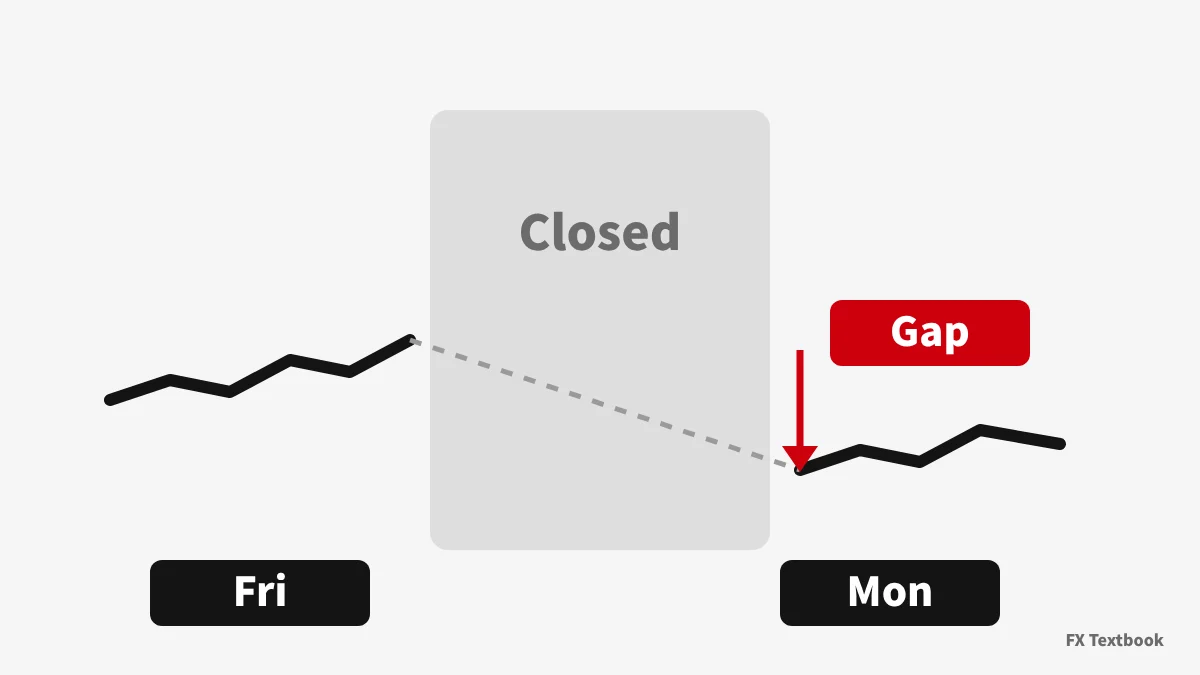
Payrolls come out on Friday night in Japan. The weekend closure follows a few hours later, so the release move and the Monday gap land on the same position.
| Broker | Around the weekend |
|---|---|
| Exness | HMR from about 3 hours before the close to 1 hour after the open (not BTC or ETH) |
| XS | HMR from 2 hours before the Friday close to 1 hour after the Monday open (1:200 on new trades) |
| Monaxa | 1:500 from 1 hour and 1:200 from 30 minutes before the Friday close; no trading in the final 1-5 minutes |
| Axi | Forex HMR from 1 hour before the Friday close to 00:30 Monday (platform time). Holding itself is allowed |
Axi's help centre says that if a major event happens while markets are closed, positions held over the weekend are at risk.
Friday 6 November in Japan time
| Time | What happens |
|---|---|
| About 22:00 | Axi HMR begins (about 30 minutes before) |
| 22:15 | Exness and XS HMR begins; Monaxa caps at 1:500 |
| 22:25 | Monaxa drops to 1:200 |
| 22:30 | U.S. payrolls released |
| 22:31:30 | Window for Exness HMR orders ends |
| About 22:32 | Axi HMR ends |
| 22:35 | XS and Monaxa HMR ends |
| Before the weekend close | Weekend HMR from about 3 hours (Exness), 2 hours (XS) or 1 hour (Axi forex) before |
Exness and XS apply HMR around holiday closures and early closes. Axi starts HMR about 3 hours before a holiday closure.
Five checks on official screens and terms before a release
- 01Put the release in your calendar in Japan time
Read the dates on the BLS and Fed pages and write them in Japan time. Payrolls are at 22:30 from November.
- 02Read your account's HMR rules
Check the window and the leverage on new trades in the official help. If you cannot find them, ask support and keep the reply.
- 03Watch the release spread on screen
Add a spread column to Market Watch and note the spread before and after the release on your own account.
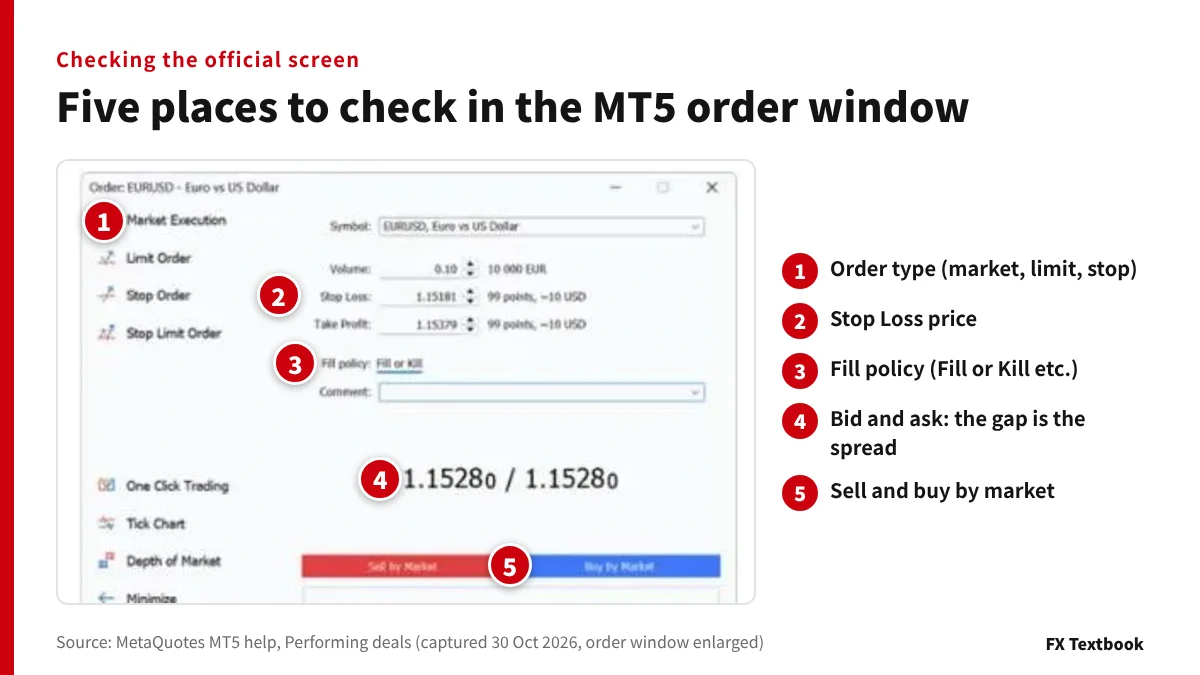
- 04Check the order window settings
Check the execution type, the deviation and your stop price. Size the trade on the basis that stops are not guaranteed.
- 05Keep a margin buffer
Keep enough free margin for margin ten times higher when 1:2000 drops to 1:200. If you cannot, reduce the size.
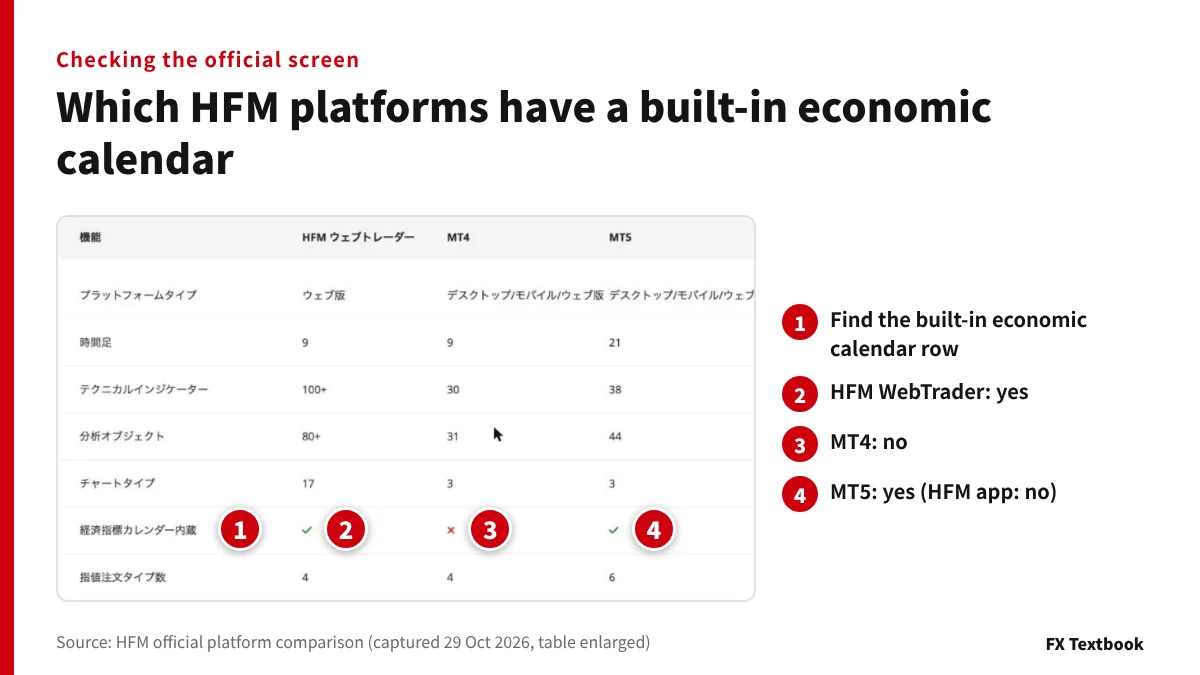
Release times in your platform's calendar
| Broker | How the official site says to check |
|---|---|
| HFM | Economic calendar built into WebTrader and MT5 (not MT4 or the HFM app) |
| Exness | Economic calendar and watchlist; a banner appears on the platform chart during HMR |
| Axi | Online economic calendars and the Axi blog |
| Monaxa | Its HMR page links to an economic calendar provided by Investing.com |
Some calendars show Japan time and others the broker's server time. HFM server time is GMT+2 in winter, so November payrolls fall at 15:30 server time (checked 26 September for our deposits column).
Is scalping around releases banned?
It is not banned by law; the broker and account terms decide. Within what we checked there is no uniform rule.
Bonus accounts can be stricter than standard ones. On Monaxa bonus accounts, scalping and high-frequency trading can lead to bonus removal and voided profits (checked 2 September 2026).
- Words to search in the terms: news, economic release, scalping
- In the margin section: HMR, higher margin, margin increase
- In the order section: slippage, requote, deviation
Prohibited trading rules: hedging, release-time scalping and account freezes
Our view: how much to hold on a release day
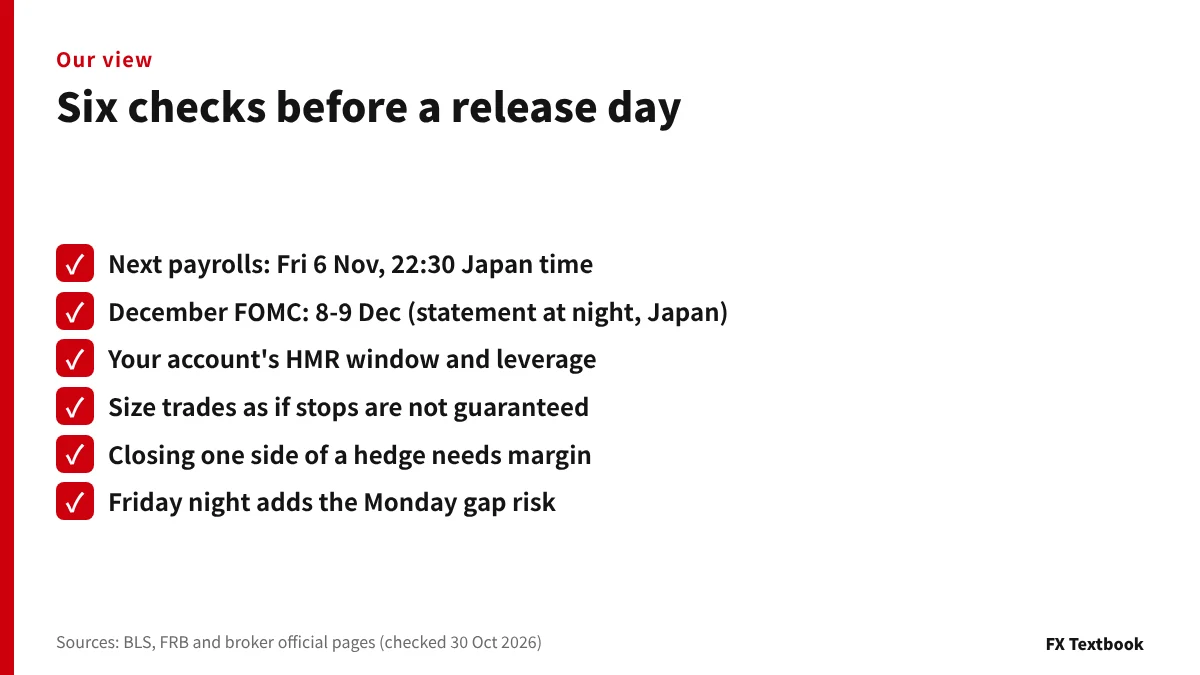
If you hold through a release, work out margin at 1:200 and size the trade so your margin level survives a stop that fills worse than set. If you cannot confirm your account's HMR window and leverage in official material, do not open new trades from 30 minutes before the release until just after it.
- Trading at release time: read HMR and slippage rules first
- Holding for days: treat Friday payrolls and the Monday gap as one risk
- Protecting with a hedge: keep margin to close one side
- Protecting with stops only: they are not guaranteed, so trade smaller
- On a bonus account: check how release trading is treated in the terms
Frequently asked questions
Q. What time are U.S. payrolls in Japan time?
A. The release on 6 November 2026 is at 22:30 Japan time. U.S. daylight saving ended on 1 November, so releases stay at 22:30 through 5 March 2027. The BLS lists 8:30 AM, which we convert as U.S. Eastern time.
Q. How much do spreads widen on payrolls?
A. No broker we checked publishes how far spreads widen. Exness names news releases as a cause and says its website figures are the previous day's average. Check the release-time spread on your own trading screen.
Q. What time is the FOMC statement in Japan time?
A. The statement of 28 October 2026 came at 2:00 p.m. Eastern, which was 3:00 on 29 October in Japan. If 9 December uses the same time, winter time makes it 4:00 on 10 December in Japan.
Q. Why do stop losses slip on releases?
A. When prices jump, the order passes your level and fills at the next available price. Axi says it does not guarantee stop losses. Exness says stop orders never slip in your favour.
Q. What is HMR?
A. HMR raises margin on new positions for a while around releases and weekends. Exness covers orders from 15 minutes before to 90 seconds after a release, Axi about 30 minutes before to 2 minutes after, both capping new forex trades at 1:200. XS and Monaxa have the same kind of rule.
Q. Is it safe to hedge before payrolls?
A. Not necessarily. Closing one side during HMR puts high margin on the other side, and the close fails if free margin falls short. Exness gives an example where a USD 100 account is USD 464 short and cannot close.
Q. Is scalping around releases banned?
A. It is not banned by law; the broker and account terms decide. Within what we checked there is no uniform rule. Some brokers restrict scalping on bonus accounts.
Q. Can I hold over the weekend after payrolls?
A. You can, but Axi warns that events during the closure put positions at risk. Exness, XS and Axi also apply HMR around weekends. On Friday night, size trades knowing the release and the Monday gap overlap.
Sources and conditions
- U.S. Bureau of Labor Statistics: Employment Situation release schedule (captured 30 October 2026) →
- U.S. Bureau of Labor Statistics: CPI release schedule (checked 23 October 2026) →
- Federal Reserve: FOMC meeting calendars (checked 30 October 2026) →
- Federal Reserve: FOMC statement of 28 October 2026 (released 2:00 p.m. EDT, checked 30 October) →
- Exness help: Higher margin requirements (HMR) (updated 22 October 2026, checked 30 October) →
- Exness help: Why is the margin for my order higher? (checked 30 October 2026) →
- Exness help: How slippage occurs (checked 30 October 2026) →
- Exness help: Slippage rules (checked 30 October 2026) →
- Exness help: About spreads (checked 30 October 2026) →
- Exness help: Why an order opened with a negative balance (checked 30 October 2026) →
- Exness help: Order types and execution types (checked 30 October 2026) →
- Exness help: Requotes (checked 30 October 2026) →
- Exness help: Hedged orders (checked 30 October 2026) →
- Exness help: Margin call and stop out levels (checked 30 October 2026) →
- Exness help: Negative balance protection (checked 30 October 2026) →
- Axi: MT4 and MT5 product schedule (AxiTrader LLC, effective 6 October 2026, checked 30 October) →
- Axi help: What are higher margin requirements? (Japanese, checked 30 October 2026) →
- Axi help: What is the margin stop out level? (Japanese, checked 30 October 2026) →
- Axi help: Are stop losses guaranteed? (Japanese, checked 30 October 2026) →
- Axi help: What is slippage? (Japanese, checked 30 October 2026) →
- Axi help: Why do I get delays or slippage in MT5? (Japanese, checked 30 October 2026) →
- Axi help: Does Axi offer fixed spreads? (Japanese, checked 30 October 2026) →
- Axi help: Open positions over weekends and holidays (Japanese, checked 30 October 2026) →
- XS: Equity-based leverage and HMR periods (Japanese, checked 30 October 2026) →
- Monaxa: Higher margin requirements (Japanese, checked 30 October 2026) →
- HFM: Trading platforms comparison (Japanese, retrieved 29 October 2026) →
- HFM: FAQs on hedge margin (Japanese, retrieved 30 October 2026) →
- MetaQuotes: MT5 help, Performing deals (checked 30 October 2026) →
- Advertising, affiliate relationships and risk disclosure →
FX Textbook is an independent information site, not a broker or provider of personal investment advice. Forex and CFDs involve risk. You may lose some or all of your invested capital. No trading result is guaranteed.
NEXT STEP
Checked HMR and stop out levels? Compare account conditions side by side.
Leverage, stop out levels and spreads for each listed broker are on one page, ready to compare with your own account before the next release.
Brokers covered in this column
Account types, trading conditions and current offers are on each broker page.