













You want to trade offshore FX with company money. Can a company open the account?
Yes. HFM confirms corporate accounts in its official FAQ, and its sign-up form has a corporate link at the bottom. Axi, XS and AXIORY publish document lists. XMTrading says it does not offer corporate accounts at present.
We checked each broker's official pages and Japan's National Tax Agency (NTA) on 30 October 2026. By the end you will know which papers to prepare and how corporate tax differs.
Short answer: HFM and three others offer it, XMTrading does not
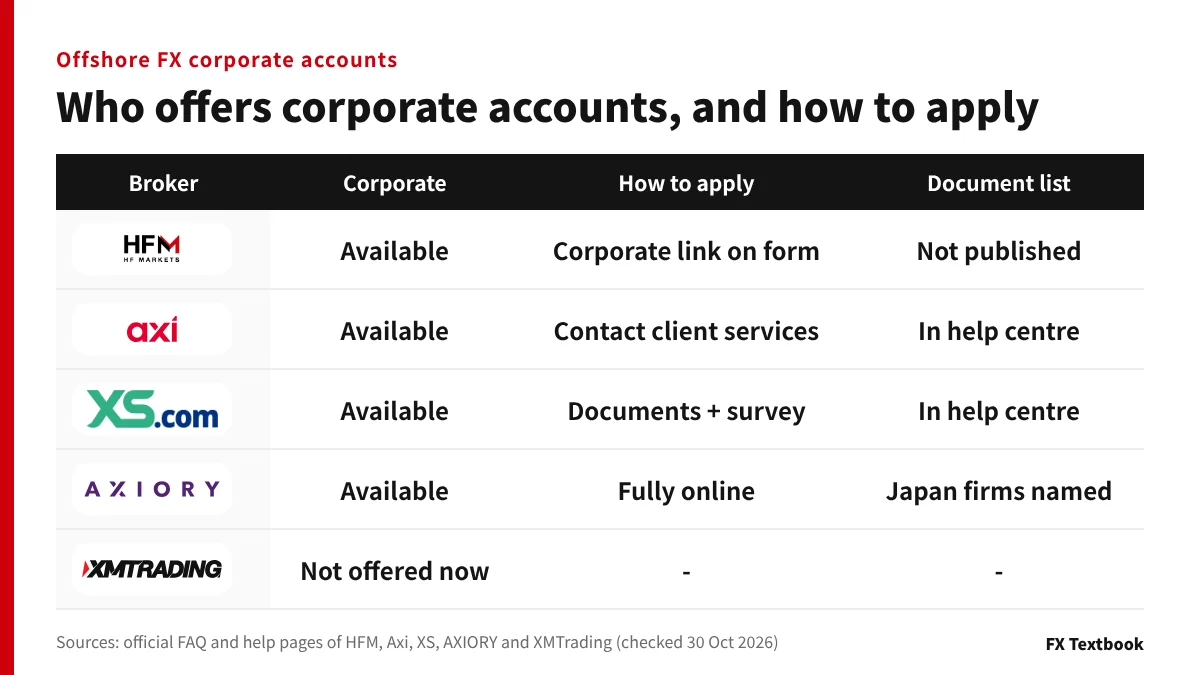
- HFM: the FAQ answers yes; a corporate link sits below the sign-up form
- Axi: contact client services; target is 3 business days after documents are verified
- XS: 8 company documents plus an email survey; the representative also needs a personal account
- AXIORY: fully online, trading from 1 hour; Japanese companies submit a registry extract
- XMTrading: the help centre says it does not currently offer corporate accounts
| Your situation | Read first |
|---|---|
| You want an HFM corporate account | HFM corporate accounts / How to apply at HFM |
| You want to compare document burdens | Axi, XS and AXIORY documents |
| You are unsure what the English document names mean | Papers for a Japanese company |
| You want to know how tax changes | Personal vs corporate tax |
Trading FX and CFDs in a company name can still lose some or all of the money deposited. Changing the account holder does not remove that risk.
What a corporate account is and how it differs
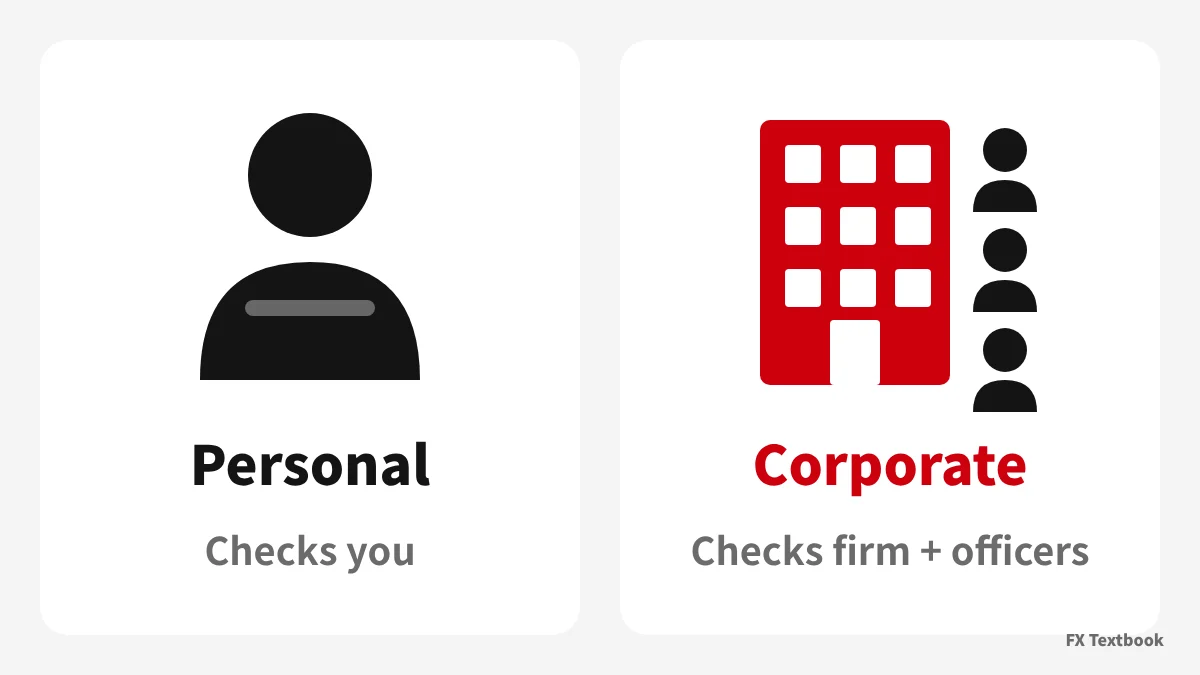
A corporate account is a trading account held by a company such as a kabushiki kaisha or godo kaisha. The money in it belongs to the company, and its profit or loss goes into the company accounts.
| Item | Personal account | Corporate account |
|---|---|---|
| Holder | You | The company |
| Who is verified | You only | Company plus representative, directors, major shareholders |
| Main documents | ID and proof of address | Registry, articles, share register, officer ID |
| Funding name | Your name | Company name |
| Users (HFM) | You | Multiple users |
| Tax | Income tax and resident tax | Corporate tax and related taxes |
Brokers check both that the company exists and who controls it. For shareholders with 25% or more, Axi asks you to declare them and AXIORY asks for their ID and proof of address.
Can sole proprietors use a corporate account?
Axi has a sole trader category that asks for a business registration. Its help page does not say whether a Japanese business-start notice counts. HFM, XS and AXIORY all assume a registered company, so without one you trade through a personal account.
An HFM joint account is held by two named individuals, and either can use it (official FAQ). A company cannot be a holder.
HFM corporate accounts: what the official FAQ says
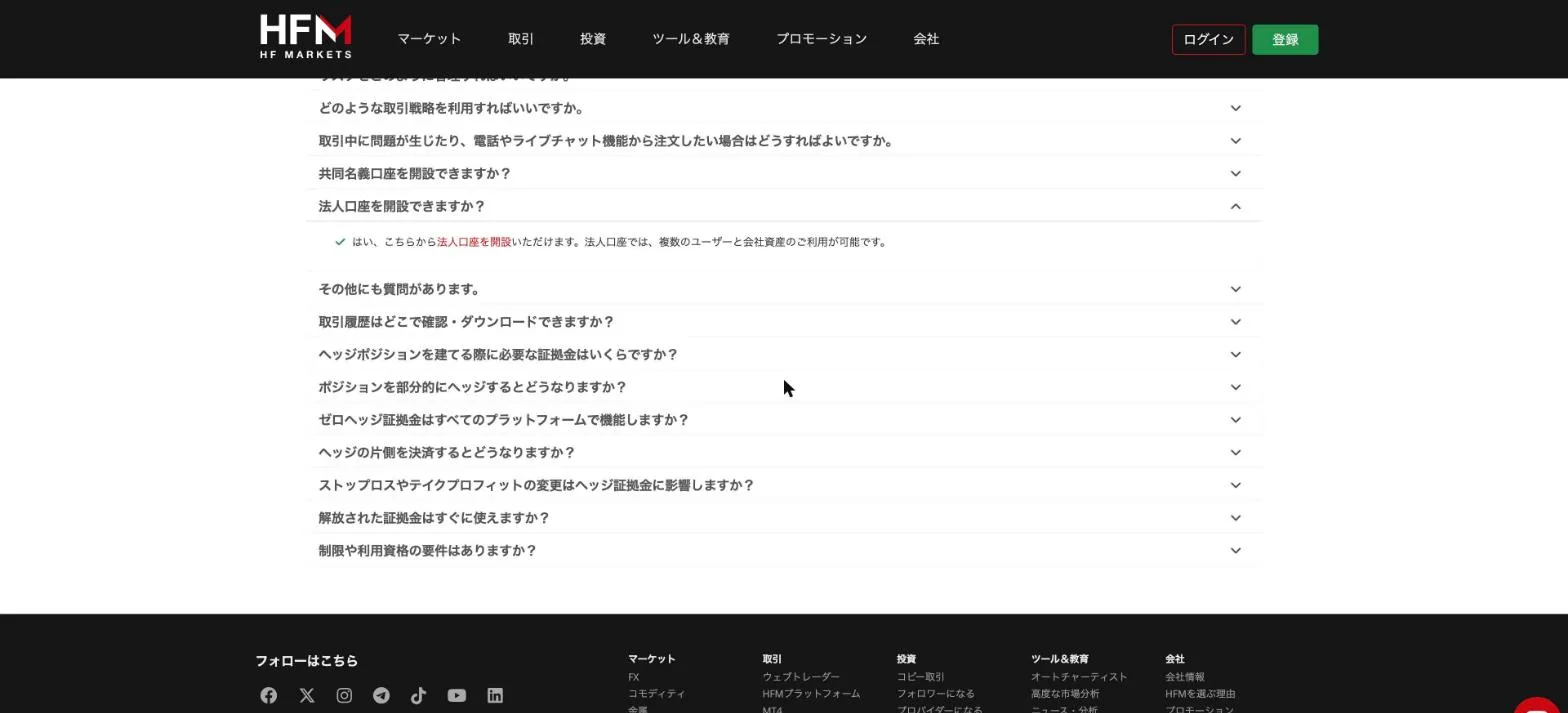
HFM's FAQ answers yes to the question about opening a corporate account, and adds that it allows multiple users and the use of company assets.
| Item | Confirmed on HFM's official pages |
|---|---|
| Corporate account | Available (FAQ) |
| Users | Multiple users |
| Funds | Company assets |
| Where to apply | Corporate link below the sign-up form |
| Document list | Not shown in the FAQ or on the sign-up page |
The entity behind HFM's Japanese site is HF Markets (SV) Ltd. If the contracting entity and terms appear during sign-up, save the screen for later reference.
Neither the FAQ nor the sign-up page lists the documents (checked 30 October 2026). Tell supportjp@hfm.com your company type and number of officers and ask whether your papers are enough.
How to open an HFM account: registration to first deposit
Ask about account types and bonuses too
HFM has six account types: Premium, Cent, Pro, Zero, KATANA and Top-Up Bonus. The FAQ does not say which of them, or which bonuses, apply to corporate accounts.
- Account types: which of the six are available to companies
- Bonus: whether the standing 20% deposit bonus applies
- Users: how many authorised people can be added
- Withdrawals: the steps for paying out to a company bank account
HFM account types compared: spreads, commissions and minimum deposits
What to include when you contact the Japanese desk
Putting these six points in your first message saves a round of questions.
| Item | Example |
|---|---|
| Company type | Kabushiki kaisha, godo kaisha and so on |
| Country of incorporation | Japan (prefecture of registration) |
| Number of officers | One representative director and one director |
| Shareholders with 25% or more | Yes or no, and how many |
| Account type wanted | Premium, Top-Up Bonus and so on |
| Funding method | Bank transfer from a company-name account |
How to apply at HFM and read the sign-up screen
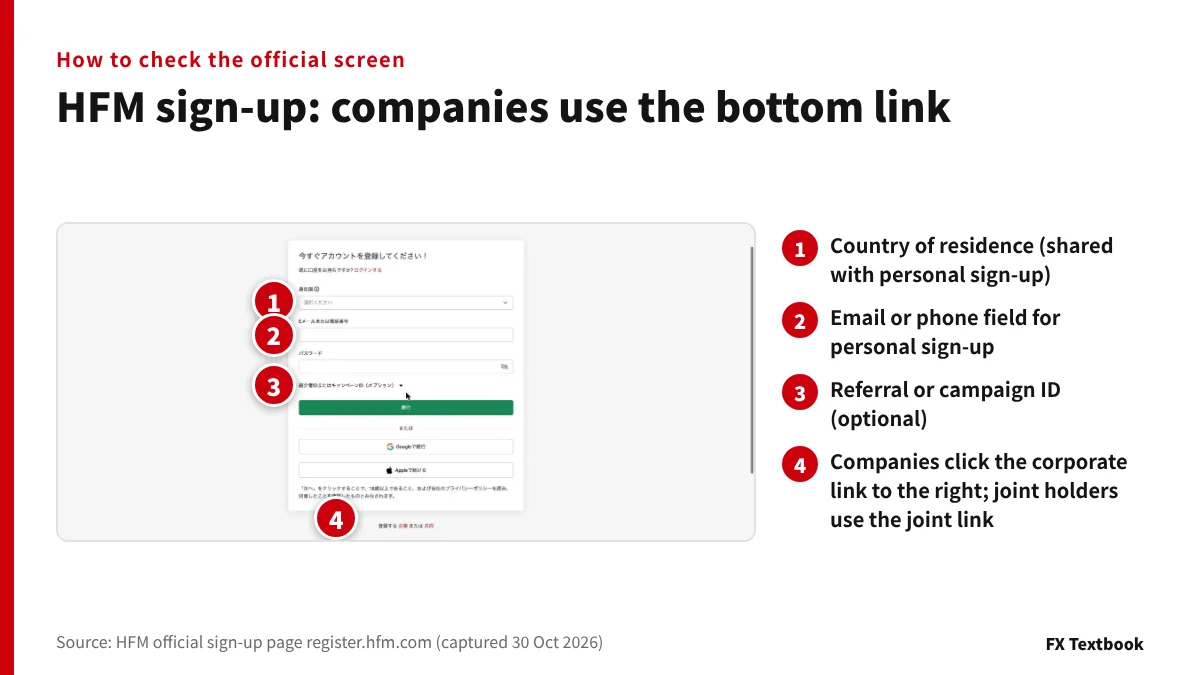
The sign-up page opens with the fields for individuals. The corporate entry point is a single line of links at the very bottom.
- 01Open the sign-up page from the official site
Start from Register on hfm.com and check the address is register.hfm.com.
- 02Scroll to the bottom
Below the form is a line offering corporate or joint registration. Leave the personal fields above empty.
- 03Click the corporate link
It opens a sign-up page whose address ends in ?corporate. The joint link is for joint accounts.
- 04Enter company and contact details
Follow the on-screen fields. Write the company name and address exactly as in the registry.
- 05Submit documents and fund in the company name
Confirm the documents on screen or with support. Use a bank account in the company name for deposits.
| On the screen | What it means |
|---|---|
| Country of residence | First field, shared with personal sign-up |
| Email or phone number | Personal sign-up starts here |
| Referral or campaign ID | Optional |
| Continue with Google or Apple | Shortcut for personal sign-up |
| Register as corporate | Goes to the corporate application |
| Register as joint | Goes to the joint account application |
At HFM the name on the funding source must match the registered name (FX Textbook broker data). For a corporate account, deposit and withdraw through a company-name bank account.
Other brokers: Axi, XS and AXIORY documents
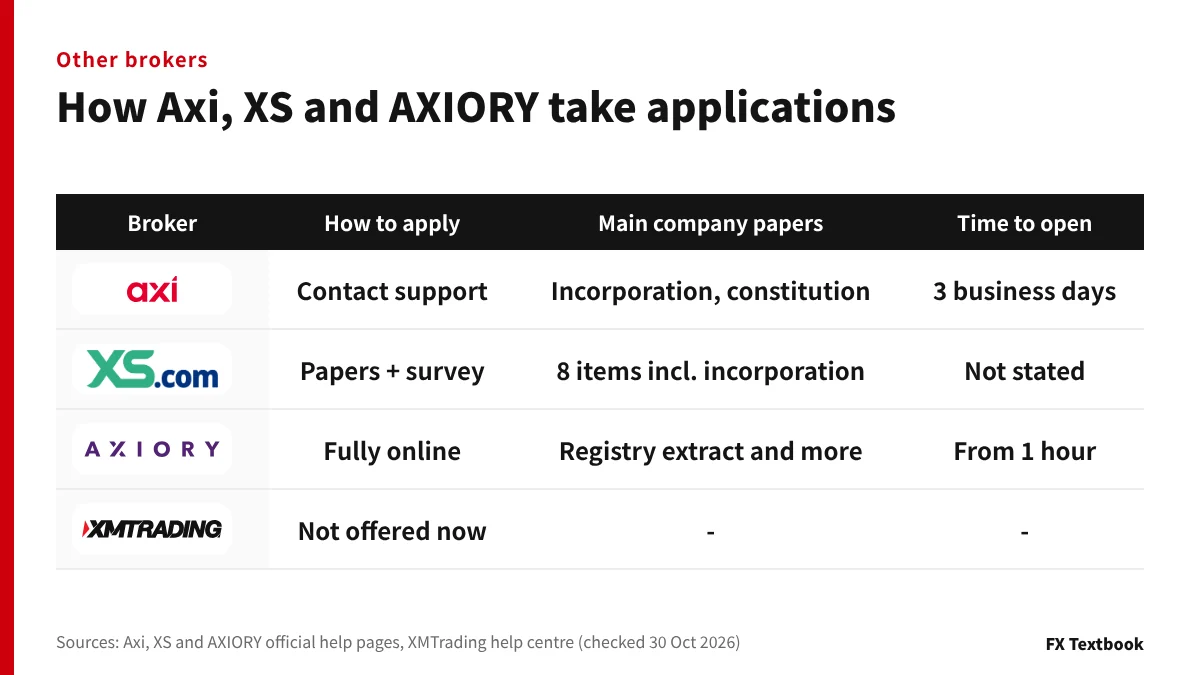
Among the brokers we checked, Axi, XS and AXIORY publish their corporate document requirements. All three ask for company papers plus ID and proof of address for directors.
Axi: start by contacting client services
| Item | Axi official help page |
|---|---|
| Categories | Company, trust (corporate), trust (individual), sole trader |
| How to apply | Contact client services to start |
| Company papers | Certificate of incorporation, constitution, share register (register within 6 months) |
| Company address | Bank statement with company name and address (3 months) |
| Directors and shareholders | Valid passport and proof of address (3 months) |
| Declaration | Shareholders or beneficial owners holding 25% or more |
| Opening | Aims to open within 3 business days of verification |
A share register issued by the company itself must be certified by a notary or qualified lawyer. Name each file in English and send English versions where available.
XS: eight documents and an email survey
- Certificate of incorporation
- Certificate of good standing (within 3 months)
- Certificate of incumbency (within 3 months, if applicable)
- Certificate of registered office
- Certificate of directors and secretary
- Certificate of shareholders
- Articles of association
- Board resolution to open and operate the account
Directors and representatives submit a passport or national ID and a utility bill or similar from the last 3 months. The company's official representative must also open a personal account using a separate email address.
AXIORY: names the papers for Japanese companies
| Item | AXIORY official pages |
|---|---|
| Process | Fully online; trading from as little as 1 hour |
| Minimum deposit | JPY 1,100 (same as personal accounts) |
| Japanese company papers | Copy of the certificate of registered matters (6 months) |
| Share register | Papers for any shareholder with 25% or more (6 months) |
| Company address | Utility bill, bank statement or seal certificate (6 months) |
| Directors' decision | Only when there are 2 or more directors |
| After applying | Email guidance within 24 business hours |
With two or more directors, every director submits ID and proof of address. The digital driving licence stored on a My Number card is not accepted.
XMTrading: not offered at present
XMTrading's help centre answers that it does not currently offer corporate accounts. It leaves open the possibility of adding them in the future.
A corporate application PDF is still hosted on XMTrading's site. Its account-type section lists the older Micro, Standard and Zero line-up, so we treat the help centre answer as the current position.
Papers for a Japanese company: matching the English names
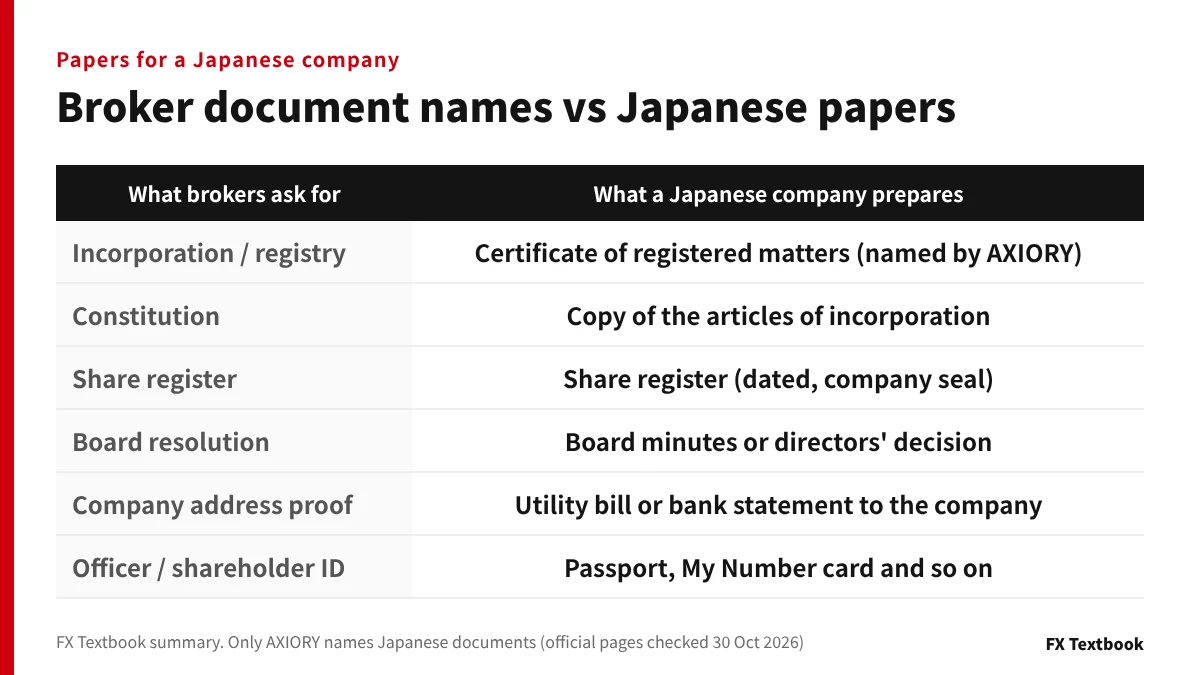
Axi and XS use document names from overseas company systems. Some, such as a certificate of good standing, have no familiar Japanese counterpart.
Among the brokers we checked, only AXIORY names Japanese documents. Ask the broker whether your certificate of registered matters can stand in for the papers it lists.
| Document | Axi | XS | AXIORY |
|---|---|---|---|
| Registry or incorporation | No deadline stated | Good standing within 3 months | Within 6 months |
| Share register | Within 6 months | No deadline stated | Within 6 months |
| Company address proof | Within 3 months | Not stated | Within 6 months |
| Officer address proof | Within 3 months | Within 3 months | Within 6 months |
- Match the strictest limit and prepare papers issued within 3 months
- Put the English document name in each file name (Axi's instruction)
- List every director and each shareholder with 25% or more
- Write the company name and address exactly as registered
Offshore FX identity checks (KYC): personal documents and review steps
Personal vs corporate tax: what the NTA publishes
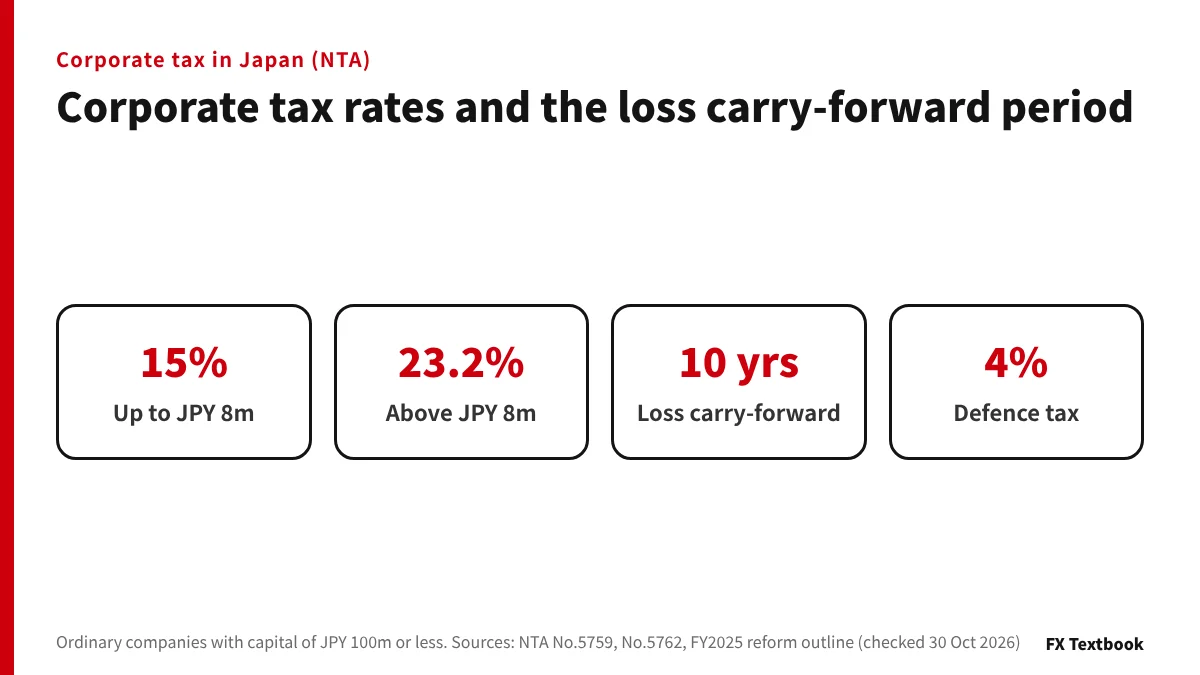
For individuals, offshore FX profit is generally miscellaneous income taxed together with salary and other income. Losses cannot be carried forward.
| Item | Individual (offshore FX) | Company |
|---|---|---|
| Main taxes | Income tax and resident tax | Corporate tax and local taxes |
| Rate | Income tax 5-45% plus resident tax 10% | Corporate tax 15% (up to JPY 8m), 23.2% |
| Loss carry-forward | Not allowed | 10 years with a blue return |
| Offsetting other income | Only within miscellaneous income | Calculated as one company income |
| Open positions | Only closed trades count | Treated as closed at year end |
※ Corporate rates are for ordinary companies with capital of JPY 100 million or less. They cover national corporate tax only, not local corporate taxes.
Offshore FX tax in Japan: rates, domestic FX comparison and loss offsetting
15% on the first JPY 8 million for smaller companies
According to NTA No.5759, an ordinary company with capital of JPY 100 million or less pays 15% on income up to JPY 8 million a year. Income above that is taxed at 23.2%, as is all income of ordinary companies with larger capital.
In a year when income exceeds JPY 1 billion, the lower band rises to 17%. Wholly owned subsidiaries of companies with capital of JPY 500 million or more do not get the 15% rate.
Losses carry forward for 10 years with a blue return
A loss from a year filed with a blue return can be set against profits for up to 10 years. Losses from business years that began before 1 April 2018 carry forward for 9 years.
The company must keep filing returns every year and keep its books. Small and medium companies with capital of JPY 100 million or less can deduct up to the full income of the year.
A special defence corporate tax for years starting from April 2026
For business years beginning on or after 1 April 2026, a special defence corporate tax applies. It is 4% of the base corporate tax after a JPY 5 million annual deduction.
Open positions are counted at year end
Article 61-5 of the Corporation Tax Act treats derivative trades still open at the end of a business year as settled at that point. Unrealised gains and losses on positions carried over therefore enter that year's income.
The result depends on income, directors' pay, social insurance and the cost of running a company. We do not estimate tax savings. Ask a tax accountant or the tax office for advice on your situation.
Rules that come with a company: directors pay and local tax
| Rule | What official sources say | Effect on trading |
|---|---|---|
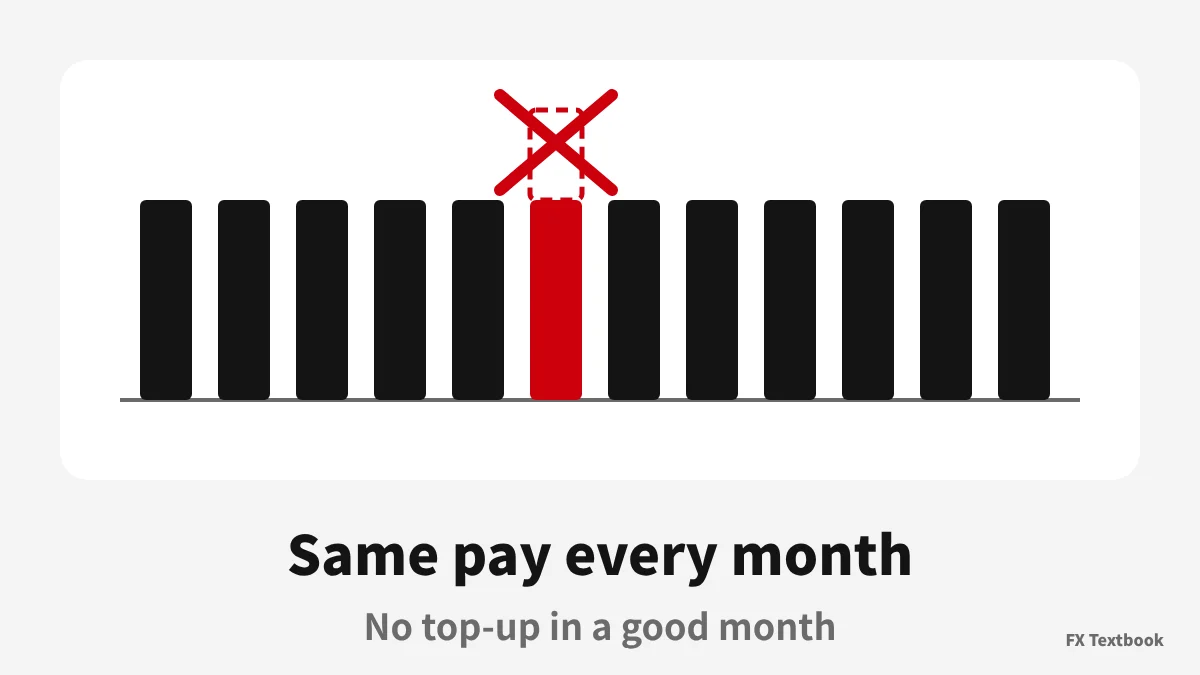
| Directors pay | Deductible only as fixed regular pay, pre-notified pay or certain performance-linked pay | Raising pay in a profitable month is not deductible |
| When pay can change | Generally within 3 months of the start of the business year | Hard to change mid-year |
| Excessive pay | The unreasonably high part is not deductible | Profit cannot all be paid out as salary |
| Corporate resident tax | A part linked to corporate tax plus a flat per-capita levy | The flat levy remains in a zero-tax year |
| Filing deadline | Generally within 2 months of the end of the business year | File and pay 2 months after year end |
NTA No.5211 lists three deductible forms: fixed regular pay, pre-notified pay and certain performance-linked pay. Topping up salary after a strong FX month fits none of them.
The Tokyo tax bureau splits corporate resident tax into a part based on corporate tax and a flat per-capita levy. The flat levy does not depend on corporate tax, so it applies in a loss year too.
The flat levy comes from a rate table based on capital and other factors. Check the prefecture and municipality pages for your company address.
What to watch with a corporate account: names, officers, shareholders
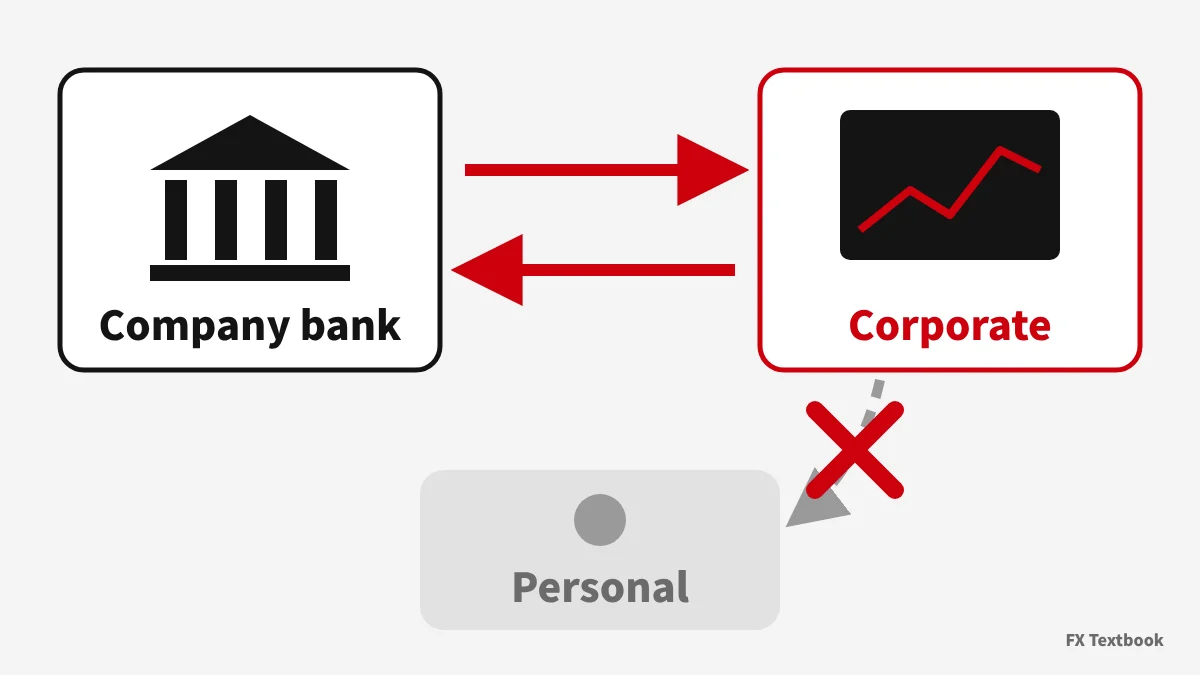
The first stumbling block is the name on the money. Funds deposited by the company belong to the company, and withdrawals normally go back to a company account.
| Point | Basis | What to prepare |
|---|---|---|
| Funding name | HFM: funding source matches registered name (FX Textbook broker data) | A bank account in the company name |
| Money used | HFM official FAQ: corporate accounts use company assets | Keep personal money separate |
| Representative's account | XS: representative opens a personal account too | A second email address |
| Major shareholders | Axi: declare holders of 25%+ / AXIORY: their documents | A list of the shareholding structure |
| English file names | Axi: name files in English | An English name for each document |
When directors or shareholders change, the papers on file no longer match. Tell the broker when that happens.
- If you plan to use a bonus, ask whether corporate accounts qualify before applying
- Start with a small deposit and test a withdrawal to the company account
- Decide before year end how you will handle positions carried over
Offshore FX deposits and withdrawals: names, fees and processing times
Apply for a corporate account only after the company is incorporated and registered. Incorporation steps and costs are outside the scope of this article.
Our view: checks before opening a corporate account
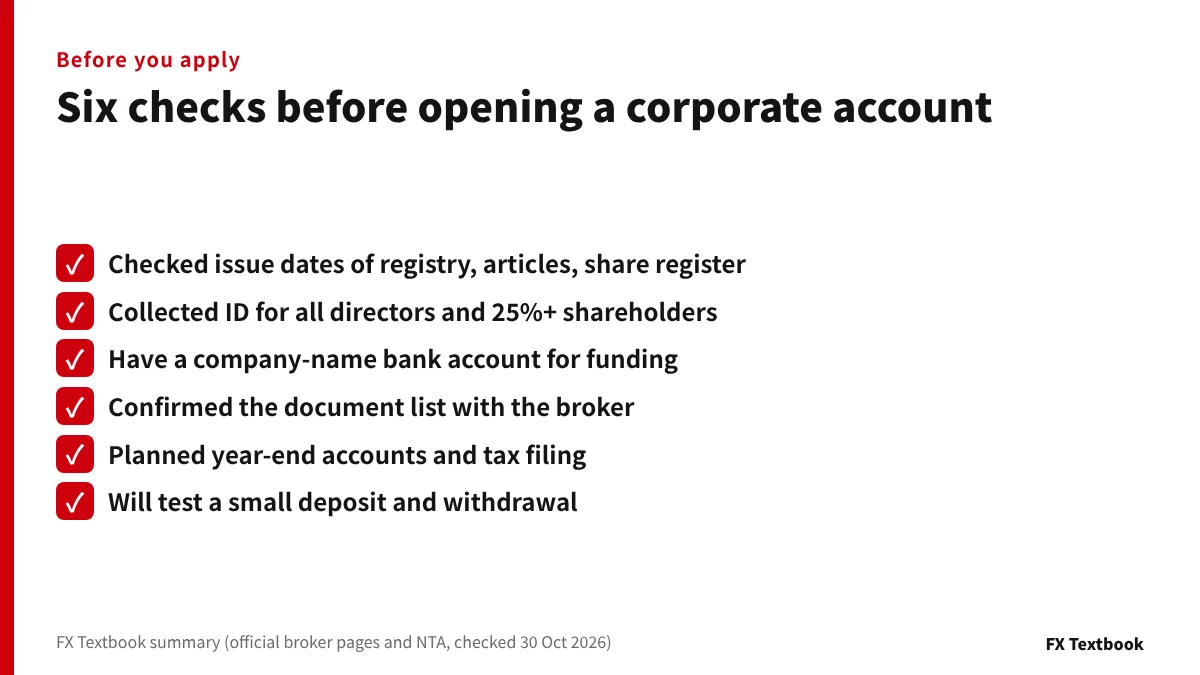
Before choosing a broker, confirm you can collect the company papers and ID for officers and shareholders. The papers you can get decide where to apply.
For HFM, apply through the corporate link on the sign-up page and confirm the document list with the Japanese desk. If you want a published list to work from, use Axi or XS; if you want Japanese document names, use AXIORY's guidance.
- Want HFM for your company: apply via the corporate link and confirm papers with support
- Want to prepare from a list first: use the Axi or XS help-centre lists
- Want Japanese document names: prepare from AXIORY's guidance
- Using XMTrading now: choose another broker to trade as a company
- Not sure about incorporating: look at tax and running costs before the account
Frequently asked questions
Q. Can a company open an offshore FX account?
A. Yes. HFM confirms corporate accounts in its FAQ, and Axi, XS and AXIORY publish document requirements. XMTrading's help centre says it does not currently offer corporate accounts (checked 30 October 2026).
Q. How do I open an HFM corporate account?
A. Scroll to the bottom of the sign-up page at register.hfm.com and click the corporate link. The FAQ does not list the documents, so tell the Japanese desk your company type and ask what to submit.
Q. Can a sole proprietor open a corporate account?
A. Axi has a sole trader category requiring a business registration. HFM, XS and AXIORY describe documents for companies. Without a registered company you would normally use a personal account.
Q. What documents does a corporate account need?
A. At Axi, XS and AXIORY: registry or incorporation papers, articles, share register and company address proof, plus ID and proof of address for directors. Issue-date limits are 3 or 6 months depending on the paper and broker.
Q. Can I open a corporate account with XMTrading?
A. No. XMTrading's help centre answers no to the question about corporate accounts. An older corporate application PDF remains on its site, but we treat the help centre answer as current.
Q. Can a company carry forward offshore FX losses?
A. Losses from a year filed with a blue return can be carried forward for up to 10 years (NTA No.5762), or 9 years for business years that began before 1 April 2018. Individuals cannot carry offshore FX losses forward.
Q. How is a joint account different from a corporate account?
A. An HFM joint account has two individual holders who can both use it. A corporate account is held by a company and allows multiple users and company assets. The sign-up page has separate joint and corporate links.
Q. How long does it take to open a corporate account?
A. AXIORY says trading can start in as little as 1 hour if documents are ready, and sends guidance within 24 business hours. Axi aims for 3 business days after verification. HFM and XS do not publish a timeframe.
Sources and conditions
- HFM official: FAQ on corporate and joint accounts (checked 30 October 2026) →
- HFM official: sign-up page, corporate entry (captured 30 October 2026) →
- Axi official help: About corporate accounts (checked 30 October 2026) →
- XS official help: documents required for a corporate account (checked 30 October 2026) →
- AXIORY official: For corporate clients (checked 30 October 2026) →
- AXIORY official: How to open a corporate account (checked 30 October 2026) →
- XMTrading official: help centre, trading accounts (checked 30 October 2026) →
- National Tax Agency of Japan: No.5759 corporate tax rates →
- National Tax Agency of Japan: No.5762 loss carry-forward for blue-return years →
- National Tax Agency of Japan: FY2025 corporate tax reform outline (special defence corporate tax) →
- National Tax Agency of Japan: No.1521 taxation of FX trading →
- e-Gov law search: Corporation Tax Act Article 61-5 →
- National Tax Agency of Japan: No.5211 directors remuneration →
- Tokyo Metropolitan Government Bureau of Taxation: corporate enterprise and resident taxes (checked 30 October 2026) →
- HFM account conditions (FX Textbook) →
- Advertising, affiliate relationships and risk disclosure →
FX Textbook is an independent information site, not a broker or provider of personal investment advice. Forex and CFDs involve risk. You may lose some or all of your invested capital. No trading result is guaranteed.
NEXT STEP
Before trading as a company, review HFM's account options.
Account types, platforms and current promotions are on one page. Confirm the corporate documents with HFM's Japanese desk before you apply.
Brokers covered in this column
Account types, trading conditions and current offers are on each broker page.