
Once you sign up at an overseas crypto exchange, balances and fees are shown in USDT. You may wonder what USDT is, how it differs from USDC and which network to pick when sending it.
USDT (Tether) is a stablecoin issued by Tether and pegged at 1 USDT = 1 US dollar. When you send it, the sending and receiving side must use the same network.
This guide is based on the official pages of Tether and Circle and the fee pages of four exchanges, checked on 16 November 2026. It explains how the two coins work and what to check before a transfer.
Summary: USDT is Tether's dollar-pegged stablecoin
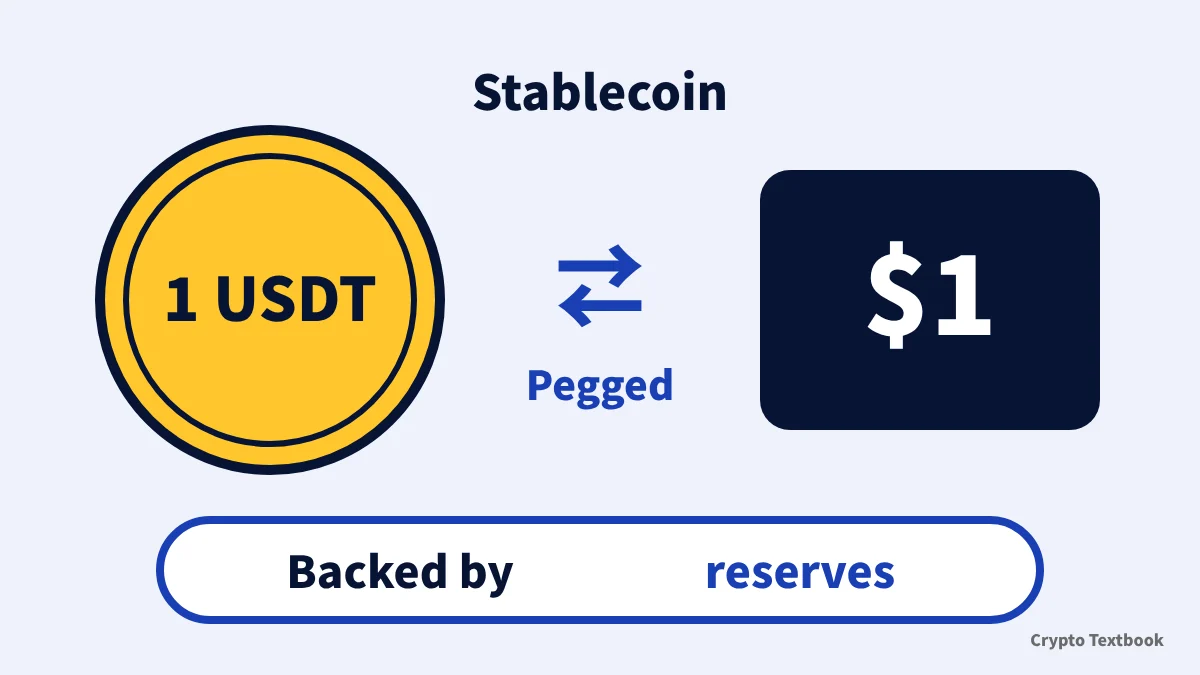
- USDT: issued by Tether, pegged at 1 USDT = 1 USD
- USDC: issued by Circle, redeemable 1:1 for US dollars
- Backing: both say reserves meet or exceed tokens in circulation
- Transfers: pick the same network, such as TRC20, ERC20 or BEP20
- Price: on exchanges the price can move above or below 1 dollar
A stablecoin is a crypto asset designed to hold the same value as a fiat currency. Its purpose differs from assets such as Bitcoin, whose price moves widely.
Step-by-step deposits are covered in the deposit and network guide. This guide explains what USDT itself is and how it compares with USDC.
How USDT (Tether) works: reserves and redemption
Tether's official FAQ describes USDT as a platform launched in 2014. It says USDT is pegged 1-to-1 to the dollar (1 USD₮ = 1 USD) and that every token is 100% backed by reserves.
The reserves include cash, cash equivalents and other assets, including loans to third parties. The FAQ also says Tether holds bitcoin and gold.
| Item | Tether official page |
|---|---|
| Circulation figures | Typically updated daily |
| Reserves report | Quarterly, prepared by BDO Italia |
| Asset breakdown | Quarterly since June 2021 |
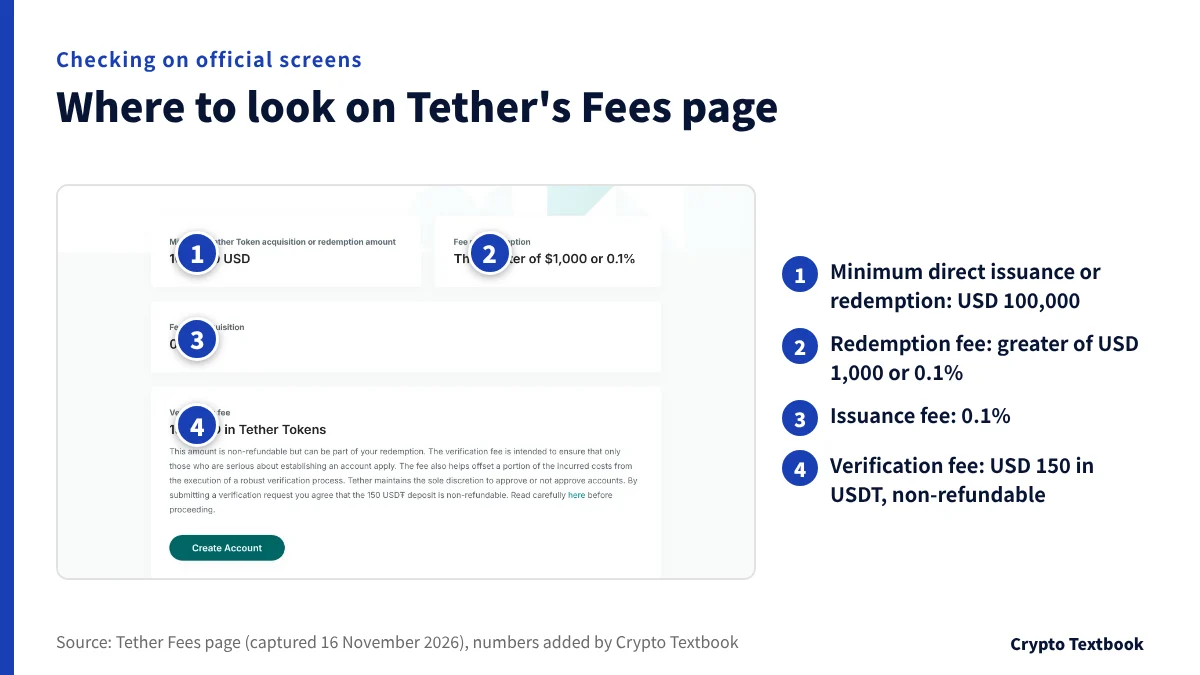
| Direct issuance or redemption | Minimum USD 100,000 |
| Redemption fee | The greater of USD 1,000 or 0.1% |
| Issuance fee | 0.1% |
| Verification fee | USD 150 in USDT, non-refundable |
How new USDT is created
New USDT is created on chain with signatures from several keys and first sits in Tether's treasury. The FAQ calls this state authorized but not issued.
Tokens count as circulating once they leave the treasury after a customer pays in. Tether says the multi-signature setup stops any one person from creating tokens alone.
Only verified customers can deal with Tether directly. With a USD 100,000 minimum, smaller users usually buy and sell USDT on an exchange.
How USDC (Circle) works: weekly disclosure, monthly assurance
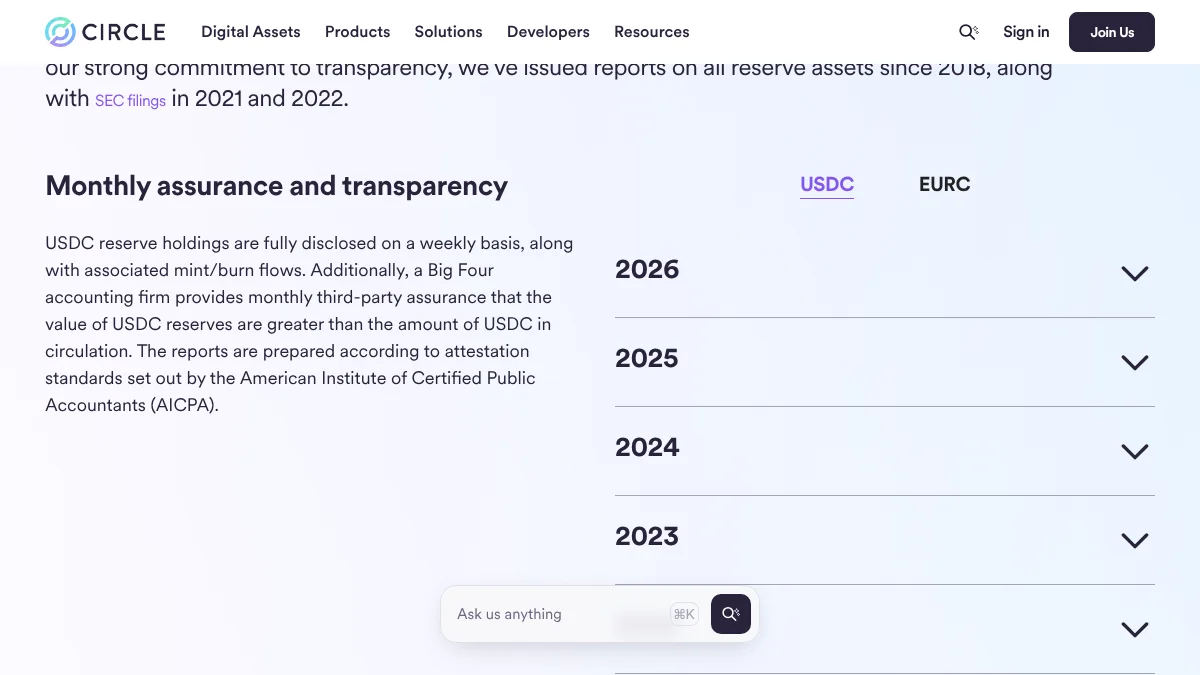
USDC is a dollar-pegged stablecoin issued by Circle Internet Financial, LLC. Circle's page says each USDC is redeemable 1:1 for US dollars.
Most of the reserve is held in the Circle Reserve Fund (USDXX), a money market fund. BlackRock manages it and BNY Mellon holds the assets.
- Reserve holdings: disclosed weekly
- Assurance: monthly, by a Big Four accounting firm
- Standard: AICPA attestation standards
- Chains: 38 networks as of 16 September 2026
When a business deposits dollars, new USDC is created; when it returns USDC, it receives dollars. Circle calls these minting and burning.
Circle Mint, which converts USDC 1:1 to dollars, serves exchanges and financial institutions. Circle says it is not available to individuals or small businesses.
USDT vs USDC: issuer, disclosure and redemption
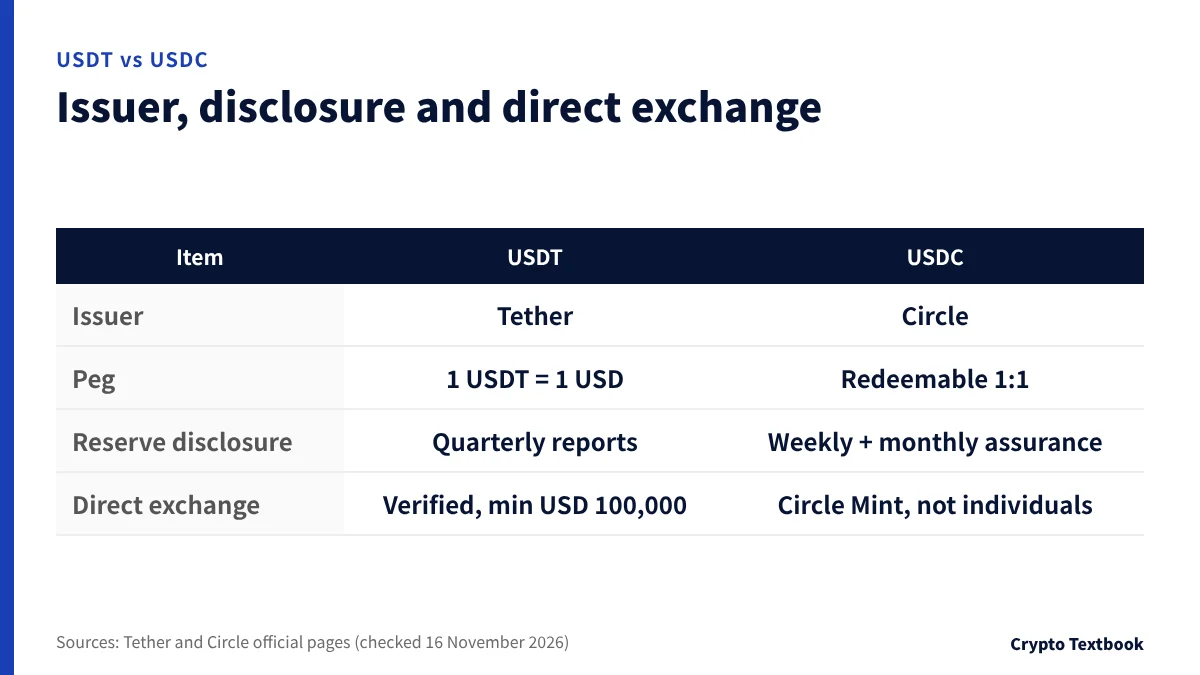
Both are pegged to the US dollar. They differ in who issues them and how often the reserves are shown.
| Item | USDT (Tether) | USDC (Circle) |
|---|---|---|
| Issuer | Tether (site operated by Tether Operations, S.A. de C.V.) | Circle Internet Financial, LLC (terms outside the EEA) |
| Peg | 1 USD₮ = 1 USD | Redeemable 1:1 for USD |
| Reserve disclosure | Quarterly reports | Weekly holdings and monthly assurance |
| Reserve assets | Cash, cash equivalents, loans and more; also BTC and gold | Cash and the Circle Reserve Fund |
| Direct exchange | Verified customers, USD 100,000 minimum | Circle Mint, not for individuals |
Most trading pairs on overseas exchanges are quoted in USDT. Even if you hold USDC, you may need to swap it to USDT before trading.
In Japan, swapping one crypto asset for another is a taxable event even without converting to yen. Swaps into USDT or USDC are included. See the tax basics guide.
USDT networks compared: TRC20, ERC20 and BEP20
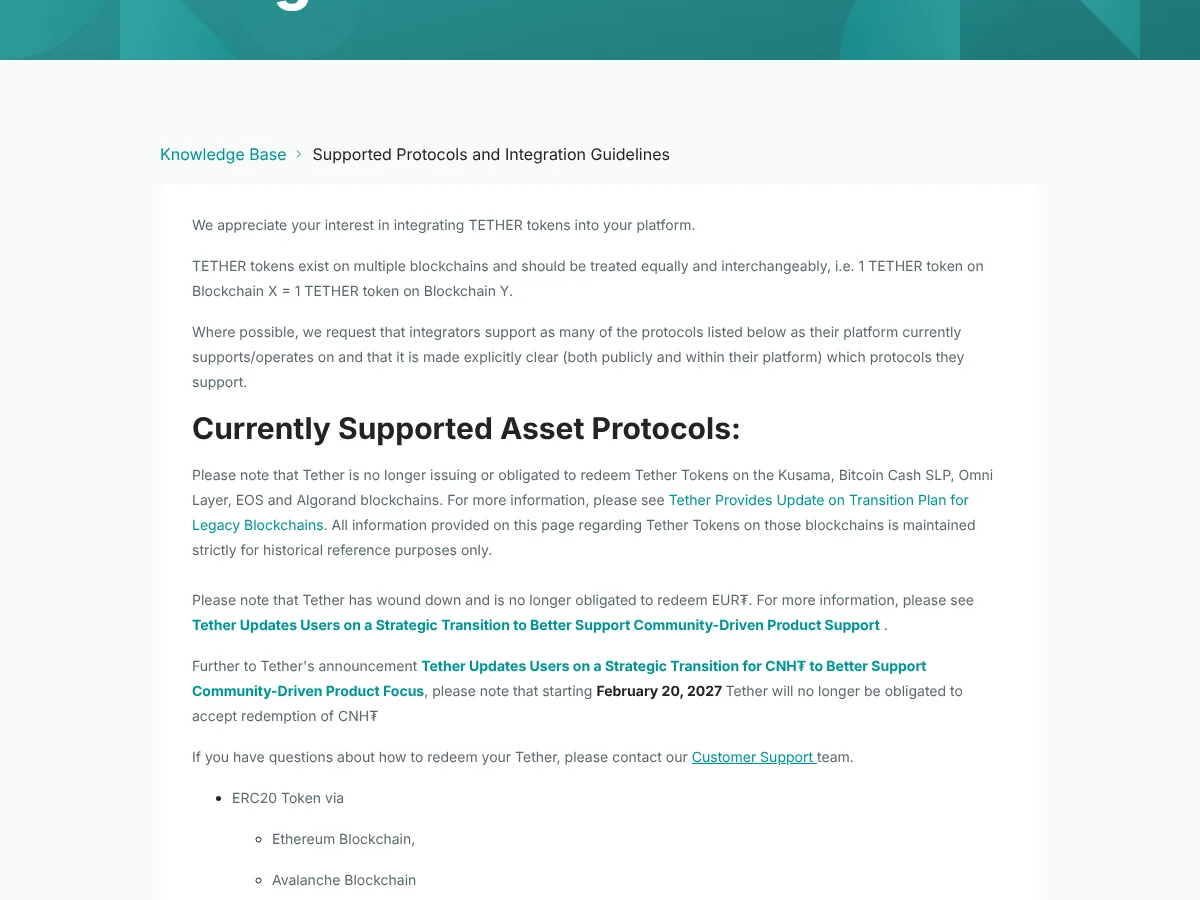
USDT is issued on several blockchains, not just one. The network you choose when sending is the chain the transfer runs on.
| Label | Chain | Tether official list |
|---|---|---|
| TRC20 | Tron | USD₮ contract listed |
| ERC20 | Ethereum | USD₮ contract listed |
| BEP20 | BNB Smart Chain | Only the XAU₮ (gold) contract listed |
| Solana and others | Solana, TON, Aptos and more | Listed as supported protocols |
All four exchanges list BEP20 USDT on their deposit pages. On Tether's own list, however, the BNB Smart Chain entry shows only the gold-backed XAU₮ contract.
Tether says it is no longer issuing or obligated to redeem USDT on Omni Layer, Kusama, Bitcoin Cash SLP, EOS and Algorand. Its terms date the end of redemption from 1 September 2025.
USDT on overseas exchanges: fees depend on the network
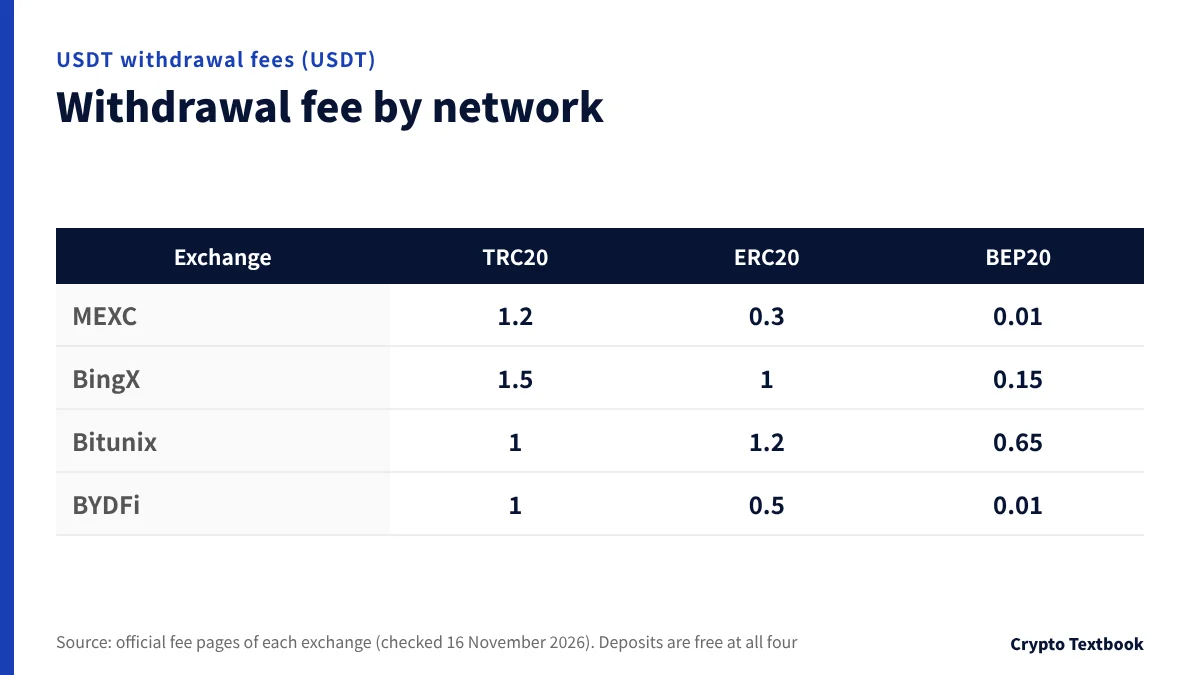
On overseas exchanges, balances, fees and futures margin are often counted in USDT. Sending USDT is also the usual way to fund an account.
All four exchanges charge no fee for USDT deposits. Withdrawals carry a fixed fee that depends on the network.
| Exchange | TRC20 | ERC20 | BEP20 |
|---|---|---|---|
| MEXC | 1.2 (min 2) | 0.3 (min 4) | 0.01 (min 0.2) |
| BingX | 1.5 (min 1.5) | 1 (min 5) | 0.15 (min 3) |
| Bitunix | 1 (min 2) | 1.2 (min 2) | 0.65 (min 2) |
| BYDFi | 1 (min 2) | 0.5 (min 3) | 0.01 (min 2) |
※ Figures in USDT. The number in brackets is the minimum withdrawal. Fees can change with network congestion, so the withdrawal screen takes priority.
Even on TRC20, the fee ranges from 1 to 1.5 USDT depending on the exchange. The smaller the amount, the larger the fee as a share of it.
MEXC deposits and withdrawals: yen deposits and fees
BingX deposit and withdrawal steps and fees
Sending USDT safely: same network and a test transfer
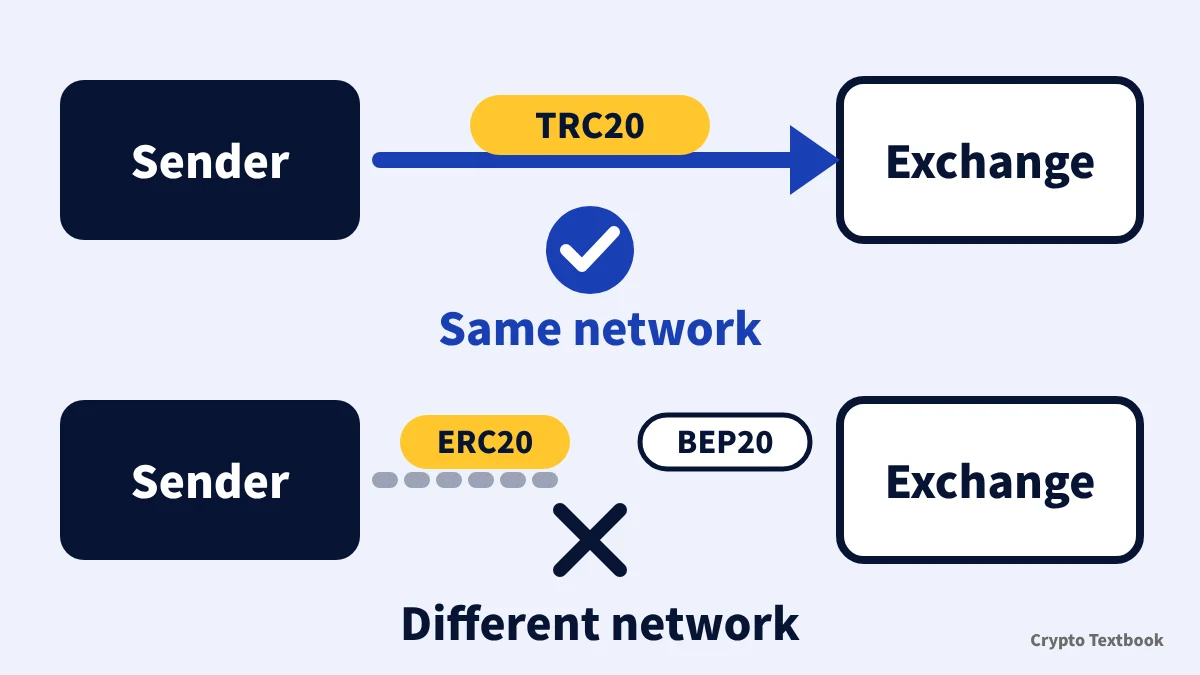
Tether's FAQ asks users to check the destination address and the transport protocol before sending. Its terms state that USDT transfers cannot be reversed.
- 01Choose the network on the receiving side
On the exchange deposit page, select USDT and a network, then copy the address shown.
- 02Choose the same network on the sending side
Check that the network name on the send screen matches the deposit page.
- 03Check the minimum deposit and fee
Deposits below the minimum may not be credited. BingX's fee page carries the same warning.
- 04Send a small test amount first
Send a small amount, confirm it reaches your balance, then send the rest.
- 05Keep the transaction ID
You will need it if the transfer does not arrive. It appears in your transfer history.
Japanese exchanges may ask you to register the destination before sending abroad. The travel rule column explains the steps.
Can USDT lose its 1 dollar peg (depeg)?
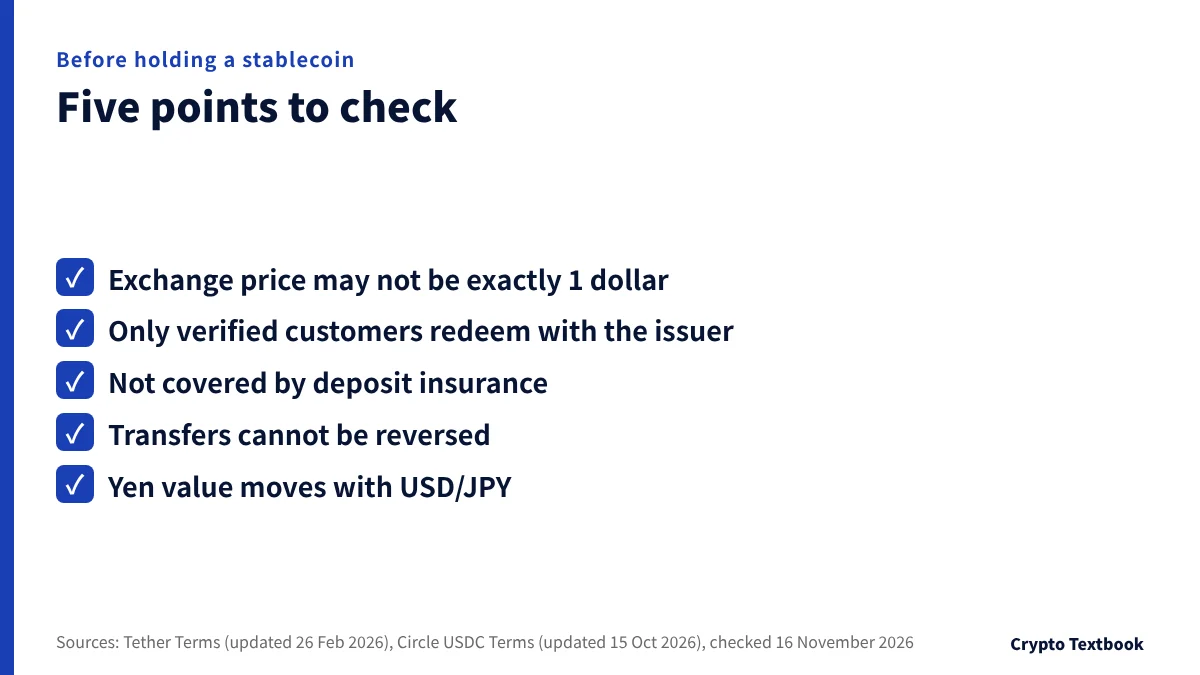
A depeg is when a stablecoin drifts away from its 1 dollar value. Circle's terms state that the price of USDC on exchanges can move above or below 1 dollar.
Tether's terms state that USDT is not legal tender and is not backed by any government or protected by insurance from Tether or its affiliates. They also say Tether may delay or suspend purchases and redemptions.
- Price: the order book may not show exactly 1 dollar
- Redemption: only verified customers can redeem with the issuer
- Protection: not covered by deposit insurance
- Transfers: cannot be reversed once sent
- Exchange rate: the yen value also moves with USD/JPY
Futures trading with stablecoin margin can magnify losses through leverage. If USDT itself moves off its peg, its value in yen changes too.
Yen-pegged stablecoins are issued under a different framework. The JPYC and JPYSC column covers them.
Yen stablecoins JPYC and JPYSC explained
If you use USDT on an exchange, check the network and withdrawal fee on both sides before sending. If you want to compare how issuers disclose reserves, look at Tether's quarterly reports next to Circle's monthly reports.
Frequently asked questions
Q. What is USDT?
A. USDT is a stablecoin issued by Tether and pegged at 1 USDT = 1 US dollar. Tether's FAQ says it is 100% backed by reserves. Overseas exchanges use it as the unit for balances and fees.
Q. Is Tether (USDT) safe?
A. You can check it against official disclosures. Tether typically publishes circulation daily and reserves quarterly. Its terms also say USDT is not backed by any government or protected by Tether's insurance, and the exchange price can move away from 1 dollar.
Q. What is the difference between USDT and USDC?
A. The issuer and the disclosure frequency differ. Tether publishes quarterly reserve reports. Circle discloses USDC reserves weekly and publishes monthly assurance from an accounting firm.
Q. Which USDT network should I choose?
A. Choose a network supported by both the sender and the receiver, then compare withdrawal fees and minimums. For example, MEXC charges 1.2 USDT on TRC20 and 0.01 USDT on BEP20 (checked 16 November 2026).
Q. What happens if I send USDT on the wrong network?
A. The funds may not arrive and may not be recoverable. Tether's terms state that transfers cannot be reversed. Keep the transaction ID and ask the receiving exchange's support whether they can help.
Q. Can I redeem USDT directly for dollars?
A. Only verified Tether customers can redeem directly, with a USD 100,000 minimum. Individuals usually sell USDT on an exchange instead.
Q. Can USDT trade below 1 dollar?
A. Yes. The exchange price moves with supply and demand. Circle's terms likewise say the price of USDC on exchanges can move away from 1 dollar.
Sources and conditions
- Tether | FAQs (checked 16 November 2026) →
- Tether | Fees (checked 16 November 2026) →
- Tether | Transparency (checked 16 November 2026) →
- Tether | Supported Protocols and Integration Guidelines (checked 16 November 2026) →
- Tether | Terms of Service (updated 26 February 2026, checked 16 November 2026) →
- Circle | USDC (checked 16 November 2026) →
- Circle | Transparency and stability (checked 16 November 2026) →
- Circle | USDC Terms (updated 15 October 2026, checked 16 November 2026) →
- MEXC | Fees, deposit and withdrawal (checked 16 November 2026) →
- BingX | Fee schedule, deposit and withdrawal (checked 16 November 2026) →
- Bitunix | Fees, deposit and withdrawal (checked 16 November 2026) →
- BYDFi | Fees, deposit and withdrawal (checked 16 November 2026) →
FX Textbook is an independent information site, not an exchange or a provider of personal investment advice. Crypto-asset trading involves risk: price moves, liquidation of leveraged positions, transfer errors and exchange operating risk can result in the loss of some or all invested capital.
NEXT STEP
Know how USDT works? Compare the exchanges next.
Spot and futures fees, deposits and withdrawals, maximum leverage and liquidation rules, exchange by exchange.
Listed exchanges