
You made a profit on crypto and do not know how much tax it adds. This table shows the tax on profits from 200,000 to 30 million yen, for two cases: with a salary and without one.
On a 1 million yen profit, an employee earning 5 million yen pays about ¥193,000 more, and a person with no salary pays about ¥57,000 (2026 income, income tax plus inhabitant tax, simplified).
After reading, you can find the row closest to your case and read off a tax estimate.
In short: a 1 million yen profit costs about ¥193,000 with a salary and ¥57,000 without
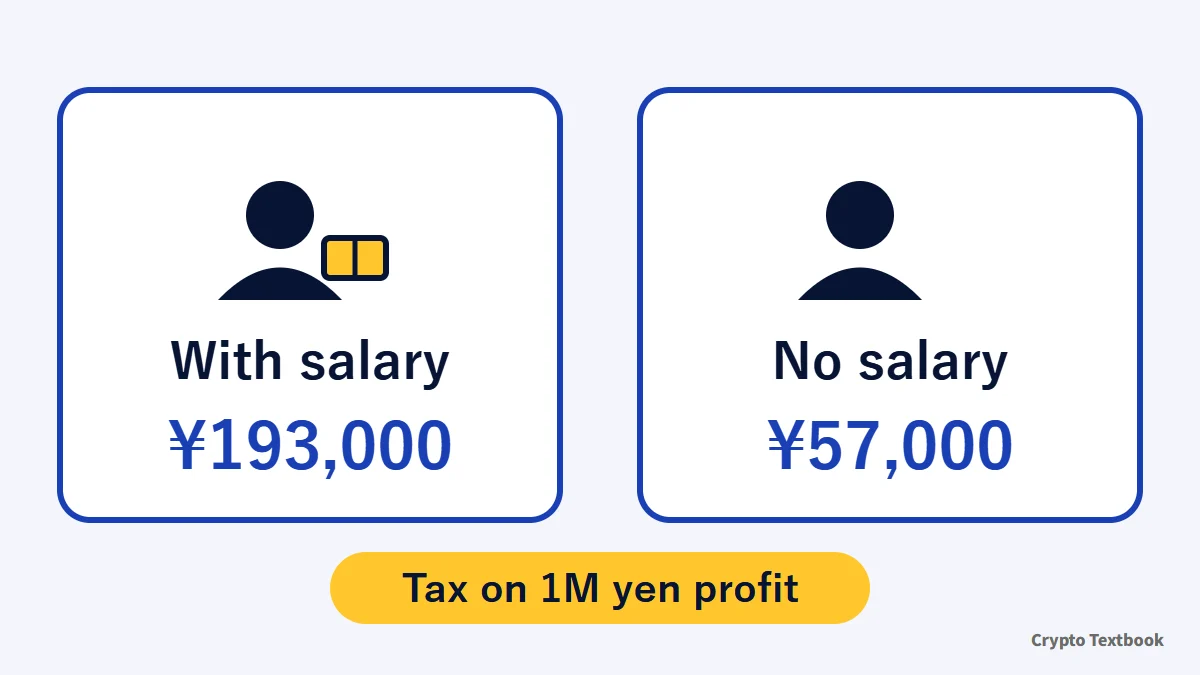
- An employee earning 5 million yen pays ¥193,000 more on a 1 million yen profit (19.3% of the profit)
- For the same employee, 5 million yen of profit costs ¥1,449,000 (29.0%) and 10 million yen costs ¥3,449,000 (34.5%)
- With no salary, the tax is ¥57,000 on 1 million yen, ¥905,000 on 5 million and ¥2,549,000 on 10 million
- The share rises with profit; with a salary it reaches 45.0% at 30 million yen
- All figures are 2026 income: income tax, reconstruction surtax and inhabitant tax combined
| Profit | With salary (5 million yen) | No salary (profit only) |
|---|---|---|
| ¥1,000,000 | ¥193,000 (19.3%) | ¥57,000 (5.7%) |
| ¥5,000,000 | ¥1,449,000 (29.0%) | ¥905,000 (18.1%) |
| ¥10,000,000 | ¥3,449,000 (34.5%) | ¥2,549,000 (25.5%) |
| ¥30,000,000 | ¥13,498,000 (45.0%) | ¥12,397,000 (41.3%) |
Dependents and insurance deductions change the result. Check with your tax office or a tax accountant before you file.
From what profit does crypto tax apply? The 200,000 yen rule and filing conditions →
Japan crypto tax table: income tax 5-45% plus inhabitant tax 10%
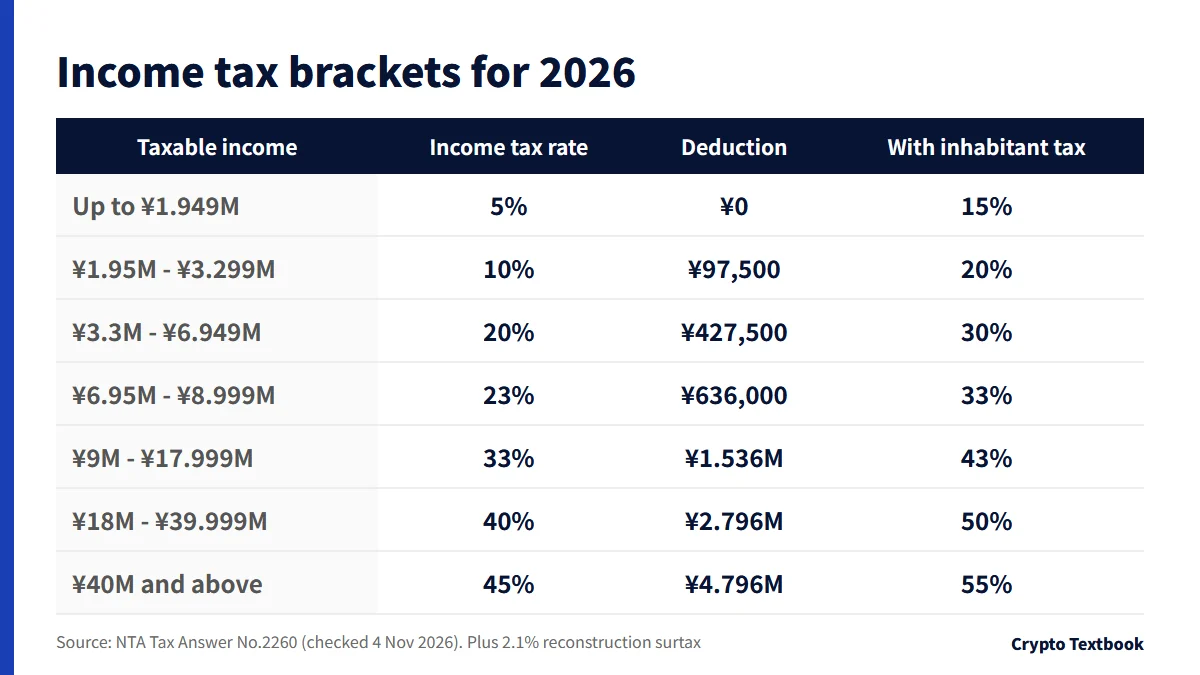
Crypto profit is miscellaneous income. It is added to your salary and taxed together, and the rate rises with taxable income.
| Taxable income | Income tax rate | Deduction | With 10% inhabitant tax |
|---|---|---|---|
| 1,000 yen to 1,949,000 yen | 5% | 0 yen | 15% |
| 1,950,000 to 3,299,000 yen | 10% | 97,500 yen | 20% |
| 3,300,000 to 6,949,000 yen | 20% | 427,500 yen | 30% |
| 6,950,000 to 8,999,000 yen | 23% | 636,000 yen | 33% |
| 9,000,000 to 17,999,000 yen | 33% | 1,536,000 yen | 43% |
| 18,000,000 to 39,999,000 yen | 40% | 2,796,000 yen | 50% |
| 40,000,000 yen and above | 45% | 4,796,000 yen | 55% |
Income tax is taxable income times the rate, minus the deduction. For 4 million yen of taxable income: 4,000,000 x 20% - 427,500 = 372,500 yen.
For 2026 income, 2.1% of the income tax is added. From 2027 a defence special income tax is introduced, and the combined rate does not change.
Crypto tax basics (miscellaneous income and timing), beginner guide →
Assumptions behind the Japan crypto tax table: with salary and without
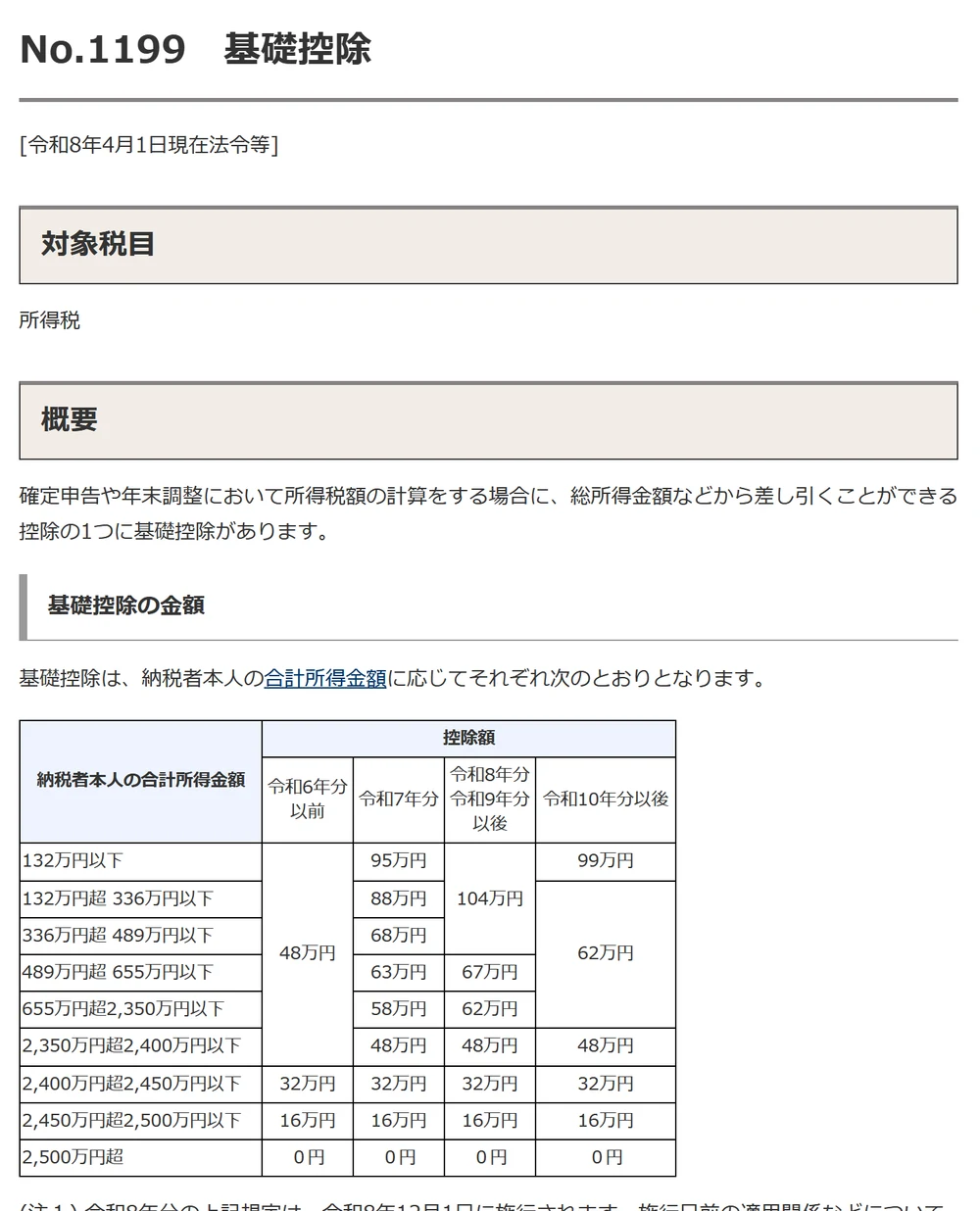
This tax table is our own calculation under the conditions below. Different conditions give different tax.
| Item | With salary | No salary |
|---|---|---|
| Salary income | 5,000,000 yen | None |
| Employment income deduction | 1,440,000 yen (income x 20% + 440,000) | None |
| Employment income | 3,560,000 yen | 0 yen |
| Social insurance deduction | 750,000 yen (assumed 15% of salary) | Assumed 0 yen |
| Crypto profit | Miscellaneous income after expenses | Same |
| Other deductions | Basic deduction only | Basic deduction only |
The basic deduction depends on total income. For 2026 it is 1,040,000 yen up to 4.89 million yen, 670,000 yen up to 6.55 million yen, and 620,000 yen up to 23.5 million yen.
- When profit pushes total income above 4.89 million yen, the basic deduction falls from 1,040,000 to 670,000 yen
- The inhabitant tax basic deduction stays at up to 430,000 yen for fiscal 2027, separate from income tax
- The per-capita levy and the adjustment credit for inhabitant tax are not included
If you pay national health insurance premiums, the deduction lowers your tax. The premiums themselves are a separate cost.
Crypto tax with a salary: tax table for profits from 200,000 to 30 million yen
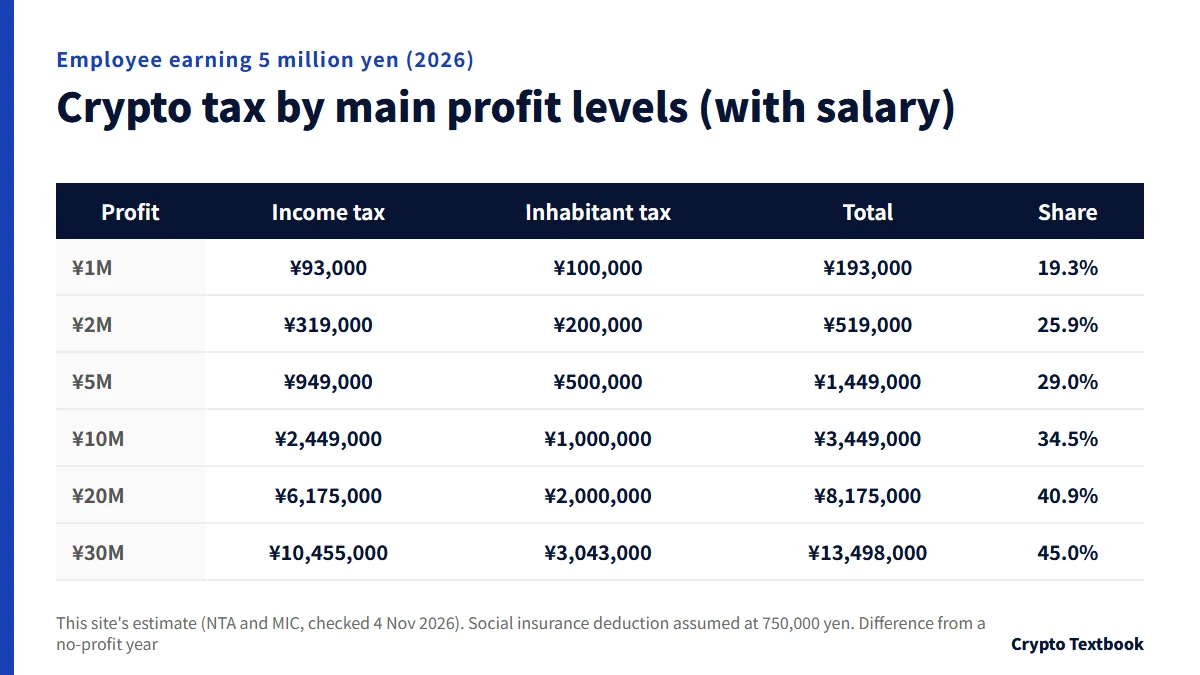
This is the extra tax an employee earning 5 million yen pays on crypto profit. A year with no profit costs ¥90,000 in income tax and ¥238,000 in inhabitant tax, ¥328,000 in total.
| Profit | Income tax + surtax | Inhabitant tax | Total (share of profit) |
|---|---|---|---|
| ¥200,000 | ¥11,000 | ¥20,000 | ¥31,000 (15.6%) |
| ¥500,000 | ¥42,000 | ¥50,000 | ¥92,000 (18.4%) |
| ¥1,000,000 | ¥93,000 | ¥100,000 | ¥193,000 (19.3%) |
| ¥2,000,000 | ¥319,000 | ¥200,000 | ¥519,000 (25.9%) |
| ¥3,000,000 | ¥533,000 | ¥300,000 | ¥833,000 (27.8%) |
| ¥5,000,000 | ¥949,000 | ¥500,000 | ¥1,449,000 (29.0%) |
| ¥10,000,000 | ¥2,449,000 | ¥1,000,000 | ¥3,449,000 (34.5%) |
| ¥20,000,000 | ¥6,175,000 | ¥2,000,000 | ¥8,175,000 (40.9%) |
| ¥30,000,000 | ¥10,455,000 | ¥3,043,000 | ¥13,498,000 (45.0%) |
- On a 200,000 yen profit you need no income tax return and pay only ¥20,000 inhabitant tax; the ¥11,000 income tax is what the formula gives if you file
- The share jumps to 25.9% at 2 million yen because the bracket rises to 20% and the basic deduction falls from 1,040,000 to 670,000 yen
- At 30 million yen total income passes 25 million, the basic deduction becomes 0 yen, and the share is 45.0%
No-filing line for salaried people (the 200,000 yen rule and inhabitant tax) →
Crypto tax with no salary: tax table by profit
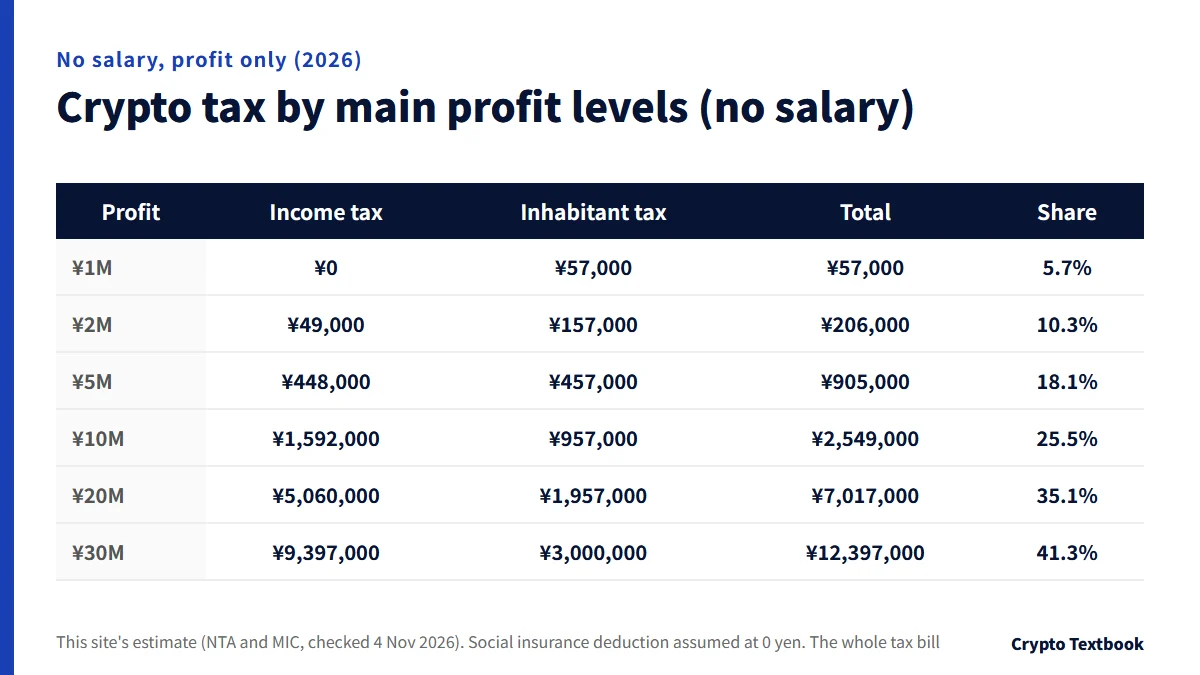
This is the yearly tax for a person with no salary and only crypto profit. Up to 1,040,000 yen of profit, the basic deduction leaves no income tax.
| Profit | Income tax + surtax | Inhabitant tax | Total (share of profit) |
|---|---|---|---|
| ¥200,000 | ¥0 | ¥0 | ¥0 (0.0%) |
| ¥500,000 | ¥0 | ¥7,000 | ¥7,000 (1.4%) |
| ¥1,000,000 | ¥0 | ¥57,000 | ¥57,000 (5.7%) |
| ¥2,000,000 | ¥49,000 | ¥157,000 | ¥206,000 (10.3%) |
| ¥3,000,000 | ¥101,000 | ¥257,000 | ¥358,000 (11.9%) |
| ¥5,000,000 | ¥448,000 | ¥457,000 | ¥905,000 (18.1%) |
| ¥10,000,000 | ¥1,592,000 | ¥957,000 | ¥2,549,000 (25.5%) |
| ¥20,000,000 | ¥5,060,000 | ¥1,957,000 | ¥7,017,000 (35.1%) |
| ¥30,000,000 | ¥9,397,000 | ¥3,000,000 | ¥12,397,000 (41.3%) |
- The inhabitant tax basic deduction is 430,000 yen, so tax starts from a 500,000 yen profit (¥7,000)
- Income tax applies only to the part of profit above 1,040,000 yen
- Costs outside tax, such as national health insurance premiums, can also rise with income (not in the table)
Can a loss be carried forward? Current rules and the planned change →
How the figures are calculated: a 5 million yen profit with a salary
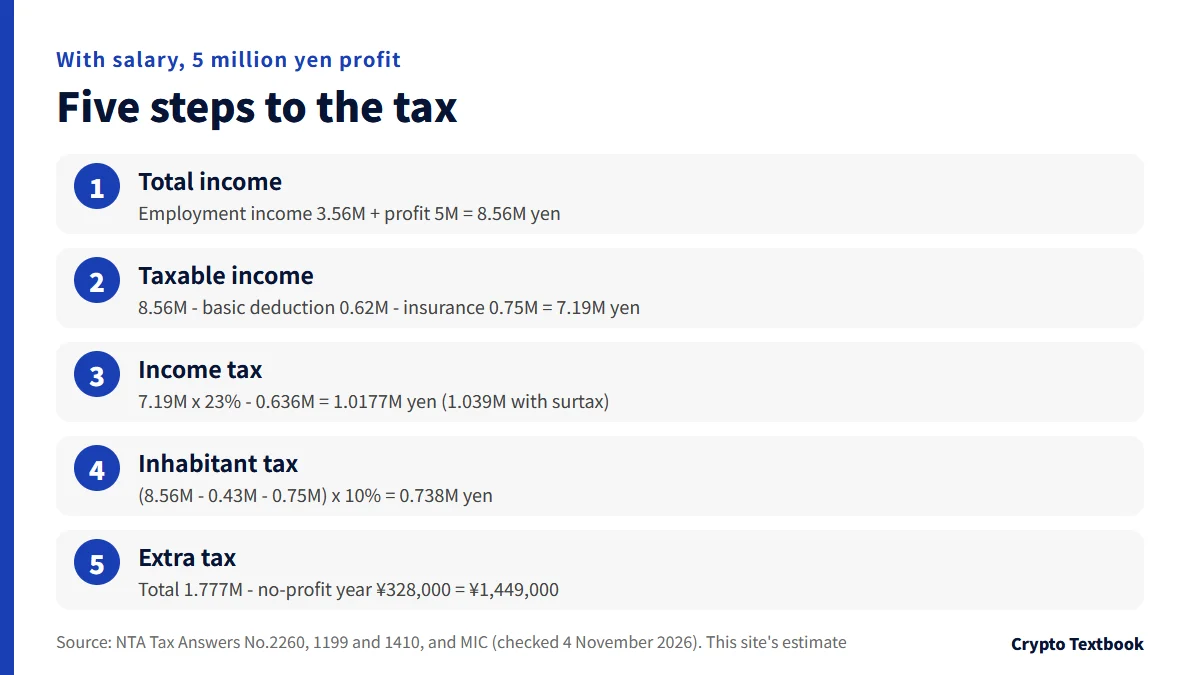
The row for a 5 million yen profit with a salary is calculated in five steps.
- 01Find total income
Employment income of 3,560,000 yen plus the 5,000,000 yen profit gives 8,560,000 yen.
- 02Find taxable income
Subtract the 620,000 yen basic deduction and 750,000 yen insurance deduction to get 7,190,000 yen.
- 03Find income tax
7,190,000 x 23% - 636,000 = 1,017,700 yen. With the surtax it is 1,039,000 yen.
- 04Find inhabitant tax
8,560,000 - 430,000 - 750,000 = 7,380,000 yen, times 10%, is 738,000 yen.
- 05Find the difference
The total is 1,777,000 yen. Subtract ¥328,000 for a year with no profit to get ¥1,449,000.
Employment income is read from a National Tax Agency table, so rounding can differ slightly.
Why the share rises, and how it compares with 20% separate taxation
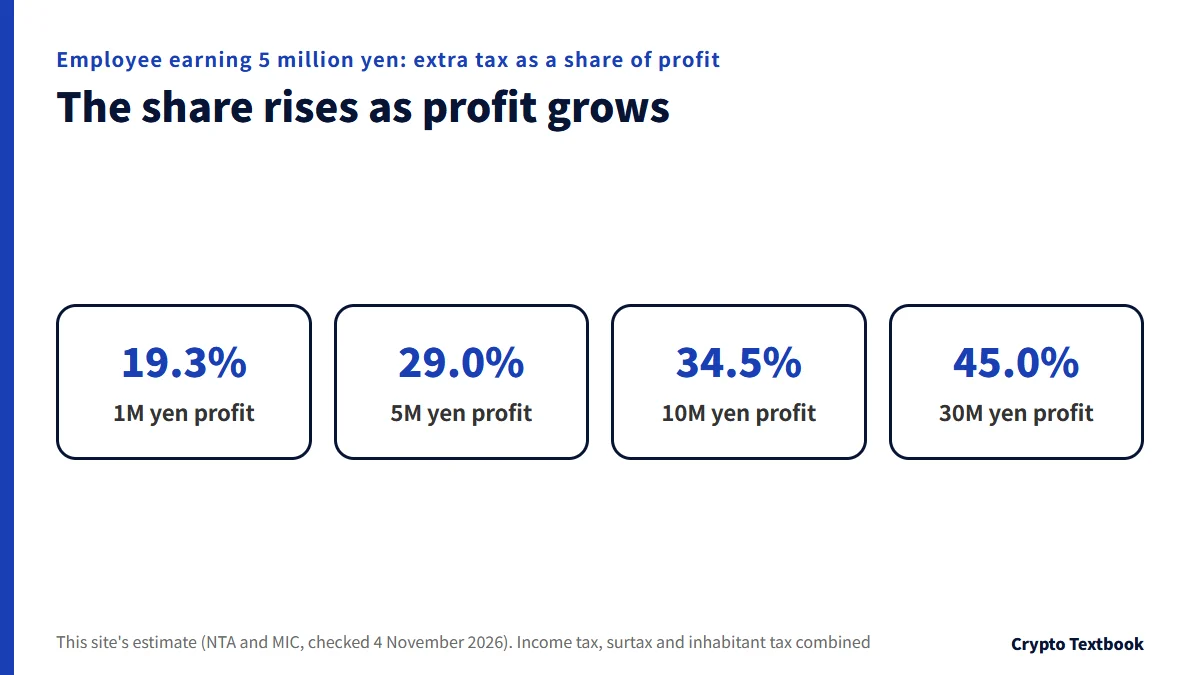
Under comprehensive taxation, the more total income you have, the higher the rate. At 5 million yen of profit you enter the 23% bracket, and each extra yen is taxed at about 33.5%.
From 1 January of the year after the amended Financial Instruments and Exchange Act takes effect, profit on specified crypto assets is expected to be taxed separately at 20%. The earliest date is 1 January 2027, so 2026 income stays under the current rules.
| Profit | With salary | No salary | Separate taxation (reference) |
|---|---|---|---|
| ¥1,000,000 | ¥193,000 | ¥57,000 | ¥203,000 |
| ¥5,000,000 | ¥1,449,000 | ¥905,000 | ¥1,016,000 |
| ¥10,000,000 | ¥3,449,000 | ¥2,549,000 | ¥2,032,000 |
| ¥30,000,000 | ¥13,498,000 | ¥12,397,000 | ¥6,095,000 |
It is expected to cover specified crypto assets, and the range will be set later. The reference column only applies the rate to the profit.
Six reasons your crypto tax can differ from the tax table
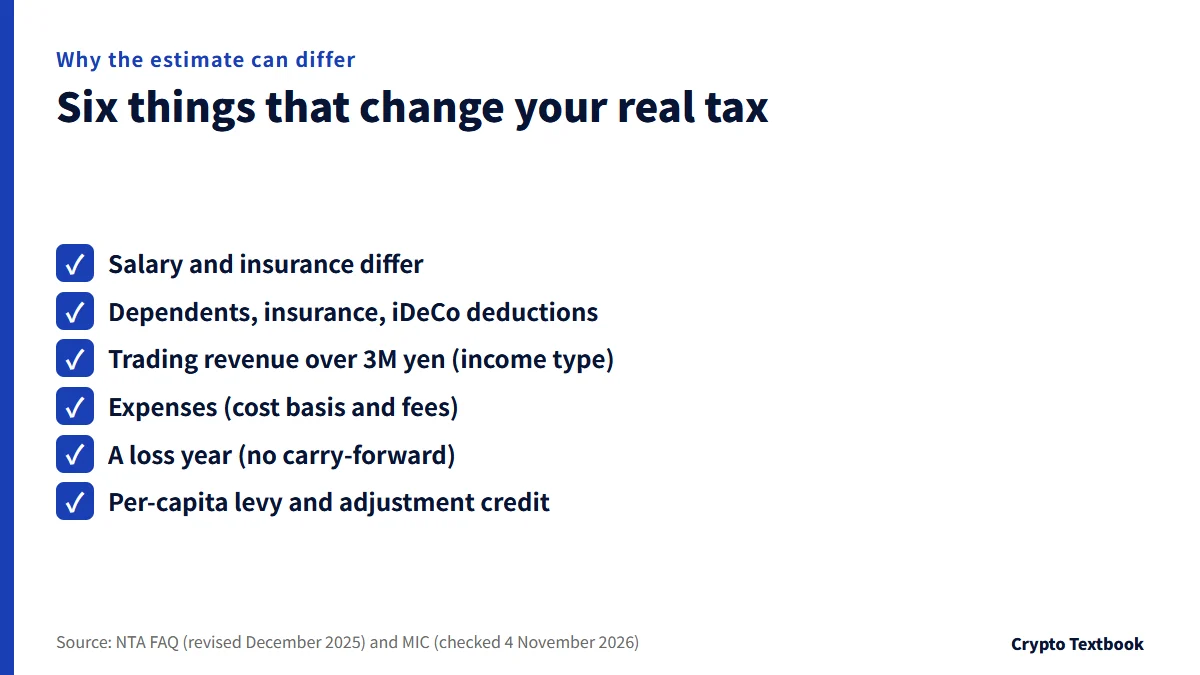
- Your salary and social insurance differ from the table's assumptions
- You have deductions for a spouse, dependents, life insurance, iDeCo or hometown tax donations
- Your annual trading revenue exceeds 3 million yen, which can make it business income or miscellaneous business income (FAQ 2-2)
- Your expenses (acquisition cost and fees) are calculated differently
- You have a loss year (losses on miscellaneous income cannot be netted against other income or carried forward)
- The per-capita inhabitant levy (4,000 yen a year) and the adjustment credit are not included
Ways to lower tax with deductions are covered in the tax-saving article. The filing steps are in the guide to filing for overseas exchanges.
Eight crypto tax-saving methods, and why there is no loophole →
How to file a tax return for profits on overseas exchanges →
How to check the official page, and our conclusion
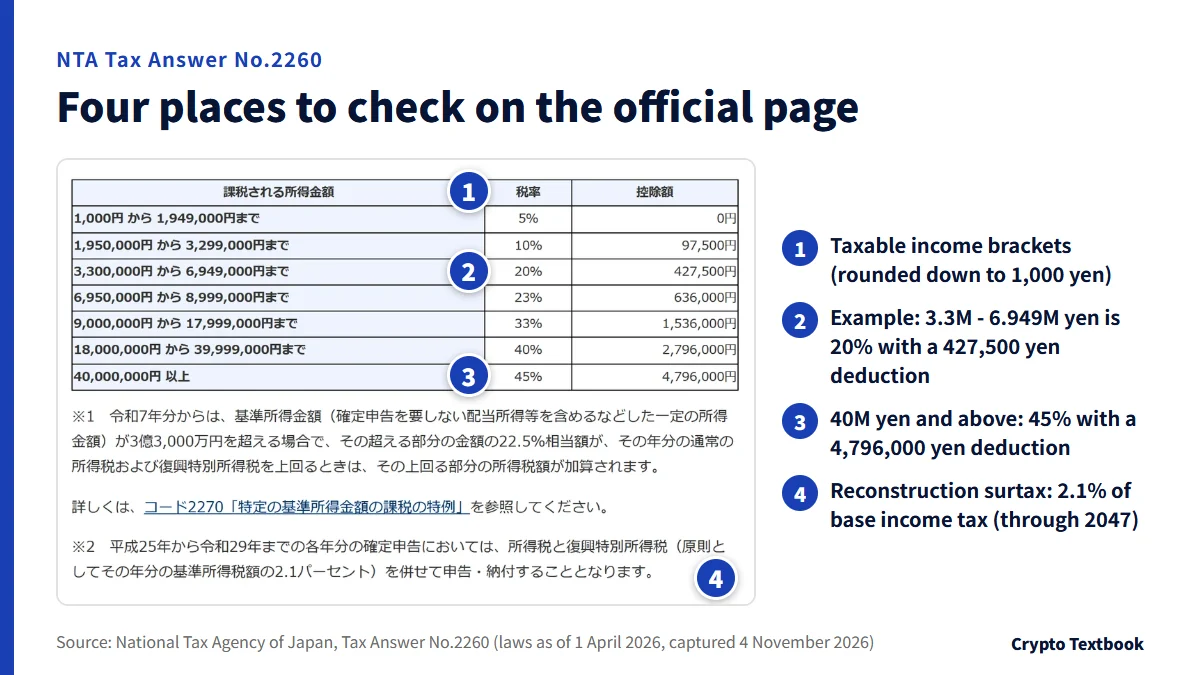
Check the rates on the National Tax Agency page, Tax Answer No.2260. The top of the page states the date of the laws it reflects.
- 01Read the date
Look for the line showing the laws as of 1 April 2026.
- 02Pick your row in the table
Find your taxable income bracket and read the rate and deduction.
- 03Read the notes
The notes below the table explain the reconstruction and defence special taxes.
If you have a salary, the basic deduction falls once total income passes 4.89 million yen, and the share of tax rises. With no salary, inhabitant tax starts at a 500,000 yen profit and income tax above 1,040,000 yen. For large amounts or unclear income types, ask your tax office or a tax accountant.
Can overseas exchange profits be found? CARF and tax audits →
Frequently asked questions
Q. How much tax do I pay on a 1 million yen crypto profit in Japan?
A. An employee earning 5 million yen pays about ¥193,000 more. A person with no salary pays about ¥57,000. These are 2026 totals of income tax, reconstruction surtax and inhabitant tax, with only the basic deduction and an assumed insurance deduction.
Q. What is the crypto tax on 2 million, 3 million and 5 million yen of profit?
A. With a salary: ¥519,000 on 2 million yen, ¥833,000 on 3 million and ¥1,449,000 on 5 million. With no salary: ¥206,000, ¥358,000 and ¥905,000.
Q. What is the crypto tax on 10 million, 20 million and 30 million yen of profit?
A. With a salary: ¥3,449,000 on 10 million yen, ¥8,175,000 on 20 million and ¥13,498,000 on 30 million. With no salary: ¥2,549,000, ¥7,017,000 and ¥12,397,000.
Q. What is the crypto tax rate in Japan?
A. Profit is miscellaneous income under comprehensive taxation. Income tax has seven brackets from 5% to 45%, inhabitant tax is 10%, and 2.1% of the income tax is added for 2026. The total is roughly 15% to 55%, set by your combined taxable income.
Q. Is there no tax if my crypto profit is 200,000 yen or less?
A. A salaried employee earning up to 20 million yen from one employer needs no income tax return if income other than salary is 200,000 yen or less (National Tax Agency No.1900). Inhabitant tax must still be reported. With a salary, about 20,000 yen of inhabitant tax applies at that profit.
Q. Why does the share of tax rise as profit grows?
A. Income tax is progressive, so higher taxable income falls into higher brackets. The basic deduction also falls once total income passes 4.89 million yen. With a salary, the share is around 45% at 30 million yen of profit.
Q. Will separate taxation from 2027 lower my crypto tax?
A. It starts from 1 January of the year after the amended Financial Instruments and Exchange Act takes effect, at the earliest 1 January 2027. The rate is about 20.315%, which is expected to be lower than comprehensive taxation for larger profits. It covers specified crypto assets, and the range is not settled.
Q. Why does my tax differ from this crypto tax table?
A. The table assumes a 5 million yen salary, 750,000 yen of social insurance and only the basic deduction. Dependents, other deductions, expenses and income type change the result. Confirm the real amount with the official filing tool or a tax accountant.
Sources
- National Tax Agency | Tax Answer No.2260 Income tax rates (laws as of 1 April 2026, checked 4 November 2026, Japanese) →
- National Tax Agency | Tax Answer No.1199 Basic deduction (laws as of 1 April 2026; 2026 amounts, checked 4 November 2026, Japanese) →
- National Tax Agency | Tax Answer No.1410 Employment income deduction (2026 amounts, checked 4 November 2026, Japanese) →
- National Tax Agency | Tax Answer No.1900 Salaried workers who must file a return (the 200,000 yen rule, checked 4 November 2026, Japanese) →
- National Tax Agency | Tax Answer No.1524 Tax treatment of profits from crypto assets (Japanese) →
- National Tax Agency | FAQ on the tax treatment of crypto assets, last revised December 2025 (PDF, Japanese) →
- Ministry of Internal Affairs and Communications | Individual inhabitant tax (income-based rate 10%: 4% prefectural plus 6% municipal; Japanese) →
- Ministry of Internal Affairs and Communications | FY2026 Inhabitant Tax Study Group, Material 3 (29 May 2026, PDF; inhabitant tax basic deduction unchanged at up to 430,000 yen; Japanese) →
FX Textbook is an independent information site, not an exchange or a provider of personal investment advice. Crypto-asset trading involves risk: price volatility, liquidation of leveraged positions, transfer mistakes and the operational risk of exchanges and service providers can cause you to lose some or all of your invested capital. No result is guaranteed.
NEXT STEP
If you use an exchange, check its conditions and operator first.
Operator, fees, leverage and liquidation, deposits and withdrawals, and identity checks, organised by exchange.