
You want to buy Internet Computer (ICP), but it does not show up in any Japanese exchange app. We checked primary sources to find out where and in what order to buy it.
ICP is not on the Japanese registered exchange lists. As of 8 November 2026, spot trading is available at MEXC, BingX and Bitunix, whose official APIs we checked.
This article walks through buying ICP at an overseas exchange, converting back to yen and how Japanese tax applies.
Answer: ICP is not on Japan's lists but trades at three overseas exchanges
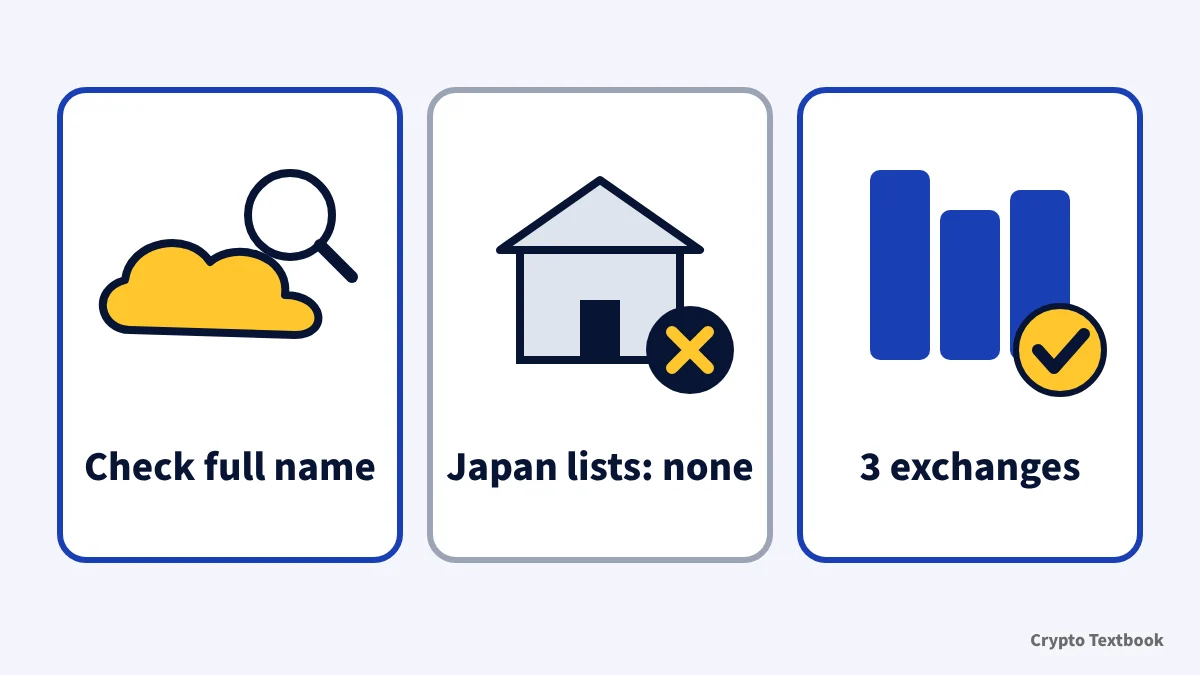
- ICP is the token of the Internet Computer network, developed by the DFINITY Foundation
- ICP and Internet Computer are not on the FSA registry (27 providers) or the JVCEA list (113 assets)
- MEXC offers ICP/USDT and ICP/USDC; BingX and Bitunix offer ICP/USDT
- None of the three is registered with Japan's FSA. Japanese investor protection does not apply, and ICP has not passed a JVCEA review
- The abbreviation ICP is also used in other fields. Check the full name Internet Computer and the pair name ICP/USDT
- Swapping USDT for ICP is itself a taxable event in Japan
We do not give price outlooks or timing advice. We do not present locking up ICP to earn rewards (staking) as something to do. ICP moves sharply. Only use money you can afford to lose.
What is Internet Computer (ICP)? Developer and basic data
Internet Computer is a network developed by the DFINITY Foundation, a Swiss not-for-profit organization. Its website describes it as a sovereign cloud where apps run without an administrator.
Apps on the network run in units called canisters. The fuel that runs them is called cycles, and it is made by burning ICP.
According to the official website, a canister combines a program (Wasm) with its own dedicated memory. Canisters talk to each other through function calls.
| Item | Details |
|---|---|
| Ticker | ICP |
| Full name | Internet Computer (name in the official docs) |
| Developer | DFINITY Foundation (Swiss not-for-profit) |
| Official website | internetcomputer.org (links both ways with dfinity.org) |
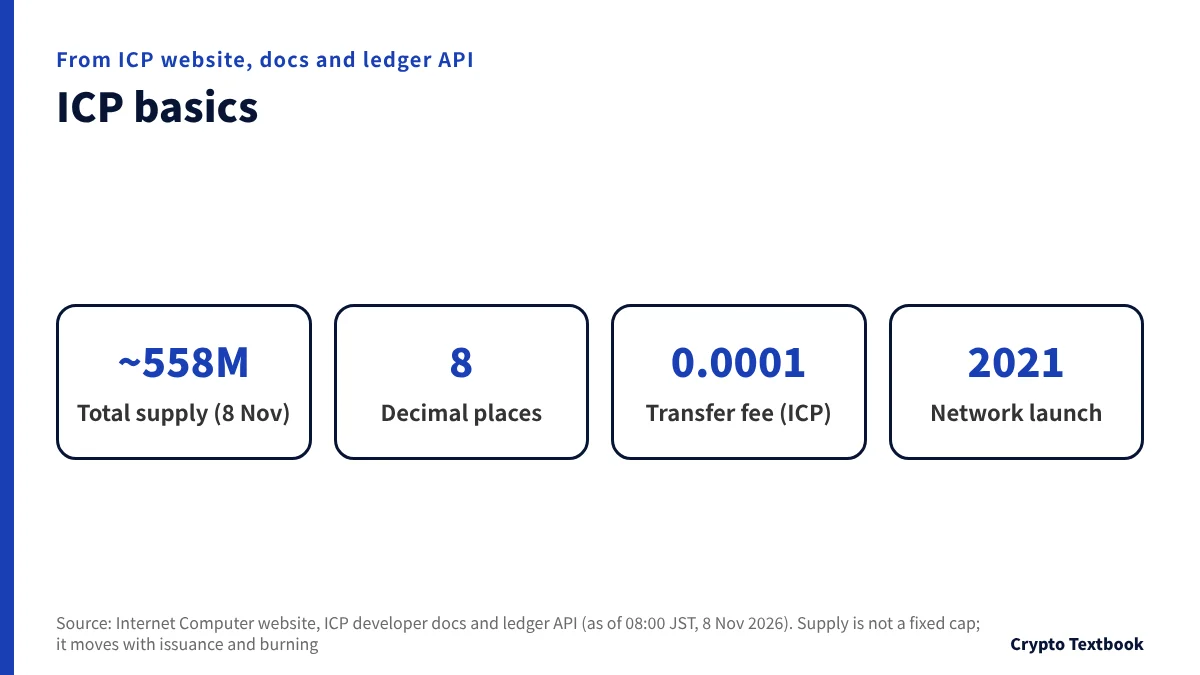
| Total supply | About 558 million ICP (ledger API, 08:00 JST on 8 November) |
| Decimal places | 8 |
| Transfer fee (official example) | 0.0001 ICP (10,000 in the smallest unit) |
| Network launch | The website's history page says "the launch in 2021" |
※ Total supply is the smallest-unit figure returned by the ledger API divided by 100 million. We could not find a fixed supply cap in the documentation. Supply rises with new issuance and falls with burning (explained later in this article).
The documentation lists four roles for ICP.
- Governance: lock ICP in a neuron and take part in voting
- Cycle conversion: turn it into fuel that runs apps on the network
- Node provider rewards: paid in newly issued ICP
- App decentralization swaps: receive an app's token
If you only buy and sell ICP on an exchange's spot market, these four roles do not come into play. They matter when you act on the network from your own wallet.
This article covers only buying and selling ICP on an exchange's spot market. Actions on the network through a wallet leave key management and transfer checks to you, so we do not recommend them for beginners. The abbreviation ICP is used in other fields too; here it means only the crypto-asset.
Can you buy ICP in Japan? What we found on Japanese exchanges
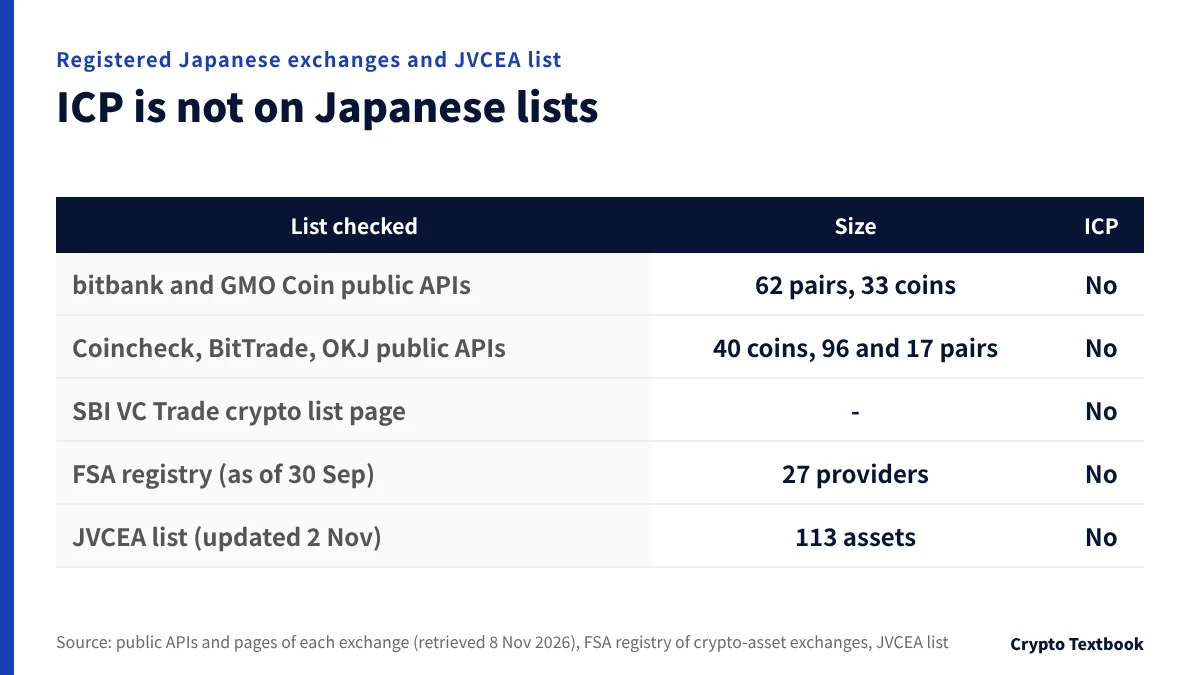
On 8 November 2026 we searched Japanese registered exchanges and the JVCEA list for ICP (Internet Computer). We used public APIs where five exchanges offer them and official lists for the rest. ICP is on none of them.
| List checked | Size | ICP |
|---|---|---|
| bitbank (public API) | 62 pairs | No |
| GMO Coin (public API) | 33 coins | No |
| Coincheck (public API) | 40 coins incl. its broker service | No |
| BitTrade (public API) | 96 pairs | No |
| OKJ (public API) | 17 pairs | No |
| SBI VC Trade (crypto list page) | - | No |
| FSA registry (as of 30 September 2026) | 27 providers | No |
| JVCEA list (updated 2 November) | 113 assets | No |
※ The FSA list is a list of providers, as of 30 September; it does not name coins. We did not check the current listing pages of Binance Japan, Rakuten Wallet, Zaif or BITPOINT; ICP is not in the FSA or JVCEA lists.
How to read the table: a public API lists trading pairs, so coins sold only through a broker service may not appear. That is why we also checked Coincheck's broker price list (40 coins).
A Japanese listing may come later. The JVCEA's notices of newly handled coins announce coins that members have started to handle. Check those notices before you buy.
Not being handled in Japan has three consequences.
- You would buy at an overseas exchange that is not registered with the FSA
- Japanese investor protection, such as segregation of assets and trust under the Payment Services Act, does not apply
- The coin has not passed the JVCEA review that Japanese exchanges go through before listing it
Running a crypto-asset exchange business in Japan requires registration under the Payment Services Act. Japanese exchanges have new coins reviewed by the JVCEA before handling them.
The penalties in the Payment Services Act target those who run the business without registration. We did not find a provision that punishes users in the parts we read. Even so, Japanese protections do not apply when something goes wrong.
Can Japanese residents use BingX? Registration, protection and where to check →
Where can you buy ICP? MEXC, BingX and Bitunix compared
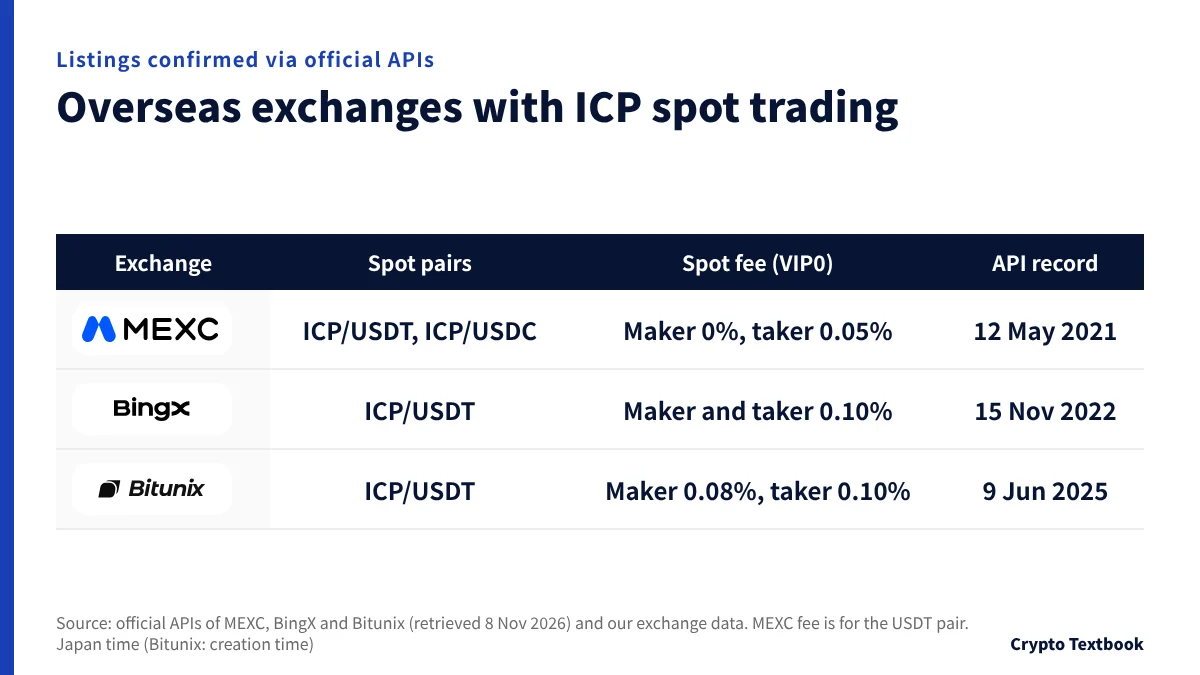
Of the overseas exchanges we feature, three showed ICP spot trading in their official APIs. BYDFi has no public API and its screens could not be retrieved, so this article does not cover it.
| Exchange | ICP spot pairs | Spot fee (VIP0) | API record |
|---|---|---|---|
| MEXC | ICP/USDT, ICP/USDC | USDT pair: maker 0%, taker 0.05% | USDT pair opened 12 May 2021, USDC pair 23 January 2025 |
| BingX | ICP/USDT | Maker and taker both 0.10% | Online since 15 November 2022 |
| Bitunix | ICP/USDT | Maker 0.08%, taker 0.10% | Registered 9 June 2025 |
※ MEXC's ICP/USDC shows 0 for both maker and taker in the API. Dates are Japan time, and Bitunix's is the API creation time (ctime). BingX's trading status is active (status 1) and its API buy and sell flags are both enabled. The 0.10% fee matches BingX's own buy page.
The maker fee applies when your limit order rests on the order book and then fills. The taker fee applies when you take an order already on the book, as a market order does.
Buying 1,000 USDT worth with a market order costs a taker fee of 0.5 USDT at MEXC (USDT pair) and 1 USDT at BingX and Bitunix. Rates change with VIP level and events, so check the actual rate on the order screen.
The Internet Computer website shows a selected, non-exhaustive list of exchanges that support ICP. Of the three, MEXC is on it; BingX and Bitunix are not. The site says the list is neither exhaustive nor an endorsement.
| Exchange | Verification level | Withdrawal limit |
|---|---|---|
| MEXC | Basic KYC, Advanced KYC | 80 BTC and 200 BTC per day (checked 26 September) |
| BingX | Unverified, Advanced verification | 20,000 and 5,000,000 USDT per 24 hours (unverified: deposits and trading unavailable per the official table, checked 8 Nov 2026) |
| Bitunix | KYC1, KYC2 | 500,000 and 5,000,000 USDT per 24 hours (checked 4 November) |
- MEXC: two pairs, USDT and USDC. The USDC pair has 0% maker and taker fees
- BingX: one pair, ICP/USDT. Unverified: deposits and trading unavailable per the official table (checked 8 Nov 2026)
- Bitunix: one pair, ICP/USDT. No deposit fee; credit takes about 3 to 30 minutes
Open the MEXC sign-up page (our referral link) →
How to buy ICP: four steps from sign-up to a spot order
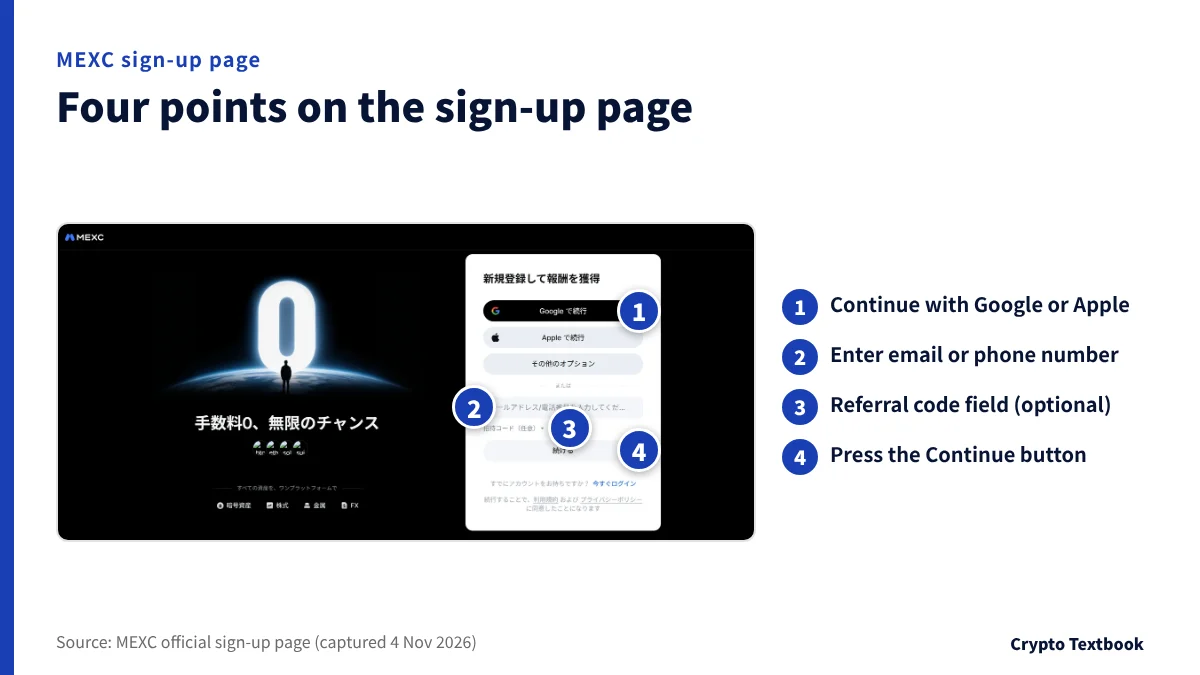
The flow is the same at all three exchanges. Screen names below come only from each exchange's official help pages and buy guides.
- 01Sign up with an email address or phone number
MEXC's sign-up screen has a field for an email address or phone number and a Referral code (optional) field. You can also continue with a Google or Apple account.
- 02Complete identity verification (KYC)
BingX does not allow deposits or trading until you verify. MEXC and Bitunix also have verification levels, and the withdrawal limit changes with the level. Choose your country of residence as shown on your ID.
- 03Deposit USDT or another crypto-asset
On the deposit screen, choose the coin and network, then send to the deposit address shown. BingX charges no deposit fee. Bitunix credits in about 3 to 30 minutes.
- 04Place a spot order for ICP/USDT
BingX's buy guide moves funds to the spot account and buys on the ICP/USDT spot market, with market and limit orders. MEXC and Bitunix use the same pair name, ICP/USDT.
You choose between a market order and a limit order. A market order fills right away at the prices on the order book. A limit order sets your price and waits until the market reaches it.
- BingX's official page recommends setting up Google 2FA (two-factor authentication)
- It also recommends setting up a passkey and an anti-phishing code
- Never share the verification codes sent to your email
BingX's official page also describes buying USDT by card, Apple Pay or P2P and then swapping it for ICP. Check the buy screen in the app for the payment methods available from Japan.
BingX identity verification (KYC): documents and withdrawal limits →
Sending crypto from a Japanese exchange and the screens to check
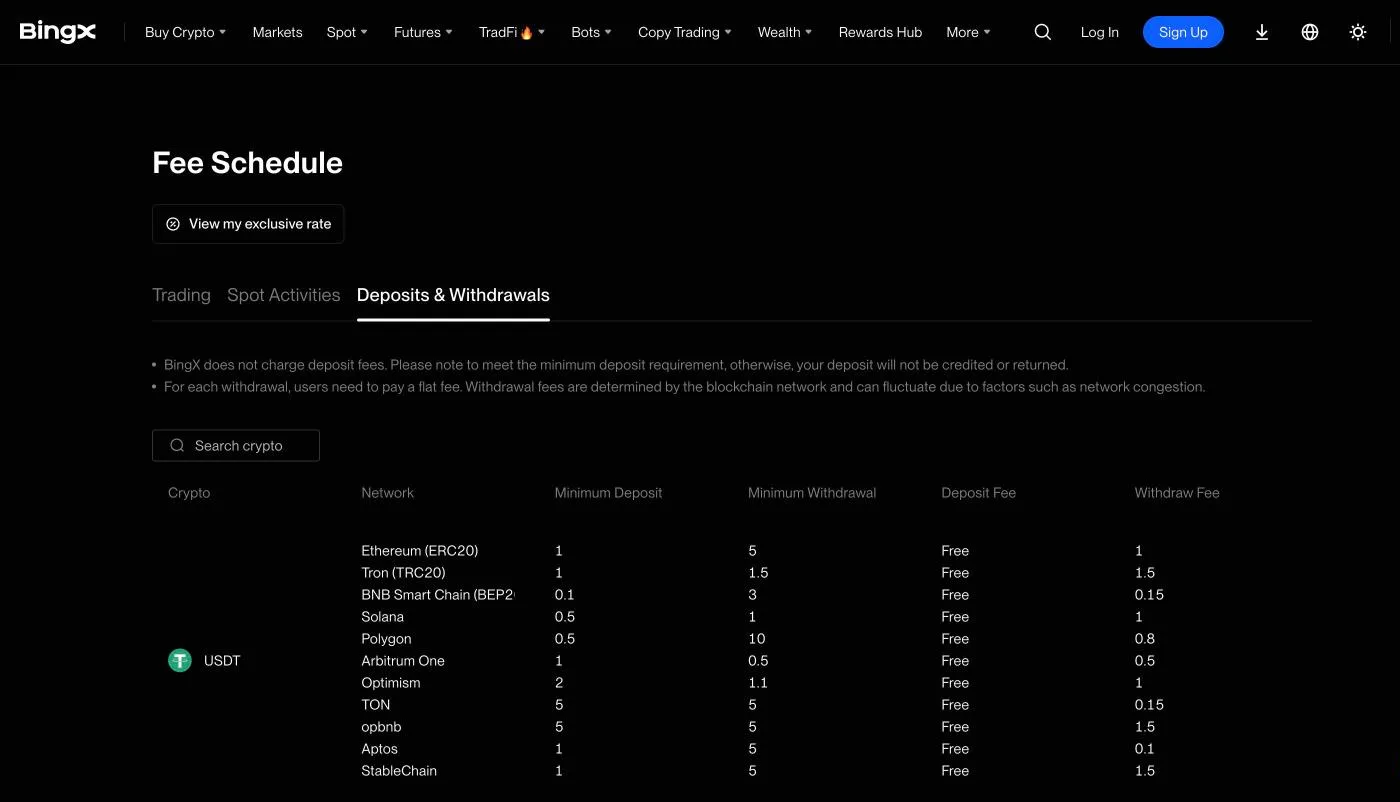
ICP is not on the Japanese lists, so you buy crypto at a Japanese exchange and send it to the overseas exchange. There you swap it for USDT and use the USDT to buy ICP.
- At the Japanese exchange, buy the crypto you will send with yen
- On the overseas exchange's deposit screen, choose the same coin and network
- Copy the deposit address and paste it into the Japanese exchange's send screen
- Send a small amount first, and the rest after it arrives
BingX's fee schedule warns that deposits below the minimum are not credited. BingX Academy tells you to choose the same network as the sending side.
Check the Japanese exchange's withdrawal fee and which crypto-assets it lets you send in its own guide first. With your first small transfer, also note how long it takes to arrive.
| What goes wrong | How to avoid it |
|---|---|
| Choosing the wrong network | Choose the same network name on the sending and receiving sides |
| Pasting the wrong address | After pasting, compare the first and last few characters |
| Below the minimum deposit | Check the minimum on the deposit screen. The part below it may not be credited |
| The deposit is slow | Look up the TxID (transaction ID) on a blockchain explorer |
When you send from a Japanese exchange overseas, you are asked for information about the destination exchange and about yourself. You may not be able to send to a destination that is not supported.
The Travel Rule when sending from Japan to overseas exchanges →
MEXC deposits and withdrawals: quick buy in yen and the withdrawal flow →
ICP destination format and how to check the network
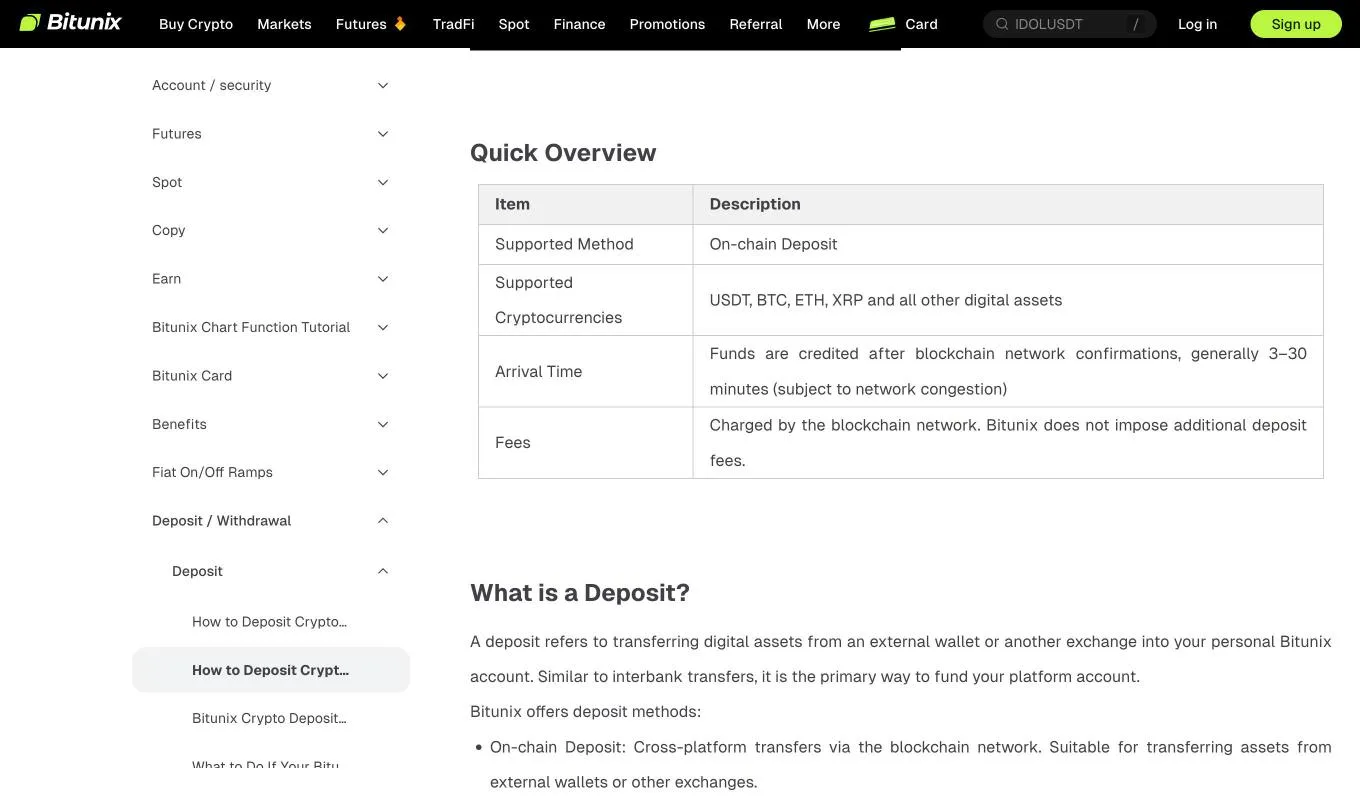
ICP is not a token built on another network such as Ethereum. The documentation calls ICP the native asset of the Internet Computer. In MEXC's official API, the contract address field for ICP is empty.
ICP balances are kept in a ledger. According to the documentation, each account in the ledger has an identifier made from a principal and an optional subaccount. Its form differs from other coins' addresses, so use only the destination shown on the exchange's deposit screen.
| Cause | What the official help says |
|---|---|
| Sent to a contract address | It is not a deposit address. Assets sent to a smart contract cannot be recovered |
| Below the minimum deposit | The minimum differs by coin and network. The part below it is neither credited nor refunded |
| Wrong network or memo | Blockchain transfers cannot be reversed, and assets can be lost |
| Held for review | If you prove who owns the funds in verification, you are guided to a refund to the sender |
The ICP ledger canister ID shown in the official documentation is "ryjl3-tyaaa-aaaaa-aaaba-cai". It identifies the ledger itself, not a destination for transfers.
The transfer fee is 0.0001 ICP in the documentation's example. Withdrawing from an exchange costs a separate exchange fee. Also check whether the deposit and withdrawal screens show a memo or tag field.
The canister ID is a value to compare with official material. The only destination to enter when you send to an exchange is the deposit address shown on its deposit screen.
From ICP back to Japanese yen
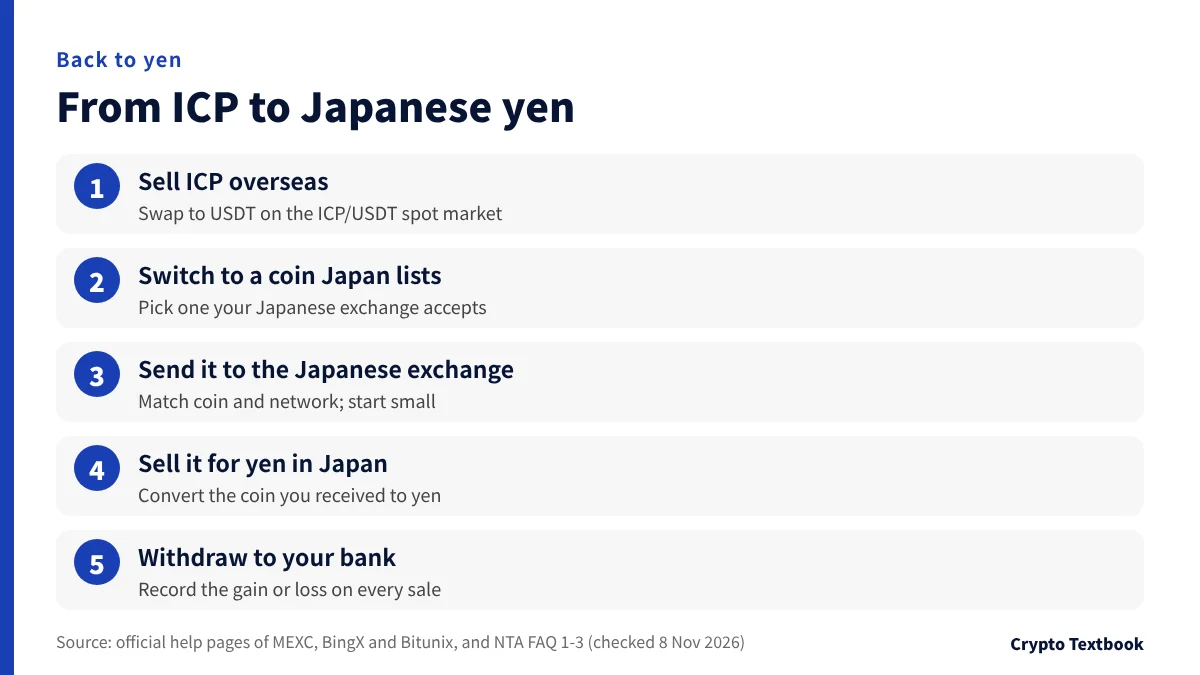
To turn ICP back into yen, you retrace the purchase. You sell at the overseas exchange for USDT, switch to a crypto-asset a Japanese exchange accepts and send it.
- 01Sell ICP on the ICP/USDT spot market
The proceeds arrive in your spot account as USDT.
- 02Switch to a coin Japan lists
Choose one the receiving Japanese exchange handles and accepts on the same network.
- 03Send it to the Japanese exchange and sell it for yen
Sell after it has arrived. Try a small amount first.
- 04Withdraw yen to your bank account
Check the withdrawal fee and the days to arrive on the Japanese exchange's guide.
Which crypto-asset you switch to before sending depends on the Japanese exchange's list and fees. This article does not point to a specific coin.
A gain or loss arises when you swap ICP for USDT and again when you swap USDT for another crypto-asset. Keep the date, quantity and yen value of every sale.
| Step | Cost |
|---|---|
| Selling ICP for USDT | Spot trading fee (taker: MEXC 0.05%, BingX 0.10%, Bitunix 0.10%) |
| Switching USDT to another crypto-asset | The same spot trading fee |
| Sending to a Japanese exchange | The overseas exchange's withdrawal fee (a fixed amount per coin and network) |
| Selling for yen and withdrawing in Japan | The Japanese exchange's trading fee and the bank withdrawal fee |
Bitunix deposits and withdrawals: fees, networks and limits →
ICP tax: swapping with USDT also creates a gain to calculate
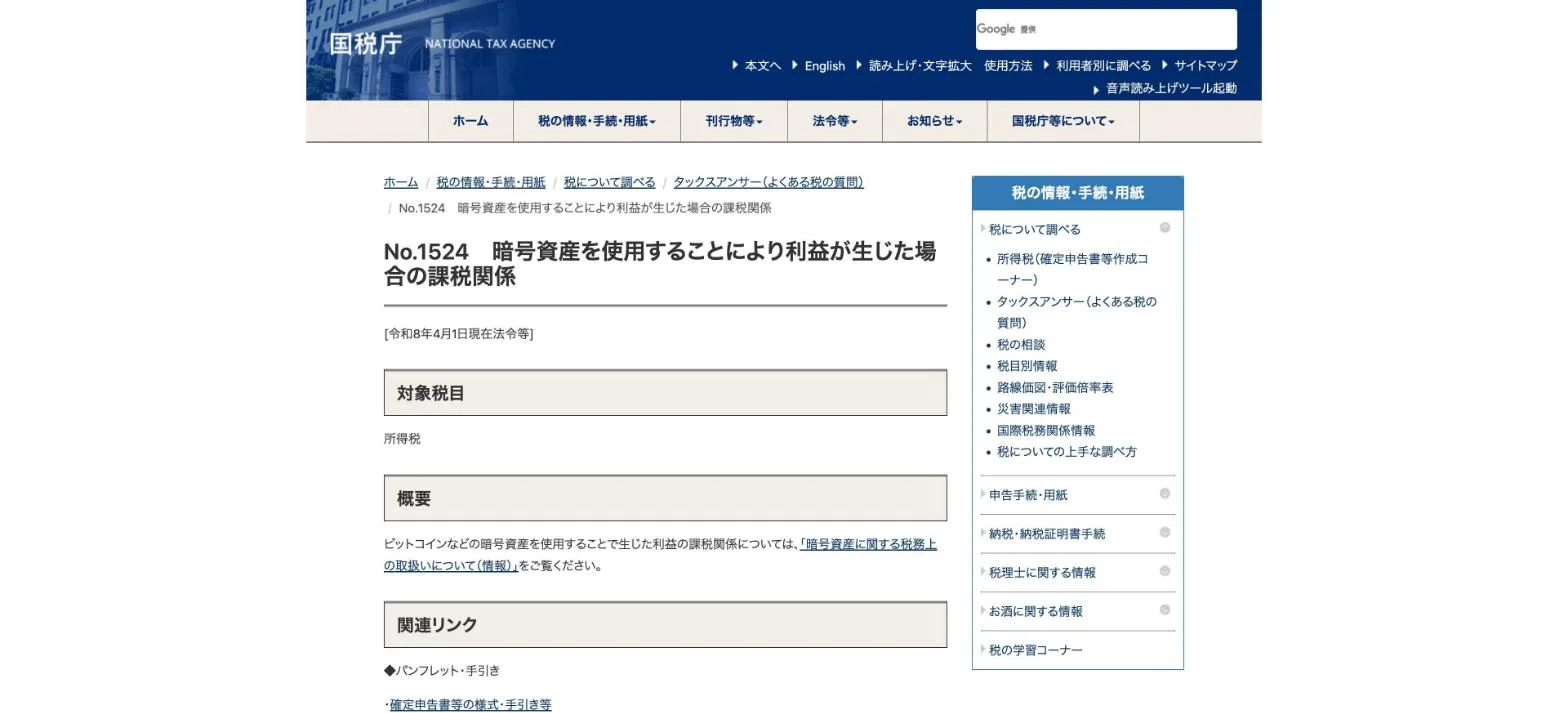
Profits from trading ICP at an overseas exchange are also subject to Japanese income tax. In the NTA's FAQ, profits from crypto-asset trading are in principle "miscellaneous income".
| Situation | How the NTA FAQ treats it |
|---|---|
| Buying ICP with USDT | An exchange of crypto-assets. Calculate the gain or loss on the USDT you gave up (FAQ 1-3) |
| Selling ICP for USDT | Calculate the gain or loss on the ICP you gave up |
| Income category | In principle miscellaneous income. Above 3 million yen of revenue, the category depends on bookkeeping (FAQ 2-2) |
| Selling for yen in Japan | Calculate the gain or loss on the crypto-asset you sent and gave up (FAQ 1-1) |
※ The calculation method is the total average method or the moving average method. If an individual does not choose, the total average method applies (note to FAQ 1-3).
NTA FAQ 2-7 says the NTA asks Japanese exchanges to issue annual transaction reports. For trades at overseas exchanges, it tells you to confirm the amounts yourself, for example from your trade history and the exchange's published market rates.
The calculation example in FAQ 1-1 notes that other necessary expenses, such as fees, are deducted if there are any. Which costs qualify is something to confirm with the NTA's guidance or a tax accountant.
Download your overseas exchange history yourself at least once a year. If the exchange becomes unusable, you may not be able to retrieve it later.
- Date and time of trades and the type of crypto-asset
- Quantity and the yen value at the time
- Trading fees and withdrawal fees paid
- Records of transfers between Japanese and overseas exchanges (TxID)
Crypto tax basics in Japan: miscellaneous income and filing →
How ICP supply works: cycle burning and the NNS
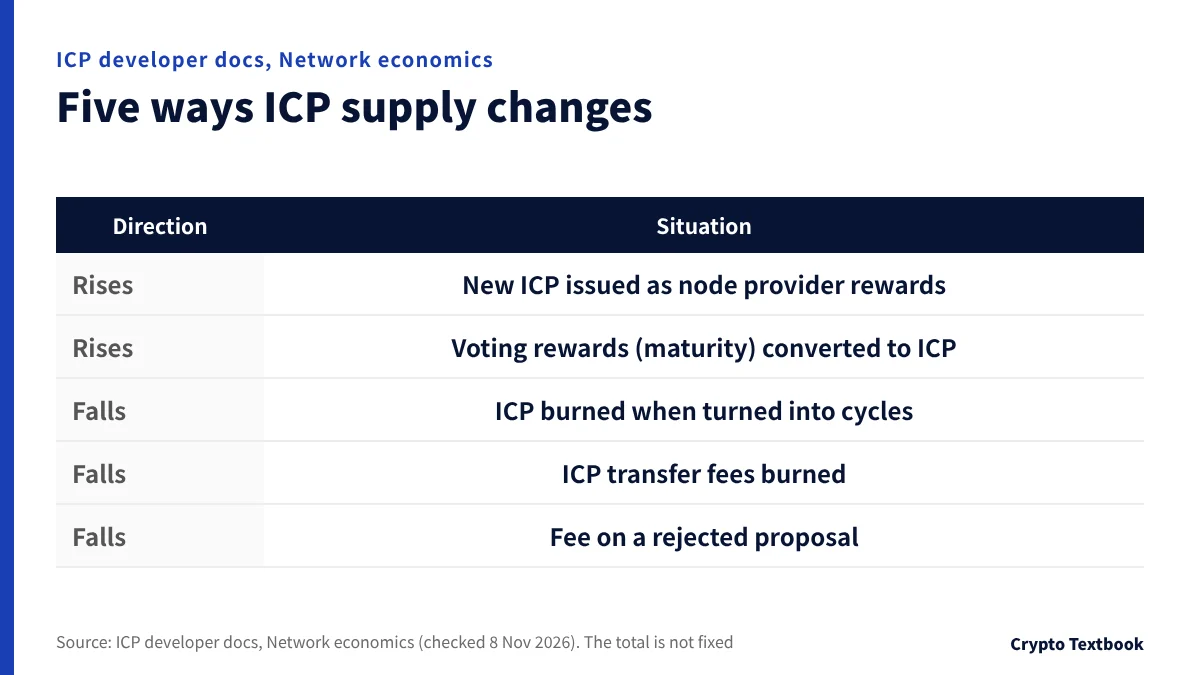
The total amount of ICP is not fixed. The documentation says there are mechanisms that issue new ICP and mechanisms that burn it.
| Direction | Situation |
|---|---|
| Rises | New ICP is issued as rewards for node providers |
| Rises | New ICP is issued when a neuron converts voting rewards (maturity) into ICP |
| Falls | ICP is burned when it is converted into cycles |
| Falls | ICP transfer fees are burned |
| Falls | A small fee is charged to the neuron behind a rejected proposal |
Unlike ICP, cycles hold a steady value. The documentation says 1 trillion cycles equal 1 XDR, the IMF's Special Drawing Right unit. The design keeps app running costs from moving with the ICP price.
- Official docs: cycles cannot be turned back into ICP once made (they can only be used up)
- Official docs: high demand for computation increases burning, and high participation increases issuance
- Whether more ICP is issued or burned depends on conditions
The NNS is the system that decides how ICP is run. The official website describes it as open and decentralized, and says anyone can take part.
If you lock ICP in a neuron, you can vote in the NNS. The minimum is 1 ICP. Locked ICP cannot be withdrawn until the dissolve delay ends, and the delay can be up to 2 years.
Joining the NNS requires you to lock ICP into a neuron yourself. We do not recommend it in this article. Locking creates a period when you cannot withdraw, so read the official documentation before you decide.
Risks to know before buying: fake sites, mix-ups, delistings and rules
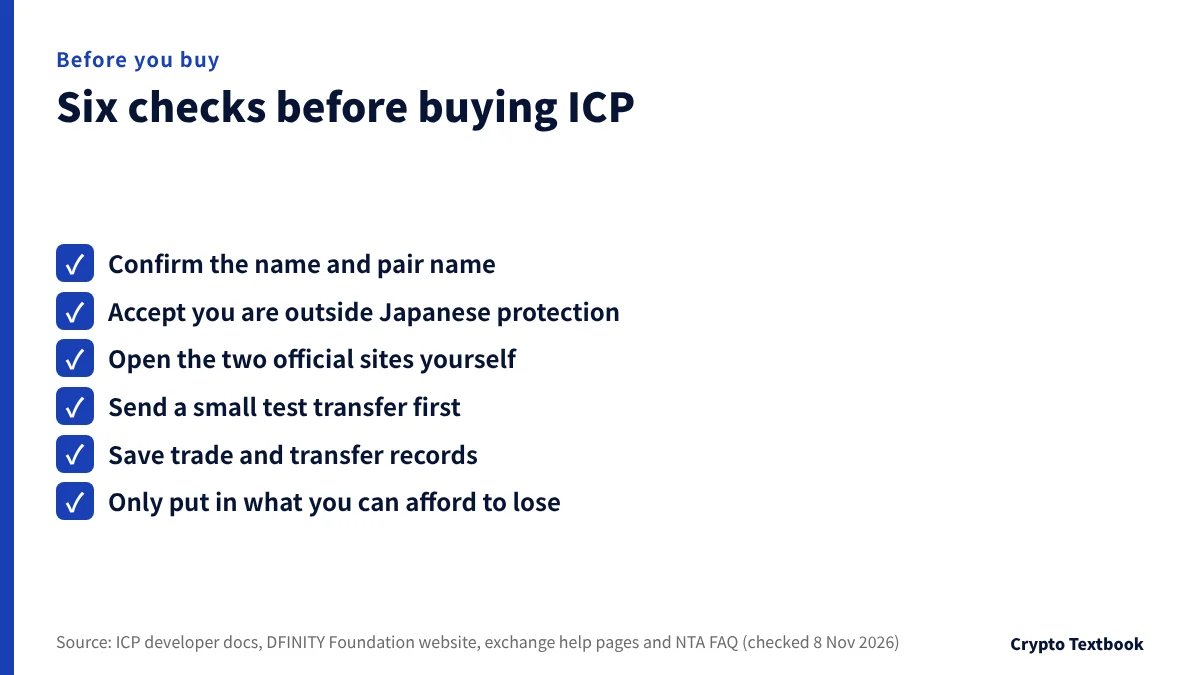
The premise is price swings and buying outside Japan's system. Next, check fakes, mix-ups and supply changes against official information.
| Risk | How to check |
|---|---|
| Price swings | The price moves sharply and can fall below what you paid. Use only money you can afford to lose |
| Outside Japanese protection and the JVCEA review | If an overseas exchange fails or has trouble, Japanese systems such as segregation and trusts do not protect you |
| Mixing up the abbreviation ICP | Match three things: the name Internet Computer, the ticker and the pair name ICP/USDT |
| Impersonation and fake sites | The DFINITY Foundation's site warns of scams that impersonate its staff. The official entry points are internetcomputer.org and dfinity.org |
| Supply growth | New ICP is issued, for example as node provider rewards. The total is not fixed |
| Locked assets | ICP locked in an NNS neuron cannot be withdrawn until the dissolve delay (up to 2 years) ends |
| Delisting and rule changes | Read the exchange's notices and terms. Before ordering, check that the spot pair is active |
Here is an example of a mix-up. BingX's spot API lists "AICP-USDT" as a separate pair next to "ICP-USDT".
On 8 November 2026 AICP-USDT was not at status 1, which means active. A one-letter difference is a different coin, so check that the pair name matches exactly.
Be careful with pages that ask you to approve something. If a site advertising a free giveaway (airdrop) asks you to connect a wallet or approve, check that you opened it from an official external link.
Each time you deposit or withdraw, compare the network name and the first and last characters of the destination. Transfers cannot be reversed. If you are unsure, ask the exchange's support.
Editorial verdict: where the line falls on buying ICP
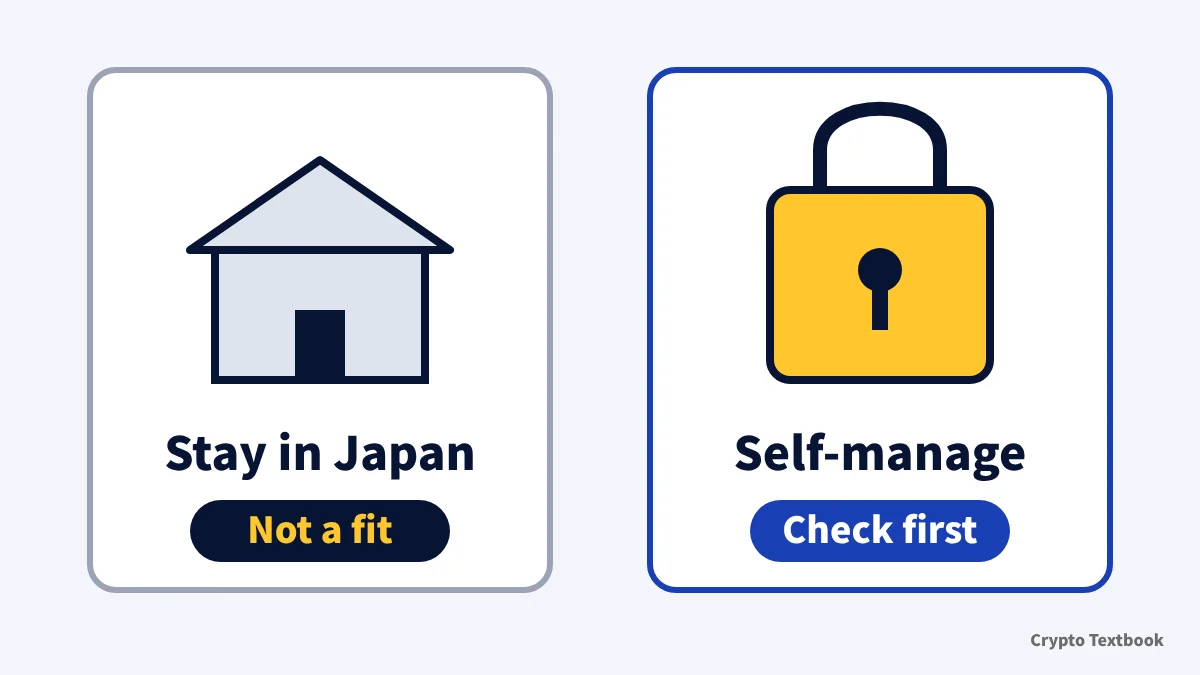
People who want to stay with Japanese registered exchanges and yen are unlikely to fit a plan to buy ICP. People who can manage an overseas account, transfers and tax records themselves should still check the flow with a small test transfer before deciding.
- If you want lower fees, compare MEXC's spot market, where the maker fee is 0%
- Treat actions on the network (wallets, staking) as separate from buying and selling at an exchange
- At any exchange, first test one deposit and one withdrawal with a small amount
This is a summary of facts we checked in primary sources on 8 November 2026. It is not a recommendation to buy ICP. Our advertising relationships are described on the advertising and risk disclosure page.
Frequently asked questions
Q. Where can I buy ICP (Internet Computer)?
A. You can buy it on the spot markets of MEXC, BingX and Bitunix. The pairs are ICP/USDT and ICP/USDC at MEXC, and ICP/USDT at BingX and Bitunix. We checked the official APIs on 8 November 2026. You cannot buy with yen; you buy with USDT or another crypto-asset.
Q. Can I buy ICP at a Japanese exchange?
A. Within what we checked on 8 November 2026, we found no Japanese exchange that offers it. ICP is not on the FSA list (27 providers as of 30 September) or the JVCEA list (113 assets, updated 2 November). If handling starts, the JVCEA notices will show it.
Q. How do I buy ICP as a beginner?
A. Open an account at an overseas exchange, complete identity verification, deposit USDT and place a spot order for ICP/USDT. You can also buy crypto at a Japanese exchange and send it overseas. First test one deposit and one withdrawal with a small amount.
Q. What is ICP?
A. It is the token of the Internet Computer network, developed by the DFINITY Foundation, a Swiss not-for-profit. It is used as the fuel (cycles) that runs apps on the network and for voting. The abbreviation ICP is also used in other fields.
Q. Can I buy ICP with a credit card?
A. BingX's official page describes buying USDT with Visa or Mastercard. You then swap the USDT for ICP on the ICP/USDT spot market. Check the buy screen in the app for the payment methods available from Japan.
Q. What are the ICP destination format and contract address?
A. ICP is not a token shown by a contract address; it is a native asset kept in a ledger. For transfers, use only the deposit address shown on the exchange's deposit screen. The ledger canister ID is given in a section in the middle of this article.
Q. Does ICP have a supply cap?
A. We could not find a fixed cap in the official documentation. The ledger API showed about 558 million ICP at 08:00 JST on 8 November 2026. Supply moves with new issuance and burning, as explained in the supply section.
Q. How do I cash out ICP to yen?
A. Swap ICP to USDT at the overseas exchange, switch to a crypto-asset a Japanese exchange handles, send it and sell it for yen there. Profits on ICP are subject to Japanese income tax. Buying ICP with USDT is an exchange and also counts for calculating gains and losses.
Sources
- Internet Computer official website | The token and cycles, Acquire (four roles of ICP and a selected list of exchanges, checked 8 November 2026) →
- Internet Computer official website (internetcomputer.org, checked 8 November 2026) →
- DFINITY Foundation official website (dfinity.org, Swiss not-for-profit, phishing alert, checked 8 November 2026) →
- ICP developer docs | Network economics (uses of ICP, supply dynamics, governance rewards, checked 8 November 2026) →
- ICP developer docs | Governance (NNS, neurons, 1 ICP minimum, dissolve delay, checked 8 November 2026) →
- ICP developer docs | Cycles (1 trillion cycles = 1 XDR, conversion from ICP, checked 8 November 2026) →
- ICP developer docs | Ledgers (ICP ledger canister ID and example transfer fee, checked 8 November 2026) →
- ICP developer docs | Digital asset standards and Rosetta API (name and decimals of ICP, checked 8 November 2026) →
- Internet Computer dashboard ledger API | Total supply (ledger-api.internetcomputer.org, as of 08:00 JST on 8 November 2026) →
- MEXC official API | defaultSymbols and exchangeInfo (ICPUSDT and ICPUSDC, retrieved 8 November 2026) →
- BingX official API | Spot symbols and recent trades (ICP-USDT, retrieved 8 November 2026) →
- Bitunix official API | Spot pair list (icpusdt, retrieved 8 November 2026) →
- BingX | How to buy Internet Computer (ICP) (official page, checked 8 November 2026) →
- BingX | Fee schedule (deposits and withdrawals, checked 3 November 2026) →
- BingX Academy | How to Deposit Crypto with BingX (deposit steps, checked 3 November 2026) →
- BingX | KYC Benefits and Advantages at Different Levels (help centre, published 7 June 2024, checked 7 November 2026) →
- Bitunix | What to Do If Your Bitunix Deposit Is Not Credited (help centre, updated 17 September 2026, checked 4 November 2026) →
- Bitunix | How to Deposit Crypto on Bitunix (help centre, checked 4 November 2026) →
- Financial Services Agency of Japan | Registered crypto-asset exchange service providers (as of 30 September 2026, 27 providers, checked 7 November 2026) →
- e-Gov Law Search | Payment Services Act (Articles 63-2 and 63-11, checked 7 November 2026) →
- Japan Virtual and Crypto assets Exchange Association (JVCEA) | Crypto-assets handled by members and overview documents (updated 2 November 2026, 113 assets, checked 8 November 2026) →
- Public APIs of registered Japanese exchanges (bitbank, GMO Coin, Coincheck, BitTrade, OKJ) and SBI VC Trade crypto list (retrieved 8 November 2026) →
- National Tax Agency of Japan | Tax treatment of crypto-assets (FAQ) 1-1, 1-3, 2-2 and 2-7 (26 December 2025, checked 7 November 2026) →
- National Tax Agency of Japan | Tax Answer No.1524 Taxation of profits from using crypto-assets (checked 7 November 2026) →
FX Textbook is an independent information site, not an exchange or a provider of personal investment advice. Crypto-asset trading involves risk: price volatility, liquidation of leveraged positions, transfer mistakes and the operational risk of exchanges and service providers can cause you to lose some or all of your invested capital. No result is guaranteed.
NEXT STEP
Check MEXC, BingX and Bitunix fees and transfers on our exchange pages.
We list the official information we have confirmed. Compare fees and operator details before you sign up.
Exchanges related to this column
Fees, leverage, funding options and current offers are on each exchange page.